Semi-Solid State Battery Cell Traceability and Batch Records
When a fleet operator reports a semi-solid state battery that swelled after 400 cycles, the first question is never “what failed”. It is “which batch, which electrode lot, which formation profile”. At Horizon Power I have spent more engineering hours on the data chain behind a cell than on the cell chemistry itself. A semi-solid electrolyte sits between a liquid and a solid, so its defect modes are subtle: a slightly high moisture level in the slurry, a two degree Celsius offset in the calendering zone, a formation step that ended thirty minutes early. None of these show up in a single pass or fail test at the end of the line. They surface months later in the field. That is why cell-level traceability and a complete digital batch record are not paperwork. They are the control system that lets us find a root cause in hours instead of weeks.
Why Cell-Level Traceability Matters for Semi-Solid State Batteries
A semi-solid state battery packs a high active material loading into a thicker electrode than a conventional lithium-ion cell. The thicker the electrode, the more sensitive the cell becomes to local variation in coating weight, compaction and drying. One mis-calibrated slot die can push a whole production run toward early lithium plating. Without traceability you cannot tell whether a returned cell came from that run, so you cannot stop the next 5,000 cells from leaving the building with the same flaw.
I treat every cell as a data object from the moment the cathode and anode slurry are mixed. The goal is simple: given any cell returned from the field, I can reconstruct exactly how it was made. That capability changes a warranty claim from a cost center into a feedback loop. When a solid-state battery from one module shows an unusual internal resistance slope, the batch record tells me whether the formation profile, the electrolyte fill, or the weld parameter was the outlier. Without it, I am guessing.
What a Digital Batch Record Must Capture
A useful batch record is not a PDF signed at the end of the shift. It is a structured, machine-readable set of records tied to a unique cell or module identity. At minimum, our records capture four layers of the process.
- Raw material lots. Cathode active material, anode material, the semi-solid electrolyte dispersion, separator, binder and foil each carry a supplier lot code. We record the certificate of analysis and the incoming inspection result against that lot.
- Electrode processing. Coating weight, coating speed, oven zone temperatures, calendering line pressure and final electrode density are logged per coating lane and per time block, not per shift average.
- Cell assembly. Stack or winding parameter, tab weld energy and peak power, electrolyte fill mass, and vacuum seal conditions are captured per cell or per verified subgroup.
- Formation and aging. The full formation and aging curve, including rest voltage and self-discharge screening, is stored against the cell ID so we can review the exact charge profile that conditioned it.
The record only earns its keep if it is queryable. A table locked in a spreadsheet that nobody opens is worse than no record, because it creates false confidence. We store these fields in a manufacturing execution system where a single cell ID returns the whole chain in seconds.
Unique Identification Without Damaging the Cell
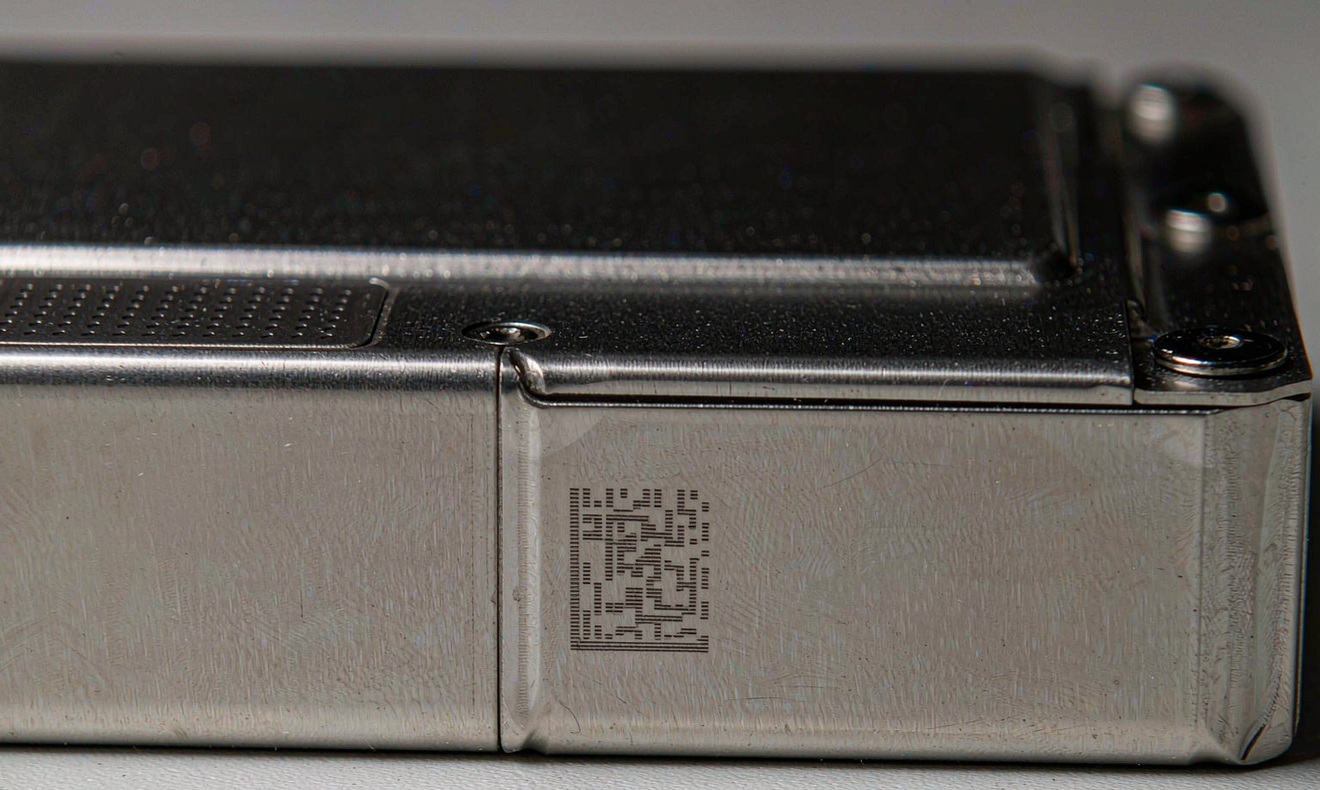
A semi-solid cell needs a permanent identity that survives ten years of service, repeated thermal cycles and occasional teardown. Printed labels fall off and peel under heat, so we mark the cell directly. Laser etching a 2D DataMatrix on the aluminum enclosure is our default, applied at low energy so the heat-affected zone stays shallow and the weld seal is never compromised.
For pouch and prismatic formats we place the code on a non-functional border away from the laser weld and the terminal. The marking must survive the customer’s own handling, so we validate it against abrasion and solvent exposure before release. We follow the identification principles in IPC-1782 for traceable manufacturing, which gives us a consistent scheme for parent and child identifiers as a module is built from cells. A module ID should always resolve down to the cell IDs inside it, and each cell ID should resolve up to the module and pack.
Connecting the Shop Floor: MES, SCADA and the Battery Passport
The data chain only works if the machines write to it automatically. We link the coating line, the welder and the formation cycler to the manufacturing execution system through a SCADA layer, so parameter sets are pulled at the time of build rather than typed in later. A cell that was built on a lane with a documented sensor fault is flagged in the system the same day, not discovered after a field failure.
This same data chain is what the battery passport now demands. Under the EU Battery Regulation, large industrial and EV cells need a digital product passport that discloses carbon footprint, recycled content and supply chain due diligence. The cheapest way to comply is to have already been collecting the data for your own quality system. A semi-solid state battery program that builds traceability in from pilot line scales to regulation far more easily than one that tries to reconstruct the story after the fact.
Compliance Drivers: EU Battery Regulation and IATF 16949
Two standards shape how we scope the record. For automotive customers, IATF 16949 sets the expectations for controlled processes, documented reaction plans and verified corrective action. A traceability miss is treated as a process escape, with the same discipline as a dimensional out-of-tolerance. For the European market, the EU Battery Regulation requires the digital product passport and pushes manufacturers toward verified carbon and material data.
I also keep UN38.3 and IEC 62133 evidence inside the same record set. UN38.3 covers the transport safety tests for lithium cells, and IEC 62133 covers the safety requirements for portable cells. When a customer audits us, the test report, the lot it covered and the cells shipped against it are all one query away. That closes the gap between “we are certified” and “this specific cell was made under the certified process”.
Turning Returns Into Diagnostics
The payoff shows up at the returns bench. When a cell comes back under warranty, we scan its ID, pull the batch record and compare it to the teardown findings. In one case a group of semi-solid cells showed elevated self-discharge after a hot-season field deployment. The batch record showed a formation rest step that had been shortened during a line changeover. We confirmed the link by opening sister cells from the same lot, then corrected the changeover checklist so it could not recur.
This closed loop is the real product of traceability. It turns a one-off failure into a permanent process improvement, and it lets us answer a customer’s “will this happen to my pack” with data instead of reassurance. For a solid-state battery program still climbing the learning curve, that feedback speed is the difference between a pilot that stalls and one that ships.
What is a battery digital product passport?
A battery digital product passport is a structured electronic record that travels with a cell or pack and discloses key data such as carbon footprint, material origin, recycled content and compliance status. For our semi-solid state battery line the passport is built directly on top of the internal batch record, so the same data serves both quality control and regulation.
How do you mark a semi-solid cell without weakening it?
We laser etch a 2D DataMatrix on a non-functional border of the enclosure at low energy, keeping the heat-affected zone shallow and away from the weld seal and terminals. The code is validated for abrasion and solvent resistance before release, so it survives field service and teardown.
Which standards apply to battery traceability?
The most relevant references are IPC-1782 for traceable manufacturing identification, IATF 16949 for automotive process control, and the EU Battery Regulation for the digital product passport. We also keep UN38.3 and IEC 62133 evidence linked to each production lot inside the same record set.
Can traceability data predict cell failure?
Not directly, but it makes root cause fast. When a returned cell shows an early resistance slope or high self-discharge, the batch record shows whether the formation profile, electrolyte fill or weld parameter was the outlier, so we stop the cause instead of replacing symptoms.
How long must batch records be kept?
For automotive and industrial programs we retain the full digital batch record for the product life plus a defined contractual period, commonly ten years or more, because field returns and regulatory audits can arrive long after shipment. The record is stored in the manufacturing execution system, not on paper.
What does a traceability system cost to deploy?
The largest cost is integration, not marking. Laser coders and a unique ID scheme are modest, but linking the coating line, welder and formation cycler to a manufacturing execution system takes real engineering. Programs that collect the data for their own quality system first get regulatory compliance almost for free.
Further Reading
References