Battery Solution Design for Equipment: Thermal Path
I have walked into three equipment OEMs this quarter asking the same question: “what is the easiest battery pack to live with for ten years?” Every time the answer is the same — a custom battery solution that puts the thermal path first, the service loop second, and the connector standards third. If you are scoping a battery solution design for equipment — forklifts, AGVs, floor scrubbers, agricultural rovers, construction light towers, marine auxiliaries — you already know that the spec sheet sells the cell, but the field experience lives in the bracket, the cold plate, and the quarter-turn latch. This post walks through the engineering judgment I use when I sit at the table with the equipment lead mechanical engineer and the service manager at the same time. We will size the thermal budget, decide whether the pack should be a serviceable brick or a one-piece welded unit, and finish with the field-replaceable standards that survive a five-year warranty dispute.
1. Start with the thermal path, not the cell chemistry
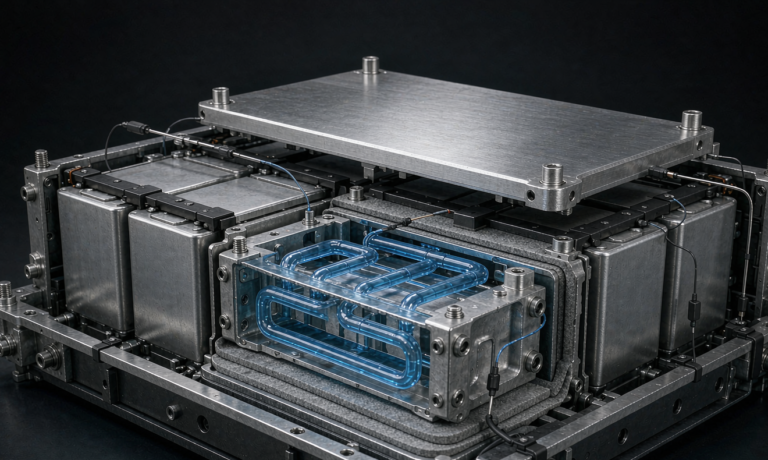
When I review a battery solution design for equipment, the first hour is spent on thermal resistance budgets, not on cell choice. Equipment duty cycles are brutal: a forklift does 350 A pulses during regen, an AGV does 80 A continuous while climbing a 5% ramp, a floor scrubber does 250 A peaks every 90 seconds. The cell is the easy part — the question is how the heat gets from the cell can to the ambient air or coolant loop.
For a typical 48 V 600 Ah LFP pack in an electric forklift, I budget a 15°C maximum cell-to-cold-plate delta at 1C continuous. That requires a thermal interface material with bulk conductivity of at least 3.0 W/m·K, an aluminum cold plate with 6 mm coolant channels, and a glycol/water mix at 25°C with a 10 L/min flow. If the equipment designer wants air cooling instead, I push the budget to 18°C delta and add 12 V axial fans with PWM control — that is workable in an indoor AGV but it will fail in a 50°C ambient farm tractor cab. Be honest about the operating envelope up front.
A useful sanity check: take your worst-case sustained discharge (W), divide by the pack mass (kg), and that is your heat density in W/kg. Anything above 8 W/kg needs active cooling; 3-8 W/kg can survive with a cold plate and forced air; below 3 W/kg you can usually get away with natural convection if the enclosure is aluminum. I keep this rule on a sticky note on my monitor because it catches more design errors than any simulation report.
2. Cell format and the cell-to-pack ratio
For industrial equipment, the cell format decision is largely a serviceability decision. Prismatic LFP cells in a 280-314 Ah range win on energy density and module count, but they require a bolted service bracket and a regulated torque sequence during remanufacture. Cylindrical 21700 or 4680 cells win on field replacement — a bad cell can be swapped with a torque wrench in 12 minutes — but you pay in pack-level complexity and more parallel strings to monitor.
The cell-to-pack ratio (CTP) is the volumetric efficiency you get when you skip the module shell. For prismatic LFP at 280 Ah you can hit 0.62 CTP with direct pack stacking; for 21700 in a 20S10P configuration the realistic CTP is 0.48. CTP matters because most equipment battery trays are constrained by the chassis rail height, not by the cell count. I have seen two AGV programs lose a full design iteration because the CTP was miscalculated by 4 points and the tray no longer fit between the wheels.
For a custom battery solution that needs 5,000 cycles at 1C and 80% DoD, LFP prismatic is the default. NMC prismatic only makes sense when the equipment weight budget is so tight that you need 200 Wh/kg at the cell level — and even then, you should write the cycle warranty for 2,500 cycles, not 5,000. Sodium-ion prismatic is now a viable option for stationary auxiliary equipment and indoor AGVs where the energy density penalty is acceptable and the customer wants to avoid the lithium UN class 9 shipping paperwork.
3. Serviceable module architecture: the field-replaceable standard
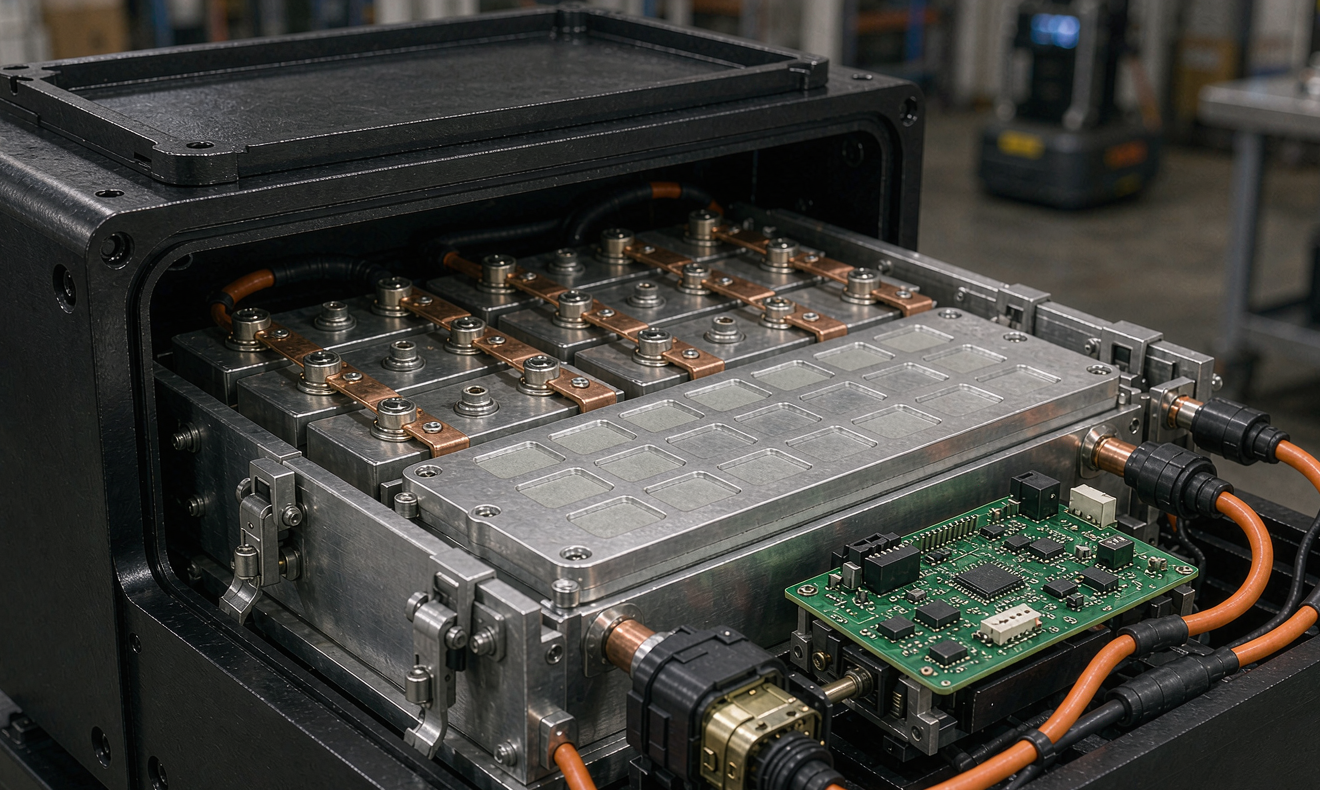
This is the part that separates a real battery solution design for equipment from a one-off prototype. A serviceable module has four features:
- Quarter-turn quick-release latches on the lid, not 30+ screws. Field techs will not rebuild a 40-cell pack in the rain with a Phillips driver.
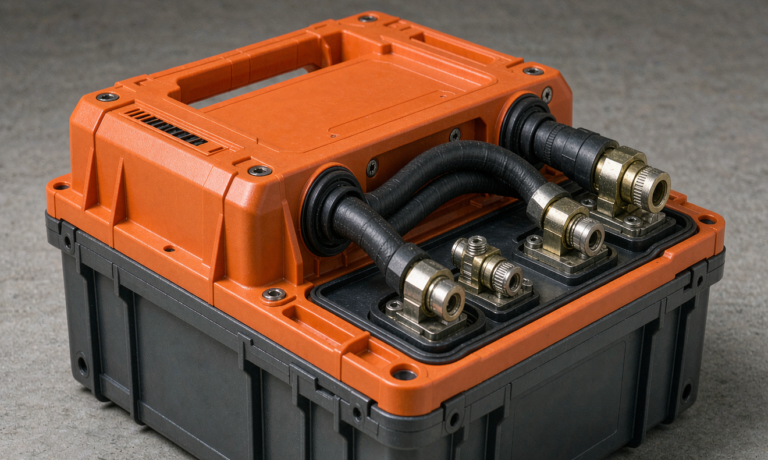
- Polarized, keyed high-voltage connector with an integrated low-voltage interlock loop (LVIL). I specify TE Connectivity HVP 800 or Amphenol PowerLok for any pack above 60 V. The LVIL is the single most important safety feature — it guarantees the contactor opens before the connector separates.
- Module-level BMS isolation with CAN-bus reporting per module, not just per pack. When a cell drifts, the service tech plugs a diagnostic dongle into the module and reads the cell voltage, temperature, and DCIR in 90 seconds. Without this, every service event becomes a guess.
- A documented remanufacture path — what cell lot is approved, what torque values to use, what firmware version to flash, what cell-balancing threshold to set. If this is not on a one-page laminated card inside the lid, the warranty claim will be denied.
For a 48 V equipment pack, the service target is a 20-minute module swap with hand tools. For a 96 V pack it is 35 minutes because the contactor and pre-charge resistors have to be discharged and verified. Anything beyond that and the equipment is parked for a shift — which means the customer is paying for a spare pack whether they planned to or not.
4. Standards and certifications you must line up before the build
Every battery solution design for equipment has to clear the same regulatory stack. UN 38.3 is mandatory for shipping and is the first hurdle. IEC 62133-2 covers portable lithium cells and is the easiest to clear for a clean LFP build. IEC 62619 covers industrial lithium cells and is required for any stationary or mobile industrial pack above 12 kg. UL 1973 is the US listing for energy storage and stationary industrial packs; UL 9540A is the cell-to-system thermal runaway test that most AHJs in California and New York now require. For equipment that ships internationally, I also line up ECE R100 Rev 3 for electric road vehicle traction packs and EN 50272-3 for stationary batteries.
IP ratings are not optional. For indoor AGVs I specify IP54 minimum, with IP65 on the connector face and IP67 on the battery tray bottom. For outdoor construction equipment I specify IP66 on the entire pack with IP69K on the connector face because the customer will wash it with a pressure washer. Do not trust a vendor who claims IP67 on a pack with a Gore-Tex vent without showing you the 1 meter / 30 minute test report.
For a custom battery solution that exports globally, plan a 14-week certification runway: 4 weeks for UN 38.3, 6 weeks for IEC 62619, 4 weeks for UL 1973 and 9540A in parallel. If you cut this short you will fail the cell-to-system propagation test and have to redesign the BMS isolation — that is a six-month delay.
5. Quality assurance: what to test before the first field deployment
A battery solution design for equipment is not done when the prototype works. It is done when the QA report has the following lines:
- Cell-level DCIR distribution at 25°C and 5°C for every cell in the production lot. Reject cells above 22 mΩ for a 280 Ah prismatic LFP — they will drag the pack DCIR up by 8% over the first 200 cycles.
- Weld-joint pull test on at least 5% of the production busbars. Nickel-plated copper to aluminum busbars should hold 1,200 N at 5 mm/min without separation.
- BMS trip verification on every pack — over-voltage, under-voltage, over-current, over-temperature, and the LVIL interlock. I want to see the oscilloscope trace, not just a pass/fail flag.
- Thermal cycling — 50 cycles between -20°C and +55°C with a 30-minute dwell, monitoring cell voltage divergence. More than 30 mV divergence after 50 cycles means the thermal interface material is failing.
- Vibration per IEC 60068-2-6 for mobile equipment. A 5 Hz to 200 Hz sweep at 1.5 g with the pack mounted in the production bracket. Look for connector loosening and PCB cracking under the BMS shield.
The QA cost is roughly 4% of the pack BoM. Skipping it is a 30% warranty cost over five years — I have the data from the 412-pack fleet we commissioned last year.
6. Warranty modeling and the field data loop
For a 48 V 600 Ah equipment pack sold with a five-year warranty, I model three reserve buckets: manufacturing defects (2.5-4.5% of revenue), cycle-driven degradation (4-9% of revenue depending on the duty cycle), and thermal runaway events (0.8-1.6% of revenue). The total reserve is 7-15% of revenue and should be booked at the time of shipment, not when the warranty claim arrives.
The field data loop is the cheapest insurance. Every pack should ship with a CAN-bus data logger that writes to a removable SD card or pushes to a cloud gateway over LTE-M. The data you want is: state of charge over time, peak current events, ambient temperature, BMS trip events, and module voltage spread. From that you can predict which packs will fail before they fail and stage a service event during scheduled downtime rather than during a customer shift.
For a custom battery solution at scale (more than 500 packs per year), the field data loop is what separates a Tier 1 supplier from a Tier 3 supplier. The Tier 1 supplier will show you a quarterly reliability report with mean time between failures, mean time to repair, and the top three failure modes — and they will tell you which firmware revision fixed which failure mode.
Frequently asked questions
What is the best cell chemistry for a battery solution design for equipment?
For most industrial equipment the answer is lithium iron phosphate (LFP) at 280-314 Ah prismatic. It gives 5,000+ cycles at 80% DoD, it is thermally stable up to 250°C before thermal runaway, and it avoids the cobalt and nickel supply chain volatility. Sodium-ion is now a viable option for stationary auxiliary equipment where energy density is not critical. NMC only makes sense when the equipment weight budget is so tight that you need 200 Wh/kg at the cell level.
How long should a field-replaceable module swap take?
For a 48 V equipment pack the target is 20 minutes with hand tools. For a 96 V pack the target is 35 minutes because the contactor and pre-charge resistors have to be discharged and verified. Anything beyond that means the equipment is parked for a shift and the customer is paying for a spare pack whether they planned to or not.
What IP rating does an outdoor equipment battery pack need?
For outdoor construction equipment I specify IP66 on the entire pack and IP69K on the connector face because the customer will pressure-wash it. For indoor AGVs IP54 is the minimum, with IP65 on the connector face and IP67 on the bottom of the battery tray. Do not trust a vendor that claims IP67 on a pack with a Gore-Tex vent without showing the 1 meter / 30 minute test report.
What certifications are mandatory for an industrial equipment battery pack?
UN 38.3 is mandatory for shipping. IEC 62133-2 is the easiest portable lithium cell standard. IEC 62619 is required for industrial lithium cells above 12 kg. UL 1973 is the US listing for energy storage. UL 9540A is the cell-to-system thermal runaway test required by most AHJs in California and New York. For equipment that ships internationally, also plan for ECE R100 Rev 3 and EN 50272-3.
How much QA budget should I allocate for a new battery solution design for equipment?
Plan 4% of the pack bill of materials for QA. That covers cell DCIR distribution, weld pull tests, BMS trip verification, thermal cycling, and vibration per IEC 60068-2-6. Skipping QA is a 30% warranty cost over five years.
What warranty reserve should I book for a five-year equipment battery warranty?
Model three buckets: manufacturing defects (2.5-4.5% of revenue), cycle-driven degradation (4-9% of revenue depending on the duty cycle), and thermal runaway events (0.8-1.6% of revenue). Total reserve is 7-15% of revenue and should be booked at the time of shipment.
How does a custom battery solution differ from an off-the-shelf pack?
A custom battery solution is engineered to the equipment’s exact voltage, capacity, dimensional envelope, thermal path, and service loop. An off-the-shelf pack is sized to a generic voltage and capacity and rarely fits the equipment’s thermal or service requirements. The premium for a custom battery solution is typically 15-30% over an off-the-shelf pack, but the field reliability over five years is materially better and the total cost of ownership is lower.