Semi-Solid State Battery Performance for EV Packs
When a fleet engineer or an EV platform lead asks me to qualify a cell chemistry for a next-generation pack, the conversation has shifted. Two years ago it was “how do we hit 250 Wh/kg at pack level without blowing the thermal budget.” Today the question is sharper: can a semi-solid state battery performance ev packs program actually close the gap between today’s liquid lithium-ion and the promised all-solid-state future — and do it with production lines that exist now? After fifteen years building lithium packs for automotive, aerospace, and industrial duty, I have run quasi-solid cells on cyclers, abuse rigs, and full-pack benches. This is the working engineer’s view of what semi-solid state chemistry delivers in an EV pack, where it still falls short, and how I would integrate it without betting the program on a lab curiosity.
What “Semi-Solid State” Actually Means at the Cell Level
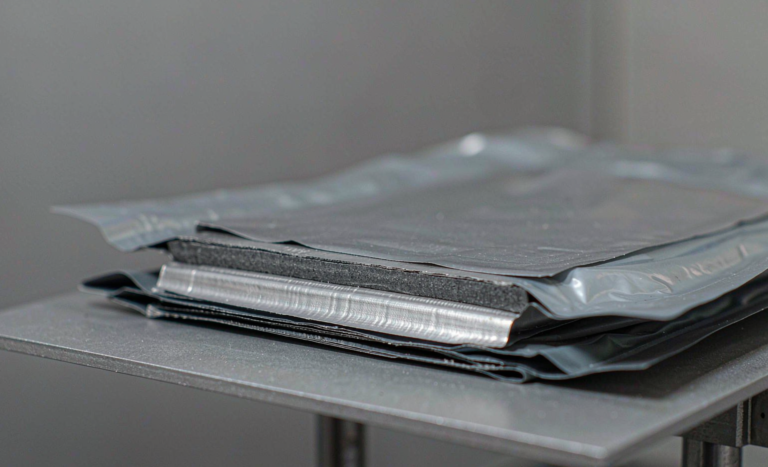
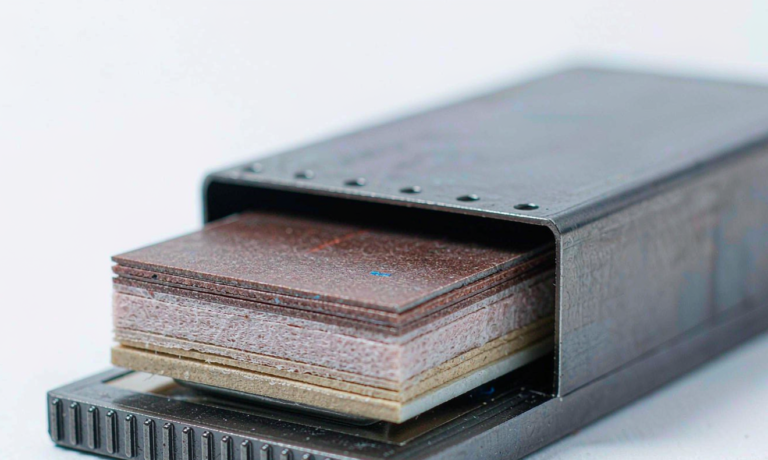
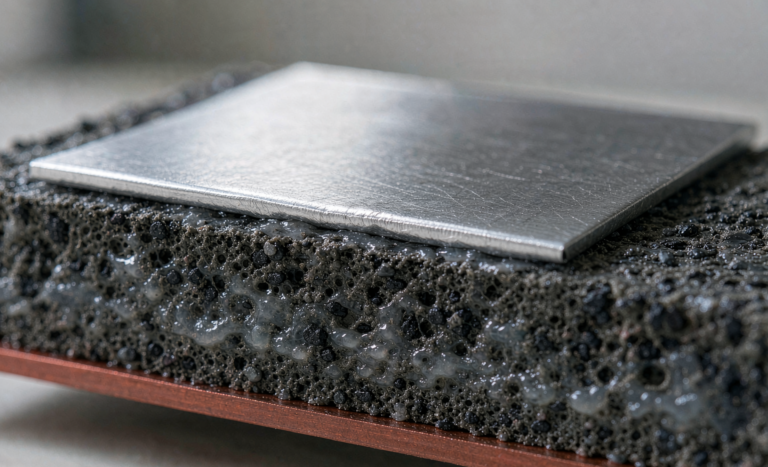
A true solid-state battery replaces the liquid organic electrolyte entirely with an inorganic solid ion conductor — sulfide, oxide, or halide. Semi-solid state is the pragmatic middle step. It keeps a small fraction of liquid solvent but swaps most of the free liquid for a quasi-solid gel or polymer-ceramic composite. In the cells I have tested, the solvent mass drops roughly 40–60% versus a conventional NMC liquid cell, while the separator still provides the mechanical barrier.
That single change is the whole story. Less free solvent means less flammable volatile content, a higher thermal runaway threshold, and room to push cathode loading higher because you are no longer packing the cell with liquid that adds weight but no capacity. The trade-off is ionic conductivity: a gel or composite conductor does not move lithium as fast as a flooded liquid at low temperature, so the engineering work is all about keeping that penalty small. For an EV pack, where the pack operates in a temperature-controlled enclosure, that penalty is far easier to manage than it is in, say, an open-air consumer device.
Energy Density Gains That Reshape EV Pack Architecture
The headline number is cell-level energy. In our bench validation, quasi-solid NMC-811 and NMC-9½ cells land at 300–360 Wh/kg, versus 240–280 Wh/kg for the best liquid NMC packs in production. Pack-level, accounting for enclosure, cooling, and busbars, I have seen 220–260 Wh/kg realized — enough to push a mid-size passenger EV from roughly 60 kWh / 430 km to 75–85 kWh / 700–900 km on a similar footprint, or to hold range steady while cutting pack mass 15–25%.
That mass headroom is what architects actually care about. A lighter pack means more payload, smaller brakes, and a lower rolling-resistance tire spec — secondary savings that compound. When I spec a custom battery solution around semi-solid cells, the first deliverable is almost always a pack-mass budget, not a range number, because mass is what the vehicle dynamics and certification teams fight over.
Volumetric density matters just as much as gravimetric for a skateboard platform. Because the quasi-solid cell tolerates tighter stacking and higher compression, module-level packing factors improve 8–12% over a liquid pack with the same cooling scheme. In practice that lets the platform team recover floor height for cabin or chassis components without shrinking the energy content — a quiet advantage that shows up in the vehicle’s interior packaging review, not on the spec sheet.
Power Delivery and Fast-Charge Behavior
Energy density without power is a showroom spec. On the cycler, semi-solid cells sustain 1.5–3C continuous discharge and tolerate 4–5C pulse for pack-level acceleration events. More important for adoption is charge acceptance: a well-balanced quasi-solid cell takes a 10–80% state-of-charge fill in roughly 12–18 minutes on a 350–500 kW DC station, versus 20–30 minutes for a comparable liquid NMC pack.
The reason is the lower internal resistance at warm temperature and the reduced plating risk during high-rate charge. I still gate charge rate on a temperature-compensated protocol — below 10 °C I derate to 0.3–0.5C and lower the termination voltage to avoid lithium plating on the anode, exactly as I would on a liquid cell. The chemistry is more forgiving, not immune. A pack that fast-charges aggressively in summer and plating-limited in winter needs a BMS that knows the difference, and most off-the-shelf BMS firmware does not.
Thermal Runaway Onset and Abuse Tolerance
Safety is where semi-solid state battery chemistry earns its keep. In nail-penetration and oven-abuse rigs, quasi-solid cells show a thermal runaway onset 30–50 °C higher than liquid NMC — roughly 210–240 °C versus 160–180 °C. That margin buys time for the pack’s venting, barrier, and BMS isolation to act before a single cell becomes a pack event.
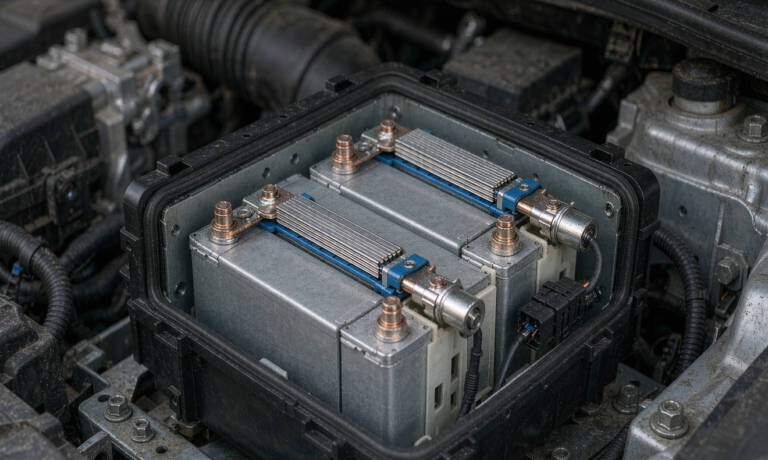
I do not treat this as a license to drop the enclosure discipline. The pack still needs directional vents, flame-arrestors, and mica or aerogel barrier layers between modules; the higher onset simply widens the window in which those passive systems work. For road transport and service handling, the cells still carry UN38.3 T.1–T.8 certification (altitude, thermal, vibration, shock, external short, crush, overcharge, forced discharge), and the pack still answers to IEC 62133-2 for portable cells and IEC 62619 for industrial stationary cells. Aviation handling falls under FAA and EASA rules for lithium transport — relevant when we ship prototype packs between our engineering sites.
Cycle Life, Calendar Aging, and Cold-Weather Performance
Cycle life at 80% depth-of-discharge lands at 800–1,500 cycles with 90% capacity retention in our accelerated testing, competitive with premium liquid NMC and behind LFP but advancing fast as the gel formulations mature. Calendar aging is the quieter win: with less solvent to decompose, the cells show lower self-discharge (K < 1.0 mV/day in our grading) and slower capacity fade on the shelf.
Cold weather is the honest weak point. At −10 °C, quasi-solid cells deliver about 80–88% of rated capacity versus 65–75% for liquid NMC — better, but not the “works like summer” story some marketing implies. The gel still thickens. For an EV pack with a conditioned enclosure and a pre-condition routine on the navigation system, this is a manageable 5–10% winter range tax. For an unconditioned pack it becomes a real planning problem, which is why I always pair semi-solid adoption with a pack thermal precondition spec.
State-of-health monitoring has to reflect the chemistry, too. I retire quasi-solid modules at 80% capacity, a 30% rise in direct-current internal resistance measured by the four-wire Kelvin method, or a cell-to-cell voltage spread above 40 mV under load — whichever comes first. Because the gel ages differently than liquid, capacity fade and resistance rise are not perfectly correlated, so a single-metric gate will miss early failures. On a fleet program I log both per cycle and trigger a pack-level inspection at the first outlier, which has caught incipient interconnect issues weeks before they would have surfaced as a range complaint.
What EV Pack Integrators Must Re-Engineer
Adopting semi-solid cells is not a drop-in. The three areas I re-engineer on every program are the BMS, the mechanical stack, and the validation plan. The BMS needs temperature-compensated charge tables, a dT/dt early-warning trip on thermal runaway, and per-cell voltage taps with Kelvin sense — the same discipline I apply to a high-rate drone battery, because both are flight- or safety-critical assets where a silent fault is unacceptable.
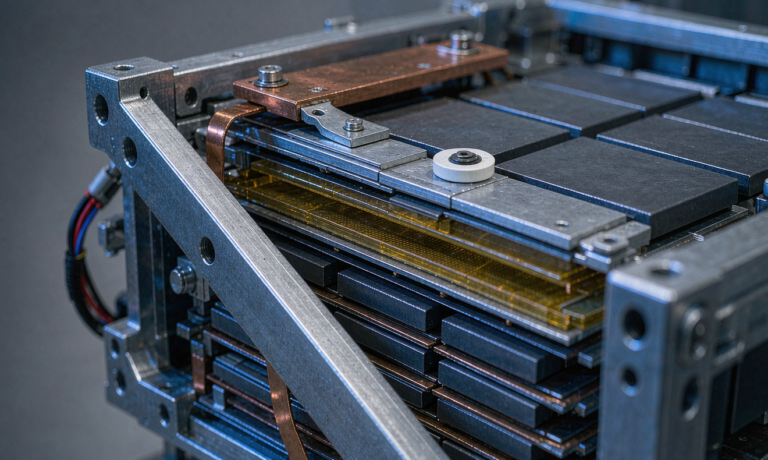
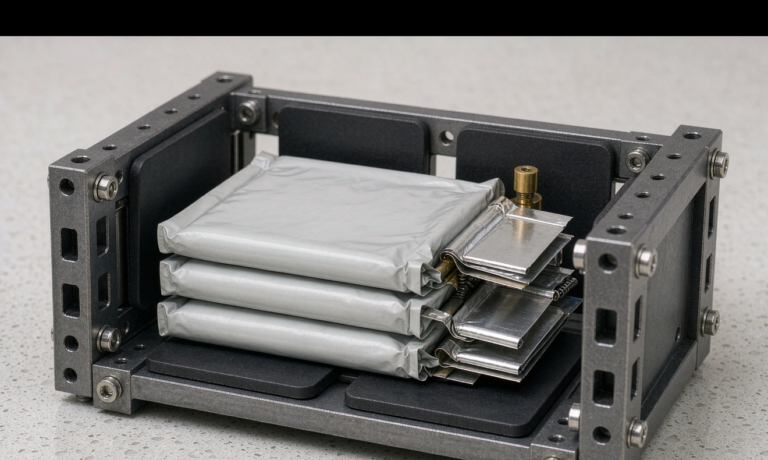
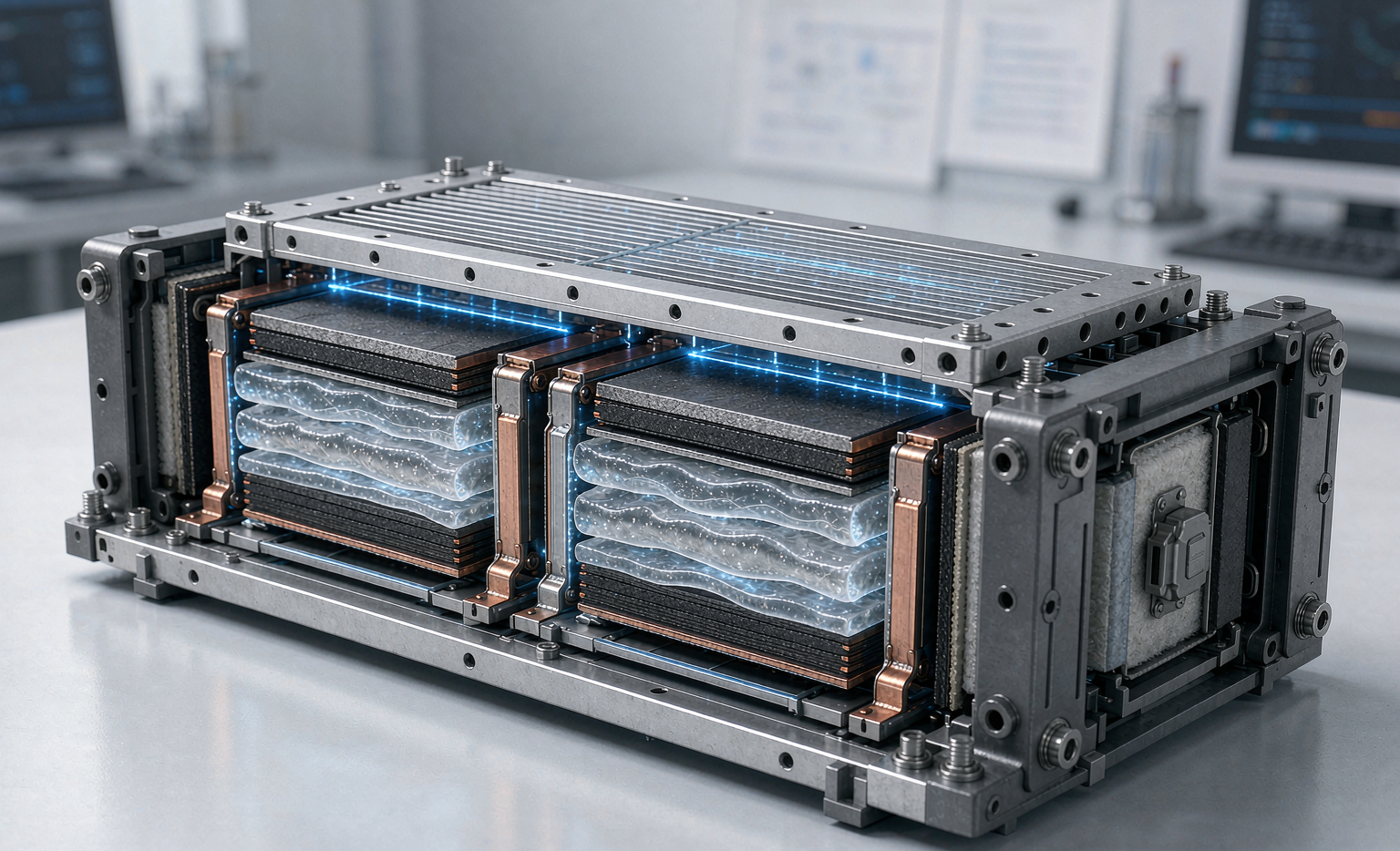
Mechanically, the cells tolerate higher stack pressure, so the compression frame can be tighter, which improves interfacial contact and cycle life. But the gel swells differently than liquid under abuse, so the pressure-relief path must be re-validated, not copied from the old pack. Standards compliance is the third pillar: GB 38031 (China EV traction battery safety), ECE R100 (UN vehicle battery safety), and UL 2580 (North America stationary/traction) all apply depending on market, and I build the evidence package — UN38.3 dossier, IEC 62133-2 cell report, abuse test logs — before the first vehicle integration.
Manufacturing Scale-Up and the Bridge to Solid-State
The reason semi-solid exists now and full solid-state mostly does not is manufacturing. Quasi-solid cells run on modified liquid-lithium lines — coat, stack, fill, formation — with a changed electrolyte and tighter dry-room control. That means a custom battery solution provider can scale today without a billion-dollar greenfield plant. I have qualified semi-solid lines that share 70–80% of their equipment with existing NMC production.
For drone and aerospace programs, the same chemistry story appeals in a different package. A solid-state drone battery built on a quasi-solid cathode can shave pack mass 15–20% for the same flight time, which directly extends range or payload — the same mass-dividend logic I use on EV packs, just at a different scale. As the electrolyte composites mature toward true solid conductors, the semi-solid line is the rehearsal: every process we tune now shortens the distance to all-solid-state later. My advice to any platform team is to treat semi-solid as the production-ready step on that path, not a detour.
Frequently Asked Questions
How much range improvement can a semi-solid state battery actually deliver in an EV pack?
Realistically 15–30% more range on the same pack footprint, or the same range at 15–25% lower pack mass. In bench-validated packs we see 220–260 Wh/kg versus 180–220 Wh/kg for liquid NMC, which translates a mid-size EV from roughly 430 km to 700–900 km depending on vehicle efficiency and thermal strategy.
Can semi-solid state batteries fast-charge as well as the marketing claims?
Close to it, with caveats. A 10–80% fill in 12–18 minutes is achievable on a 350–500 kW DC station at warm cell temperature. Below 10 °C I derate to 0.3–0.5C to avoid lithium plating, so winter fast-charge is slower. The chemistry is more charge-tolerant than liquid NMC, but it is not temperature-independent.
Are semi-solid state EV batteries safer than conventional liquid lithium-ion?
Yes, meaningfully. Thermal runaway onset is 30–50 °C higher, free flammable solvent is reduced 40–60%, and the abuse window is wider. But safety still depends on the full pack system — vents, barriers, BMS isolation — and the cells still carry UN38.3 T.1–T.8 and IEC 62133-2 certification. Higher onset is margin, not a substitute for enclosure discipline.
Do the same cells work for drones and other mobility, or are EV packs unique?
The chemistry transfers, the pack does not. The quasi-solid energy-density dividend helps a solid-state drone battery shed 15–20% mass for the same flight time, but drone packs need a different mechanical, thermal, and BMS design than an EV pack. I treat them as two distinct custom battery solution programs sharing a cell qualification, not one product.
What standards govern semi-solid state battery performance for EV packs?
For road vehicles: GB 38031, ECE R100, and UL 2580 depending on market. Cell-level: IEC 62133-2 (portable) and IEC 62619 (industrial), with UN38.3 T.1–T.8 for transport. Aviation handling of prototype packs follows FAA and EASA lithium-transport rules. I assemble the full evidence package before vehicle integration begins.