Semi-Solid Cell Crush and Impact Testing Explained
When a battery pack lands in a vehicle, an aircraft, or an industrial cabinet, no one asks whether it passed a comfortable test. They ask whether it will stay safe after a crash, a dropped tool, or a forklift bump. As Karl Huang, Senior lithium battery Engineer at Horizon Power, I have run thousands of mechanical abuse trials, and the two that keep me up at night are crush and impact. A semi-solid state battery changes the failure physics compared with a conventional liquid-electrolyte cell, but it does not get a free pass. This article explains how we set up, run, and judge a semi-solid crush impact test so the result actually means something for your application.
Why Mechanical Abuse Testing Matters for Semi-Solid Cells
Mechanical abuse is the leading root cause of field thermal incidents that are not tied to manufacturing defects. A cell that survives an electrical overstress can still fail when its enclosure is pinched, dented, or struck. In a semi-solid state battery the electrolyte is a thick, paste-like composite rather than a free-flowing liquid, so the first assumption many engineers make is wrong: thicker does not automatically mean safer. The semi-solid layer can delay internal short circuits, but it also changes how stress distributes through the electrode stack. If you skip or dilute the crush and impact qualification, you are betting your certification on hope.
From a compliance standpoint the tests are not optional. UN38.3 governs air and sea transport, and its crush and impact requirements are a gate you cannot ship without. IEC 62133-2 is the reference most OEMs and certifiers accept for cell-level safety. We treat both as the floor, not the ceiling, because our customers install these cells in environments where a single failure is a recall, not a footnote.
How the Crush Test Is Performed
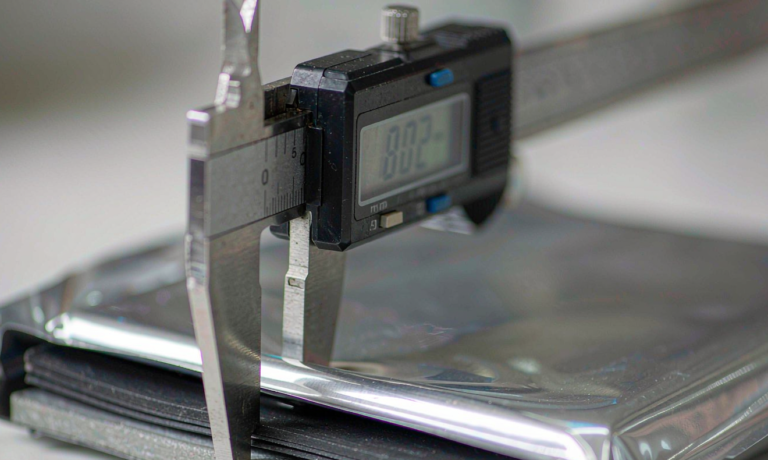
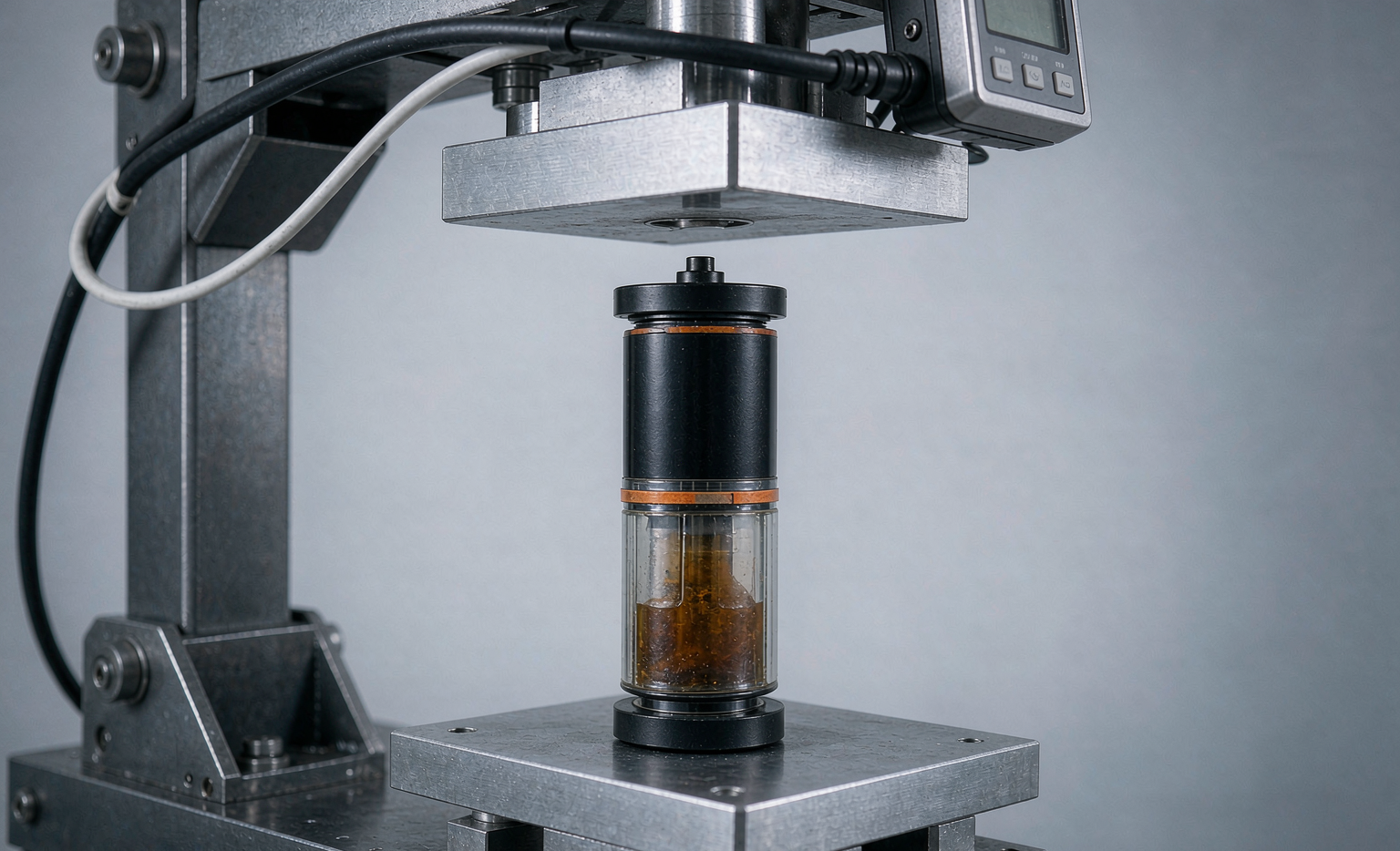
The crush procedure is deceptively simple to describe and difficult to do consistently. We place the cell between two flat, parallel steel platens and apply force along the principal axis. The target is 13 kilonewtons, or we stop earlier if the voltage collapses by more than 100 millivolts or the cell deforms to one third of its original thickness. Once the force reaches the limit, we hold for at least ten minutes while we watch temperature, voltage, and any venting.
For a semi-solid cell the hold phase is where the interesting behavior shows up. The semi-solid electrolyte resists the rapid internal migration that a liquid cell would experience, so the initial voltage dip is often smaller. Do not read that as safe. What we are really watching for is localized heating at the contact face and the onset of gas generation. A clean pass means no fire, no explosion, and no rupture that ejects flammable material. We log the peak temperature and the exact deformation at which any voltage anomaly begins.
Repeatability depends on alignment. A misaligned platen creates a shear component that a semi-solid stack tolerates differently than a wound liquid cell. We use a guided press with a load cell rated at five times the test force, and we discard any run where the platen tilt exceeds half a degree.
Conditioning matters more than people expect. We test at the customer’s stated state of charge, usually between 30 percent and 100 percent, because a fully charged semi-solid cell stores more energy and fails sooner than a half-charged one. We also equilibrate every sample at 25 degrees Celsius for at least twelve hours before the press closes. Skipping this step is the fastest way to produce scattered results that no certifier will accept.
How the Impact Test Differs
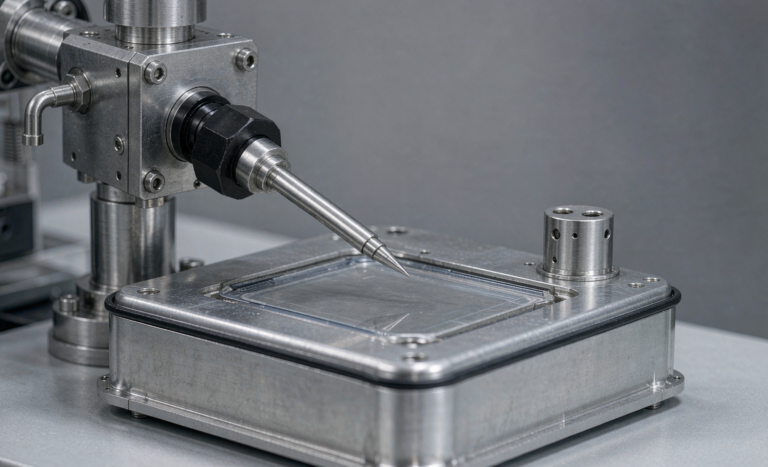
Impact testing applies a sudden, concentrated load rather than a slow squeeze. The classic method uses a rigid bar resting across the center of the cell with a defined weight dropped from a fixed height. The idea is to mimic what happens when a heavy object falls on a pack or a cell is struck by debris. The energy is delivered in milliseconds, which stresses the separator and the semi-solid layer in a way a quasistatic crush does not.
In our lab we also run a variant with a hemispherical impactor at calibrated velocities, because real-world strikes are rarely a clean bar drop. The semi-solid composite tends to spread the contact stress over a slightly larger area than a liquid cell would, which can delay penetration, but the trade-off is a stiffer response that transmits more load to the cell ends. We measure peak acceleration at the cell can and the time to any internal short, then compare against the acceptance window.
The bar method has fixed geometry for a reason. A 15.8 millimeter diameter bar and a defined drop weight from a set height produce a repeatable contact pressure that a custom rig rarely matches. We still validate our hemispherical impactor against the bar reference on a quarterly basis so the two data sets stay comparable across years of qualification work.
Acceptance is strict and binary in the standard: no fire and no explosion during or after the impact. We add our own graded criteria, including a maximum surface temperature and a maximum pressure rise in the test chamber, so we can rank cells that pass but barely.
What Makes Semi-Solid Failure Modes Different
The whole reason to test a semi-solid cell on its own terms is that its failure path is not the same as a liquid cell. In a liquid-electrolyte cell, once the separator is pierced, free electrolyte floods the short and the reaction accelerates fast. In a semi-solid state battery the composite electrolyte stays put, which slows that initial cascade. That sounds reassuring, and it is, up to a point.
The catch is mechanical. The semi-solid layer is less conformable than liquid, so under crush it can develop a hard spot that concentrates stress on a small region of the anode or cathode coating. If that spot reaches the thermal threshold, you get a localized hot spot instead of a diffuse warm-up. Our post-test teardowns consistently show smaller, more contained damage zones in semi-solid samples, but also sharper temperature gradients at the failure point. Designing the test to capture that gradient, with thermocouples placed at the expected contact line, is the difference between a meaningful result and a lucky one.
Test Setup, Instrumentation, and the Data I Capture
A credible semi-solid crush impact test produces a data trail, not just a pass or fail sticker. At minimum we record force versus displacement, cell voltage, surface temperature at three points, chamber pressure, and high-speed video of the contact region. For impact we add an accelerometer on the impactor and a strain gauge on the can.
I tell my team that the most valuable number is often the one just before failure. The slope of the temperature curve in the final two seconds of a crush tells you how much margin you had. We archive every run to a standardized template so a customer or a certifier can trace exactly what was done. When we qualify a new semi-solid format, we run at least twenty cells per condition and report the worst case, never the average.
Sampling rate is not a detail. We record force and voltage at one kilohertz and temperature at one hundred hertz, because the failure event in a semi-solid cell can unfold in under fifty milliseconds. A slow logger will show you the before and after but miss the moment that matters, and that moment is exactly what separates a robust design from a marginal one.
Frequently Asked Questions
What standard covers the crush and impact test for lithium cells?
The transport requirement comes from UN38.3, while most product safety certifications reference IEC 62133-2 for cell-level abuse. We run both and report the stricter outcome, because a cell that clears one but not the other is still a liability in a global supply chain.
Does a semi-solid cell always perform better in crush testing?
Not always. The semi-solid electrolyte can slow the initial short and contain damage, but it also creates stiffer stress paths that concentrate load. The real advantage shows up as a smaller failure zone, not as an automatic pass, which is why dedicated testing is essential.
What is the acceptance criterion for a pass?
Under the core standards a cell passes if it shows no fire and no explosion during or after the test. We add internal graded limits on peak temperature and chamber pressure so we can distinguish a comfortable margin from a near miss.
How many cells should be tested per configuration?
For a new semi-solid format we run at least twenty cells per condition and report the worst-case result rather than the average. Mechanical abuse has batch-to-batch variation, and qualifying on an average hides the cell that will fail in the field.
Can a cell that passes crush still fail impact?
Yes. Crush is a slow, distributed load, while impact is a sudden, concentrated one. A cell can absorb a quasistatic squeeze yet fail when the same energy arrives in milliseconds, so both tests must be passed independently.
Further Reading
References