Semi-Solid Cell External Short Circuit Testing
When a customer asks me to qualify a semi-solid state cell for aviation or industrial duty, the external short circuit test is one of the first abuse screens I run. As Karl Huang, Senior lithium battery Engineer at Horizon Power, I have put several hundred cells through the UN38.3 T.6 sequence, and the semi-solid chemistry behaves in ways that surprise engineers trained only on liquid electrolyte lithium-ion. This article walks through how I set up and interpret the external short circuit test for semi-solid cells, the standards that govern it, and the failure modes I design against.
What the External Short Circuit Test Actually Simulates
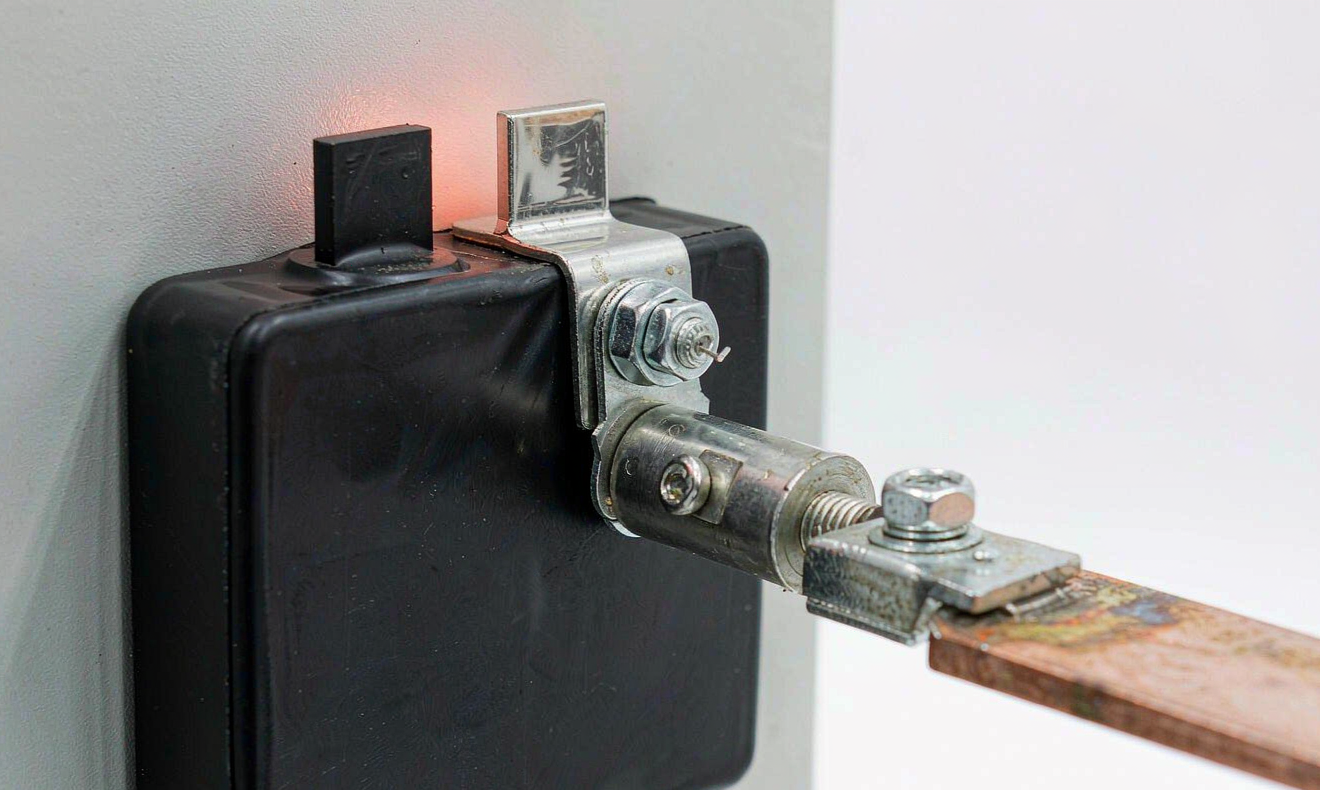
An external short circuit is the simplest and most common real-world fault: a low-resistance path connects the positive and negative terminals outside the cell. It can happen from a dropped tool, a crushed enclosure, a metal object left inside a pack, or a fault in the busbar. The current spikes to the theoretical maximum set by the cell internal resistance and open-circuit voltage, and that energy is dumped as heat inside the cell.
The ESC test is not about whether the cell survives a small overload. It is about whether a fully charged cell, exposed to the worst-case external fault, stays contained: no fire, no rupture, no disassembly. Transport regulators such as the FAA and EASA rely on this test through the UN38.3 framework before any lithium battery can be shipped by air. Industrial standards such as IEC 62619 and UL 2580 reference equivalent short-circuit requirements for stationary and traction packs, and IEC 62133-2 covers the same screen for portable cells.
How I Run the UN38.3 T.6 Procedure on Semi-Solid Cells
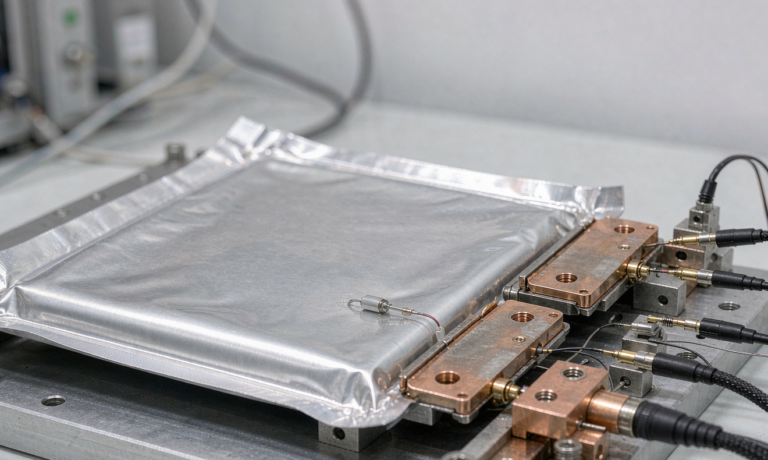
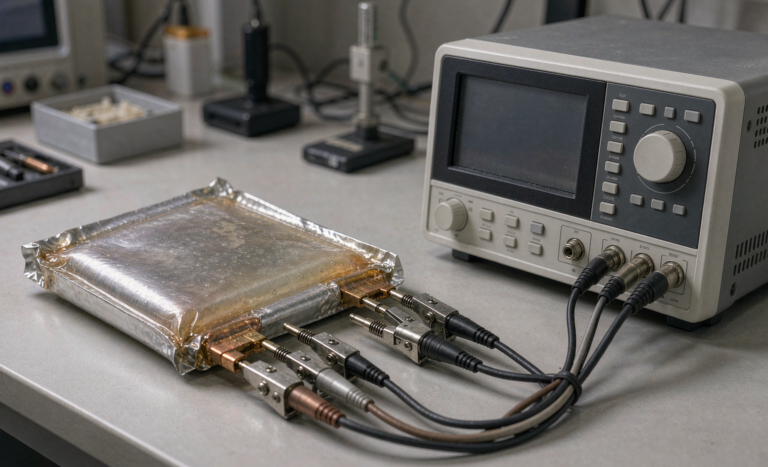
The procedure I follow is straightforward but unforgiving. I charge the semi-solid cell to its maximum permitted voltage at the standard charge rate, then place it in a thermal chamber held at 55 degrees Celsius plus or minus 2 degrees for at least six hours so the core temperature equilibrates. I then connect both terminals through a switch to a fixed external resistor of 0.1 ohm or less, often an 80 milliohm shunt, and close the circuit.
The cell stays shorted until its surface temperature returns to within 10 degrees Celsius of the chamber setpoint and then for an additional hour, or for a fixed hold of 24 hours in some qualification programs. Throughout the test I log terminal voltage, short-circuit current, and surface temperature on at least three thermocouples at one-second intervals. For a custom battery solution that must clear aviation transport, I repeat the sequence on fully charged and on 50 percent state-of-charge samples to bracket the worst case, because a cell that passes only at one charge state is not a qualified cell.
Semi-Solid Electrolyte Behavior Under a Hard Short
The defining feature of a semi-solid cell is its quasi-solid electrolyte: a polymer or ceramic-filled matrix that carries lithium ions while suppressing the free liquid that dominates conventional cells. Under a hard external short, that matrix changes the failure sequence in two ways I watch closely.
First, ionic conductivity in a semi-solid electrolyte is typically lower than in a flooded liquid cell, so the peak short-circuit current is often a little smaller for the same cell size and voltage. That sounds like good news, but it also means the heat generation spreads over a longer time, which can mask a slow thermal runaway that a liquid cell would have announced with a faster, sharper spike. I never trust a fast pass; I watch the full thermal curve.
Second, because there is far less free solvent, the fuel available for a flammable vent is reduced. In my data, semi-solid cells that do enter thermal runaway tend to swell and vent white smoke rather than eject flaming electrolyte. That difference matters for pack-level fire containment design, but it does not relax the pass criteria one bit. A contained swell is still a failed cell if it breaches the can.
Separator Shutdown and Internal Safety Devices
Every semi-solid cell I qualify carries at least one internal safety layer, and the ESC test is where those layers earn their keep. The most common is a ceramic-coated polyethylene separator with a shutdown temperature around 130 degrees Celsius. As the separator melts and closes its pores, ionic transport stops and the internal current collapses before the core reaches the runaway threshold.
Many of our larger semi-solid cells also include a current interrupt device and a positive temperature coefficient resettable fuse. Under a sustained external short, the PTC heats and its resistance climbs, throttling the fault current; the CID physically disconnects the jelly roll if internal pressure crosses a setpoint. I verify both devices during ESC qualification, because a cell that passes only because a CID tripped is still a cell that failed its primary containment path and must be redesigned before it ships.
Acceptance Criteria and How to Read the Data
Per UN38.3 T.6 and the aligned IEC 62133-2 clause 7.3.2, the cell passes the external short circuit test if it shows no disassembly, no rupture, and no fire, and if its external temperature does not exceed 150 degrees Celsius. I hold a stricter internal limit of 120 degrees Celsius surface on the can during the hold, because our customers integrate these cells into sealed enclosures with limited cooling.
Reading the data is as important as the pass or fail. A healthy semi-solid cell shows a current spike that decays as the internal resistance climbs with temperature, a single temperature peak well under the separator shutdown point, and a stable post-test open-circuit voltage. If I see the temperature curve plateau near 125 to 130 degrees Celsius for more than a few minutes, I treat it as a near-miss and rework the electrode loading before signing off. A lithium battery that nearly trips its own safety device in a qualification lab will trip it in the field.
Common Failure Modes and How We Design Them Out
The failures I see most often in semi-solid ESC testing are not exotic. The first is separator shrinkage at the edge of the winding, which lets the anode and cathode touch after the initial heat pulse. We design out edge shrinkage with a wider ceramic margin and a tighter winding tension spec verified on every lot.
The second is uneven areal loading that creates local hot spots where the solid electrolyte interface resists ion flow and generates more heat than the bulk. I catch this in incoming inspection by mapping the coating weight across the web and rejecting rolls with more than plus or minus 2 percent variation before they reach the line.
The third is a weak weld at the tab that vaporizes under sustained high current, turning an external short into an internal arc. Our tab welding process uses a fixed energy profile and a 100 percent peel test on a destructively sampled strip from each lot to keep that failure out of the field.
Frequently Asked Questions
What resistor value is used for the external short circuit test?
The standard calls for an external resistance of 0.1 ohm or less, typically an 80 milliohm shunt, to approximate a hard metallic short between the terminals. The goal is to force the worst-case fault current the cell can deliver.
At what temperature is the external short circuit test performed?
UN38.3 T.6 specifies a chamber temperature of 55 degrees Celsius plus or minus 2 degrees, with the cell held there for at least six hours before the short is applied. Some industrial programs also run a cold variant near 20 degrees Celsius to bracket seasonal duty.
How does a semi-solid cell behave differently from a liquid electrolyte cell in this test?
A semi-solid cell usually shows a slightly lower peak short-circuit current and far less flammable venting because it carries little free solvent. The trade-off is a slower, more drawn-out heating curve that can hide a creeping thermal runaway, so I log temperature for the full hold rather than trusting a fast pass.
What is the pass criterion for UN38.3 T.6 external short circuit?
The cell must show no disassembly, no rupture, and no fire, and its external temperature must stay at or below 150 degrees Celsius. We apply a stricter internal surface limit of 120 degrees Celsius for sealed-pack integration.
How many samples are required for external short circuit qualification?
UN38.3 T.6 requires a minimum of ten cells from a single production batch, split across charge states and test temperatures, with all samples passing. For a custom battery solution we typically test twenty to cover lot-to-lot variation and qualification confidence.
Conclusion
The external short circuit test is the single most revealing abuse screen I run on a new semi-solid cell, because it stresses the electrolyte, the separator, and the internal safety devices all at once. A clean pass against UN38.3 T.6 and IEC 62133-2 is the baseline that lets a Horizon Power semi-solid cell move on to transportation approval, pack integration, and field duty with confidence. If your program needs a short-circuit qualification plan built around your specific cell format and operating envelope, our engineering team can run the sequence and hand you the full data package.
Further Reading
References