Semi-Solid State Battery Scalability and Gigafactory Readiness: An Engineer’s Manufacturing Assessment
The question I get from procurement teams has changed. Two years ago it was “does the chemistry work?” Now it is “can you build forty thousand cells a month, at a price I can defend to my board, starting in Q3?” Those are different questions, and the second one is far harder to answer honestly.
I am Karl Huang, a senior lithium battery engineer. Over the past several years I have spent more time in slurry rooms and dry rooms than in test labs, walking pilot lines from first coin cell through to tooled production. This guide covers semi-solid state battery scalability and what gigafactory readiness actually means for this chemistry: where the process is genuinely simpler than conventional manufacturing, where it is harder, and what the capex model looks like when you build it without optimism baked in.
I will include the counter-arguments. A technology that only ever gets described in superlatives is a technology nobody has yet tried to mass-produce.
What Semi-Solid Manufacturing Removes From the Line
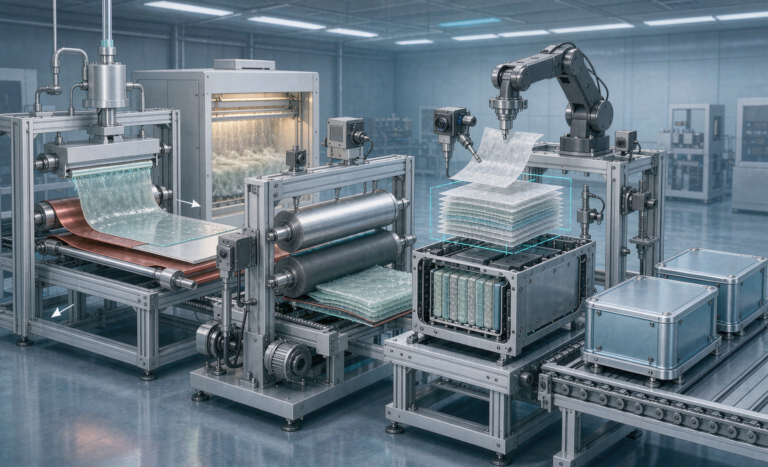
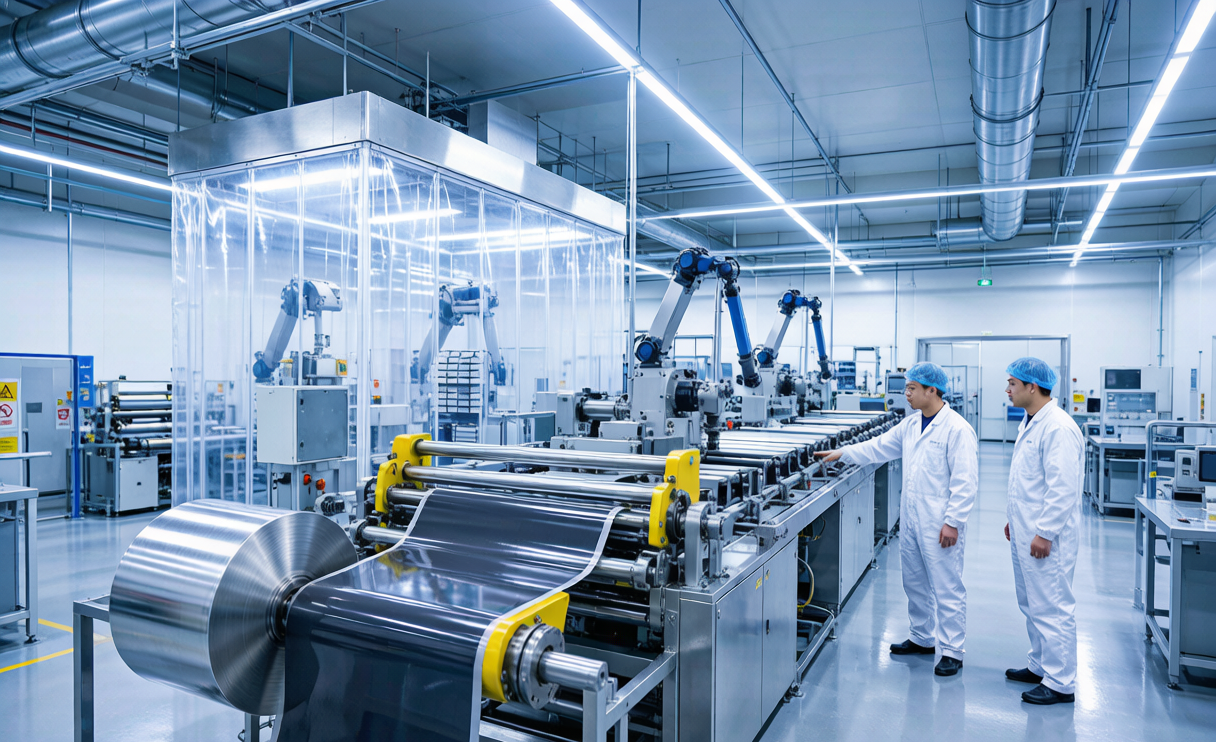
Start with what a conventional cell line does. Slurry mixing, double-sided coating onto foil, a drying oven bank, solvent recovery if you use NMP, calendering to target porosity, slitting, stacking or winding, tab welding, sealing, electrolyte filling, wetting soak, degassing, formation, aging, and final grading. Fourteen major steps, and roughly forty sub-processes with their own control limits.
A semi-solid cell removes or radically shrinks three of the most expensive. The electrolyte is already inside the electrode slurry when it is cast, so there is no separate fill-and-soak stage. On our conventional line, wetting soak occupies 12 to 36 hours of work-in-progress and a substantial climate-controlled buffer area. On the semi-solid line that step is effectively zero, because the ion path is wet from the moment the electrode is formed.
The second saving is the drying oven. Conventional electrode coating requires a 30 to 60 metre oven bank to drive off solvent, and on the lines I have costed, that oven plus its solvent recovery accounts for 30 to 40% of electrode-section capex and 40 to 50% of process energy. Semi-solid electrodes retain their liquid fraction by design, so the thermal load drops by roughly two thirds. You still need controlled conditioning, but you are managing viscosity and skin formation, not evaporating a tonne of solvent per shift.
The third is degassing. Semi-solid cells still form an SEI on first charge, but with far less free solvent the gas volume we measure is roughly 35 to 55% lower, which simplifies the pouch vent-and-reseal sequence considerably.
The Throughput Math Nobody Puts on a Slide
Here is the honest counterweight, and it is the single most important number in any semi-solid state battery scale-up plan.
A conventional slot-die coater running a 70 micrometre electrode moves web at 60 to 100 metres per minute. A semi-solid extrusion head laying down a 250 to 400 micrometre electrode runs at 8 to 20 metres per minute. That looks catastrophic until you account for energy per metre of web.
A conventional coated cathode delivers roughly 3.5 to 4.2 mAh/cm² of areal capacity. A semi-solid cathode at 300 micrometres delivers 12 to 16 mAh/cm². So each metre of web carries three and a half to four times the energy. Multiply through: a conventional line at 80 m/min produces the equivalent of 80 units of energy per minute; a semi-solid line at 15 m/min produces roughly 15 × 3.8 = 57 units. That is still about 25 to 30% less annual GWh from a single coating head.
Anyone who tells you semi-solid manufacturing is simply faster is selling. What it is, is denser per square metre of floor and shorter in total process time. You lose on coater throughput and win on oven length, buffer area, formation duration, and stacking count — a 60 Ah semi-solid pouch needs 14 to 20 electrode layers where its conventional equivalent needs 48 to 62. That cuts stacker cycles per cell by roughly 65%, and in a high-volume plant the stacker, not the coater, is usually the real bottleneck.
Net across the whole line, our modelling puts equivalent-GWh floor area at 0.72 to 0.85 of a conventional plant, and total process time from slurry to graded cell at 38 to 52 hours against 96 to 130. That work-in-progress reduction is where the working-capital argument lives.
Dry Room, Yield, and the Defect Modes That Ambush You
Semi-solid slurries are more moisture-sensitive than conventional ones because the electrolyte sits exposed for longer in an open process. We hold casting and stacking zones at a dew point of −40 to −45 °C, tighter than the −35 °C many conventional lines run. That is real money: on a 5 GWh plant the dehumidification package lands between $9M and $14M.
Then there are the defect modes specific to thick electrodes. Four of them account for most of our early scrap:
- Through-thickness density gradient. A 300 micrometre electrode can consolidate unevenly, leaving a lower-porosity skin that starves the interior of ions. It passes capacity check at C/10 and fails at 1C. We catch it with a differential-rate screen, not a static one.
- Edge cracking after calendering. Thick electrodes have far less compliance. Our first tooling produced 6 to 9% edge-crack scrap until we moved to a two-stage roll with a heated second pass.
- Collector delamination. The mass loading per unit adhesion area is three to four times higher, so binder chemistry that worked on a thin electrode simply peels. We now specify a primed foil and a 90-degree peel strength above 12 N/m at incoming inspection.
- Entrapped gas voids. High-viscosity slurry drags air. Vacuum de-aeration before the extrusion head is not optional, and we monitor it as a critical control point.
Yield tells the real story of readiness. Our pilot line started at 62% first-pass yield. Fourteen months and roughly 40 process changes later it sits at 88%. For cost parity with an established lithium battery plant you need to hold above 93% at volume. That gap is what separates a working pilot from a bankable gigafactory, and it is measured in quarters of disciplined engineering, not in press releases.
Formation and Aging: The Capex Line Item Everyone Underestimates
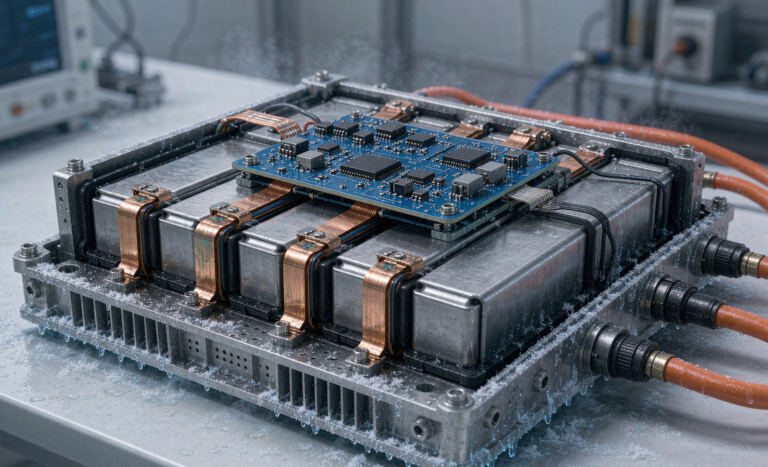
Formation is where new entrants get their budget wrong. Every cell must be cycled under controlled current and temperature to build its SEI, and every cell needs a channel to do it in. Channels cost money and occupy heated floor space.
On a conventional line, formation plus aging typically runs 48 to 96 hours per cell. Semi-solid cells arrive at formation already wetted, so the pre-soak dwell disappears and the first charge can start immediately. Our measured formation-plus-aging window is 26 to 40 hours. For a 5 GWh plant producing 60 Ah cells, that difference removes roughly 30 to 40% of the required formation channels — on the order of $18M to $26M of equipment and the building volume to house it.
One caution from experience: do not shorten the aging hold to chase throughput. Self-discharge screening at 25 °C over a minimum 10-day window is how you catch micro-shorts before they reach a customer. We tried an accelerated 4-day screen at elevated temperature and it missed two latent defects in a 3,000-cell lot. We reverted, and I would not ship a qualified battery solution without the full window.
Equipment and Supply Chain Maturity: The Honest Gaps
Scalability is not only a process question. It is a question of whether you can buy the machines.
Semi-solid slurries run at 30,000 to 80,000 cP, against 3,000 to 8,000 cP for conventional cathode slurry. That rules out most standard slot-die hardware. You need twin-screw or planetary-vacuum mixers rated for the shear, and extrusion heads with die-gap control to ±3 micrometres across a 600 mm width. As of today I know of a single-digit number of equipment vendors who can deliver that at production scale, and quoted lead times run 14 to 22 months. If your plan assumes you can order coaters like commodity items, rebuild the schedule.
Materials are more comfortable. Cathode active material, anode, lithium salts, and separator all come from the existing supply base. The gel or polymer electrolyte precursor is the one specialised input, and pilot-volume pricing runs 2.5 to 4× the eventual volume price — a distortion that flatters or wrecks your cost model depending on which figure you use.
Certification adds calendar time that runs in parallel but must be planned. Every production configuration needs UN 38.3 T.1 through T.8 for transport, IEC 62619 for industrial cells, UL 1973 for stationary applications including home energy storage, and IEC 62133-2:2017 where the cells go into portable equipment. Shipping falls under UN 3480 and UN 3481 with IATA PI 965 requiring 30% state of charge for standalone cells. Aviation customers add FAA Part 107 operational limits and EASA airworthiness requirements on top. Budget 5 to 8 months per configuration and remember that a change of electrode thickness is a new configuration.
A Cost Model You Can Actually Defend
Here is how the arithmetic lands on the projects I have costed, in round numbers per GWh of annual capacity.
- Conventional NMC line: $85M to $110M capex per GWh, cell cost $78 to $95/kWh at 95% yield and full utilisation.
- Semi-solid line: $72M to $96M capex per GWh, cell cost $96 to $124/kWh at 88% yield, falling to $82 to $98/kWh at 94% yield.
Semi-solid is lower capex per GWh and currently higher cell cost, and the entire gap is yield plus electrolyte precursor pricing. Both improve with volume; neither improves by itself. My planning assumption is cost parity between 8 and 15 GWh of cumulative production.
The commercial case in the interim is not price per kWh. It is that 300 to 360 Wh/kg at cell level buys system savings a conventional cell cannot: lighter enclosures, smaller thermal management, fewer modules, and in a drone battery pack, flight time no amount of cost engineering on an LFP cell will deliver. Sell the system, not the cell.
When Semi-Solid Is the Wrong Answer for Your Volume
Three situations where I advise against it, and I have given all three to paying customers.
Annual demand below roughly 50 MWh. Do not build. Qualify a merchant cell supplier and put your engineering into pack design and BMS. A dedicated line at that volume never amortises.
Cost-driven stationary storage. If your application is grid-tied, floor-mounted, and mass-insensitive, LFP wins today and probably for the rest of the decade. Sodium-ion is coming for the same segment. Energy density you cannot monetise is a specification you are paying for twice.
Sustained discharge above 4C. Thick electrodes lengthen the ion diffusion path. Our 300 micrometre cells hold rate capability well to about 3C and degrade measurably beyond 4C sustained. Power tools, racing applications, and heavy pulse loads still belong to thin-electrode designs. Any competent custom battery solution starts by matching electrode architecture to the duty cycle, not to the marketing brochure.
How We Stage a Scale-Up
The programme structure that has worked for us runs three gates, and we do not skip them regardless of schedule pressure.
Gate A — Chemistry Lock
Coin cells and 2 Ah single-layer pouches. Objective is to freeze cathode, anode, electrolyte formulation, and target electrode thickness. Exit criterion: 200 cycles at 1C with capacity retention above 95% and cell-to-cell capacity spread under 1.5%. Typically 4 to 7 months.
Gate B — Process Lock
10 to 20 Ah pouches on pilot tooling, minimum 500 cells across at least five separate batches. This is where you find the defect modes above. Exit criterion: first-pass yield above 85%, batch-to-batch capacity variance under 2%, and a full UN 38.3 pass on the pilot configuration. Typically 8 to 14 months.
Gate C — Production Lock
Hard-tooled production format, 5,000-cell qualification lot, full abuse and certification programme. Exit criterion: yield above 93% sustained for 30 days, plus certification files closed. Typically 10 to 16 months, running partly in parallel with Gate B.
Total honest timeline from locked chemistry to shippable production volume is 24 to 34 months. I have seen 18-month plans. I have not seen an 18-month plan finish in 18 months.
Frequently Asked Questions
Is semi-solid state battery production genuinely cheaper than conventional manufacturing?
Cheaper on capex per GWh, currently more expensive per kWh of output. Capex drops 12 to 20% because you eliminate most of the drying oven, the electrolyte fill line, and 30 to 40% of formation channels. Cell cost stays high until yield reaches the low 90s and electrolyte precursor moves to volume pricing. Anyone quoting cost parity today is quoting a forecast, not an invoice.
Can an existing lithium battery plant be converted to semi-solid production?
Partially. Mixing, stacking, welding, sealing, formation, and grading equipment carry over with modest modification. The coating section does not — you are replacing the slot-die head and can decommission most of the oven bank. In practice we see 55 to 70% of existing equipment retained, which makes brownfield conversion meaningfully cheaper than greenfield, provided your dry room can be tightened to −40 °C dew point.
What yield should a mature semi-solid line achieve?
Above 93% first-pass, with a stretch target of 96%. Conventional lines run 94 to 97% after years of tuning. The gap closes as thick-electrode calendering and de-aeration mature. Treat any pilot claiming above 90% in its first year with polite scepticism, and ask to see the scrap log.
How long does gigafactory qualification take end to end?
From locked chemistry to shippable volume, 24 to 34 months across the three gates. Certification under UN 38.3, IEC 62619, and UL 1973 runs 5 to 8 months per configuration in parallel. Automotive customers add PPAP and IATF 16949 audits, typically another 4 to 6 months.
Does thick-electrode design limit fast charging at scale?
It limits sustained high-rate charging, not fast charging as most applications define it. Our production cells accept 2C to 3C charge within a 20 to 80% SOC window at cell temperatures between 20 and 40 °C. Above 4C the ion diffusion path through a 300 micrometre electrode becomes the constraint and lithium plating risk climbs. Design the BMS to lock out charge above 4C and below 5 °C without preheat, and the chemistry behaves.
What is the minimum viable volume to justify a dedicated line?
Around 200 to 300 MWh per year for a single-format line, assuming utilisation stays above 70%. Below roughly 50 MWh, buy cells. Between those figures, contract manufacturing with dedicated tooling usually beats owning the asset.
Where This Leaves a Buyer
Semi-solid state battery scalability is a manufacturing engineering problem, not a physics problem. The chemistry works and has worked for several years. What decides whether a supplier can serve you at volume is yield discipline, equipment lead time management, and whether their formation and aging capacity actually matches their coater output — a mismatch I see constantly on plant tours.
When you audit a prospective supplier, ask for three documents: the scrap log by defect code for the last 90 days, the formation channel count against stated nameplate capacity, and the certification file for the exact cell configuration you intend to buy. Those tell you more about gigafactory readiness than any capacity announcement, and they are worth reviewing before the capex committee meets rather than after.