Lithium Battery Performance for Power Tools: What Engineers
When a contractor drops a cordless impact driver and it keeps running, nobody thinks about the lithium battery inside it. As a senior lithium battery engineer who has spent over a decade building packs for OEM power-tool brands, I think about it constantly. When a buyer asks me about lithium battery performance power tools, they usually mean one thing: why does my tool feel weak under load? The gap between a cheap pack that dies in a season and a professional pack that survives 800 charge cycles comes down to how deliberately the lithium battery performance was designed, measured, and validated. In this guide I will walk through the exact metrics my team tracks, the standards we certify against, and the trade-offs that separate a good power-tool cell from a great one.
What Power Tools Actually Demand From a Lithium Battery
A power tool is one of the harshest environments you can put a cell in. Unlike a phone that draws a steady few watts, a drill or angle grinder pulls hard, bursty current. A 20VMax pack in a circular saw can see 30 to 50 amps of continuous draw and short spikes well above 80 amps during a stall. That burst current is the real test of lithium battery performance for power tools, not the lab-rated capacity.
The three physical stresses are heat, vibration, and depth of discharge. Heat comes from internal resistance during high-current discharge. Vibration comes from the motor and the user’s hand. Depth of discharge is aggressive because users run packs flat before recharging. A lithium-ion battery engineered for this duty needs low DCIR (direct current internal resistance), a rigid mechanical frame, and a battery management system that tolerates deep cycles without quietly killing the cells.
The Metrics That Define Lithium Battery Performance
When a buyer asks me to quote a pack, I do not start with price. I start with the spec sheet of numbers that predict field life. Here are the ones I never skip.
Continuous and Peak Discharge Current
This is the headline number. A 18650 cell rated at 3,000 mAh but only 10A continuous is a poor fit for a saw, while a high-rate 18650 rated at 15 to 20A or a 21700 rated at 25 to 45A is the right tool for the job. We match cell rating to the tool’s peak amp draw with at least a 20 percent margin so the pack is never the bottleneck.
Capacity and Energy Density
Capacity (Ah) sets runtime; energy density (Wh/kg) sets weight. For a handheld tool, weight is ergonomics, and ergonomics is adoption. A lithium-ion battery pack pushing past 200 Wh/kg lets us deliver longer runtime without making the tool unpleasant to hold.
Internal Resistance and Voltage Sag
Low internal resistance keeps voltage from collapsing under load. If a pack sags below the tool’s cutoff during a hard cut, the motor loses torque and the user feels weakness. We measure DCIR at 50 percent state of charge and 25 degrees C, then model sag at the tool’s worst-case current.
Cycle Life and Capacity Retention
We define end of life at 80 percent of original capacity. A professional pack should reach 500 to 1,000 full cycles. Capacity retention curves, not marketing claims, are what go into our datasheets.
Choosing Cell Chemistry and Form Factor
For power tools, the chemistry decision is almost always between NMC (nickel manganese cobalt) and LFP (lithium iron phosphate). NMC offers higher energy density and better low-temperature behavior, which is why most premium cordless lines use it. LFP wins on safety, cycle life, and thermal stability, at the cost of weight and cold-weather voltage. For a jobsite where the pack is dropped, kicked, and left in a truck, the conversation is rarely about chemistry alone, it is about the whole custom battery solution wrapped around the cells.
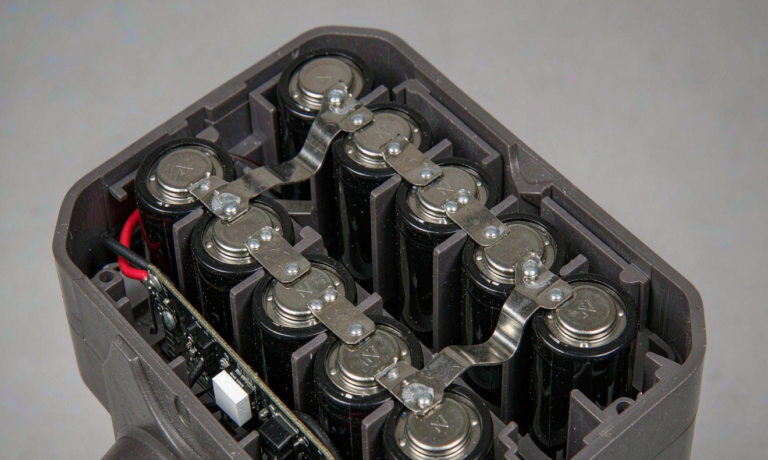
Form factor matters too. 18650 cells are cheap, proven, and easy to weld, but 21700 cells pack more energy per cell and reduce pack-level interconnection, which lowers resistance and failure points. When a client wants maximum runtime in a compact footprint, I push them toward 21700. When they want lowest cost at volume, 18650 still wins.
Thermal Management in a Sealed Plastic Pack
Power-tool packs are sealed, so there is no fan and no liquid cooling. Heat has to move through the cell wrapper, the pack filler, and the plastic shell into ambient air. We manage this three ways: selecting low-DCIR cells, using thermally conductive potting or gap filler at hot spots, and shaping the enclosure for convection. In our thermal chambers we run the pack at its rated current until case temperature stabilizes, then verify it stays under the limit set by IEC 62133 and the tool’s own IEC 62841 safety envelope.
One lesson from the field: users charge packs immediately after heavy use. Charging a hot pack accelerates aging. Good chargers and BMS firmware step down charge current when cell temperature is high. That single behavior probably adds more cycle life than any cell upgrade.
The Battery Management System Is the Real Product
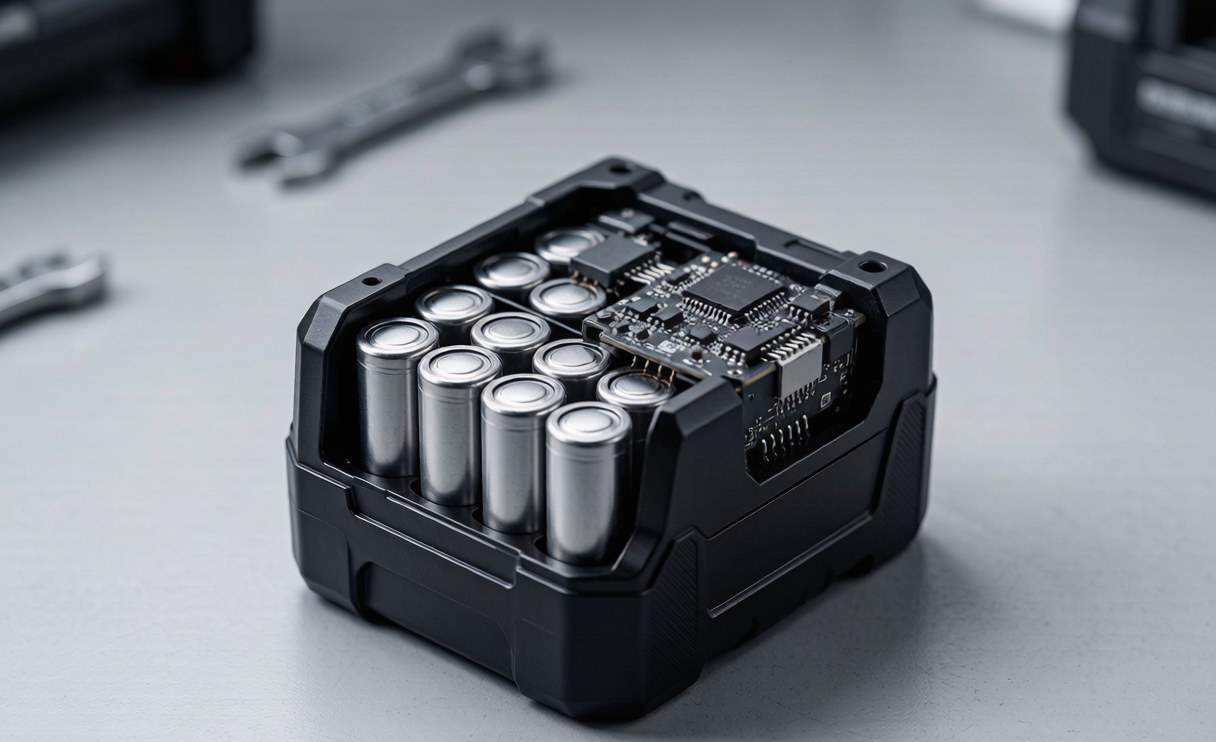
The cells are commodities. The battery pack intelligence is what a brand owns. A proper power-tool BMS monitors every parallel group with balanced voltage sensing, watches temperature with at least two NTC thermistors, and protects against over-current, over-voltage, under-voltage, and short circuit. For communication with the tool we use a single-wire or I2C data line so the tool can read state of charge, limit power when cold, and report health.
Cell balancing is not optional. In a 10S pack, a 20 mV imbalance across groups compounds into lost capacity and uneven aging within a few dozen cycles. Active or passive balancing during charge keeps groups aligned. We validate balancing by deliberately stressing one group and confirming the BMS recovers it.
Benchmarks From the Lab and the Jobsite
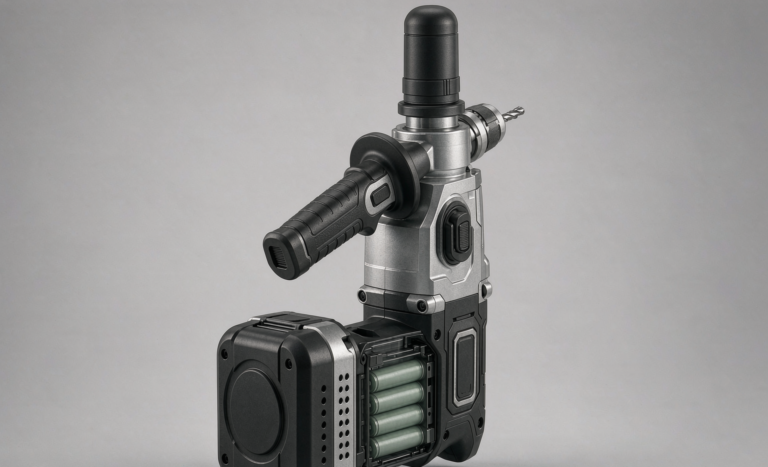
Numbers from a datasheet are a hypothesis. Field data is the proof. On a recent 18V 5.0Ah NMC pack for a rotary hammer, we measured these in our test lab:
- Continuous discharge: 40A sustained, 90A peak for 2 seconds
- DCIR at 50 percent SOC: 28 milliohm per pack
- Runtime in a 26 mm concrete drill test: 62 holes per charge
- Cycle life to 80 percent: 740 cycles at 25 C, 410 cycles at 45 C
- Self-discharge after 30 days storage: under 3 percent
The 45 C result is the one I show clients. Heat is the silent killer of lithium battery performance. Every 10 degrees C of sustained operating temperature roughly halves chemical lifetime, so a pack that runs cooler outlasts a pack with better-looking headline specs.
Building a Custom battery solution for a Specific Tool
When an OEM comes to us, the brief is rarely “sell me cells.” It is “make my saw beat the competitor’s saw on the same job.” That is a system problem. We start from the tool’s motor curve, map the current profile, pick cells with margin, lay out the series-parallel topology, design the mechanical frame to survive a 1.5 meter drop per IEC 60068-2-31, and tune the BMS firmware to the tool’s behavior.
For a custom battery solution we also certify the whole assembly, not just the cells. UN38.3 covers transport safety across its eight tests (T.1 altitude, T.2 thermal, T.3 vibration, T.4 shock, T.5 external short, T.6 impact, T.7 overcharge, T.8 forced discharge). IEC 62133-2 covers the cell and pack safety for portable applications. UL 2054 and UL 2595 apply for the North American market. Skipping any of these is how a brand ends up with a recall instead of a product.
Common Mistakes That Destroy Pack Life
The fastest way to wreck a good pack is a bad charger. A charger that floats voltage too high cooks the cells; one that terminates early leaves the user frustrated. We specify charger termination at 4.20V plus or minus 0.05V per cell with a proper taper. The second mistake is ignoring the cold. Below 0 C, charging an NMC pack causes lithium plating that is permanent. A BMS that blocks charge under 0 C, or throttles discharge, pays for itself in returned-merchandise savings.
FAQ
What is the best lithium battery for power tools?
For most cordless professional tools, a high-rate NMC 18650 or 21700 cell in a well-balanced pack offers the best mix of energy density, current capability, and weight. LFP is the better choice when safety and cycle life outweigh runtime and cold-weather performance.
How many cycles should a power tool lithium battery last?
A quality pack reaches 500 to 1,000 full charge cycles before dropping to 80 percent of original capacity. Runtime, charging habits, and operating temperature matter more than the printed rating. Keeping the pack cool and avoiding full discharges extends life significantly.
Why does my battery lose power under heavy load?
Voltage sag from internal resistance is the usual cause. As current spikes, pack voltage drops. If it crosses the tool’s cutoff, the motor weakens. Lower-DCIR cells, good interconnections, and a pack sized with current margin solve it.
Is a higher amp-hour rating always better?
Higher Ah means longer runtime but also more weight and sometimes higher cost. The right rating depends on the tool and the user. A compact drill benefits from a lighter 2.0Ah pack; a circular saw wants a 5.0Ah or larger pack for sustained cuts.
Can I use any charger with my lithium-ion battery pack?
No. Use a charger specified for the pack’s chemistry and cell count. An incorrect charger can overcharge, overheat, or damage cells permanently. Chargers should terminate at the correct per-cell voltage and include temperature-aware current control.