Sodium-Ion Battery for Rail and Transit Backup: Keeping Trains and Stations Powered When the Grid Drops
When I first walked a metro depot as a battery engineer, the backup power conversation was almost always about lead-acid or diesel gensets. That is changing fast. Over the last two years at Horizon Power I have spec’d and field-tested sodium-ion battery packs for rail and transit backup, and the results are hard to ignore. A sodium-ion battery rail transit backup system gives operators a non-flammable-favoring chemistry, stable performance in cold depots, and a supply chain that does not depend on lithium or cobalt prices. This article walks through why transit operators are adopting it, how we engineer the pack, and which standards you must clear before it ever touches a live rail site.
Why Rail and Transit Operators Are Rethinking Backup Power
Rail networks are unforgiving about downtime. A signal power loss for even ninety seconds can cascade into a stalled line, a missed dispatch window, and a regulator’s incident report. Traditional backup has been lead-acid strings and diesel generators, but both carry problems I see repeatedly in the field.
Lead-acid degrades quickly under partial-state-of-charge cycling, which is exactly how most backup banks actually operate: they sit at float, take a shallow discharge during an outage, then recharge. Diesel is reliable but noisy, emits on-site, needs fuel logistics, and fails its own emissions and noise compliance in urban stations. As a custom battery solution engineer, I have increasingly been asked to design something that bridges both: instant response like a battery, but without the thermal anxiety and commodity-price exposure of lithium.
That is where sodium ion battery chemistry fits. Sodium is abundant, cheap, and geographically diversified. The cells are forgiving in cold, which matters for outdoor wayside cabinets and unheated northern depots. And because the energy density is lower than NMC, the packs are heavier but that is rarely a constraint for a trackside cabinet or an under-floor train module where volume is the limit, not mass.
What Makes Sodium-Ion a Fit for Rolling Stock and Wayside Sites
Let me be specific about the two deployment classes, because the engineering is different.
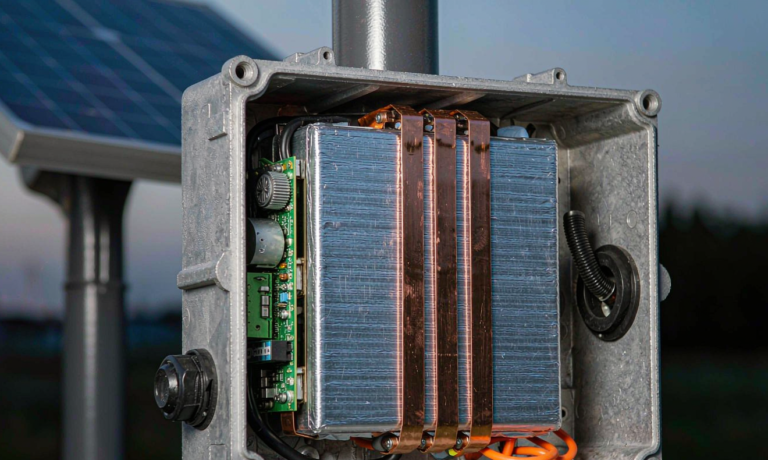
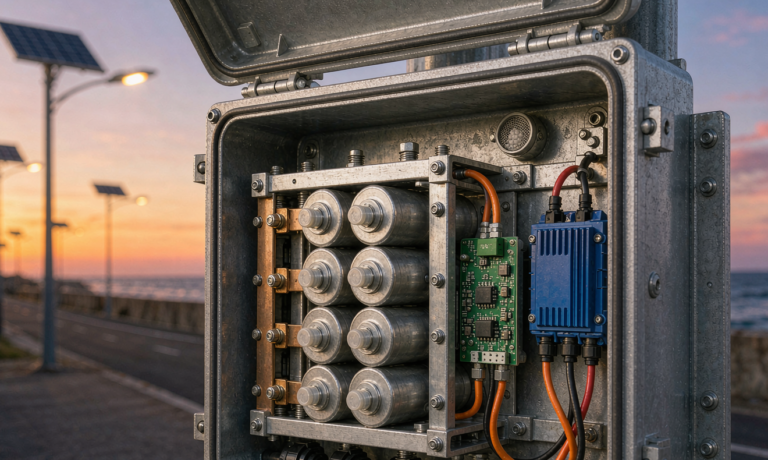
Wayside and stationary backup. This covers signal power houses, switch-machine heating, station lighting, and dispatch SCADA. These sites are stationary, often exposed, and see temperature swings from minus twenty to plus forty Celsius. Hard-carbon anode sodium-ion battery cells hold capacity far better than LFP in the cold, and they do not need the aggressive thermal management that NMC demands. For a remote signal hut with no technician on site, that resilience is the whole value proposition.
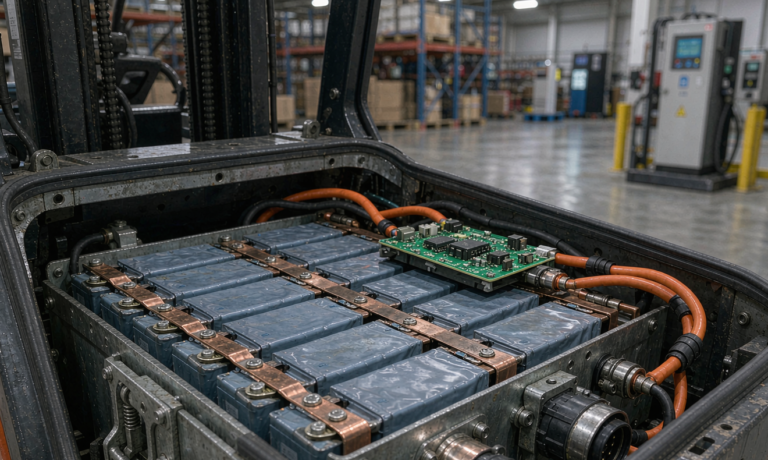
On-board and depot backup. Inside an EMU or a maintenance vehicle, the battery supports hotel loads, low-speed rescue moves, and bridge power during pantograph changeover. Here the pack must survive vibration, shock, and a moving electrical environment. Sodium-ion’s wide operating window and tolerance to over-discharge make it a calmer cell to manage than a tightly windowed lithium pack, though it still needs a competent BMS.
- Cold retention: capacity stays usable at minus twenty Celsius where LFP drops sharply.
- Supply security: no lithium, no cobalt, no nickel in the active materials we currently specify.
- Safety posture: oxide cathodes and hard-carbon anodes are less prone to thermal runaway than high-nickel chemistries.
- Cycle life: 3,000 to 6,000 cycles at the shallow backup duty we design for.
Engineering the Pack: Cell Selection, Thermal and Mechanical Design
A backup battery is only as good as the pack around the cells. When I design a sodium-ion battery rail transit backup unit, the cell format choice drives everything else.
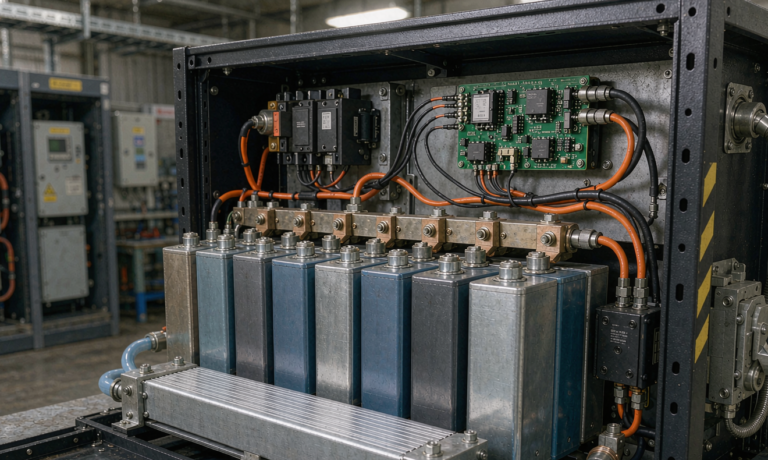
For wayside cabinets I prefer prismatic cells in the 50 to 100 ampere-hour range, arranged in a 1P or 2P string to hit the required voltage, then series-stacked to the system bus. For on-board rescue modules, a soft-pack or prismatic format with a welded busbar and a damped mounting tray handles the vibration profile better than cylindrical cells would.
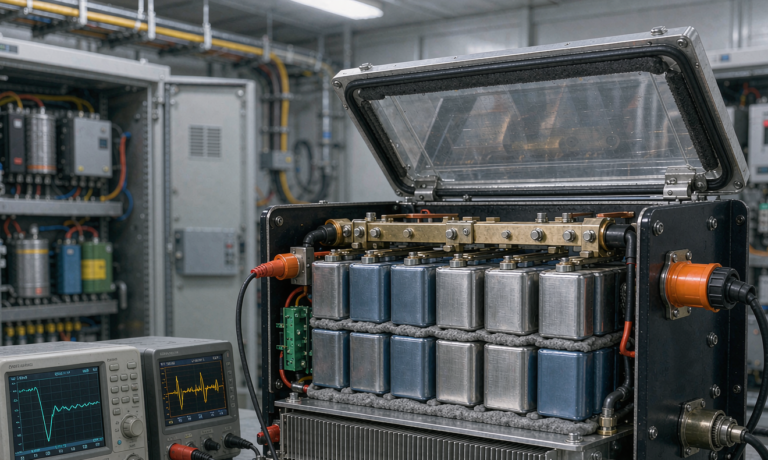
Thermal design is simpler than with lithium because sodium-ion tolerates a broader window, but I still specify a passive ventilation path and, for enclosed indoor stations, a low-power fan with thermal cutoff. Mechanical design gets the most attention: the pack must meet the rail shock and vibration standards of the line, so we use elastomer isolation mounts and torque-locked busbars. I have seen a loosely torqued connection cause more field failures than the chemistry ever did.
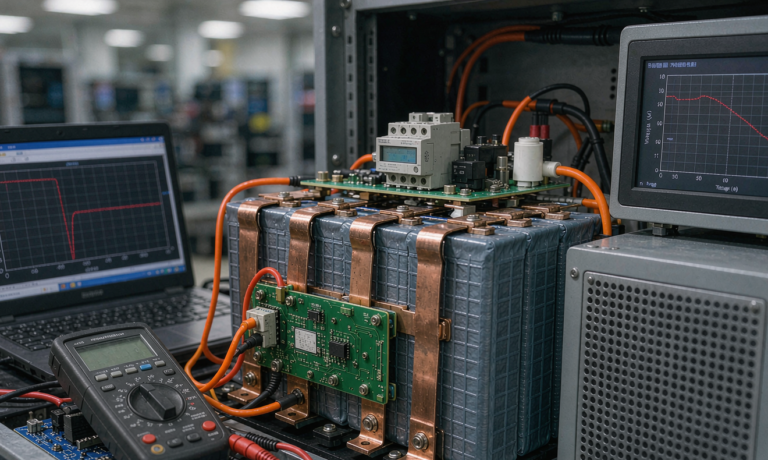
The BMS is where I spend the most validation time. For transit you need contactor control, insulation monitoring to catch earth faults on the DC bus, cell-balancing, and a clean Modbus or CAN feed into the depot’s SCADA. A backup system that the operators cannot see is a backup system they will not trust.
Standards and Certification You Cannot Skip
This is the section I never let a procurement team skip. A battery going into a rail or transit environment crosses transport, electrical, and rail-specific rule books.
- UN38.3. Every cell and pack we ship must pass the eight tests, T.1 through T.8, covering altitude simulation, thermal, vibration, shock, external short circuit, impact, overcharge, and forced discharge. I treat the vibration and shock profiles here as a floor, not the rail-grade target.
- IEC 62133-2. The baseline safety standard for secondary cells and batteries containing alkaline or other non-acid electrolytes, used for the portable and stationary containment and abuse testing.
- IEC 62619. The industrial battery safety requirement we apply to the stationary wayside cabinets, covering thermal runaway propagation, BMS functional safety, and Battery Management System reliability.
- IEC 62477-1. Power electronic converter systems safety, relevant where the battery interfaces through a bidirectional PCS into the station or depot supply.
- EN 50155 and EN 50121. The rail environmental and EMC standards for on-board electronic equipment. Any pack intended for rolling stock must survive the temperature, humidity, vibration, and electromagnetic immunity bands these define.
- EN 45545. Fire safety of railway rolling stock. A pack inside a passenger or maintenance vehicle must demonstrate the required hazard level for fire behaviour of materials.
Note that FAA and EASA air-transport rules are not the controlling framework for ground rail, but the UN38.3 transport test still governs how the cells arrive at the depot, so I keep that documentation current for every shipment.
Real-World Deployment Patterns: Depots, Signals, and EMUs
Let me translate the theory into the patterns I actually deploy.
Signal power backup. A trackside signal hut loses grid power and must keep the interlocking and point machines alive for at least the diversion window. I size a sodium ion battery bank for two to four hours of autonomous operation, paired with a PCS that transfers in under twenty milliseconds. In cold regions this is where sodium-ion simply beats LFP on retained capacity.
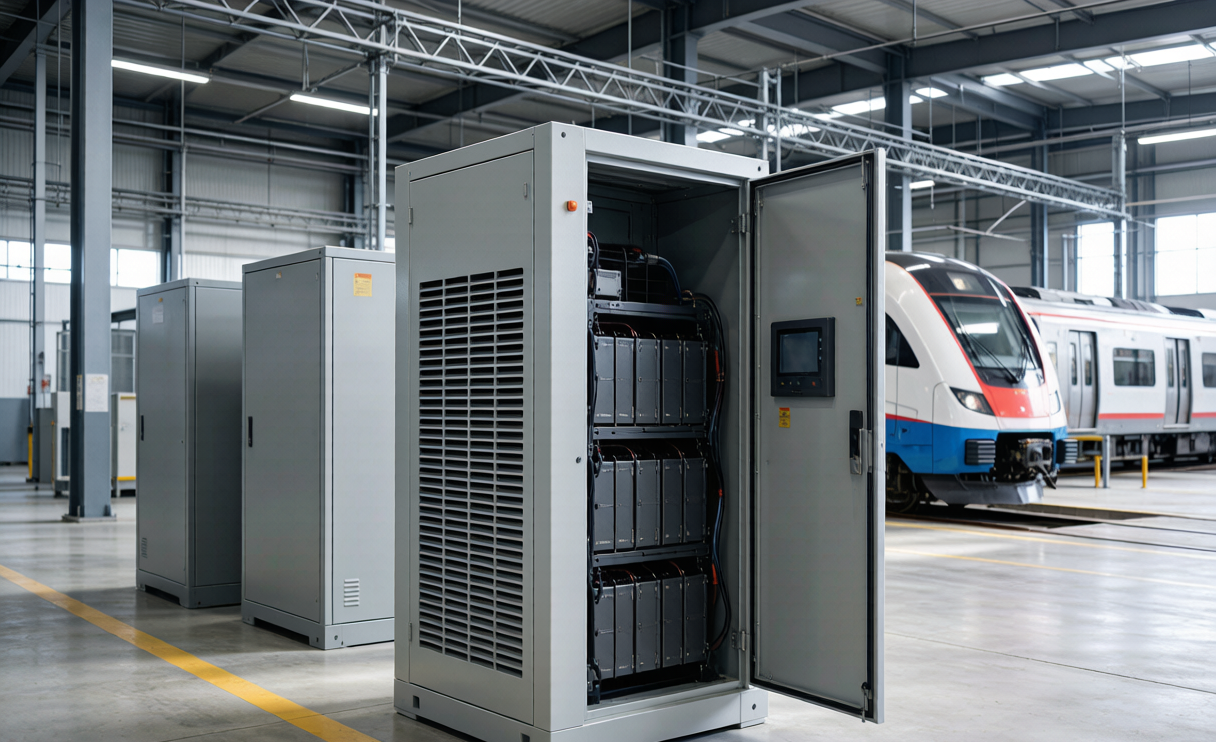
Depot bridge power. When a train sheds the pantograph during maintenance, the car still needs lights, HVAC, and tool power. A depot-sited custom battery solution feeds the shed through a galvanically isolated converter, removing the need to start a diesel set inside a confined building.
EMU rescue and hotel load. A limited-range under-floor sodium-ion module gives a stalled train low-speed self-rescue capability to the next siding, plus bridge power for passenger comfort during a stall. The lower energy density is acceptable because the distance requirement is short and volume is the binding constraint.
Cost, Lifecycle, and What to Watch in 2026
On a per-kWh basis, sodium-ion is now landing close to or below LFP in many B2B quotes I have received this year, largely because the cathode avoids lithium and the supply base is scaling. The trade is weight and volume: you will need more cabinet space for the same energy. For a trackside cabinet that is a non-issue; for a tightly packed EMU it is a real layout conversation.
Lifecycle is where the story gets better. Backup duty is shallow cycling, and hard-carbon sodium cells handle that profile with minimal capacity fade across the warranty window. I typically model a ten-year service life with the bank seeing only a few dozen deep events, which means the levelized cost per backup-hour is attractive versus diesel fuel and maintenance.
What to watch: first, cell consistency between batches as new sodium-ion lines ramp; second, the still-maturing rail-specific certification evidence from some suppliers, so I audit test reports rather than accept a datasheet; third, recycling logistics, which are simpler than lithium but not yet standardized everywhere. Each of these is manageable with good supplier qualification, which is exactly the work we do before a pack earns a place on a live line.
Frequently Asked Questions
Is sodium-ion safe for use inside trains and stations?
Yes, when engineered to the right standards. The chemistry itself is less prone to violent thermal runaway than high-nickel lithium, and we validate every pack to IEC 62619 for stationary use and EN 45545 fire behaviour for on-board use. Safety comes from the combination of a calmer cell and a qualified pack design, not from the cell alone.
How does sodium-ion compare to LFP for rail backup?
For stationary wayside and depot backup, sodium-ion usually wins on cold retention, supply security, and increasingly on price. LFP still leads on energy density, so if the constraint is weight or volume on a moving train, LFP can be the better fit. My rule is simple: if the site is trackside or unheated, lean sodium; if it is tightly packaged on a vehicle, compare both honestly.
What certifications apply to stationary versus on-board transit batteries?
Stationary wayside cabinets need UN38.3 transport, IEC 62133-2, IEC 62619, and IEC 62477-1 for the power interface. On-board packs add the rail-specific EN 50155 environmental and EN 50121 EMC standards, plus EN 45545 fire safety. I keep all test evidence in the project file before any energization.
Does cold weather affect sodium-ion rail backup?
Far less than it affects LFP. Hard-carbon anode cells retain usable capacity well below freezing, which is why I recommend sodium-ion battery backup for signal huts and depots in cold climates. You still need a basic thermal plan, but you avoid the heavy heaters and capacity cliffs that plague lithium in the same conditions.
What is the typical payback for a transit sodium-ion backup system?
Payback varies with diesel fuel prices, maintenance labour, and outage frequency, but most depot and wayside projects I have modelled recover their cost in four to eight years through avoided fuel, reduced maintenance, and lower compliance risk. The softer benefit, fewer stalled-line incidents, is often worth more than the energy savings on paper.