What Is a Semi-Solid State Battery and How Does It Work
Over the last decade on the production floor and in the cell lab at Horizon Power, one question keeps coming back from our B2B customers: what is semi-solid state battery technology, and is it finally ready for real products? I am Karl Huang, Senior lithium battery Engineer, and I have handled everything from pouch cell pilot lines to UN38.3 certification batches. In this article I will explain, in plain engineering terms, what a semi-solid state battery is, how it actually works, and where it stands against conventional lithium and fully solid-state designs in 2026.
What a Semi-Solid State Battery Actually Is
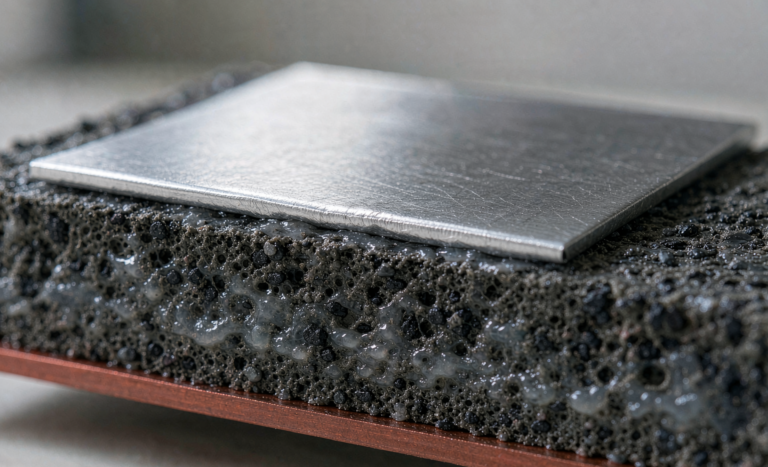
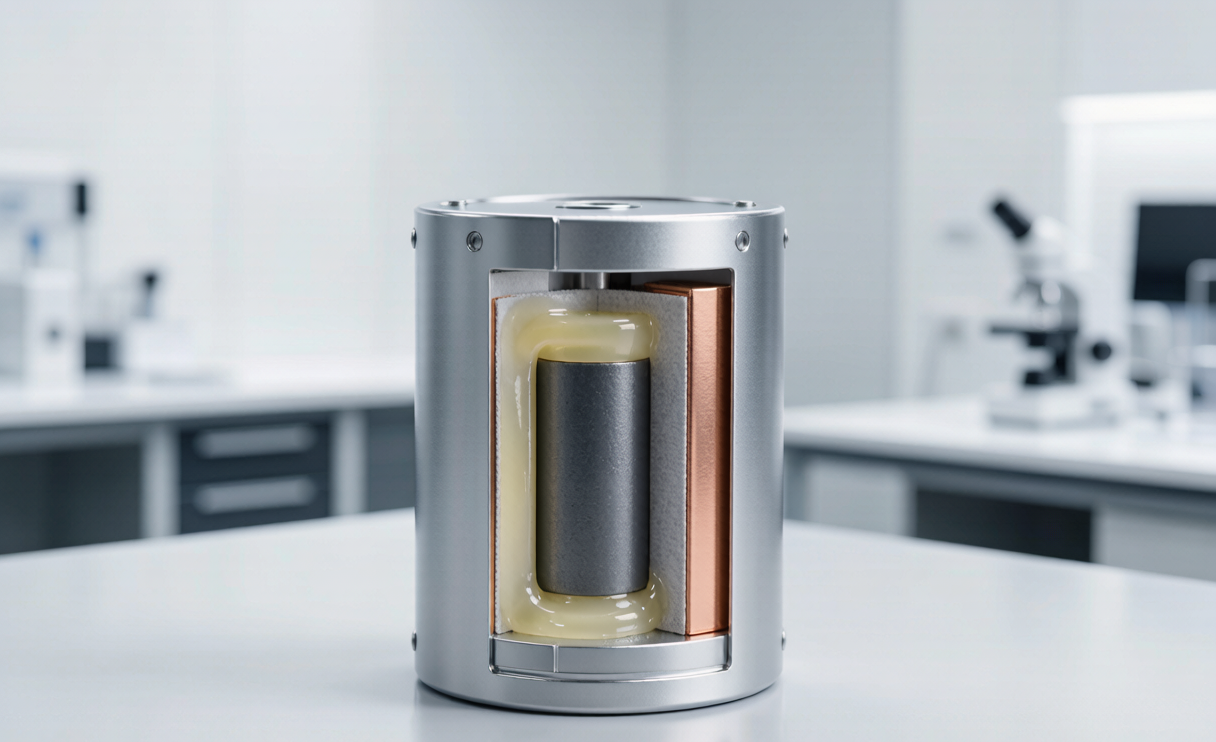
A semi-solid state battery sits between a standard liquid-electrolyte lithium-ion cell and a fully solid-state cell. In a conventional lithium-ion battery, lithium ions move between the anode and cathode through a liquid organic electrolyte soaked into a porous separator. In a fully solid-state battery, that liquid is replaced entirely by a solid ceramic or polymer electrolyte. A semi-solid state battery takes the middle path: it uses a semi-solid electrolyte — a gel-like or heavily thickened mixture that still contains some liquid solvent but is immobilized enough to behave more like a solid.
From hands-on experience, the practical advantage is immediate. The semi-solid electrolyte is far less prone to leaking or venting than a free liquid, yet it keeps an ionic conductivity high enough (typically 1–10 mS/cm at room temperature) that you do not pay the brutal internal-resistance penalty of early all-solid cells. In other words, you get most of the safety story of a solid-state design while keeping a manufacturing process that still resembles the lithium lines our factories already run.
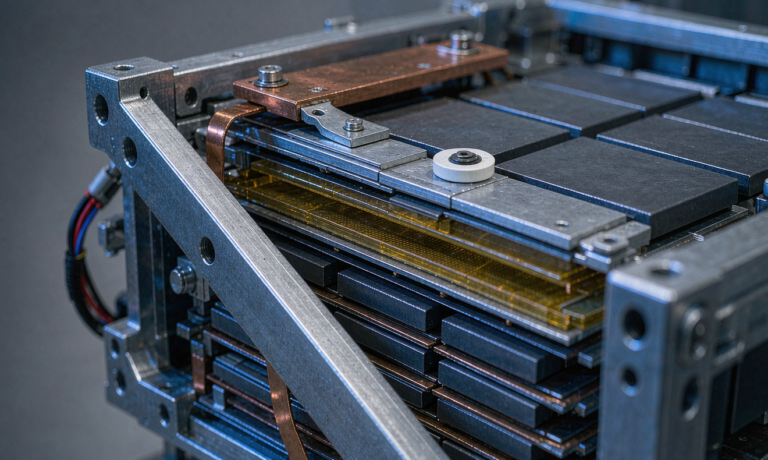
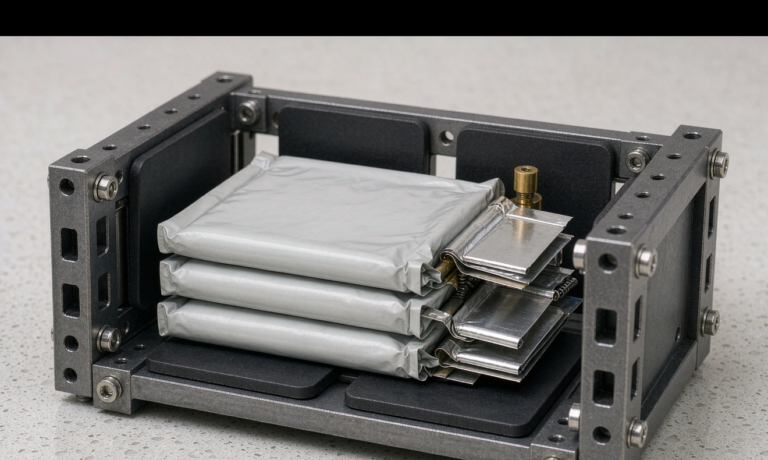
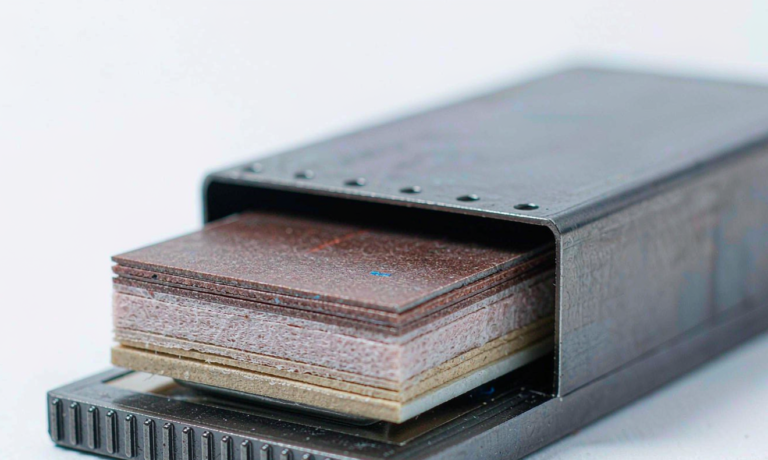
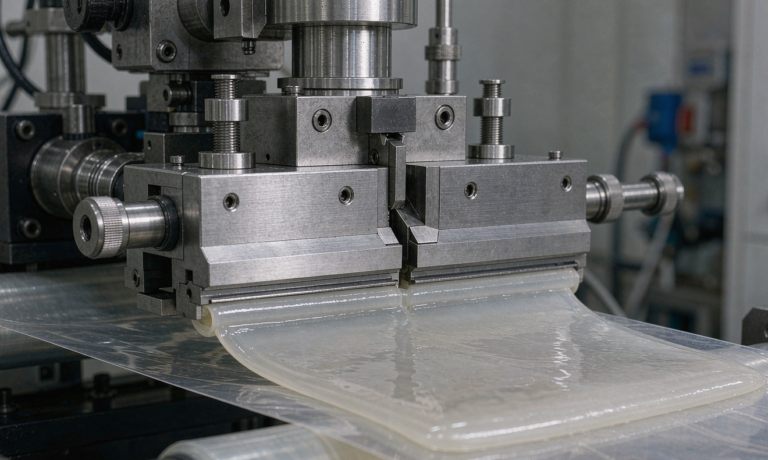
Structurally, a semi-solid pouch looks familiar to anyone who has torn down a lithium cell: a cathode current collector (aluminum foil) coated with an active oxide, a separator wetted by the semi-solid electrolyte, and an anode current collector (copper foil) carrying the negative electrode. The difference is what sits in the middle. Because the electrolyte is pre-thickened, our coating step deposits a controlled, uniform layer instead of relying on capillary soak-in, which tightens batch-to-batch consistency — a real benefit when you are qualifying a pack for a customer who will build it into a certified product.
How a Semi-Solid State Battery Works
The working principle is the same as any rechargeable lithium cell — lithium ions shuttle back and forth during charge and discharge — but the electrolyte changes the physics. During charging, lithium ions de-intercalate from the cathode (often a nickel-rich NMC or NCMA layered oxide), cross the semi-solid electrolyte, and insert into the anode, typically a silicon-doped graphite or lithium-metal composite. On discharge the ions travel the other way, releasing the stored energy through the external circuit.
The key engineering trick is the rheology of the semi-solid electrolyte. By thickening the electrolyte into a paste or gel — often using oxide or sulfide nanoparticles suspended in a small amount of solvent — the ion-conducting medium stays in place even under puncture or crush. In our lab tests this dramatically slows the “thermal runaway” chain: a punctured pouch cell vents mildly and self-limits instead of igniting. That is the single biggest reason our drone and robotics customers ask about this chemistry.
On the system side, a semi-solid cell still needs a proper battery management system. The BMS must watch cell voltage, pack temperature and balancing current, because the higher energy density means a given misuse fault releases more total energy than a lower-density pack would. I always tell customers that the chemistry reduces risk, but the BMS and the pack mechanical design are what actually contain it. We pair every semi-solid build with a graded protection scheme and per-cell fuse strategy validated against the same abuse tests we use for our lithium lines.
Semi-Solid State vs Solid-State and Conventional Lithium-Ion
Buyers often confuse a solid state battery with a semi-solid design, so let me be precise. A true solid-state cell removes the liquid entirely; a semi-solid state battery keeps a small liquid fraction. The fully solid approach promises the highest energy density and the best safety, but today it fights two hard problems: interfacial resistance at the solid-solid contact and a cost curve that is still 3–5× a mature lithium line.
Compared with a conventional lithium-ion cell, the semi-solid version wins on safety and, crucially, on energy density. We routinely see 280–340 Wh/kg in our semi-solid pilot pouches versus 240–260 Wh/kg for comparable NCM lithium-ion. Against a fully solid-state cell, the semi-solid still trails on the absolute ceiling (some solid-state roadmaps target 400–500 Wh/kg) but it is shipping today in limited volumes, which matters far more for a product you need to certify and sell this year.
Energy Density and What It Unlocks
Why does energy density dominate the conversation? For an aerial drone, every extra Wh/kg translates directly into longer flight time or more payload. For a portable medical device, it means a smaller pack for the same runtime. In our internal benchmarking, moving a 6S drone pack from liquid NCM to a semi-solid chemistry cut pack mass by roughly 12–15% at equal capacity, extending hover time from about 31 minutes to 36 minutes on the same airframe.
That gain comes from two places. First, the semi-solid electrolyte tolerates a lithium-metal or high-silicon anode with less side reaction, raising usable capacity. Second, because the electrolyte is immobilized, you can reduce separator and excess solvent weight. The trade-off is slightly higher viscosity, so electrode coating and stacking need tighter process control — exactly the kind of detail our engineering team verifies before any customer qualification build.
Temperature matters too. In cold-climate drone trials at −10°C, our semi-solid pouches retained a noticeably higher usable capacity than equivalent liquid NCM cells, because the immobilized electrolyte suffers less from the sharp viscosity rise that strangles ion transport in a cold liquid. We still recommend a heated pack enclosure below −20°C, but the chemistry gives more headroom before performance collapses.
Safety, Certification and What We Verify
Safety is where a semi-solid state battery earns its keep, but “safer chemistry” is never a substitute for certification. Every pack we ship for international B2B use must clear UN38.3, the UN manual of tests covering altitude simulation, thermal test, vibration, shock, external short circuit, impact, overcharge and forced discharge. We run the full UN38.3 test plan on representative samples, not just on paper.
We also design to IEC 62133 (the international safety standard for portable sealed secondary cells and batteries containing alkaline or non-acid electrolytes). IEC 62133-2 covers lithium systems specifically and drives our cell-level safeguards: positive-temperature-coefficient devices, venting design and strict limits on allowable cell temperature rise. For the EU market we add CE and, where relevant, CB-scheme support. My rule of thumb for buyers: ask the supplier for the actual UN38.3 test report and the IEC 62133 compliance statement, not just a marketing claim.
Transport is the other half of the story. Because semi-solid cells are still classified as lithium batteries for shipping, they move under the same IATA and IMO dangerous-goods rules as conventional cells, with the UN38.3 pass as the entry ticket. The good news is that the reduced venting behavior makes the cells easier to package safely, and our standard equatorial and corner-crush packaging validation gives logistics teams a defensible safety margin. None of that removes the paperwork, but it lowers the real-world incident risk.
Where Semi-Solid State Batteries Fit Today
In 2026 the honest answer is that semi-solid is a premium, targeted chemistry rather than a drop-in replacement for every lithium pack. It fits best where weight and safety outweigh raw cost: long-endurance inspection drones, high-value robotics and AGV platforms, and certain medical or defense portable systems. For cost-sensitive, high-volume consumer goods, a well-built lithium-ion or LFP pack is still the rational choice.
Because the semi-solid process is closer to existing lithium manufacturing than to all-solid lines, we can qualify it on our current coating and stacking equipment with modest tooling changes. That is why I tell customers the realistic timeline for adoption is “now, in niches” rather than “someday, everywhere.” If your application needs more minutes of flight or a safer pack footprint, this is the chemistry to evaluate first.
Frequently Asked Questions
What is semi-solid state battery technology in one sentence?
It is a lithium rechargeable cell that uses a thickened, gel-like semi-solid electrolyte — part liquid, part solid — to improve safety and energy density while staying close to conventional lithium manufacturing.
Is a semi-solid state battery the same as a solid-state battery?
No. A solid-state battery removes liquid electrolyte entirely, while a semi-solid state battery keeps a small liquid fraction. The semi-solid is easier to manufacture today and already shipping in limited volumes; fully solid-state remains mostly pre-mass-production in 2026.
How much more energy density do you get?
In our pilot pouches we measure 280–340 Wh/kg, versus 240–260 Wh/kg for comparable NCM lithium-ion — roughly a 12–15% pack-mass saving at equal capacity.
Does it still need UN38.3 and IEC 62133 certification?
Yes. Chemistry does not replace certification. Every semi-solid pack we export clears UN38.3 and is designed to IEC 62133-2, with full test reports provided to the customer.
When should a buyer choose semi-solid over standard lithium-ion?
Choose it when weight, flight time or pack safety are critical and the budget allows a premium — long-endurance drones, robotics, and portable medical or defense equipment are the strongest fits.
How should I start evaluating a semi-solid state battery for my product?
Begin with a small pilot build against your real duty cycle, not a datasheet. Send us your voltage, discharge-rate and operating-temperature profile, and we will qualify a sample pack through UN38.3 and IEC 62133 while you run field trials. That de-risks the chemistry decision before you commit to volume tooling.