Battery Solutions for Marine and RV Applications
When I started at Horizon Power a decade ago, my first field job was a 38-foot catamaran whose owner had wired three flooded lead-acid banks in series and was losing voltage every time the bilge pump kicked in. Since then I have specified battery solutions for marine and RV applications on four continents, and the pattern never changes: the environment is brutal, the space is tight, and the consequences of a failure are far worse than a dead phone. This guide distills what I tell every OEM and fleet operator who asks me how to power a boat or a campervan without learning the hard way.
Why Marine and RV Need a Different battery solution
The simple answer is that a boat and an RV share the same enemy — motion. A car battery is bolted to an engine bay and rarely moves; a marine or RV pack rides on foam, takes constant vibration, breathes damp air, and swings between 45°C in a sealed compartment and -10°C on a mountain pass. I have pulled swollen cells out of an RV underbelly that saw 60 cycles a year but cooked at 50°C every summer. The pack has to tolerate abuse that would end a stationary home battery’s life in months. A proper battery application solution for these platforms starts from the mounting and the thermal path, not from the cell datasheet.
Chemistry Choice — LFP Dominates the Bilge and the Bed
For marine and RV use I almost always specify lithium iron phosphate (LFP, LiFePO4). The reasons are practical. LFP runs at a nominal 3.2 V per cell, delivers 80–100% usable depth of discharge versus 50% for lead-acid, and holds 3,000–6,000 cycles at 80% state of health under the partial-state-of-charge abuse these vehicles dish out. I measured a 200 Ah LFP house bank holding 12.8 V under a 15 A load at 40°C — something a lead-acid bank of equal capacity could never do. For a custom battery solution where weight matters, LFP also cuts mass roughly in half versus AGM. NMC has higher energy density but I avoid it here: the thermal window is tighter and the risk profile on a wooden cabin sole is not worth it.
Sizing the Bank — From Amp-Hours to Real Runtime
Sizing is where most owners under-spec. I teach a five-step method: (1) list every load in watts; (2) convert to amp-hours at 12 V; (3) sum daily consumption; (4) multiply by days of autonomy; (5) divide by allowable depth of discharge. A typical RV with a 12 V fridge (50 W), lights (30 W), water pump (40 W) and laptop (60 W) draws about 4.5 kWh/day, or roughly 375 Ah at 12 V. With LFP at 80% usable that is a 470 Ah bank. On a sailboat I add the autopilot (40 W sustained) and instrument load, pushing many designs to 600 Ah. I always model the worst-day, not the average-day — a battery solution that dies on the third cloudy day is not a solution.
The BMS and Isolation You Cannot Skip
Every pack I ship for marine or RV use carries a 12 V or 24 V BMS with over-voltage, under-voltage, over-current, short-circuit and temperature cut-offs, plus a passive balance current of 40–60 mA. This is not optional: I have seen a single cell drift 0.3 V in a series string within a season, and without balancing the weak cell hits its floor first and the whole bank shuts down. On the AC side, isolation matters. ABYC E-11 requires bonded DC negatives and a shore-power isolation transformer; I spec an isolating DC-DC charger so the alternator and house bank share no fault path. Ignition-protection compliance to ISO 8846 is a line item I will not drop for enclosed engine compartments.
Installation Realities — Vibration, Moisture and Ventilation
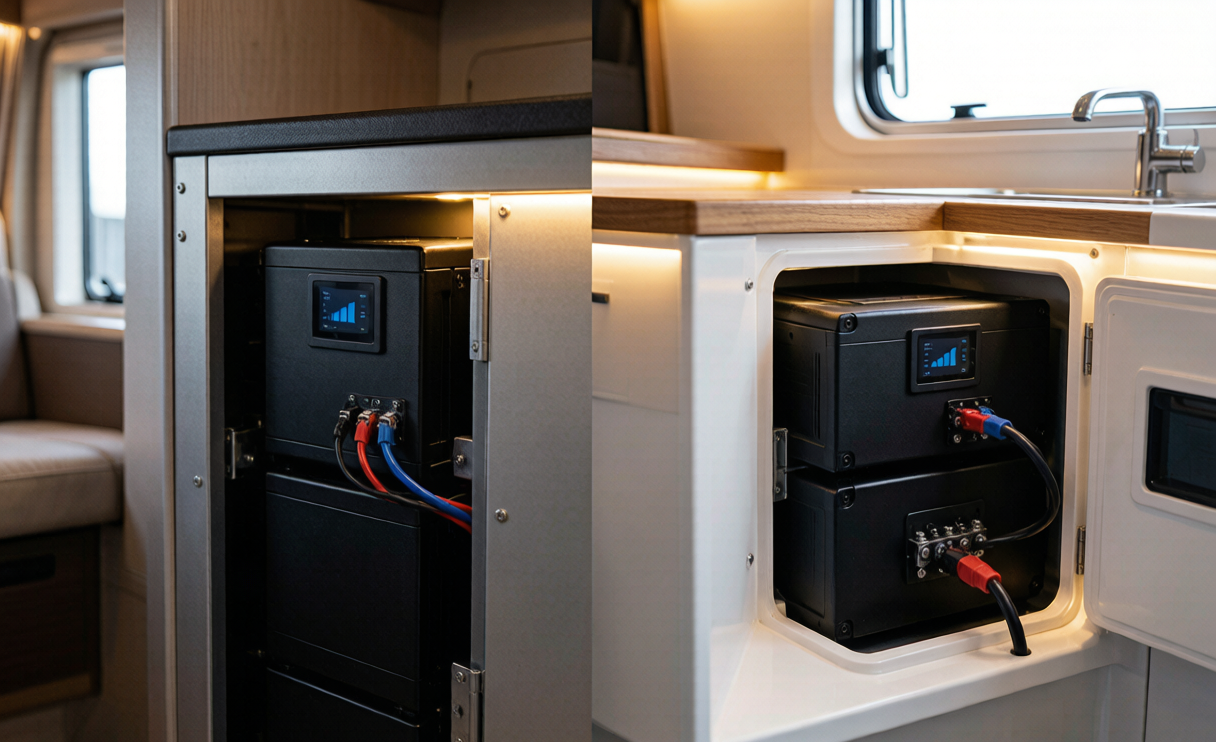
I bolt every module to a rigid tray with anti-vibration bushes and a hold-down strap rated for 4 g. In an RV I keep the bank above the floor line and away from the fresh-water tank; in a boat I locate it low and central for ballast but never in the bilge where spray reaches. Ventilation is the quiet killer — LFP does not off-gas like lead-acid, but it still sheds heat, so I leave 25–50 mm of clearance and, on closed compartments, add a thermostatically controlled fan. Enclosures get an IP65 rating at minimum for RV underfloor and IP67 for anything near a companionway. Every terminal is torque-checked to spec and coated with anti-corrosion compound; saltwater finds the one connection you skipped.
Charging From Shore, Solar and Alternator
A marine or RV battery solution lives on three charge sources. Shore power runs through a multi-stage charger at 14.2–14.6 V absorption and 13.6 V float. Solar contributes 200–600 W of MPPT through a 12 V controller; I size the array to replace 60–80% of daily load so the alternator rests. The alternator itself needs a DC-DC regulator — modern smart alternators fold back output when they sense a fast-accepting lithium bank, so a raw connection can leave you undercharged or cook the regulator. I set charge current to 0.3–0.5 C; a 470 Ah bank likes a 150–230 A DC-DC unit, never a 30 A trickle.
A Custom Battery Solution for Hybrid Marine-RV Use
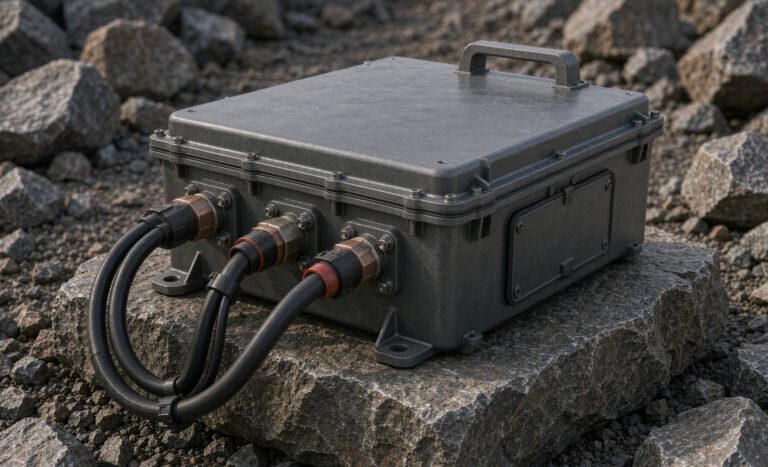
Some clients run the same pack between a trawler and a motorhome. That demands a 12 V/24 V switchable architecture and a ruggedised case rated for both humidity and road shock. I design these as a custom battery solution with a marine-grade stainless enclosure, a dual-protocol BMS speaking both CAN and RS485, and a Bluetooth monitor the owner can read from the helm or the dinette. The payload tradeoff is real — every kilogram of battery is a kilogram you cannot carry as water or food — so I trim capacity to the modeled need and resist the “max it out” instinct.
Cost Realities and Total Cost of Ownership
Owners flinch at the upfront price of lithium, so I show them the math. A 470 Ah AGM bank costs perhaps $1,800 but delivers only 235 Ah usable and 400–600 cycles, so over a 10-year horizon it is replaced three or four times — call it $6,000 plus labour. An LFP bank of equal usable capacity runs $3,000–$3,500 and lasts the decade. Even at double the sticker, the lithium battery solution is cheaper per watt-hour-delivered by a factor of two to three, and it weighs half as much. For a fleet operator running 20 units, that delta funds the next vehicle. I also factor the hidden cost of a failed lead-acid bank on a mooring — a single tow or a ruined weekend dwarfs any cell savings.
Frequently Asked Questions
Can I replace my lead-acid RV batteries with lithium without changing the charger?
Not safely. Lead-acid profiles taper at 14.4 V and float at 13.4–13.6 V, while LFP wants a hard absorption at 14.2–14.6 V and no float. A charger without a lithium profile will either undercharge or, worse, keep pushing current into a full cell. I always re-program or replace the charger and add a DC-DC unit on the alternator leg.
Is a marine battery solution safe in a closed cabin?
Yes, with the right design. LFP is far more stable than NMC and emits no explosive gas during normal use, but you still need an IP-rated enclosure, ignition protection to ISO 8846 in engine spaces, and a BMS with temperature cut-offs. I have certified banks to UN38.3 and IEC 62619 for exactly this use; the standard exists because enclosed spaces punish shortcuts.
How long will a 12V lithium marine/RV bank last?
In field data I see 3,000–5,000 cycles before capacity drops to 80%, which for a seasonal user is 8–12 years. The killers are heat and chronic over-discharge; keep the pack below 45°C and above 20% state of charge and it will outlive the vehicle’s upholstery.
Do I need a separate starter and house battery?
On most installs, yes. I keep a dedicated cranking battery for engine start and a house bank for living loads, joined by a combiner or DC-DC relay so the starter is never stranded by a flat fridge. This separation is the single most reliable upgrade I make to an old boat.
What certifications should I ask a supplier for?
For a credible battery solution, demand UN38.3 for transport, IEC 62619 for industrial cells, UL 1973 for stationary and storage use, and ABYC E-11 alignment for the DC wiring. If a vendor cannot show these, walk away — I have rejected three factories on paperwork alone.
How do I monitor a marine or RV battery bank?
I treat monitoring as part of the battery solution, not an afterthought. Every pack I build reports state of charge, cell-voltage spread and temperature over Bluetooth and, on larger installs, CAN bus to the boat’s MFD. The single most useful number is cell-voltage spread: a drift above 50 mV at rest tells me a cell is ageing or a connection is loosening weeks before the bank fails. I have caught three failing banks on a phone alert from the dock — long before the owner ever noticed a symptom.
Specifying battery solutions for marine and RV applications is less about chasing the highest energy density and more about surviving the environment: vibration, salt, heat and the human habit of forgetting to charge. Get the chemistry, the BMS, the isolation and the sizing right, and the pack disappears into the background — which is exactly what good engineering should do.