Battery Solution for Underwater ROV and Subsea Gear
When people ask me what the hardest environment is to design a battery solution for, they usually expect me to say “electric vehicles” or “aerospace.” My honest answer after fifteen years in lithium cell engineering is the deep ocean. A single mistake in an underwater ROV pack does not mean a召回 or a warranty claim; at 3,000 meters it means a total loss of the vehicle and, often, the tether. I’m Karl Huang, Senior lithium battery Engineer, and over the last decade I have built packs for inspection-class ROVs, work-class subsea tooling, and scientific instrumentation pods. This guide walks through how we actually engineer a battery solution underwater ROV subsea operators can trust, from cell chemistry to pressure housing to the BMS that keeps everything honest.
Why Subsea Power Is a Different Engineering Problem
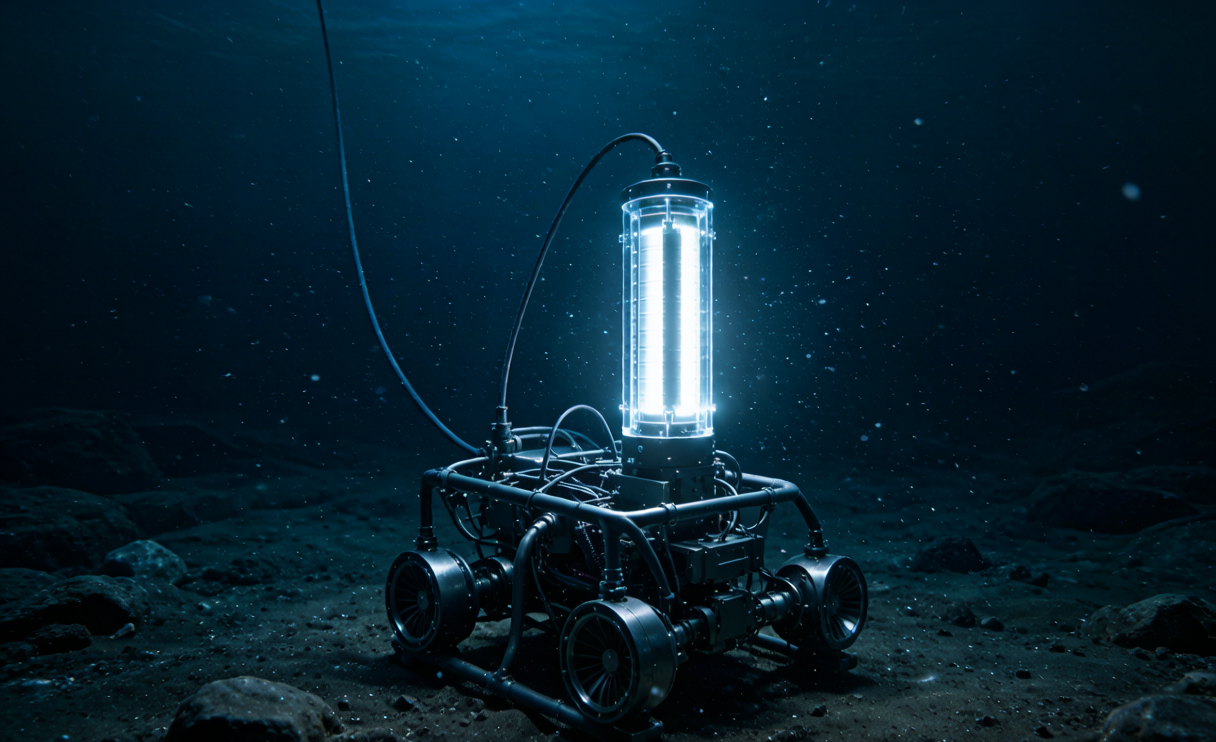
The first thing to internalize is that water is not just a backdrop; it is an active participant in your failure modes. Three physics facts dominate every decision. First, hydrostatic pressure climbs ~1 bar for every 10 meters of depth, so a work-class ROV rated to 3,000 m sees roughly 300 bar (30 MPa) squeezing the enclosure. Second, deep water is cold and stable, typically 2–4°C below the thermocline, which changes how lithium cells behave. Third, the medium is corrosive, conductive, and unforgiving of any seal that is less than perfect.
On land, if a cell vents, you get heat and gas in open air. Underwater, a vent inside a sealed canister can do two things at once: drive a pressure spike that breaches the housing, and release flammable electrolyte gas into an enclosed volume. That is why a battery application solution for subsea use is never a repackaged industrial battery. The enclosure, the chemistry margin, and the protection logic all have to be designed from the seabed up.
Cell Chemistry: Li-ion vs LiFePO4 and What We Actually Ship
For ROV and subsea gear, the two chemistries we seriously consider are NMC/NCA lithium-ion (high energy density) and lithium iron phosphate (LiFePO4, high safety margin). A typical 18650 NMC cell delivers 220–260 Wh/kg and 3.6 V nominal; LiFePO4 lands around 120–160 Wh/kg at 3.2 V nominal but is far more tolerant of abuse. For a buoyant, energy-hungry inspection ROV where every gram of payload matters, NMC is attractive. For a tooling skid bolted to a work-class vehicle, where a thermal runaway would be catastrophic and weight is secondary, LiFePO4 is my default recommendation.
Cycle life also diverges sharply by temperature and depth of discharge. At a controlled 4°C, LiFePO4 cells comfortably exceed 2,000 cycles at 80% depth of discharge, while NMC in the same envelope trends toward 500–1,000 cycles before capacity drops below 80%. When a client asks for the longest-lived battery solution, the chemistry choice alone can double or halve the service interval.
Pressure Housing and Oil Compensation: Where Reliability Is Won or Lost
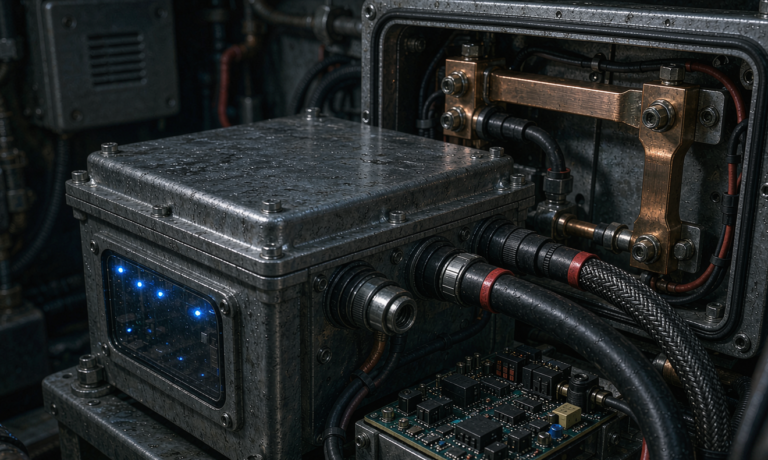
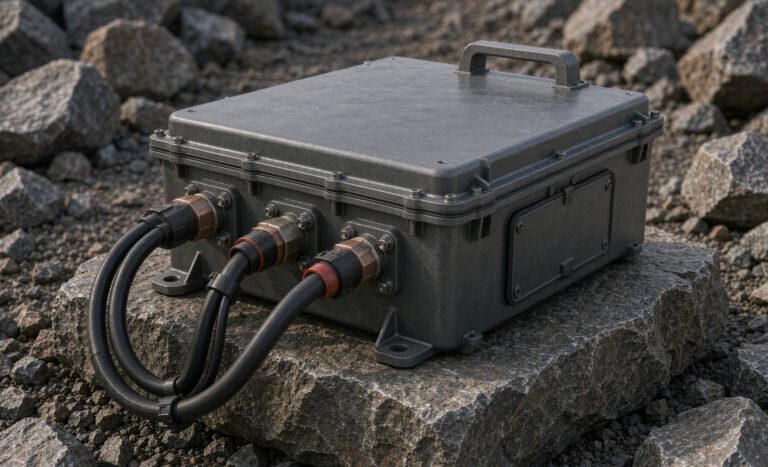
The enclosure is more important than the cells. A rigid aluminum or titanium housing rated to depth handles external pressure, but the smarter approach for large packs is oil compensation: the cells sit in a synthetic dielectric oil inside a flexible or pressure-balanced bladder. As the ROV descends, the external seawater pressure pushes the oil inward through a compensator, equalizing pressure across the cell stack so the enclosure wall never has to resist the full differential. This is the standard trick behind deep-rated subsea batteries and it is why oil-compensated packs routinely reach 4,000–6,000 m while rigid dry packs stall out near 1,000–2,000 m.
Seals matter more than ratings on paper. We use double O-ring arrangements on every penetrator and connector, with a pressure-test to 1.5× rated depth before the pack ever leaves the bench. A connector that passes a 10-bar bubble test in the shop and then fails at 150 bar on the seafloor is the single most common cause of “mysterious” ROV power loss I have been called to diagnose.
The BMS Solution: Telemetry, Communications, and Fail-Safe Behavior
A surface drone or e-bike BMS is a black box that cuts off and that is the end of it. A subsea BMS solution has to report. The vehicle pilot needs state of charge, cell-level voltage, pack temperature, and fault flags streamed live over the tether, usually via CAN bus (CANopen) or RS485/Modbus mapped into the ROV’s topside control software. I design every subsea BMS with thresholds that are conservative by land standards: a cell imbalance of more than 50 mV or a pack temperature above 45°C triggers a controlled current ramp-down rather than a hard disconnect, because a sudden power loss at depth can drop an ROV onto a pipeline.
The BMS also carries the protection mandate for transport and handling standards. Every pack we build is validated against UN38.3 (the lithium transport test suite: altitude simulation, thermal, vibration, shock, external short, impact, and forced discharge) and built on cells certified to IEC 62133 for secondary lithium safety. Those certificates are not paperwork; they are what lets a vessel chief carry the pack onboard and what lets a logistics manager fly it to the port without a hazardous-goods standoff.
Designing a custom battery solution Around the Mission Profile
Generic packs fail subsea missions. A custom battery solution starts from the duty cycle, not from a catalogue. I ask clients for three numbers: peak thruster current (often 2–4× the cruise current), average mission power in watts, and desired dive duration. From those I size the pack in watt-hours, add a 20–30% margin for cold-temperature capacity loss and tether losses, and then work backward to series-parallel cell count.
A real example: a 1,500 m inspection ROV drawing 350 W average with 250 A peak thruster inrush, targeted for a 4-hour dive, needs roughly 1,400 Wh usable. With a 30% margin that becomes a ~1,820 Wh pack. In NMC at ~230 Wh/kg that is about 8 kg of cells; in LiFePO4 it is closer to 12–13 kg. That weight difference feeds directly back into the vehicle’s buoyancy and trim budget, which is why the battery application solution and the vehicle hydrodynamics have to be designed together, not bolted on afterward.
Certification and Marine Handling: UN38.3, IEC 62133, and DO-160 Equivalents
Beyond transport, marine operators increasingly expect environmental and EMC qualification that mirrors aerospace practice. We routinely screen packs to vibration and shock profiles comparable to RTCA DO-160 Section 8 (vibration) and Section 15 (crash shock), because the launch-and-recover cycle on a heaving deck is mechanically brutal even if the dive itself is calm. Ingress protection is specified at IP68 with depth and duration stated, never just “waterproof.”
Handling on the vessel deserves its own paragraph. Subsea lithium packs should be stored in a ventilated, temperature-controlled locker away from the winch and fuel, transported in a non-conductive case, and never charged inside a sealed dry box. The battery solution is only as safe as the last person who handled it on the deck, so we ship every pack with a one-page marine handling card in plain language, not just a datasheet.
Conclusion
Designing power for underwater ROVs and subsea gear is less about squeezing out the last watt-hour and more about respecting pressure, cold, and corrosion at every joint. Pick the chemistry for the mission, compensate the housing for depth, and make the BMS talk to the pilot instead of just cutting power. Do those three things and a battery solution underwater ROV subsea operators can rely on stops being a story about the dive, not about the battery.
Frequently Asked Questions
How deep can a lithium battery pack operate safely?
It depends entirely on the housing. Rigid dry enclosures typically cap out around 1,000–2,000 m, while oil-compensated packs using a pressure-balancing bladder routinely reach 4,000–6,000 m. We pressure-test every pack to 1.5× its rated depth before delivery.
Which chemistry is safest for ROV and subsea gear?
LiFePO4 is the safer choice for tooling skids and any application where a thermal event would be unacceptable; it tolerates abuse and stays stable at high temperature. NMC/NCA wins on energy density for buoyancy-limited inspection ROVs. The right answer follows the mission profile, not a default.
How do you safely recharge subsea battery packs?
Almost always at the surface, in a ventilated, non-conductive charging case, with the BMS telemetry monitored. We do not recommend charging a sealed pack inside an enclosed dry box. Charge current is limited and balanced per the cell manufacturer’s spec, typically 0.2C–0.5C for long life.
What is a typical ROV battery runtime?
Inspection-class ROVs commonly run 2–6 hours per dive on a single pack, while work-class vehicles with heavy tooling may plan for 1–3 hours. Runtime is a direct function of watt-hour capacity divided by average mission power plus tether losses.
How long do subsea battery packs last in service?
LiFePO4 packs at 4°C and 80% depth of discharge typically exceed 2,000 cycles before dropping below 80% capacity; NMC trends toward 500–1,000 cycles in the same envelope. Calendar life is usually 3–5 years regardless of cycle count, driven by seal aging and electrolyte stability.
Can ROV batteries be shipped and carried on a vessel?
Yes, provided they are UN38.3 tested and the cells are IEC 62133 certified. We supply the transport documentation and a marine handling card so vessel crews can carry and stow the pack compliantly without a hazardous-goods standoff.