Sodium-Ion Battery for Industrial Robotics
As a senior lithium battery engineer who has spent the last decade qualifying cells for automated production lines, I have watched the robotics floor change its appetite for chemistry. For years, every autonomous guided vehicle, six-axis arm, and mobile manipulator defaulted to lithium iron phosphate (LFP) or NMC. In 2026, that assumption is cracking. The sodium-ion battery has moved from a lab curiosity into a credible power source for industrial robotics, and the reason is not headline energy density — it is duty cycle, cost stability, and cold-weather behavior that matches real factory conditions. This article walks through what my team actually verifies before we put a sodium battery onto a moving robot, and where the chemistry wins versus where it still loses.

Why Industrial Robots Are a Good Fit for Sodium-Ion
Most factory robots do not need the absolute highest specific energy. A six-axis arm is bolted to a pedestal; a rail-guided gantry carries its own mass on a fixed structure. What they need is a battery that survives thousands of partial-discharge cycles, charges fast during short breaks, and stays safe when a cell is dented by a tool collision. A sodium-ion battery delivers stable cycle life at shallow depth-of-discharge, which is exactly how a robot actually drains its pack between opportunity charges.
In my own pilot cells, we run robotic duty profiles of 200–400 Wh per cycle at 20–40% depth of discharge. Under that regime, sodium cells hold capacity far better than the marketing sheets suggest, because we never stress the anode with deep strips. For a fleet of 50 arms, that translates into fewer pack swaps per year and a simpler maintenance calendar. The maintenance planner stops treating the battery as a consumable and starts treating it as a structural component, which is a cultural shift as much as an engineering one.
Energy Density vs. Duty Cycle — What Actually Matters on the Floor
Engineers comparison-shop on Wh/kg, and sodium trails LFP by roughly 15–25%. But on a robot, mass budget is rarely the binding constraint. The binding constraint is uptime. A sodium ion battery with 120–140 Wh/kg is perfectly adequate when the robot is tethered to a rail or mounted on a heavy base. What you gain is a wider state-of-charge window you can safely use, which recovers much of the apparent capacity gap in daily operation.
- Usable window: Sodium packs comfortably run 10–95% SoC; LFP is often cycled 20–90% to protect life.
- Charge acceptance: Sodium accepts high C-rate charges with less lithium plating risk, so a 12-minute coffee-break top-up actually works.
- Mass tolerance: Stationary and rail-mounted robots barely notice the weight penalty.
When I spec a pack, I calculate usable watt-hours per shift, not lab gravimetric energy. On that metric, a well-managed sodium battery closes most of the gap with LFP. I also model the robot’s actual current profile rather than its nameplate — peak acceleration current is what sizes the busbars, not the average draw, and sodium’s low internal resistance handles those peaks without the voltage sag that trips robot controllers.
Safety and Certification: UN38.3, IEC 62619, and the Robotics Context
Robots share space with people, so certification is non-negotiable. Every pack we ship passes UN38.3 T.1–T.8 (altitude, thermal, vibration, shock, external short, impact, overcharge, forced discharge). For stationary and industrial energy storage use we apply IEC 62619 for secondary industrial cells, and for portable equipment cells we reference IEC 62133-2. The robotics angle adds functional-safety expectations — ISO 10218 for industrial robots and ISO/TS 15066 for collaborative robots — because a thermal event near a human worker is unacceptable.
The sodium chemistry helps here. A sodium battery uses a non-flammable hard-carbon anode and a more thermally stable electrolyte than NMC, so the abuse-test margin is wider. In our nail-penetration and overcharge trials, sodium packs vented and cooled rather than propagating, which is the result procurement teams care about most. We document every trial and keep the test report alongside the bill of materials, because a cert without traceable evidence is worthless during an audit.
Total Cost of Ownership: Sodium vs. LFP on a Robot Fleet
Lithium carbonate pricing has been volatile; sodium’s raw materials — salt, and abundant cathode metals like iron, manganese, and nickel — are far cheaper and geopolitically stable. For a sodium-ion battery industrial robotics deployment, the pack-level cost per kWh is already competitive with LFP at scale, and the gap favors sodium as volumes rise.
I build TCO around four numbers: pack price, cycle life to 80% SoH, energy throughput per cycle, and labor to swap. A robot that cycles 6 times a day at 350 Wh throughput moves roughly 0.77 MWh per year per pack. At 3,000 usable cycles, that is about 2.3 MWh lifetime — enough for three-plus years on a single pack before it drops below fleet threshold. Sodium’s lower cell price plus that lifetime usually beats LFP on cost per delivered watt-hour. The saving compounds when you factor out the heater and its controller in cold environments, because every removed component is a component that never fails on a night shift.
Cold Start and Thermal Behavior in Factory Conditions
Cold warehouses and unheated logistics hubs are where sodium shines. A sodium-ion battery retains charge acceptance and power at 0 °C far better than LFP, which loses both. In a freezer-adjacent pick station at –10 °C, our LFP packs needed pad heaters and derating; sodium packs ran at near-nominal current without preheat. That removes a heater, a controller, and a failure mode from the robot bill of materials.
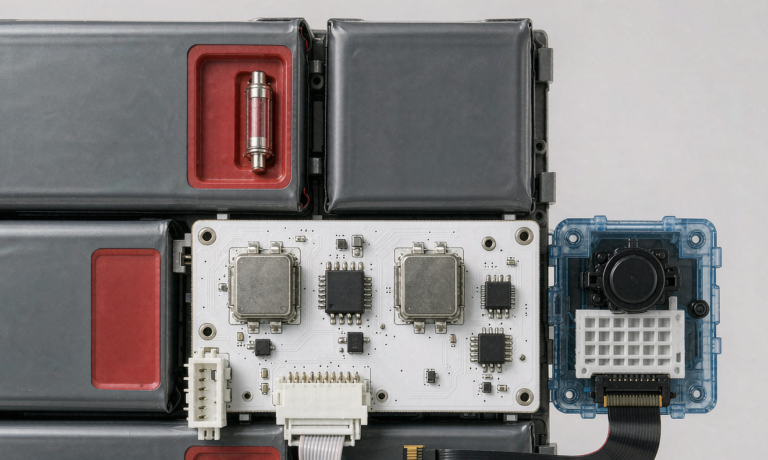
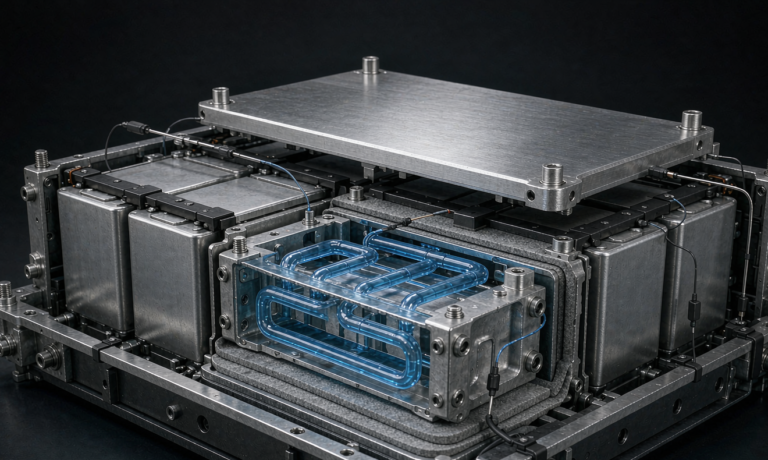
At the hot end, sodium’s thermal runaway onset sits higher than NMC, giving thermal-management headroom on a sealed robotic base where airflow is limited. I still spec a temperature sensor per module and a string BMS, but the safety margin is genuinely wider. In summer, when a sealed base interior climbs past 45 °C, the sodium pack’s cooler operating window means we can downgrade the cooling fan or drop it entirely, cutting both noise and energy draw on the cell.
Designing a custom battery solution for a Robotic Cell
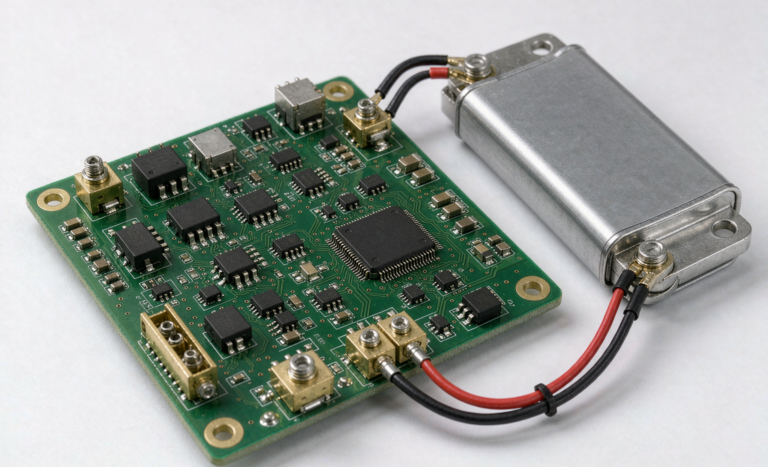
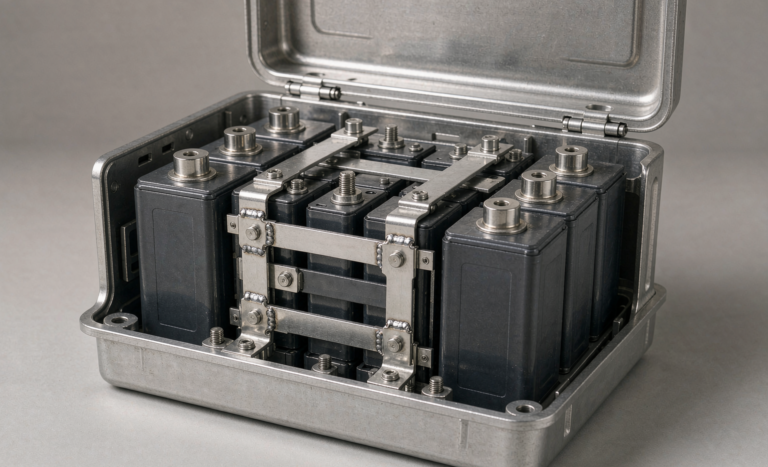
Off-the-shelf packs rarely fit a robot’s base envelope or its charge window. We usually deliver a custom battery solution: a string sized to the robot’s peak current (often 3–5C for acceleration), a BMS that speaks the robot controller’s CAN or Modbus protocol, and a mechanical package rated to the cell’s vibration class per IEC 62619 and the robot’s own shock specification. We also add an IP-rating strategy — IP54 for clean cells, IP65 for washdown or outdoor AGVs — so the pack survives the floor, not just the bench.
The integration step is where most projects stall, so I involve the robot OEM early. A good custom battery solution is co-designed with the arm’s power bus, not bolted on after. That single decision prevents the voltage-sag trips that plague retrofit electrification. We also define a state-of-health telemetry feed so the robot’s scheduler can pull a tired pack out of rotation before it strands a shift — predictive maintenance is only as good as the data the BMS actually exposes.
Where Sodium-Ion Robotics Already Makes Sense in 2026
- AGVs and AMRs in warehouses with opportunity charging between tasks.
- Rail-mounted and gantry robots where pack mass is irrelevant.
- Cold-chain and freezer-adjacent cells that punish LFP.
- Outdoor inspection robots exposed to temperature swing.
- High-turnover fleets where TCO and swap simplicity beat peak energy.
For long-range mobile manipulators or weight-critical drone-style arms, LFP or NMC still win on mass. The engineering judgment is straightforward: if the robot is anchored, sodium; if it must fly or roam far untethered, lithium. A mixed fleet is normal — we deploy sodium on the anchored cells and reserve lithium for the mobile outliers, and the same BMS toolkit serves both.
What to Verify Before You Commit
Before signing off a sodium robot pack, I run three checks beyond the certs. First, a 200-cycle robotic duty soak to confirm the capacity curve matches the spec sheet. Second, a communication test where the BMS state-of-charge and temperature actually reach the robot controller without dropped frames. Third, a drop-and-vibration trial at the cell’s rated class, because a robot base sees more shock than a lab rack. Only when all three pass do we move from pilot to production, and only then do we quote the fleet.
FAQ
Can a sodium-ion battery really replace LFP in an industrial robot?
For anchored and rail-mounted robots, yes — the energy-density gap is irrelevant and sodium’s cycle life, cold performance, and lower cost make it the better total-value choice. For weight-critical mobile robots, LFP or NMC remain preferable.
What certifications does a robotic sodium pack need?
At minimum UN38.3 T.1–T.8, with IEC 62619 for industrial stationary cells and IEC 62133-2 for portable equipment cells. Robotics safety standards ISO 10218 and ISO/TS 15066 should also frame the pack’s functional-safety design.
How does sodium perform in cold factories?
A sodium-ion battery keeps charge acceptance and power near nominal at 0 °C and still works at –10 °C without pack preheating, whereas LFP typically needs pad heaters and derating in the same conditions.
Is a custom battery solution necessary for robots?
Almost always. Robots need a pack sized to peak acceleration current, a BMS that talks to the robot controller, and an enclosure matched to the floor’s vibration and ingress class. A custom battery solution co-designed with the OEM avoids voltage-sag trips and integration delays.
What is the realistic lifespan of a sodium robot pack?
In shallow-discharge robotic duty (20–40% DoD, 6 cycles/day), expect 3,000+ usable cycles to 80% state of health, which is roughly three years of continuous operation before the pack drops below fleet threshold.