Semi-Solid State Battery Pouch vs Prismatic Form Factor: Engineering Trade-Offs You Should Know
When a client asks me to spec a semi-solid state battery for a new platform, the first question is rarely chemistry. It is form factor. After fifteen years on the lithium battery manufacturing floor, including three years running pilot lines for semi-solid and solid-state drone battery programs, I have learned that the pouch-versus-prismatic decision shapes everything downstream: pack weight, cooling strategy, the certification path, and even your bill of materials. This article walks through that decision the way I would explain it to an engineering team, with real numbers and the compliance reality you will actually face when you build a custom battery solution around either format.
Why the Semi-Solid Electrolyte Changes the Form-Factor Math
A semi-solid state battery sits between a conventional lithium battery and a true solid-state battery. Instead of a fully liquid electrolyte, it uses a composite: a lithium salt dissolved in an organic solvent, immobilized inside a polymer or oxide skeleton. That leaves roughly 5 to 30 percent liquid retained, which keeps ionic conductivity in the useful 1 to 10 mS/cm range while suppressing dendrite growth far better than conventional liquid cells.
The practical payoff is energy density. Where a good NMC 21700 cylindrical cell lands near 250 to 300 Wh/kg, semi-solid NCM pouch and prismatic cells routinely reach 300 to 360 Wh/kg at the cell level. Because the electrolyte is partly immobilized, you can push thicker electrodes and higher active-material loading than you safely could with a free-flowing liquid. But that same chemistry behaves differently once you wrap it in a flexible laminate versus bolt it into a rigid case. The electrolyte does not change shape on its own, so the package still decides how the cell breathes, swells, sheds heat, and survives abuse.
Pouch Cells: Anatomy and Where They Win
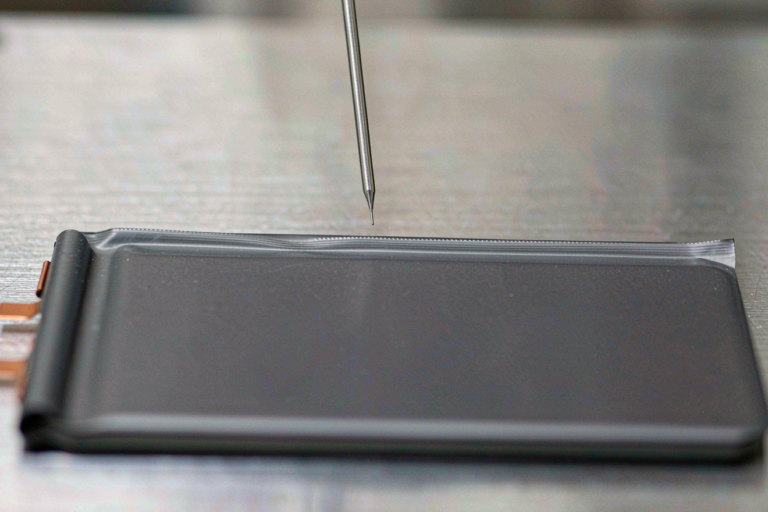
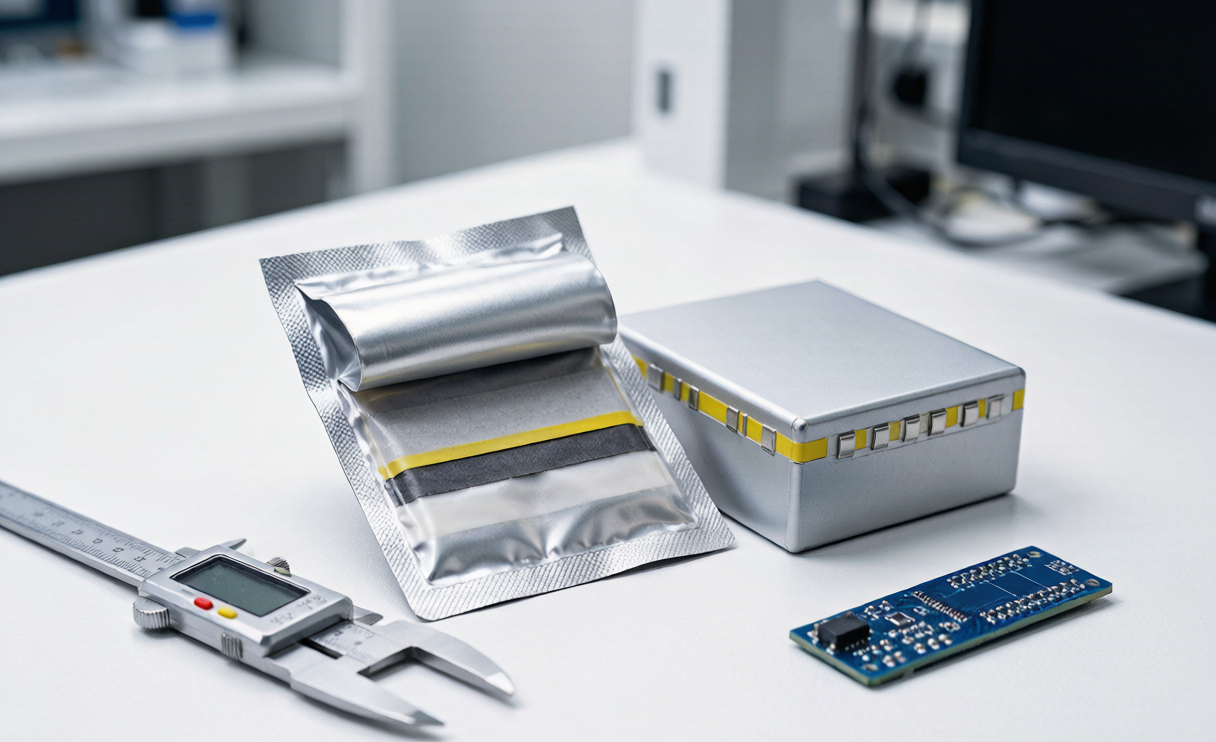
A pouch cell is sealed in aluminum-laminate film, typically 0.1 to 0.15 mm thick with an aluminum layer around 40 microns. There is no rigid case. Internally the electrodes are stacked or Z-folded, which lets us use larger, thicker electrode sheets and fewer inter-cell spacers than a wound format. That is why a pouch pack reaches 70 to 80 percent pack-level volumetric efficiency, versus roughly 60 to 70 percent for a prismatic pack that carries heavier casing and mandatory spacing.
For weight, the difference is stark. A 10 Ah pouch shell weighs only about 15 to 25 grams, while a comparable prismatic aluminum case runs 80 to 120 grams. On a drone, where every gram is flight time, that package weight alone can mean several extra minutes aloft. Pouch cells also have a high surface-to-volume ratio, so they shed heat passively better than a chunky prismatic block. The catch is structural: a pouch has no case to lean on. It tolerates only about 0.1 to 0.2 MPa of internal pressure before it swells, so the pack design must supply mechanical support and a controlled swell budget. In one survey drone project I supported, switching from prismatic to pouch trimmed 380 grams from a 1.6 kWh pack and added roughly four minutes of hover time, but only after we engineered a carbon sandwich tray to brace each cell against in-flight vibration.
Prismatic Cells: Structure and Reliability Profile
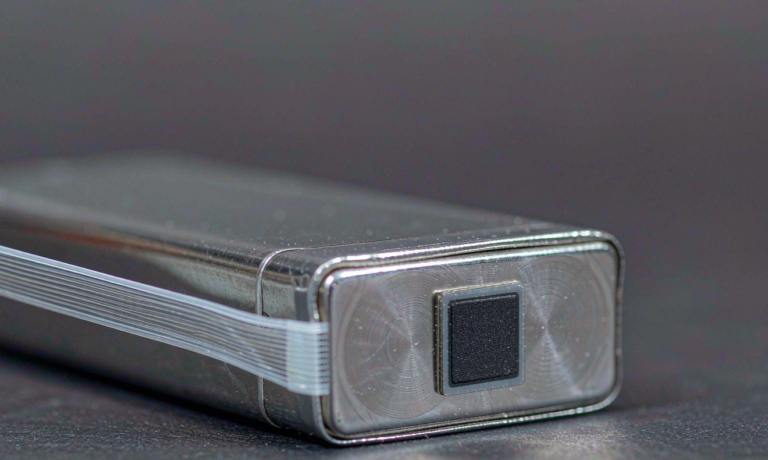
A prismatic cell lives inside a rigid aluminum case with 0.6 to 1.0 mm walls and bolted terminals. That case is the whole story. It absorbs mechanical shock, contains internal pressure past 1 MPa, and gives you a predictable, repeatable footprint that drops straight into standardized modules. For stationary storage, industrial vehicles, and automotive packs, that mechanical discipline is worth more than a few percent of pack weight.
Thermally, the prismatic case is a double-edged tool. Its lower surface area per watt-hour makes passive cooling harder, so you usually pair it with a cold plate or liquid loop. But the rigid envelope also slows thermal runaway propagation between cells. In a pack where a single cell failure must not cascade, that containment is a feature you cannot bolt onto a pouch. When a client tells me their priority is long service life with minimal maintenance in a harsh environment, prismatic is my default recommendation.
Energy Density, Weight, and Pack-Level Volume
Let me put numbers on the table, because the marketing sheets rarely match the pack. At the cell level, semi-solid NCM reaches 300 to 360 Wh/kg. Move to a finished pack and the picture shifts by format:
- Pouch pack: cell-level density carries through well. You lose maybe 20 to 25 percent to packaging, busbars, and the support frame, landing around 230 to 290 Wh/kg at the pack. Volumetric efficiency 70 to 80 percent.
- Prismatic pack: the heavier case and spacing eat more, so you typically see 190 to 250 Wh/kg at the pack, with 60 to 70 percent volumetric efficiency.
If your constraint is energy per kilogram or energy per liter, pouch wins on paper. If your constraint is structural robustness and predictable swelling over a ten-year calendar life, prismatic wins in the field. I have watched both formats hit their numbers in the lab and diverge only once the pack is dropped, baked, and cycled for two thousand hours.
Thermal Management and Safety Certification
Neither format ships without clearing the same baseline. Every semi-solid cell we release passes UN38.3, the transport safety test covering altitude (T.1), thermal (T.2), vibration (T.3), shock (T.4), external short circuit (T.5), impact (T.6), overcharge (T.7), and forced discharge (T.8). For product compliance we then align to IEC 62133-2 for portable equipment and IEC 62619 for industrial stationary applications, with IEC 63056 for higher-voltage stationary systems.
Aviation is where form factor choices bite. A solid-state battery or semi-solid cell bound for crewed or cargo aircraft must plan early for EASA guidance such as SC-VTOL and the RTCA DO-311A minimum operational performance standard for rechargeable batteries, while drone operators in the United States work under FAA 14 CFR Part 107. On the transport side, air shipment follows IATA Dangerous Goods and ICAO Technical Instructions under UN3480 or UN3481. Pouch cells need extra cushioning and pressure-relief design to pass these; prismatic cells lean on the case. Either way, the certificate is the same standard, but the engineering evidence you present to the auditor is built differently.
Manufacturing, Cost, and Scalability
On the line, the two formats use different muscle memory. Pouch production stacks electrodes and heat-seals the laminate, which suits the more viscous semi-solid slurry because thicker coatings are easier to deposit when the material does not run. Prismatic production winds or stacks into a case and laser-welds the top cap, a slower per-cell process but one that scales into very uniform modules.
Cost follows geometry. Pouch tooling is lighter and lets us mold a custom battery solution into an irregular airframe cavity without a bespoke case die. Prismatic tooling is heavier upfront but rewards you with lower per-unit variance at volume. When a client needs five hundred identical modules a month, I steer them to prismatic. When they need a one-off shape that fills an odd drone bay, pouch is the only rational answer. The hidden cost on both sides is validation: a new semi-solid format needs its own formation, aging, and grade-A sorting data before it earns a place in a certified pack, and that qualification work rarely shows up in the first quote.
Frequently Asked Questions
Which form factor is better for a long-endurance drone?
For most aerial platforms, pouch. The package weight and volumetric advantage extend flight time directly, and the flexible shape fills irregular airframe cavities. The trade-off is that you must design real thermal and mechanical support into the pack, because pouch cells have no case to lean on. A bare pouch in free space will swell and fail.
Can I mix pouch and prismatic cells in one battery pack?
I would not. Different swelling behavior, internal resistance, and thermal profiles make a mixed pack a balancing nightmare for the BMS. Pick one format per pack and tune the entire custom battery solution, from cooling plates to fusing, around that single choice.
Do semi-solid cells work with standard lithium battery BMS hardware?
Electrically, yes. The cell voltage window, roughly 2.8 to 4.35 V for an NCM semi-solid, and the communication are conventional, so existing lithium battery BMS platforms read them fine. What changes is the thermal and balancing strategy. Semi-solid tolerates faster charge, but you still need proper cell-level fusing, careful temperature sensing, and a charge profile validated against your actual cell lot.
What certifications apply if I fly these in aviation?
Beyond UN38.3 for transport, you are looking at IEC 62133-2 or IEC 62619 depending on the use case, and for airborne integration the EASA framework plus RTCA DO-311A for rechargeable batteries. A semi-solid state battery destined for crewed or cargo aircraft should plan for that compliance path from the first prototype, not after the pack is built.
Conclusion
There is no universal winner between pouch and prismatic for a semi-solid state battery. Pouch delivers the highest energy per kilogram and the freedom to shape a custom battery solution around your product; prismatic delivers the structural discipline and containment that long-life, high-abuse installations demand. My rule of thumb: choose pouch when weight and form freedom dominate, choose prismatic when reliability and predictable swelling dominate. Either way, design the pack, the cooling, and the certification evidence around the format you pick, because the electrolyte may be the same, but the cell you actually build is not.