Semi-Solid State Battery for Mining and Heavy Equipment: An Engineer’s Field Guide
I have commissioned battery systems in a lot of unpleasant places, but nothing rearranges your design assumptions quite like an underground haulage level 400 metres down, where the ambient air sits at 34 degrees Celsius, the humidity never drops below 90%, and every machine on the level vibrates hard enough to loosen a torqued fastener inside a shift. Mining does not care about your datasheet. It cares whether the machine moves ore at the end of the second shift.
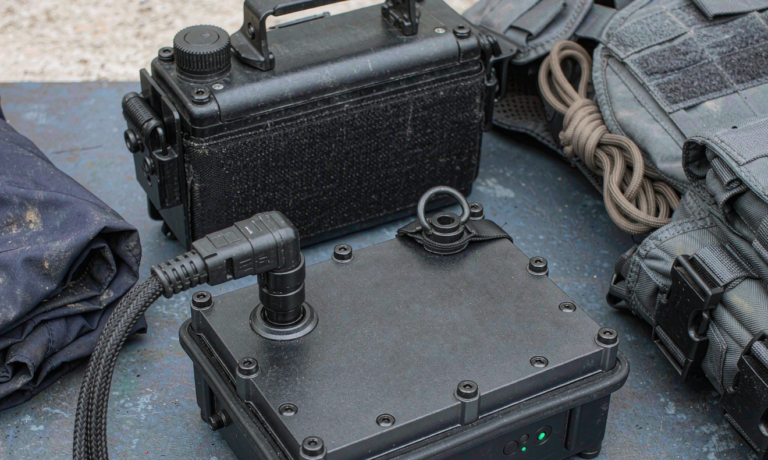
Over the past four years my team has designed, built, and field-supported traction and auxiliary packs for load-haul-dump loaders, drill jumbos, personnel carriers, and surface haul trucks. A growing share of those programmes now specify semi-solid chemistry. This article explains why, where the technology genuinely earns its cost premium, and where a conventional pack is still the smarter engineering answer.
What a Semi-Solid Cell Actually Is, in Plain Engineering Terms
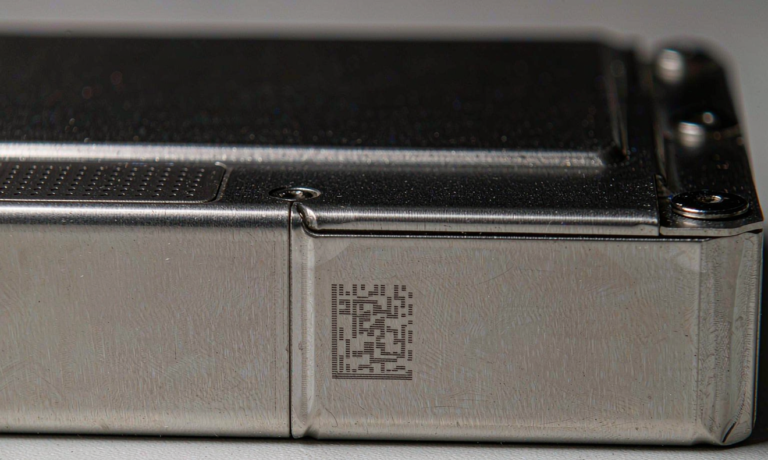
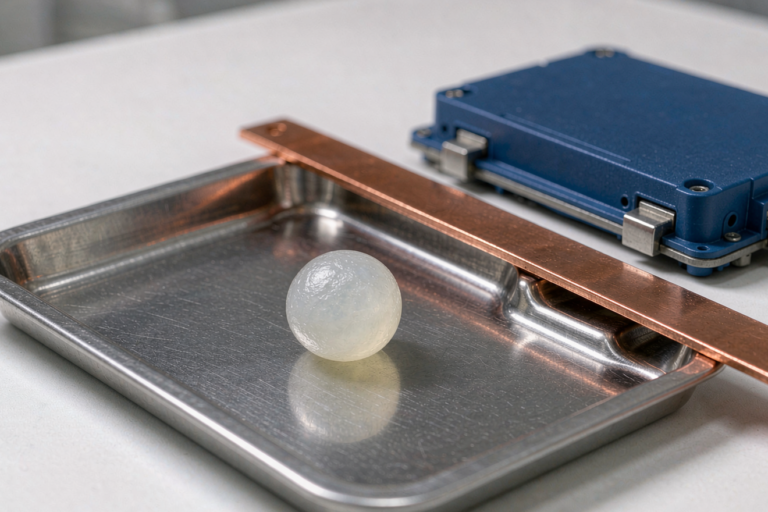
There is a lot of loose language in this market, so let me be precise. A fully solid-state cell replaces the liquid electrolyte entirely with a ceramic, sulfide, or polymer conductor. A semi-solid state battery keeps a small quantity of liquid or gel electrolyte — typically 5% to 15% by mass instead of the 18% to 25% in a conventional cell — held inside a thickened, partially solidified matrix that also carries the active material.
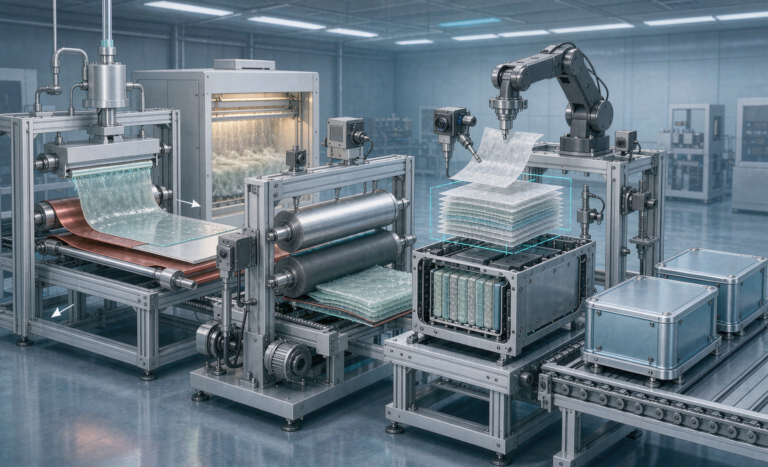
That single change cascades through the whole design. The electrode can be made much thicker, often 250 to 400 micrometres against the 60 to 90 micrometres of a standard coated electrode, because the semi-solid matrix conducts ions through its bulk rather than relying purely on a thin flooded layer. Thicker electrodes mean fewer current collectors, fewer separators, and less inactive mass per kilowatt-hour. That is where the energy density gain comes from: production cells today land between 300 and 360 Wh/kg at cell level, against 250 to 280 Wh/kg for a good NMC lithium battery of the same generation.
The second consequence matters far more underground. With most of the electrolyte immobilised, a mechanical breach does not produce a running pool of flammable solvent. In our nail penetration work on 60 Ah semi-solid pouches, peak surface temperature settled between 180 and 240 degrees Celsius with venting but no flame propagation to neighbouring cells. The same test on conventional high-nickel pouches of comparable energy gave us flame events in roughly one trial out of three. For a machine operating in a confined drift with a single escape route, that difference is not a specification line — it is the whole argument.
The Five Conditions That Break Conventional Packs Underground
Before discussing chemistry further, it is worth naming what actually kills batteries in this application. From our warranty returns, five stressors account for the overwhelming majority of failures.
Sustained high ambient temperature. Deep workings run 30 to 40 degrees Celsius ambient before you add machine heat. A pack that sees 45 degrees Celsius average cell temperature ages roughly twice as fast as one held at 35, following the usual Arrhenius doubling per 10-degree rise. Over a three-year machine life that is the difference between 78% and 62% remaining capacity.
Vibration and shock. We log 4 to 8 g RMS broadband on LHD chassis mounts, with impact spikes above 25 g when a bucket hits the face. Cell tabs, busbar joints, and connector backshells are the first things to fatigue. Our current specification demands survival of IEC 60068-2-6 sine sweep and 2-27 random profiles at 8 g RMS for 24 hours per axis, followed by a full capacity and resistance check.
Dust and water ingress. Underground water is mineralised and conductive. We build to IEC 60529 IP67 as the floor and IP69K for anything washed down with high-pressure hot water, which is most surface fleets.
Opportunity charging. Mining duty cycles are not tidy. Operators plug in during a crib break, during a blast delay, during a tramming wait. A pack may see six or eight partial charges per shift. That means the design must tolerate high-rate partial-state-of-charge cycling indefinitely, which is precisely the regime where lithium plating quietly accumulates.
Deep discharge under load. A loaded LHD climbing a 1-in-7 decline can draw 3 C to 4 C for two to three minutes at a time. Sag under that load, not nameplate capacity, determines whether the machine crests the ramp.
Where Semi-Solid Chemistry Wins on a Mining Machine
Against that backdrop, here is where the technology has measurably earned its place in our designs.
Energy per available volume
Machine designers give battery engineers whatever envelope is left after the hydraulics, the operator cabin, and the ground clearance requirement. On a 14-tonne LHD retrofit we completed last year, the available battery bay was 1,180 by 720 by 540 millimetres. With a conventional prismatic NMC solution we could fit 168 kWh usable. Moving to semi-solid cells at 330 Wh/kg took the same bay to 214 kWh usable — a 27% gain with no change to the machine structure. That converted directly into a full extra tramming hour per charge, which the customer measured as 1.6 additional bucket cycles per shift.
Thermal margin in hot workings
Semi-solid cells tolerate a higher sustained operating ceiling. We validate continuous operation to 55 degrees Celsius cell temperature against the 45 degrees Celsius we would normally permit for high-nickel liquid cells, because the immobilised electrolyte suppresses the solvent decomposition reactions that drive gas generation and impedance rise. In practice this lets us specify a smaller, lighter cooling loop — on the LHD programme we dropped from a 9 kW chiller to a 5.5 kW unit, saving 41 kilograms and, more importantly, one failure-prone rotating assembly.
Reduced propagation risk
Cell-to-cell propagation resistance is the single most valuable property for underground certification. Combining semi-solid cells with 2 millimetre mica interlayers and a directed vent path, our 214 kWh pack passed a single-cell thermal runaway initiation test with no propagation beyond the initiating cell and no external flame, holding the enclosure skin below 95 degrees Celsius. That result is what allowed the customer’s mine to approve the machine without a dedicated suppression bottle in the battery bay.
Tolerance of partial-state-of-charge cycling
In our accelerated opportunity-charging protocol — 30% to 80% state of charge at 1.5 C charge, eight cycles per simulated shift — semi-solid cells retained 88% capacity at 1,800 equivalent full cycles. Conventional high-nickel cells in the same fixture sat at 79%. The mechanism is straightforward: the semi-solid matrix maintains better interfacial contact under the volume changes of fast partial cycling, and there is less free solvent available to grow the surface film.
Where I Still Specify a Conventional Lithium Battery
I would be doing a disservice if I presented this as a universal upgrade. Three situations still point me elsewhere.
The first is cost-driven surface applications with generous space. A surface haul truck or a fixed substation buffer has volume to spare. There, lithium iron phosphate at 160 to 180 Wh/kg costs roughly 40% to 55% less per kilowatt-hour and delivers 4,000 to 6,000 cycles. If the envelope is not binding, the cheaper chemistry wins on total cost of ownership every time. This is exactly the same trade-off we work through with customers on our home energy storage line, where cycle life and price beat density.
The second is very high continuous power at low energy — say a shuttle car that needs 5 C continuous but only 40 kWh. Semi-solid cells with thick electrodes have longer ion diffusion paths, so their sustained-power capability is respectable but not class-leading. A thin-electrode power cell is the better tool.
The third is extreme cold. Semi-solid electrolyte conductivity falls more sharply below minus 10 degrees Celsius than a well-formulated liquid system. For open-pit operations in northern latitudes we either revert to liquid chemistry or budget heater duty accordingly, typically 4% to 6% of pack energy for pre-conditioning.
Designing the Pack: What We Specify and Why
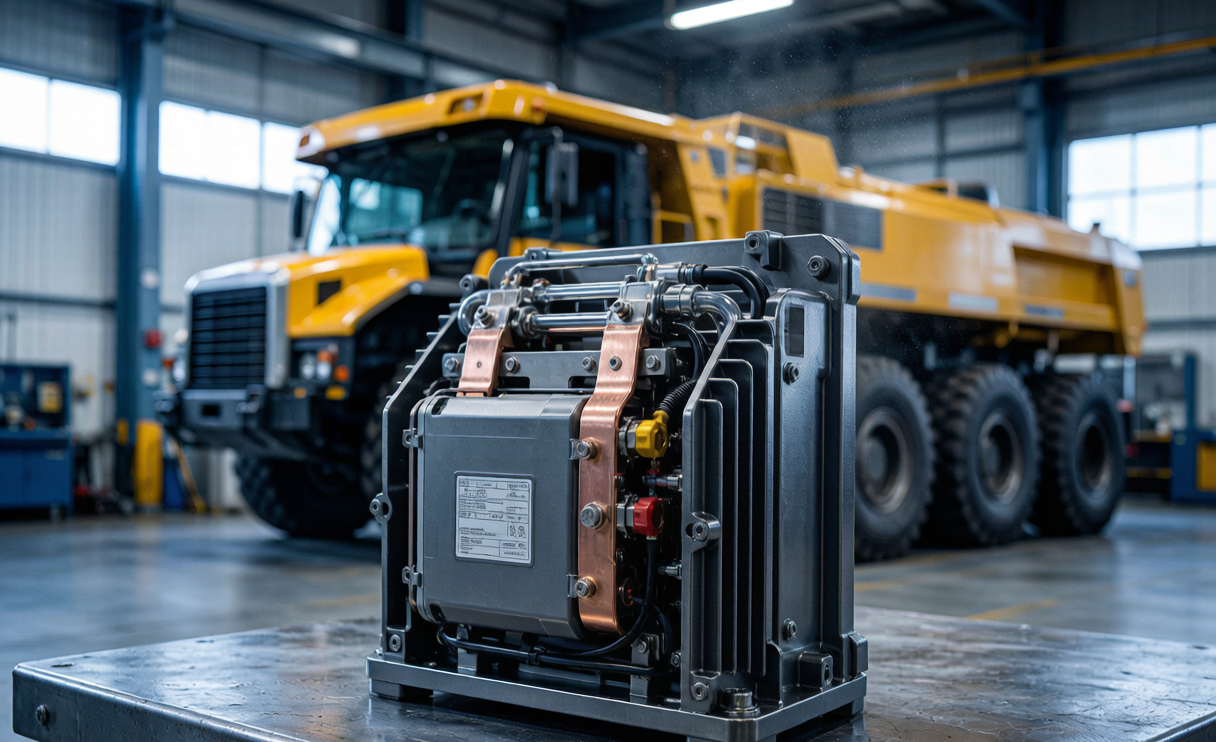
A cell is not a product. The pack around it is where mining reliability is won, and every mining custom battery solution we deliver is built around the same core decisions.
Module architecture. We favour modules of 12 to 16 kWh, sized so two technicians can handle one with a lifting bar in a confined drift. Blind-mate high-current interfaces with a floating alignment tolerance of plus or minus 2 millimetres let a module be swapped without a fitter aligning cable lugs by feel in bad light.
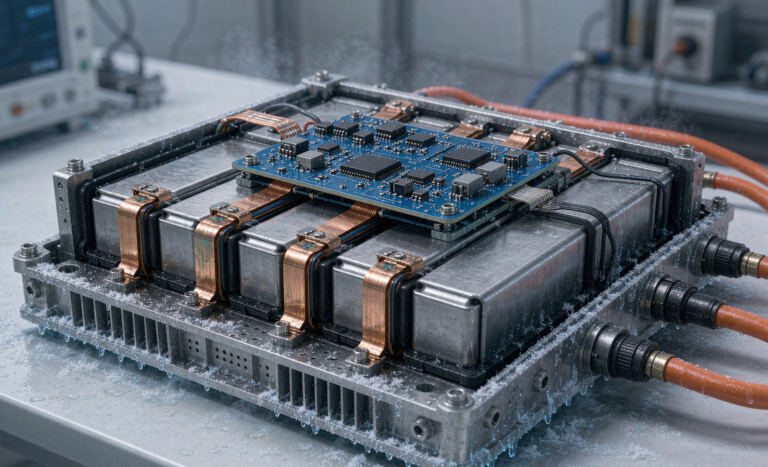
Mechanical isolation. Cells are compressed to 0.3 to 0.5 MPa in a rigid frame — semi-solid cells specifically need this stack pressure to maintain interfacial contact and hold their cycle life. The frame then mounts to the machine on elastomeric isolators tuned to a 12 to 18 Hz corner frequency, which puts machine excitation well above resonance.
Thermal management. Liquid cold plates on the cell face, 50/50 glycol, target 30 to 38 degrees Celsius cell temperature with a maximum 4-degree spread across the pack. Spread matters more than absolute temperature for balancing behaviour, and it is the number I ask for first when reviewing field telemetry.
Battery management. Dual redundant contactor control, per-cell voltage sensing, three temperature sensors per module, insulation resistance monitoring against chassis at better than 500 ohms per volt, and a hard charge lockout below 5 degrees Celsius cell temperature to prevent plating. We log every cell at 1 Hz and retain 90 days on board, because underground failures are almost never witnessed and the log is your only witness.
Enclosure. Welded steel, IP67 minimum, with a pressure equalisation vent and a burst path directed away from the operator station and any hydraulic line.
Certification and Transport Reality
Every cell and pack we ship completes UN 38.3 testing, T.1 through T.8, covering altitude simulation, thermal cycling, vibration, shock, external short circuit, impact or crush, overcharge, and forced discharge. Semi-solid chemistry does not exempt anything here — it is still a lithium cell under transport regulation.
At the system level, our mining packs are validated to IEC 62619 for industrial secondary lithium cells and batteries, with UL 1973 applied where the customer’s insurer requires it. Machines destined for the European market additionally need the battery integration to satisfy the relevant machinery directive risk assessment, and mines with gas hazards will demand equipment group and category assessment under the applicable explosive-atmosphere framework before anything goes underground.
For shipment, packs above 100 Wh travel under UN 3480 as standalone units or UN 3481 when installed in equipment, at 30% state of charge for air freight under IATA Packing Instruction 965, with ADR provisions applying to European road movement. A 214 kWh pack is a Class 9 dangerous goods consignment and needs to be planned around, not discovered at the dock.
Commissioning Lessons I Would Not Have Predicted
Two field lessons have changed our standard practice more than any laboratory result.
The first came from a copper operation where three machines showed unexplained capacity drift within four months. The cells were fine. The chargers were not: they sat on a supply with 6% voltage sag during shift change and terminated early on a voltage criterion rather than current taper. The packs never reached full charge, balancing never ran to completion, and cell spread widened every cycle. We now specify termination on taper current below 0.05 C and require a supply quality survey before commissioning.
The second involved wash-down. A surface fleet was cleaned nightly with 80-degree water at 100 bar. The enclosures were correctly sealed to IP67, but the thermal cycle from hot wash to cool ambient created a pressure differential that drew mineralised water past a vent membrane over several months, dropping insulation resistance from above 20 megohms to under 800 kilohms. The fix was a labyrinth vent path with a hydrophobic membrane set back from the spray line. Insulation resistance trending is now mandatory in every handover pack we write.
Frequently Asked Questions
How much more does a semi-solid pack cost than a conventional lithium pack?
At current volumes we see a 25% to 40% premium per kilowatt-hour against comparable high-nickel NMC, and considerably more against lithium iron phosphate. The premium is justified when the machine envelope is volume-constrained, when the operating environment is hot, or when propagation resistance is required for mine approval. It is not justified on a surface machine with space to spare.
What cycle life should I plan for on a mining duty cycle?
Plan for 2,000 to 2,800 equivalent full cycles to 80% remaining capacity under a mixed opportunity-charging profile at 35 to 45 degrees Celsius average cell temperature. Cooler operation and gentler charging push that toward 3,200. Anyone quoting 5,000 cycles for a high-energy semi-solid cell on a mining duty cycle is quoting a laboratory number.
Can I retrofit a semi-solid pack into a machine designed for lead-acid or older lithium batteries?
Usually yes, and it is one of the most common projects we take on. The constraints are ballast and centre of gravity — many machines relied on battery mass for stability, so a lighter pack may require added ballast — plus charger compatibility, contactor ratings, and the CAN interface to the vehicle controller. We budget six to ten weeks for a first-article retrofit including integration testing.
Is a semi-solid state battery safe enough to remove fire suppression from the battery bay?
That is a decision for the mine’s risk assessment, not for me. What I can say is that a properly designed pack with mica interlayers and directed venting has, in our testing, contained single-cell runaway without propagation or external flame. Several customers have used that evidence to simplify suppression requirements. None have removed suppression from the machine as a whole, nor should they.
How should packs be stored during a shutdown?
Store at 40% to 60% state of charge, between 10 and 25 degrees Celsius, disconnected, with a top-up check every 90 days. Semi-solid cells self-discharge at roughly 1.5% to 3% per month at 25 degrees Celsius, so a six-month shutdown without a check can take a pack below its safe floor.
What monitoring data actually predicts failure?
Three signals, in order of usefulness: cell voltage spread at end of charge, direct-current internal resistance trend measured on a consistent load step, and maximum cell temperature spread across the pack. A spread above 45 millivolts at full charge or a 25% resistance rise from commissioning baseline both warrant intervention before they become downtime.
Closing Thoughts
Semi-solid chemistry is not a magic material. It is a well-judged engineering compromise that trades a modest amount of cost and low-temperature performance for a meaningful gain in energy density, thermal headroom, and propagation resistance. In mining, where the envelope is tight, the workings are hot, and the consequence of a fire underground is severe, that trade lands on the right side of the ledger more often than not.
If you are scoping a machine electrification programme, start with the duty cycle and the available envelope rather than the chemistry. Measure the actual current profile over a full shift, measure the ambient at the working face rather than at the portal, and only then choose cells. Every serious battery solution we have delivered underground began with that data, and every disappointing one began with a datasheet.