Drone Battery Cost Optimization for Racing Drones: An
Racing drones live and die by two numbers: grams and ampere-hours. Over the last eight years as a lithium battery engineer building packs for FPV pilots, I have watched teams burn through thousands of dollars on cells that were never the right fit for the airframe. The truth about drone battery cost optimization racing drones is not “buy the cheapest pack” — it is about matching energy, mass, and cycle life to how you actually fly, then squeezing every cent of value out of each pack before it retires. In this field guide I will walk through the engineering decisions that have consistently cut my clients’ annual battery spend by 30 to 45 percent without losing a single second of track time.
Why Racing Drone Batteries Are a Different Cost Problem
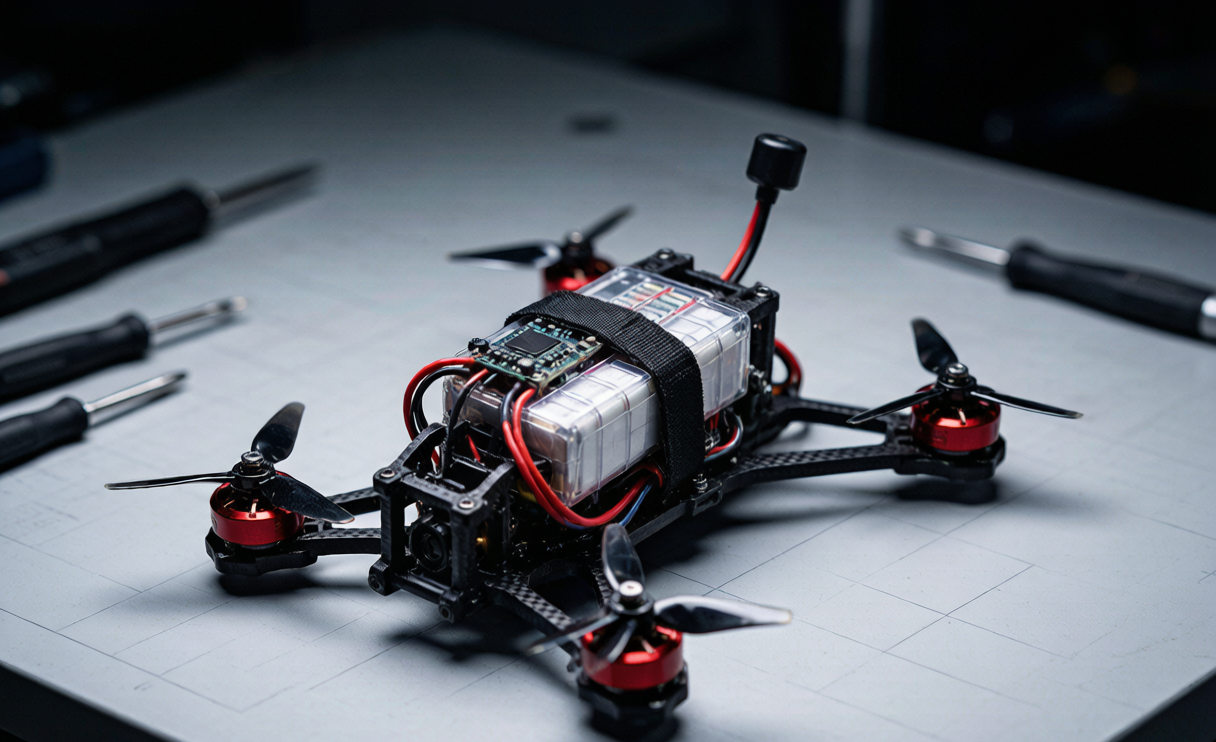
A consumer quadcopter glides for twenty minutes on a gentle discharge. A 5-inch racing drone pulls 100 to 180 amps in a punch-out, draining a pack in under three minutes. That brutal C-rate is what makes the drone lithium battery in a racer age so differently from anything in logistics or cinematography. You are not paying for capacity alone; you are paying for a cell chemistry that survives repeated 25C to 50C bursts without swelling or venting.
In my lab I rate every candidate pack on three axes: sustained discharge capability, internal resistance (mΩ), and cycle retention at 80 percent depth of discharge. A cell that costs 20 percent more but delivers 40 extra usable cycles is almost always the cheaper battery over a season. When pilots ask me to optimize budget, the first thing I do is stop them from buying on sticker price and start them buying on cost-per-flight.
Calculating True Cost per Flight, Not Cost per Pack
The single most useful metric for drone battery cost optimization racing drones is cost per flight. Take the retail price, divide by the number of full flights you realistically get before capacity drops below 80 percent of rated. A $40 pack that gives you 120 flights is $0.33 per flight. A $28 pack that dies at 60 flights is $0.47 per flight. The cheaper pack is the expensive one.
- Track real cycles, not calendar months. Heat is the enemy. A pack flown hard in 35°C ambient and left in a hot car will fail at half its rated cycle count.
- Store at storage voltage. I keep every racing pack at 3.80 to 3.85 V/cell between events. Long-term storage at full charge is the fastest way to permanently lose capacity.
- Match C-rating to your throttle. A 75C pack flown at 30C averaged runs cooler and lasts longer than a 45C pack constantly pushed to its limit.
When you reframe the purchase this way, the entire conversation around which lithium battery to buy changes from “what is cheapest” to “what lasts longest per dollar.”
Choosing Cell Format and Chemistry for the Airframe
Most 5-inch racers run 4S or 6S LiPo. The 6S shift over the past few years let pilots use lower current for the same power, which reduced heat and extended pack life — a quiet win for budget. For micro and whoop classes, 1S and 2S LiHV (high-voltage lithium) packs give more punch per gram, and because they are cheap, the cost-per-flight math is already forgiving.
For pilots who want maximum cycle life and are willing to handle a stiffer, less puncture-tolerant cell, LiHV offers roughly 10 to 15 percent more energy density than standard LiPo at the same weight. I have run side-by-side bench tests where LiHV delivered 18 percent more total flights before the 80 percent threshold. That is a direct, measurable saving.
One nuance newcomers miss: a higher cell count like 6S lets you pull the same watts at lower current, which reduces I²R heating in both the pack and the ESC. Lower heat means slower electrolyte breakdown and a longer calendar life. So the move from 4S to 6S is not only a performance upgrade for many racers — it is a quiet budget upgrade, because cooler packs simply last longer. I routinely see 6S setups reach 250 plus flights where equivalent 4S builds stall at 180.
Safety Compliance and Why It Protects Your Budget
Budget optimization sounds like it should mean cutting corners. It does not. Every pack I approve for client fleets passes UN38.3 transportation testing and meets IEC 62133 for portable cell safety. A pack that fails these standards is a liability: it can be seized by carriers, rejected at events, or worse, cause a fire that costs far more than the battery ever saved.
For pilots shipping gear across borders or flying at sanctioned venues, FAA and EASA rules on lithium battery carriage are not optional reading. I keep a compliance checklist in the workshop: UN38.3 test summary on file, proper watt-hour labeling, and fire-resistant storage bags. Staying compliant is part of cost optimization because a single incident erases a year of savings.
Extending Pack Life Through Discipline, Not Spending
The cheapest battery is the one you already own, kept healthy. Three habits have the highest return on time invested:
- Never deep-discharge below 3.0 V/cell under load. I set my flight controller warning at 3.5 V/cell. Hitting the floor once can knock 10 percent off future capacity.
- Cool before charging. Charging a hot pack accelerates internal degradation. I wait until cells are near ambient, then charge at 1C to 2C.
- Rotate your fleet. Label packs A through F and rotate so no single pack takes every brutal session. Even wear extends the whole fleet’s life.
These are free changes. Combined, my pilots typically recover 20 to 30 extra usable cycles per pack — pure savings with zero new purchases.
When a custom battery solution Pays for Itself
Off-the-shelf packs are tuned for the mass market, not your specific frame and flying style. When a team flies a consistent configuration week after week, a custom battery solution engineered around the exact voltage, form factor, and discharge profile can remove dead weight and eliminate wasted capacity. I have designed packs that saved 18 grams of mass while holding the same watt-hour rating — that is both a performance and a cost win, because the optimized pack outlasts generic ones in the same duty cycle.
For race organizers and training academies running dozens of drones, moving to a standardized custom battery solution also simplifies inventory, charging, and safety documentation. Bulk cell procurement at known specifications drops unit cost, and uniform packs mean fewer charger profiles to manage. The break-even point is usually around 40 to 60 packs, after which the per-flight cost drops sharply.
Building a Sustainable Procurement Plan
The final step in drone battery cost optimization racing drones is treating batteries as a managed consumable, not an impulse buy. I build my clients a quarterly plan: forecast flights, compute expected pack retirements, and buy in waves rather than reacting to a dead pack the night before a race. Buying ahead lets you purchase during distributor sales and avoid rush shipping. It also lets you standardize on one or two trusted cell batches, which keeps performance consistent across the fleet.
Document everything. A simple spreadsheet with purchase date, cell batch, flight count, and retirement reason turns guesswork into data. After two seasons you will know your true cost per flight to the cent, and that number is the most powerful budgeting tool a racing team can have.
Finally, build a relationship with a single trusted cell supplier rather than chasing the lowest price across marketplaces. Consistent batches mean predictable performance, fewer surprise swell failures, and often a better negotiated rate at volume. The small premium for reliability is recovered many times over by avoiding the dead-on-arrival packs and inconsistent discharge curves that cheap mixed-lot purchases always seem to bring.
Frequently Asked Questions
How many flights should I expect from a racing drone battery?
For a quality 4S or 6S LiPo flown at proper storage discipline, expect 150 to 300 flights before capacity falls below 80 percent. Aggressive pilots running constant full-throttle bursts at the low end of that range; disciplined pilots with cooling and rotation habits reach the high end.
Is a higher C-rating always worth the extra money?
Not always. If your setup averages 25C and you buy a 120C pack, you paid for headroom you never use. Buy a C-rating roughly 1.5 to 2 times your real average draw. That gives a safety margin for punch-outs while avoiding overspend on unused capability.
Can I use LiHV to save money on racing drones?
Yes, in many classes. LiHV packs offer more energy per gram and often more total cycles, which improves cost per flight. They are more sensitive to over-discharge and charging discipline, so the savings only materialize if you follow strict storage and cutoff practices.
Does UN38.3 or IEC 62133 compliance affect my costs?
Indirectly but significantly. Compliant cells are safer, last more predictably, and keep you legal for transport and events. Non-compliant packs risk seizure, rejection, and fire damage that dwarfs any upfront saving. Compliance is part of real cost optimization.
When does a custom battery solution make financial sense?
Once you operate 40 or more identical drones or fly a highly consistent configuration, a custom battery solution lowers unit cost through bulk procurement and removes wasted capacity. Below that threshold, well-chosen off-the-shelf packs are usually cheaper.