Drone Battery Design for Racing Drones: An Engineer’s Guide
When a pilot hands me a new FPV airframe and says “make it faster,” the last thing I touch is the propeller. The first thing I open is the battery CAD. At Horizon Power, where I work as a senior lithium battery engineer, drone battery design for racing drones is a discipline of milliseconds and milliohms, not just watt-hours. A racing pack lives its entire life in a 10–60 second window of brutal burst discharge, hard cornering, and thermal shock on the landing. Get the topology or the cell grade wrong and you lose the lap before you leave the pad. This guide walks through how we actually design a competitive racing drone battery: cell format, series-parallel topology, busbar resistance, thermal envelope, and the safety standards that keep it legal to fly.
Why Racing Drone Battery Design Is a Different Discipline
Most lithium battery engineering optimizes for energy density and cycle life. Racing is the opposite end of the curve. A drone lithium battery for cinematic work might see a 3C average load and a 5C peak for a second. A racing pack sees 15C continuous and 40C+ for the punch-out. The cell chemistry is the same lithium-ion family, but the design priorities flip: internal resistance, pulse capability, and stack rigidity beat gravimetric capacity every time.
That single shift changes every downstream decision. We pick cells by their AC-IR at 50% state of charge, not by their milliamp-hour label. We size busbars to survive 120 A without heating 8 degrees. And we design the enclosure to shed heat in 40 seconds of flight, not to insulate it for a two-hour mission. If you are migrating a custom battery solution from a mapping drone to a racer, expect to rebuild the pack from the cell up.
Choosing the Cell: Format and Discharge Rating
For racing, the two realistic candidates are the cylindrical 21700 and the high-rate lithium-polymer pouch. The 21700 wins on mechanical robustness and consistency; a good 21700 rated at 30–40 A continuous gives us a predictable AC-IR around 18–25 milliohms and a pulse ceiling we can model. The pouch wins on gravimetric energy and form-factor freedom but demands a rigid custom battery solution chassis because it has no can to resist swell.
We spec the discharge rating first, then the capacity. A 6S pack targeting 1300–1500 mAh at 40C gives roughly 52–60 A continuous and 120–160 A for the launch punch. I tell customers to ignore the marketing “burst 100C” number on a pouch label; what matters is the cell’s voltage sag at 30C after 50 cycles. A quality drone lithium battery holds above 3.3 V per cell at rated load. Below that, the ESC starts current-clipping and the lap time inflates.
How We Read a Cell Datasheet for Racing
Three numbers decide the build: nominal capacity, maximum continuous current, and AC internal resistance at 50% SOC and 25°C. If the vendor cannot supply AC-IR at temperature, we measure it on a 1 kHz impedance bridge before it enters the pack. For a racing drone battery design, a 1 milliohm spread between cells in a parallel group is the difference between a balanced pack and one that cooks the weak cell.
Pack Topology: Series-Parallel Balancing for Burst Current
Racing packs are almost always 6S (22.2 V nominal) because that matches the common ESC and motor KV window. The question is parallel count. Two parallel groups of 21700 (2P) double the burst current and halve the per-cell load; three parallel (3P) buys more headroom but adds mass. We model the burst current, divide by the cell’s safe continuous rating, and pick the smallest P that keeps every cell under 80% of its rated continuous current at the worst-case corner.
battery pack design here is a resistor network problem. Each series connection adds busbar resistance; each parallel group adds balancing complexity. We keep parallel groups small (2P or 3P) so that if one cell drifts, the pack still flies, and we place the parallel welds symmetrically so current paths are equal length. Asymmetric wire runs are the most common cause of one cell running hot in an otherwise good drone battery.
Busbar and Interconnect Design for Low Resistance
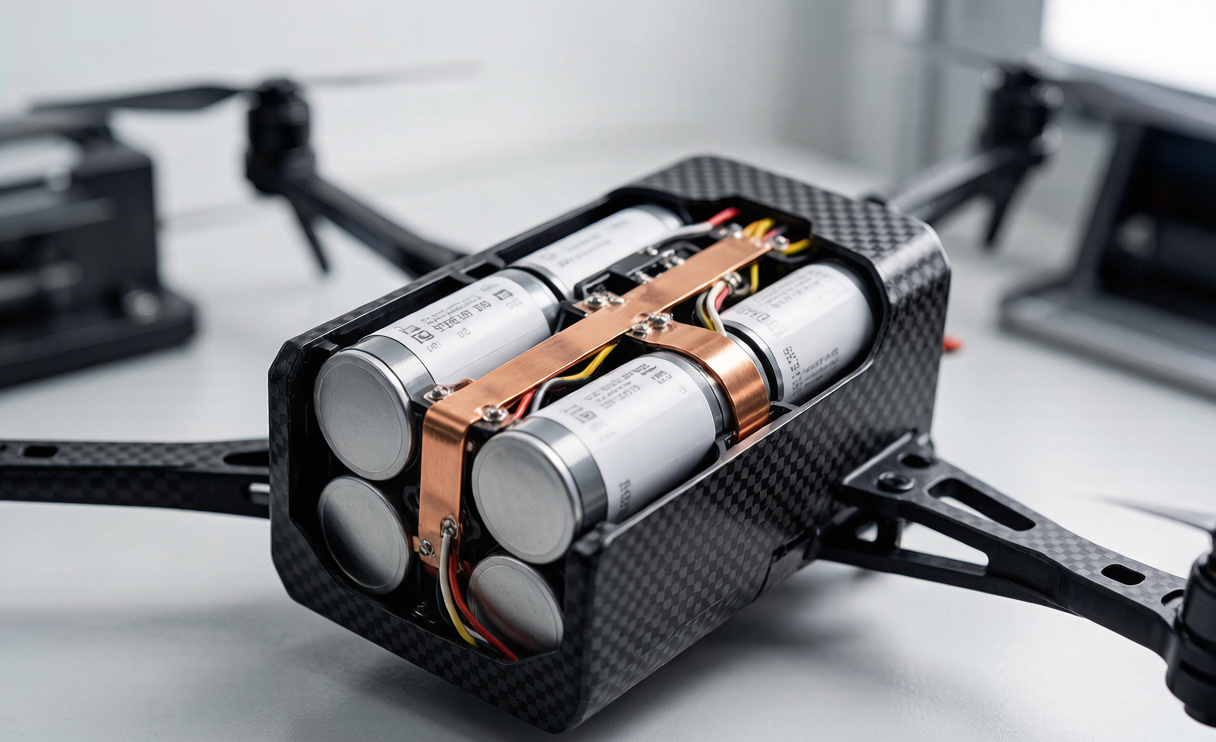
At 120 A, resistance is everything. A 10 milliohm busbar dissipates 144 W of pure heat — enough to melt a spot weld in seconds. We use solid nickel or nickel-plated copper busbars, not wire, for the high-current legs, and we size cross-section from I²R at the peak current, not the average. A typical racing drone battery busbar runs 0.2 mm nickel over a 3 mm wide strip, laser-welded to the cell can so the joint resistance stays under 0.3 milliohms.
Weld quality is where hobby packs fail and engineered packs survive. We pull a 5-sample shear test on every weld lot and reject any joint under 25 N. A weak weld is a hidden resistor; under burst load it heats, the joint oxidizes, resistance climbs, and the pack drops voltage exactly when the pilot needs punch. This is the part of drone battery design racing drones pilots never see but always feel on the timer.
Thermal Envelope: Keeping Cells Safe Under Burst Loads
A 40C burst for 4 seconds dumps heat faster than any airflow can remove mid-corner. The trick is not to cool during the burst — it is to enter the burst cold and exit before the cell core crosses 45°C. We model the adiabatic temperature rise from I²R and the cell’s specific heat, then set the flight envelope so even back-to-back heats stay under the 60°C hard ceiling. Surface temperature on the can is our field proxy; if the wrap reads above 50°C at landing, the next pack gets a wider busbar or a smaller P.
For a custom battery solution on a closed-course racer, we sometimes add a vented enclosure with a thin aluminum heat spreader. It costs 6–9 grams but holds the parallel-group delta under 3°C across a 3-minute final. On a freestyle build where every gram is a flip, we skip it and rely on the airflow from the props. The thermal envelope is a design choice, not a fixed rule, and it is the one I revisit most after track data comes back.
Enclosure and Structural Integration
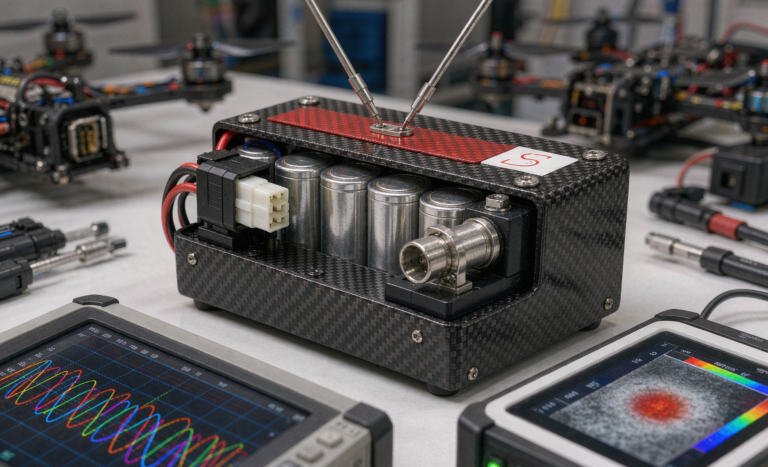
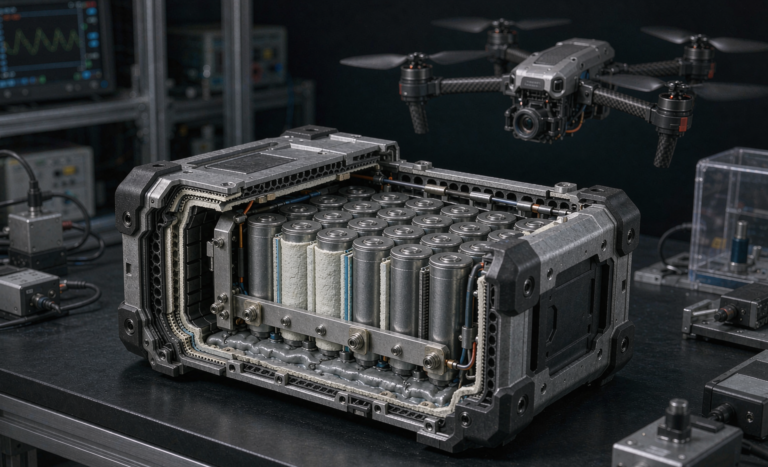
The enclosure does three jobs: protect the cells from crash impact, lock the busbars so they cannot short, and present a stiff mounting face to the frame. A racing drone battery is glued or strapped to the airframe, so the enclosure is part of the structure. We use a carbon-fiber shell for stiffness at low mass and line the inside with a 0.5 mm fire-retardant barrier rated to IEC 62133-2 abuse tests. The shell is designed to fail away from the busbars in a crash, so a cracked case does not become a short.
Mounting also affects electrical performance. A pack that flexes under thrust micro-fractures its welds over a season. We bond the cell group to the shell with a structural adhesive rated to the vibration profile of the airframe, then verify with a IEC 60068-2-6 sweep. A drone lithium battery that survives the bench but cracks on the third race lost the design at the enclosure stage.
Verification Against UN 38.3 and IEC 62133-2
No racing pack leaves Horizon Power without passing the transport and safety baseline. UN 38.3 T.1 through T.8 covers altitude simulation, thermal test, vibration, shock, external short, impact, overcharge, and forced discharge. For a high-rate drone battery, the vibration and external short sections are the real gates — a weak weld that passes T.3 on the bench can still fail T.4 at the race. We add IEC 62133-2:2017 cell and pack safety on top, because our customers fly commercially and their carriers (and the FAA Part 107 / EASA regimes) expect it.
We also log the pack’s watt-hour rating and keep it under the 100 Wh carry-on threshold, or under 160 Wh with operator approval, so it stays shippable and race-legal. A drone battery design racing drones teams can actually transport is worth more than a faster pack they cannot fly to the event.
FAQ
What C-rating do racing drone batteries actually need?
For competitive FPV, plan for a continuous rating of at least 25–30C and a pulse ceiling of 40C or higher at the pack level. But verify it against real voltage sag at 30C after 50 cycles, not the label. A quality drone lithium battery holds above 3.3 V per cell under rated load; if it sags below that, the motor is being current-clipped and you are losing speed you paid for.
How many cells go in series for a 6S racing pack?
Six series, giving 22.2 V nominal. The parallel count (2P or 3P) is set by your burst-current target divided by the cell’s safe continuous current, keeping every cell under 80% of its rating at the worst corner. Battery pack design here is mostly a resistor and current-sharing problem, not a capacity problem.
Can I use the same lithium battery for racing and cinematic drones?
Not well. A cinematic pack is tuned for energy density and low self-discharge; a racing pack is tuned for AC-IR and pulse current. Running a racing pack on a mapping drone wastes its burst capability and shortens life; running a cinematic pack on a racer risks sag and heat. If you need both, request a separate custom battery solution for each airframe.
How do I size a custom battery solution for a new airframe?
Start from the motor’s max current at full throttle, multiply by a 1.3 safety factor, and divide by your chosen cell’s continuous rating to get the parallel count. Then set capacity from your target flight time at average load, and validate the thermal envelope on track. We treat the first three packs as prototypes and only lock the design after we see real can temperatures at landing.
What standards must a racing drone battery pass before flight?
At minimum UN 38.3 T.1–T.8 for transport safety and IEC 62133-2:2017 for cell and pack safety. Commercial operators should also confirm FAA Part 107 and EASA expectations and keep the pack under the 100 Wh carry-on or 160 Wh approved threshold. We certify every Horizon Power racing pack to that baseline before it ships.