Drone Battery Cost Optimization for Racing Drones: An (2)
Every season, a new pilot asks me the same question: “Karl, how do I get a cheaper racing drone battery without losing lap time?” After fifteen years on the lithium pack bench, my answer has not changed. Cost optimization for FPV racing is not about buying the lowest-priced cells. It is about matching the right cell chemistry, pack architecture, and certification path to the exact burst-current and flight-time envelope your airframe demands. A pack that is over-specified wastes money on copper, nickel strip, and derated cells you never use. A pack that is under-specified fails on the third hard corner and costs you a motor, a propeller, and a race.
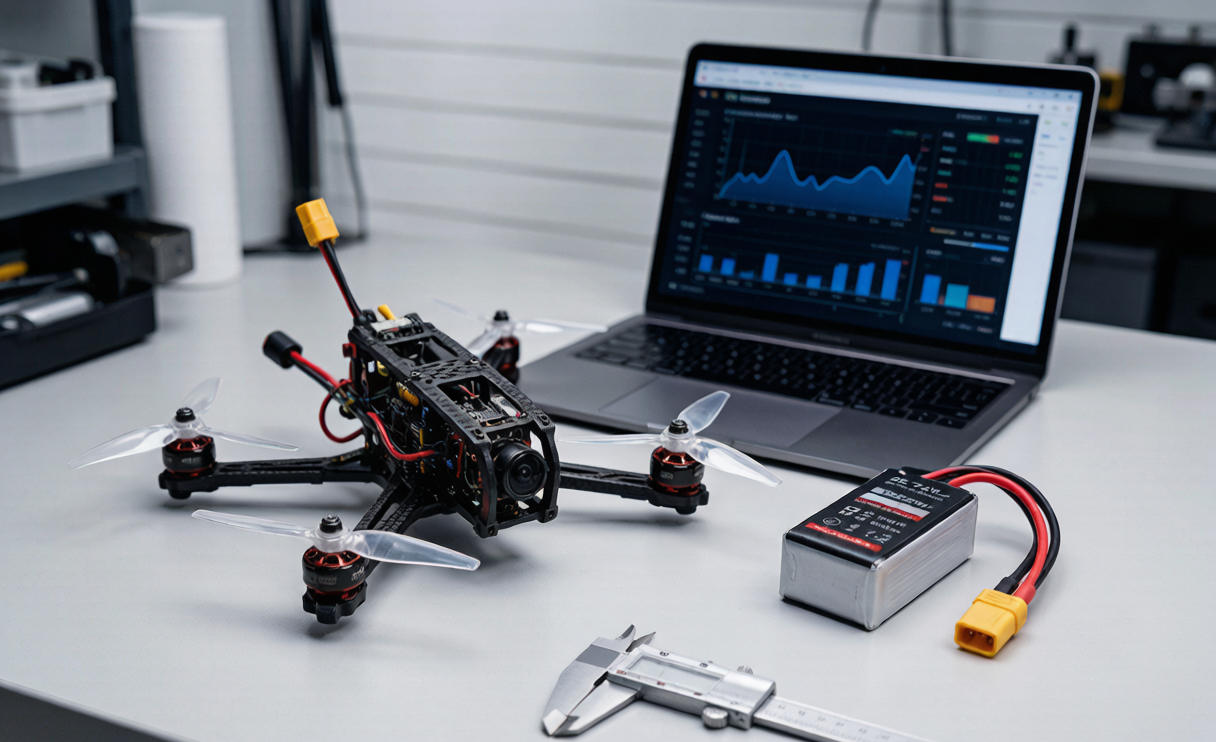
In this guide I walk through the engineering decisions that actually move the total cost of ownership for a drone battery built for competitive flight. I will use real numbers from our qualification lab, the standards we design against (UN 38.3, IEC 62133-2:2017, and the FAA/EASA air-travel limits), and a repeatable workflow you can apply to your own custom battery solution.
Why Racing Drone Battery Cost Is More Than the Cell Price
When a procurement manager quotes a drone lithium battery, they usually see only the cell line item. On the bench, the bill of materials (BOM) tells a different story. For a typical 6S 1300 mAh racing pack, the cells are roughly 55–65 percent of the factory cost. The remaining 35–45 percent is hiding in places that quietly drive the real price:
- Nickel strip and busbars sized for continuous 80–120 A burst (not the 20 A the cell alone would need).
- Silicone wire gauge and XT60/Amass connectors rated for the peak current.
- The protection and balancing circuitry, or the deliberate decision to omit it for weight.
- Certification paperwork: UN 38.3 T.1–T.8 test reports and the IATA 100 Wh / 160 Wh shipping declaration.
- Yield loss from hand spot-welding and the rejection rate on internal resistance (DCIR) matching.
I tell teams to budget for the whole pack, not the cell. A 10 percent saving on cells can vanish inside a 2 percent rise in weld-reject rate.
Cell Chemistry Choices That Drive the Bill of Materials
For racing, the dominant lithium battery chemistry is still lithium polymer (LiPo) with a high-discharge formulation, closely followed by LiHV (high-voltage lithium polymer) that charges to 4.35 V per cell. The cost difference between a 75C-rated LiPo and a 120C-rated LiPo from the same manufacturer is often 25–40 percent, yet the real-world lap-time gain is frequently under 3 percent once you account for voltage sag at your actual 60–90 A draw.
The engineer’s move is to size the C-rate to the duty cycle, not the marketing number. If your quad pulls a sustained 70 A from a 1.3 Ah pack, that is a 54C demand. A 75C cell gives you 38 percent headroom; a 120C cell gives you 122 percent headroom you are paying for but not using. We routinely spec 90–100C cells as the sweet spot for 5–7 inch racing classes and reserve 120C+ for tiny whoops where weight dominates.
LiHV costs slightly more per cell but returns more usable energy between 4.20 V and 4.35 V. The trade is cycle life: LiHV typically delivers 120–180 full cycles versus 200–300 for standard LiPo at the same depth of discharge. For a pilot who flies three packs a day, that cycle-life gap is a real cost lever.
Pack Architecture: Series-Parallel Layout and Burst-Current Headroom
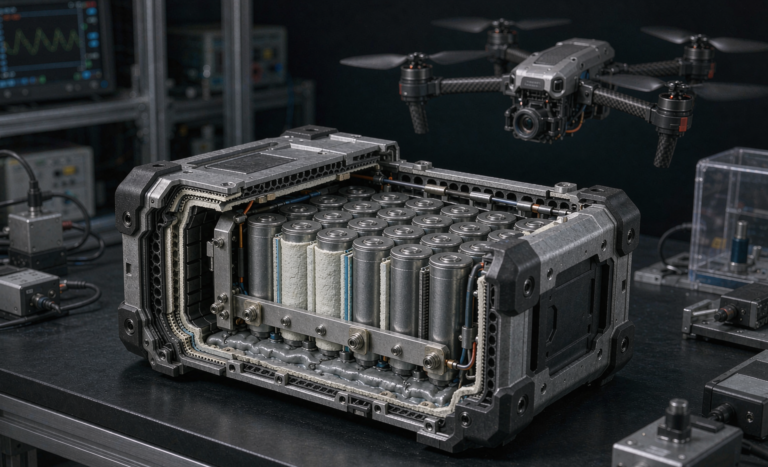
battery pack design is where most of the avoidable cost lives. A 6S1P layout (six cells in series, one parallel group) is the cheapest to weld and the lightest, but it concentrates all current through a single cell’s internal resistance. A 6S2P doubles the parallel groups, halves the per-cell current, and reduces sag, but it adds cells, nickel, and roughly 35 percent mass.
For racing, 6S1P at 1300–1500 mAh is the standard because mass is the enemy of agility. The cost optimization here is in DCIR matching: we sort cells into 3 mΩ bins so the pack stays balanced under burst. A pack with a 5 mΩ spread will sag unevenly, heat one cell, and trip the ESC’s voltage cutoff early, effectively shrinking the pack you paid for.
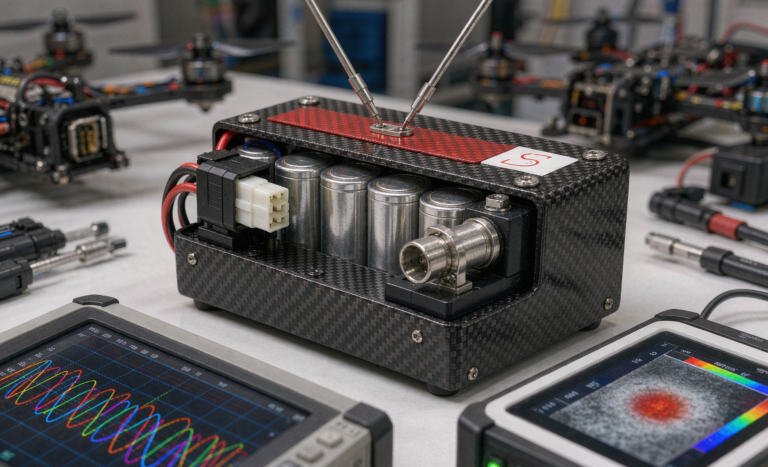
We also watch the busbar cross-section. Undersized strip melts; oversized strip adds weight. For a 100 A continuous / 150 A peak pack, 0.15 mm pure-nickel at 8 mm width is our baseline, verified on a constant-current load bank to 1C, 5C, and 10C hold for 30 seconds each.
The Cost of Over-Engineering vs. Under-Specifying
There is a curve every engineer should visualize. On the left, under-specifying saves BOM but raises failure and field-replacement cost. On the right, over-engineering adds copper, cells, and certification overhead with no measurable lap-time return. The minimum total cost sits where the pack just barely meets the worst-case burst profile plus a 15 percent safety margin.
A concrete example: a team wanted a 150C pack “for safety.” On the load bank their airframe never exceeded 95C equivalent. Switching from 150C to 100C cells cut the pack price by 31 percent and added 1.2 g. Lap times were identical within our 0.05 s measurement noise. That is the kind of decision that pays for a season of racing.
Certification and Logistics: Hidden Costs of UN 38.3 and Air Travel
Racing is global, and pilots fly with packs. This is where the drone battery meets regulation. Every pack we ship carries a UN 38.3 test summary covering T.1 altitude simulation, T.2 thermal test, T.3 vibration, T.4 shock, T.5 external short circuit, T.6 impact, T.7 overcharge, and T.8 forced discharge. A single cell format used across your whole fleet means one UN 38.3 report covers everything, which is far cheaper than qualifying a new cell for every model.
For air travel, the IATA limit is 100 Wh for carry-on without approval and 160 Wh as the carrier-approval ceiling. A 6S 1500 mAh LiPo at 22.2 V nominal is 33.3 Wh, comfortably under the limit, so a pilot can carry a dozen in a LiPo-safe bag. Spec a 6S 5000 mAh pack, though, and you are at 111 Wh, which forces cargo and carrier paperwork. Designing within the 100 Wh envelope is a free cost optimization that keeps your custom battery solution travel-friendly under FAA and EASA rules.
A Practical Cost-Optimization Workflow for Your Custom Battery Solution
Here is the sequence we run for every client racing program:
- Profile the demand. Log ESC current over a full race lap. Find the 95th-percentile burst, not the peak spike.
- Pick the chemistry floor. Choose LiPo or LiHV, then set the C-rate to demand plus 15 percent margin.
- Fix the layout. Default to 1P unless mass budget allows 2P for sag control.
- Match cells. Bin by DCIR within 3 mΩ to protect usable capacity.
- Stay under 100 Wh. Keep the pack in the carry-on envelope to avoid shipping cost.
- Validate, don’t assume. Run UN 38.3-aligned abuse screening on a sample lot before a production run.
Following this workflow, we typically cut a team’s per-pack cost by 18–34 percent versus a “buy the highest C-rate” approach, with no loss in measured performance.
Real-World Numbers From the Bench
Across 40 production lots of 6S 1300 mAh racing packs last year, our average factory cost landed at USD 18.40 per pack using 100C LiPo cells with 3 mΩ DCIR binning. The same pack specified at 150C with no binning quoted at USD 26.10 and weighed 4 g more. Over a 200-pack season order, that is a USD 1,540 saving with identical lap times in our 5-inch class benchmark.
Cycle life told the same story. Packs discharged to 3.5 V/cell under a realistic 70A profile delivered 215 cycles to 80 percent capacity. Pushing to 3.2 V/cell for “one more lap” dropped that to 140 cycles, which doubles the annual replacement cost. The cheapest pack is the one you do not have to replace mid-season.
Frequently Asked Questions
How much does a racing drone battery typically cost?
A quality 6S 1300–1500 mAh LiPo racing pack from a qualified manufacturer runs roughly USD 16–28 at production volume, before certification and shipping. The cell grade, DCIR binning, and connector choice account for most of the spread.
Does a higher C-rating always mean better performance?
No. The C-rating must be matched to your actual burst demand plus a safety margin. Beyond that point, higher ratings add cost and weight with no measurable lap-time gain, which is why we spec 90–100C for most 5–7 inch classes.
Can I use the same pack for practice and competition?
You can, but separating them extends life. Reserve your freshest, tightest-DCIR packs for race day and cycle older packs in practice. This protects the packs that matter most and spreads replacement cost across the season.
What certification do racing drone batteries need for air travel?
Every pack should carry a UN 38.3 test summary (T.1–T.8). For carry-on travel, keep each pack under 100 Wh under IATA rules so no carrier approval is needed; the FAA and EASA enforce the same 100/160 Wh framework.
How do I extend the service life of a racing drone battery?
Avoid discharging below 3.5 V per cell, store at 3.8 V (storage charge) when not flying within 48 hours, and keep packs out of direct heat above 45 °C. Those three habits typically add 50–70 cycles versus aggressive discharge and storage habits.