Drone Battery Manufacturing for Racing Drones
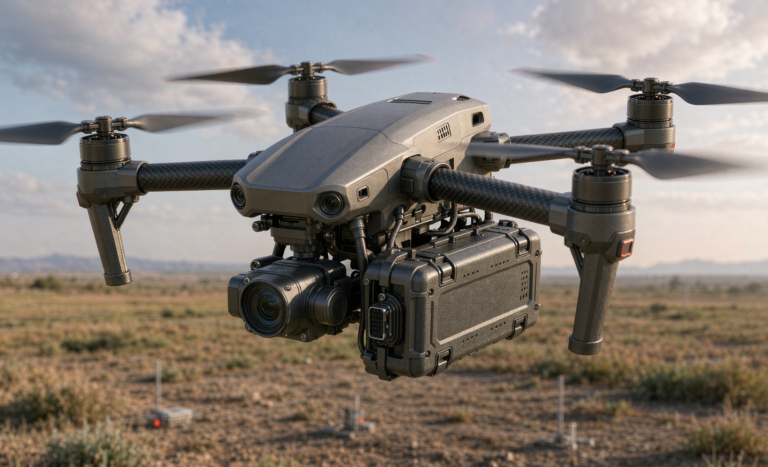
Racing drones are unforgiving machines. The instant a pilot slams the throttle forward, the entire flight depends on whether the drone lithium battery can deliver brutal, repeatable bursts of current without voltage sag, dangerous heating, or swelling. After more than a decade on the manufacturing floor building packs for FPV racers, I can tell you plainly that drone battery manufacturing for racing drones is a discipline completely separate from building consumer or industrial cells. We are not optimizing for calendar life, cycle count, or cost per watt-hour. We are optimizing for power density, discharge consistency, and a weight budget measured in single grams. In this article I will walk through how a high-performance racing pack is actually made, the safety standards it must clear, and where a custom battery solution gives a competitive pilot the edge that wins heats.

Why Racing Drone Batteries Are Built Differently
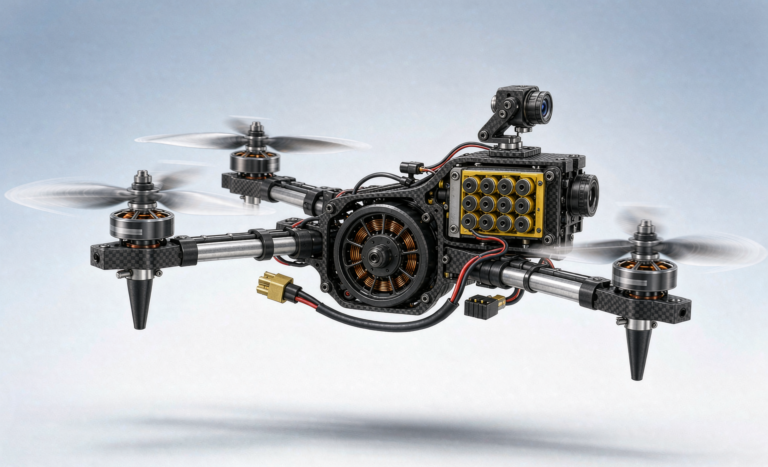
A typical 5-inch FPV racer drawing a 6S pack will pull 80A to 150A plus during hard acceleration and propwash recovery. That is a continuous discharge rate of 40C to 70C, with momentary burst demands well above 100C. A standard lithium battery designed for a flashlight or a scooter would collapse under that load. The cell chemistry, the weld joints, and the internal busbars all have to be engineered so the pack holds its voltage under extreme load.
Weight is the second master constraint. Every gram of battery mass is a gram the motors must lift and the frame must carry. A racing pack is therefore a constant trade-off: more capacity means longer flight but heavier mass and slower responsiveness. Most serious racers settle in the 4S–6S, 1300mAh–1800mAh band, where the energy-to-weight ratio is tuned for 3 to 5 minutes of maximum-attack flying rather than endurance.
Cell Chemistry — LiPo, LiHV, and Graphene Hybrids
The backbone of almost every racing drone battery is still the lithium polymer (LiPo) pouch cell. Standard LiPo charges to a 4.20V per-cell cutoff. The higher-energy variant, LiHV (lithium high voltage), charges to 4.35V per cell, squeezing roughly 5% to 8% more energy from the same mass. For a racer fighting for tenths of a second, that headroom is meaningful — but LiHV is less forgiving on degradation if over-charged, so our manufacturing process grades and labels it strictly.
Over the last few years, graphene-doped and silicon-anode hybrid cells have moved from marketing buzzword to real production. The additive lowers internal resistance and improves thermal behavior, which translates directly into less voltage sag at high C-rates. In our own test benches, a well-made graphene-hybrid 6S 1500mAh pack holds 1.0V to 1.5V higher under a 100A load than an equivalent standard LiPo of the same mass.
The Manufacturing Flow — From Raw Cell to Flight-Ready Pack
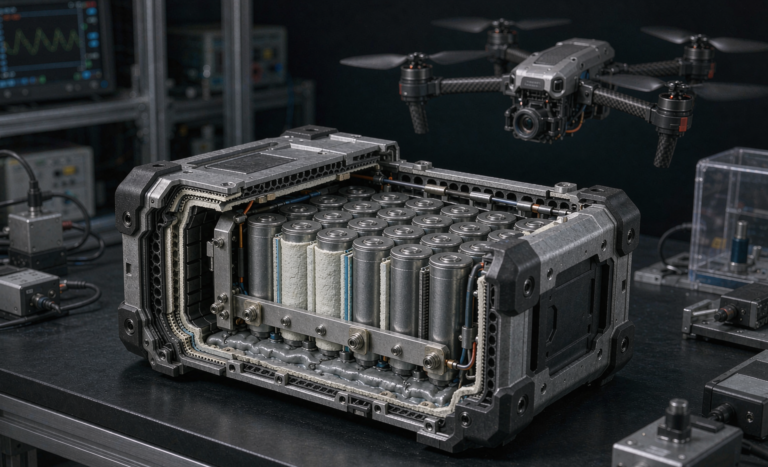
Drone battery manufacturing for racing drones follows a tightly controlled sequence. I will break it into the stages we run on our line:
- Incoming cell inspection. Every pouch cell is weighed and capacitance-checked. Out-of-tolerance cells are rejected before they ever reach a pack.
- Capacity and internal-resistance grading. Cells are binned into tight IR and capacity windows so a single pack is built only from matched siblings.
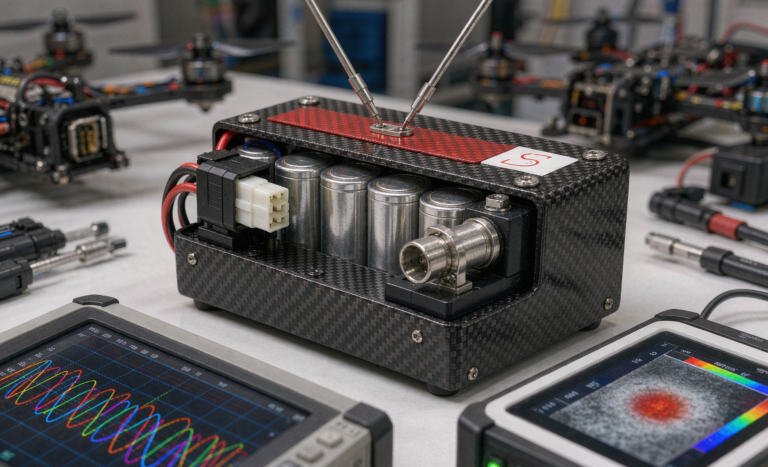
- Spot welding. Pure-nickel strips are welded to the cell tabs to form series and parallel groups with minimal joint resistance.
- Busbar and lead routing. Silicone leads and XT60 or Amass connectors are attached, with strain relief to survive crashes.
- Encapsulation. Heat-shrink or soft-case wrapping protects the assembly, with a balance lead loomed separately.
- Final charge, balance, and QC. Each pack is charged, balanced to within a few millivolts, and discharge-tested for sag.
Spot Welding, Busbars, and the Art of Low Resistance
The single most important manufacturing step for performance is the weld. A poorly welded nickel tab adds milliohms of resistance at every joint; across a 6-cell series pack that resistance becomes heat, voltage drop, and lost power. We use pure nickel strip, not nickel-plated steel, because pure nickel carries current with far lower loss and resists corrosion in humid pit areas.
Weld energy is dialed in per cell batch. Too little energy and the joint lifts under vibration; too much and you punch through the delicate pouch foil and kill the cell. On our line we qualify weld parameters on a scrap batch for every new cell shipment, then lock the settings. For racers who want the absolute lowest resistance, we offer copper-nickel composite busbars in a custom battery solution, though the cost and weight premium only pays off at the professional level.
Cell Matching, Balancing, and Capacity Grading
No two cells are identical, and a racing pack is only as strong as its weakest cell. Our grading bins cells into internal-resistance windows as tight as ±2mΩ and capacity windows of ±20mAh. When a 6S pack is built, all six series groups come from the same bin, so the pack ages evenly and the balance charger has almost nothing to correct.
We also pre-balance every pack before it ships. A freshly built pack leaves our floor within a few millivolts across cells, which means the pilot can fly almost immediately and the battery management is purely about storage, not rescue. This kind of discipline is what separates a reliable racing drone lithium battery from a random assortment of cells taped together.
Safety, Certification, and Air-Transport Compliance
High-discharge lithium packs are regulated goods, and racing teams that travel to events must comply with transport law. Every pack we manufacture is built to clear UN38.3, the United Nations test standard covering altitude simulation, thermal, vibration, shock, external short circuit, impact, overcharge, and forced discharge. Our cells also meet IEC 62133, the international safety standard for portable sealed secondary cells and batteries.
For pilots flying to races, the FAA and EASA rules matter directly. Spare lithium batteries must travel in carry-on baggage, terminals protected against short circuit, typically capped at 100Wh per battery without operator approval (a 6S 1500mAh pack is well under this). We print the watt-hour figure and the UN number on every label so a racer can clear security without argument. None of this is optional — it is part of responsible drone battery manufacturing.
Custom Battery Solutions for Racing Teams
Off-the-shelf packs cover most pilots, but serious teams increasingly ask for a custom battery solution. That can mean an unusual cell count for a experimental 7-inch or 10-inch class, a specific lead length and connector orientation to clean up cable routing, or a trimmed-mass pack where we shave grams by using thinner, higher-grade wrap and shortened balance leads.
We have built packs with asymmetric parallel groups to bias capacity toward the front of a quad, and packs with reinforced busbars for pilots who run sustained 100C loads in outdoor freestyle. The engineering trade is always the same: more performance or more capacity costs weight or cycle life. A good custom design makes that trade explicit instead of accidental.
Frequently Asked Questions
What C-rating do racing drone batteries need?
For modern 5-inch FPV racing on 4S–6S, plan for a continuous rating of at least 75C to 100C and a burst rating above 150C. The higher the C-rating relative to your actual draw, the less voltage sag you will see and the more consistent your throttle response will feel through a whole pack.
Are LiHV batteries better than standard LiPo for racing?
LiHV charges to 4.35V per cell and delivers roughly 5% to 8% more energy for the same mass, which can translate into a small but real speed and punch advantage. The downside is tighter charging discipline and slightly faster wear if abused. Many racers run LiHV for qualifying and standard LiPo for longer practice sessions.
How do manufacturers keep racing packs so light?
Weight is controlled at every step: thin pouch foil, pure-nickel strips sized to the current rather than over-built, short silicone leads, minimal wrap, and tight cell matching that removes the need for heavy protective structure. A few grams saved in the battery is worth more than a few grams saved anywhere else on the airframe.
Can I ship racing drone batteries by air?
Yes, but only as carry-on spare batteries with terminals protected, and within the watt-hour limits enforced by the FAA and EASA. Keep packs under 100Wh per battery unless you have operator approval, and carry documentation showing UN38.3 compliance. We label every pack with the Wh figure to make this straightforward.