Drone Battery Safety for Racing Drones
Walk into any FPV racing pit area on a race weekend and you will see something that would make a consumer-electronics safety engineer nervous: racers carrying dozens of fully charged high-discharge lithium packs in backpacks, swapping them between heats, and charging them at 4C or higher in the open air. As a senior lithium battery engineer who has spent years designing packs for competitive drone racing, I can tell you that a racing drone battery is one of the most demanding and potentially dangerous energy-storage products on the market. A typical 6S racing pack can deliver 60C continuous and 120C burst, which means it can dump enough current to weld a wrench or ignite itself if something goes wrong. In this article I lay out the safety engineering we use to keep that energy contained, from cell chemistry and pack protection to charging discipline, storage, transport, and the field protocols that separate a safe race day from a burned-down trailer.
Why a Racing Drone Battery Is a Special Safety Case
Most lithium products are designed to spend their lives inside a protective enclosure, gently cycled by a conservative battery management system. A racing drone is the opposite environment. The pack is exposed, frequently crashed, fast-charged between heats, and pushed to its absolute electrical limit. Three factors combine to make drone battery safety racing drones a discipline of its own:
- Extreme discharge rates. Racing draws 40C to 120C in bursts. At those currents even a few milliohms of internal resistance becomes tens of watts of self-heating inside the cell.
- Mechanical abuse. Crashes mean impact, crush, and puncture, the three classic triggers of internal short circuits.
- Field conditions. Packs are charged, carried, and stored in non-climate-controlled spaces by operators who are focused on lap times, not battery chemistry.
When I brief a new racing team, I tell them the single most important fact: a lithium cell failure is not gradual. Once a cell enters thermal runaway it can reach 500 to 700 degrees Celsius in seconds and vent flammable electrolyte. The entire safety design goal is to make sure that never starts, and that if one cell does fail, it cannot propagate to the rest of the pack.
Cell-Level Safety: Chemistry, Separator, and Internal Short
The first line of defense is the cell itself. A drone lithium battery for racing is almost always a high-rate lithium polymer or cylindrical NMC cell with a thin separator and a cobalt-rich cathode to maximize power density. That chemistry is unforgiving, so we engineer around it:
- Separator shutdown temperature. We specify separators with a shutdown point a full 20 to 30 degrees below the onset of exotherm, so a local hot spot melts the separator and isolates the short before it cascades.
- Internal short resistance. Every production lot is screened for dendrite risk by measuring self-discharge and DC internal resistance spread; cells outside tolerance are rejected before they ever reach a pack.
- Cathode choice. For racing we accept the higher risk of LCO/NMC because the power-to-weight ratio is non-negotiable, but we compensate with stricter pack-level protection than we would apply to a lower-rate cell.
This is where a generic consumer pack and a racing pack diverge. The cell chemistry is more aggressive by design, which means every other layer of safety has to be stronger to compensate.
Thermal Runaway and Propagation Control
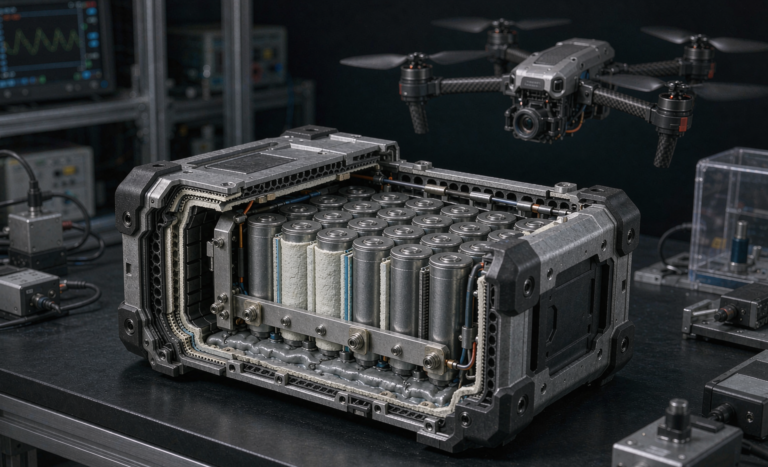
Thermal runaway propagation, or TRP, is the failure mode that turns one bad cell into a fire. In a tightly packed racing battery the cells sit millimeters apart, so heat from one cell preheats its neighbors and lowers their trigger threshold. Our mitigation strategy has four parts:
- Thermal barriers. We place ceramic or aerogel-based barriers between cell groups to break the conduction path.
- Vent routing. Pouch cells are oriented so their burst vents point away from adjacent cells and away from the drone frame.
- Spacing and potting. Where weight allows, a thin layer of thermally conductive but electrically isolating potting slows local heating.
- Trigger margins. We set the protection cutoff well below the runaway threshold so the BMS acts long before chemistry does.
In our bench tests a well-barriered 6S pack can contain a single-cell failure without propagating, which is the difference between losing one pack and losing the aircraft.
Pack-Level Protection: PCM, Balancing, and BMS
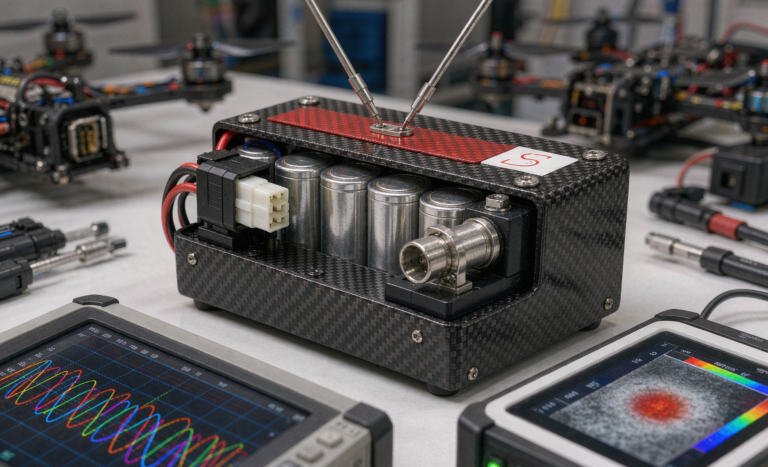
No racing pack should fly without active protection. The protection architecture we use combines three functions:
- Primary protection (PCM). A resettable protector switch opens the circuit on over-current, short circuit, and over-temperature. For racing we size it to clear a dead short in under 200 milliseconds.
- Active balancing. Cell imbalance is the silent killer of racing packs. We balance to within 10 millivolts per cell so no single cell is over-stressed during the high-current discharge.
- BMS telemetry. Race-grade packs report per-cell voltage and temperature to the flight controller, and we configure hard cutoffs for over-voltage, under-voltage, over-current, and over-temperature.
I have seen packs saved by a correctly sized protector more times than I can count. The mistake racers make is bypassing protection to save a few grams, then wondering why a pack went up in flames after a prop-strike short.
Mechanical Safety: Surviving the Crash
If you race, you crash. Mechanical safety is about ensuring a crash damages the drone, not the battery’s internal integrity. We address three hazards:
- Hardcase versus softcase. For airframes with tight frames we use hardcase cells; where weight dominates, we add a molded enclosure and energy-absorbing foam around softcase pouches.
- Crush and puncture resistance. The pack is positioned away from the heaviest impact zones, and leads are strain-relieved so a crash cannot yank a tab and create an internal short.
- Lead and connector security. XT60 or MR30 connectors are crimped and sealed, not soldered in the field, because a cold solder joint is both a resistance heater and a failure point.
The goal is simple: the battery should stay electrically intact even when the airframe does not.
Charging Safety: The Highest-Risk Hour
More racing battery fires happen on the charging table than in the air. Charging concentrates energy into a pack that may already be warm from a previous flight. Our charging rules are non-negotiable:
- Charge rate limits. We charge at 1C to 4C depending on cell rating, never beyond the manufacturer’s specified maximum, and never a warm pack.
- Balance charging every cycle. A smart charger that balance-charges each cell is mandatory; fast-charge without balancing is how cells drift into overcharge.
- Never leave unattended. Every charging pack sits in a fireproof LiPo bag on a non-combustible surface, in view of the operator.
- Cool-down between cycles. We enforce a rest period so cell temperature returns to ambient before the next charge.
The temptation at a race is to charge as fast as possible between heats. Resist it. A pack charged hot at 6C is a pack one internal short away from a fire.
Storage and Transport Safety
Off the track, the hazards shift to storage and shipping. Any lithium battery left at full charge degrades faster and is more volatile; any pack shipped carelessly is a regulatory and safety liability.
- Storage state of charge. We store racing packs at 3.7 to 3.85 volts per cell, roughly 30 to 50 percent state of charge, in a cool dry place inside fireproof containers.
- UN38.3 and IEC 62133-2. Every pack we ship has passed the UN38.3 T.1 through T.8 test sequence (altitude, thermal, vibration, shock, external short, impact, overcharge, forced discharge) and the IEC 62133-2 safety standard.
- Air transport. For air freight we follow IATA rules: packs at or below 30 percent state of charge, individually protected against short circuit, and within the FAA and EASA limits of 100 to 160 watt-hours per battery for most carry-on scenarios.
- Fireproof containment. During transport packs ride in certified LiPo-safe cases, never loose in a bag with metal objects.
Field Protocols: The Pre-Flight and Post-Flight Checklist
Good engineering fails if the operator ignores it. We train every team on a two-minute checklist:
- Pre-flight. Inspect the pack for swelling, punctures, or heat; verify every cell is within 0.1V and the balance lead is seated; confirm the protector has not tripped.
- During flight. Watch telemetry for per-cell voltage sag and pack temperature; land early if a cell drops below 3.3V under load.
- Post-flight. Feel the pack; if it is hot or swollen, quarantine it immediately in a safe container and do not recharge it.
A swollen pack is not a pack you nurse along. It is a pack you retire. I have watched racers try to discharge a puffed cell “one more time” and lose the pack and the workbench with it.
Incident Response: What to Do When a Pack Fails
Even with perfect engineering, field abuse eventually produces a bad pack. The response protocol matters as much as prevention:
- Isolate. Move the pack to a non-combustible, well-ventilated area away from other packs and flammables.
- Do not handle a venting cell. If it is hissing or smoking, let it burn out in a safe container; electrolyte fumes are toxic.
- Have suppression ready. A Class D extinguisher or a bucket of sand is the right tool; water on a lithium fire can make it worse.
- Quarantine and analyze. We log every failed pack, cut it open in the lab, and trace the failure to a cell, a weld, or an abuse event so the next design improves.
This feedback loop is how a custom battery solution for racing actually gets safer over time. Every incident is data.
Building Safety In, Not Bolting It On
The teams that never have fires are the ones that treat safety as a design layer, not an afterthought. That means specifying the right cell, engineering thermal and mechanical protection into the pack, enforcing charging and storage discipline, and training operators on field protocols. When a client comes to us for a racing program, we do not just sell them cells; we deliver a complete safety architecture tuned to their airframe, their charge logistics, and their race-day workflow. The result is a drone battery that wins laps and comes home in one piece.
What is the safest state of charge for storing racing drone batteries?
Store racing packs at 3.7 to 3.85 volts per cell, which is roughly 30 to 50 percent state of charge. This minimizes both capacity loss and the risk of thermal events during long-term storage, and it is also the level required for air transport under IATA rules.
How fast can I safely charge a racing drone battery?
Charge at the cell manufacturer’s rated maximum, commonly 1C to 4C for racing packs, and never charge a pack that is still warm from flight. Always balance-charge every cycle and never leave a charging pack unattended.
Why does cell balancing matter so much for safety?
Imbalanced cells force the weakest cell into over-voltage during charge and under-voltage during discharge, both of which accelerate degradation and raise the risk of internal short. Balancing to within about 10 millivolts per cell keeps every cell inside its safe window.
What certifications should a racing drone battery meet?
At minimum, packs should pass UN38.3 T.1 through T.8 and comply with IEC 62133-2. For air transport, follow IATA state-of-charge and packaging rules and stay within FAA and EASA watt-hour limits, typically 100 to 160 Wh per battery.
What should I do if a racing pack swells after a flight?
Quarantine it immediately in a fireproof container away from other packs and flammables, do not recharge it, and retire it. A swollen pouch cell indicates internal damage and can enter thermal runaway without warning.