Drone Battery Energy Density vs Power Density Tradeoffs
When a buyer asks me to “just give me the longest flight time,” the first thing I do is stop and ask a sharper question: is your mission energy-limited or power-limited? That single distinction sits at the heart of every drone battery energy density power density tradeoff we engineer at Horizon Power, and getting it wrong is the most common reason a pack underperforms in the field. I am Karl Huang, a senior lithium battery engineer here, and over the last decade I have specced cells for everything from 250-gram racing quads to 12-kilogram survey airframes. The lesson repeats itself on every program: energy density and power density are not the same axis, and the cell chemistry that wins one usually loses the other.
Energy Density and Power Density Are Not the Same Thing
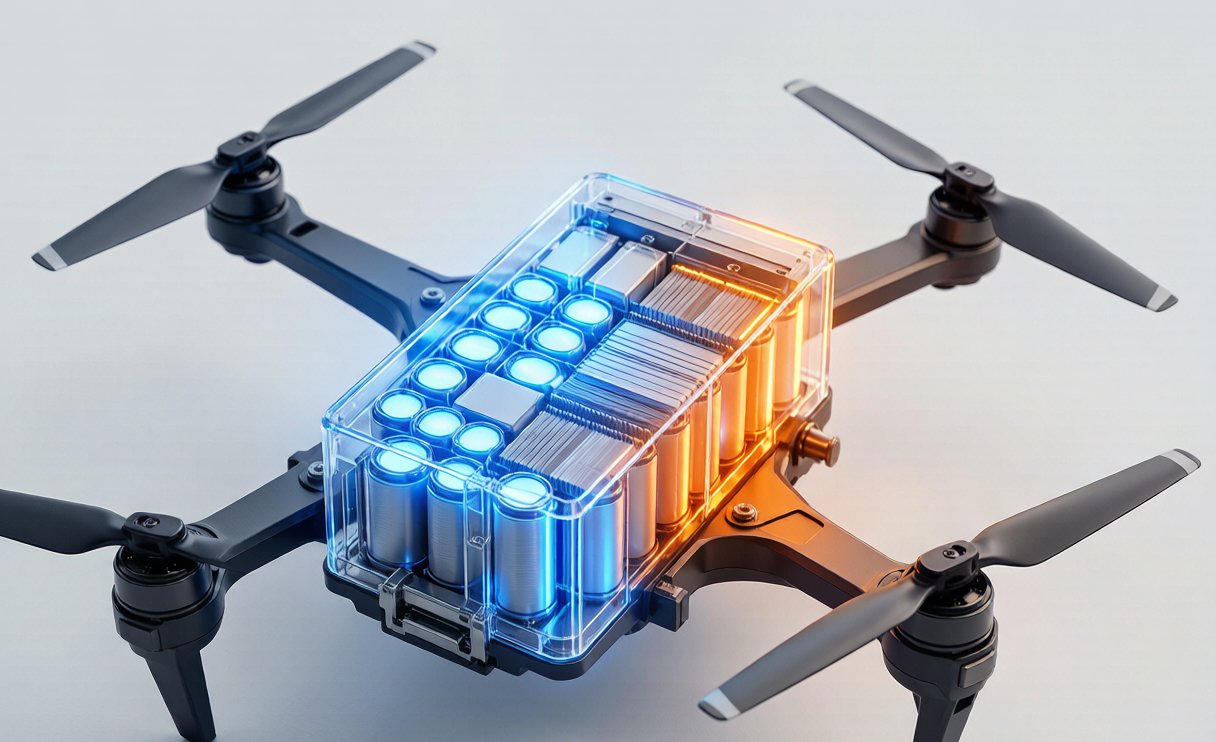
The first confusion I clear up with any customer is vocabulary. Energy density is how much energy a pack stores per unit of mass or volume. We quote it two ways: gravimetric in watt-hours per kilogram (Wh/kg) and volumetric in watt-hours per liter (Wh/L). This number sets your flight time. A 230 Wh/kg drone lithium battery simply carries more minutes than a 150 Wh/kg pack of the same weight.
Power density is how fast you can pull that energy back out, measured in watts per kilogram (W/kg). This number sets your acceleration, climb rate, gust rejection, and how many amps the pack can source before its voltage collapses. A long-endurance mapping quad is energy-limited: it sips current for 25 minutes. A racing drone at launch is power-limited: it yanks 150 amps for three seconds. The same battery chemistry rarely wins both races, and that is the tradeoff every engineer has to manage.
Reading the Ragone Plot: Why the Two Fight Each Other
Battery engineers visualize this on a Ragone plot, a log-log chart of power density against energy density. All lithium-ion sits on one falling curve: as you slide toward higher energy, you give up power, and vice versa. Here is where the major lithium battery chemistries actually land in production packs:
- NMC / NCA (high-energy): 200-250 Wh/kg, 3-5C continuous discharge, 10-15C pulse. The default for endurance and payload drones.
- LFP (lithium iron phosphate): 120-160 Wh/kg but unusually low internal resistance (1-3 mΩ) and easy 3-5C / 10C pulse. Lower energy, excellent power, and outstanding cycle life (2,000-4,000 cycles).
- High-power LiPo (racing grade): 150-200 Wh/kg but 30-50C burst rating with very low IR of 3-6 mΩ. Built to dump current, not to cruise for an hour.
- Semi-solid-state (qualifying): 250-300 Wh/kg, closing the gap between energy and power as the chemistry matures for aerospace use.
The practical rule I give buyers: the further up the energy axis you push, the harder it becomes to pull high power without damaging the cell. You cannot simply “add more C-rate” to an energy cell; the electrode physics will not allow it.
The Internal-Resistance Link: Why Thick Electrodes Cost Power
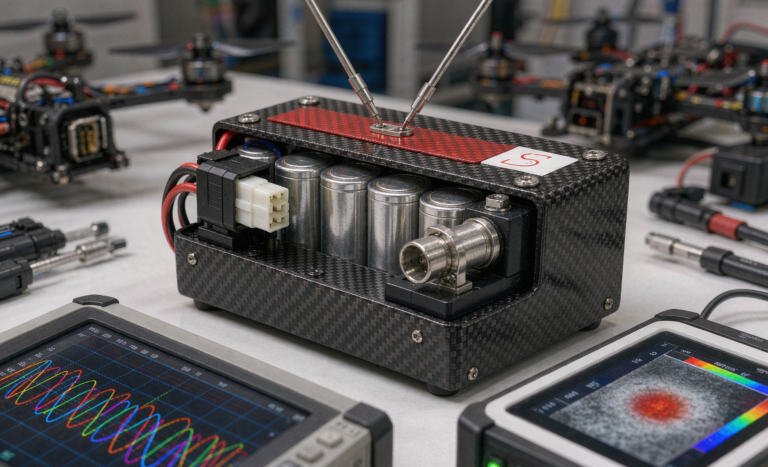
The reason is physical. A high-energy cell uses thick electrodes packed with active material to maximize Wh/kg. But thicker electrodes mean a longer ionic diffusion path, which raises the cell’s direct-current internal resistance (DCIR). A high-power cell does the opposite: thin electrodes and high surface area keep DCIR low, but there is less material, so energy drops.
DCIR is what determines voltage sag under load. The sag is simply V = I x R. At 150 A on a 12S pack with 8 mΩ internal resistance, you lose about 1.2 V, roughly 2.5 percent of the 50.4 V nominal. That is acceptable. But take an energy-only cell that has drifted to 20 mΩ and the same 150 A produces a 3 V sag, over 6 percent, and your motors lose headroom while the ESC runs hot. So Wh/kg and mΩ are two sides of one coin: you cannot maximize both in a single chemistry without paying somewhere.
How Mission Profile Sets the Tradeoff
Once a buyer understands the axes, the next step is to map the actual flight profile. I split missions into two archetypes:
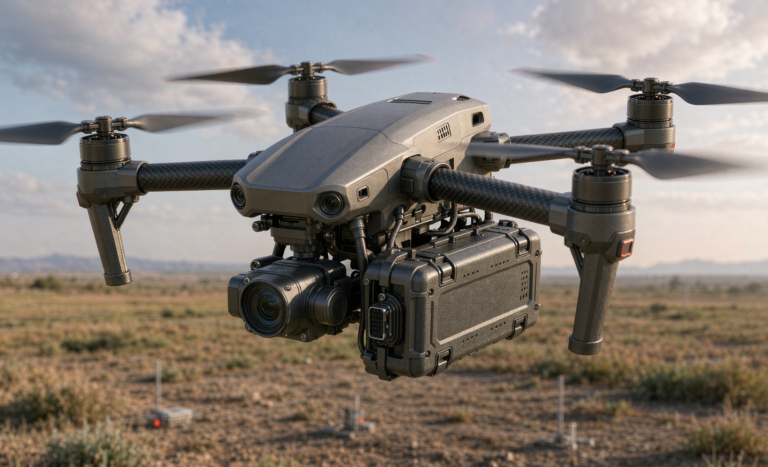
- Endurance and loiter missions (survey, mapping, search and rescue, BVLOS corridor cruise) are energy-limited. You want the highest Wh/kg cell that still meets the peak burst needed for takeoff and climb. NMC / NCA at 200-250 Wh/kg, or semi-solid where it qualifies, is the right call.
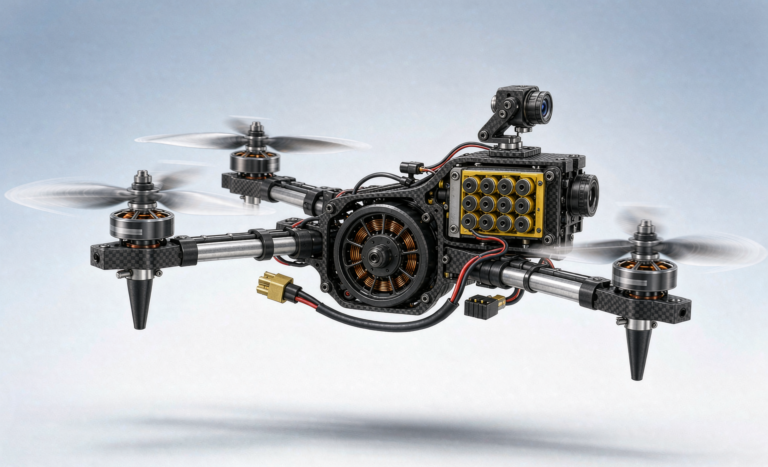
- Burst and agility missions (racing, rapid climb, hard wind-gust correction, payload drops) are power-limited. You need low IR and a high C-rate. A high-power LiPo or an LFP blend earns its place even though its energy is lower.
I have watched teams bolt a beautiful high-energy pack onto an aggressive racing frame and wonder why it thermals out in lap two. The mission was power-limited; they bought energy. Matching the cell to the dominant limit is 80 percent of a good drone battery design.
Pack Architecture: Voltage and Parallel Groups as Levers
Cell choice is only half the story. How you assemble the pack changes the tradeoff materially.
Series count (S) raises voltage. For a fixed power P, current I = P / V, so a 12S pack draws half the current of a 6S pack at the same power, and because loss scales with I², that quarters the I²R heating. This is exactly why heavy-lift and cinema ships run 12S or 14S: higher voltage gives them more usable power from the same cells. If your platform allows it, going up a voltage step is the cheapest power upgrade available.
Parallel groups (P) multiply both capacity and current capability. A 2P arrangement doubles energy and doubles peak current, but it also adds mass. The cleaner approach is to choose a cell whose rated C-rate times its usable capacity meets the required peak current. For a 6S 22 Ah pack (about 0.49 kWh) hovering at 60 A, that is roughly 2.7C continuous and 5.5C at a 120 A burst, which energy cells rated 3-5C continuous and 10C pulse handle comfortably. A racing airframe asking 30C+ needs the power-grade chemistry instead.
Thermal Consequences of the Tradeoff
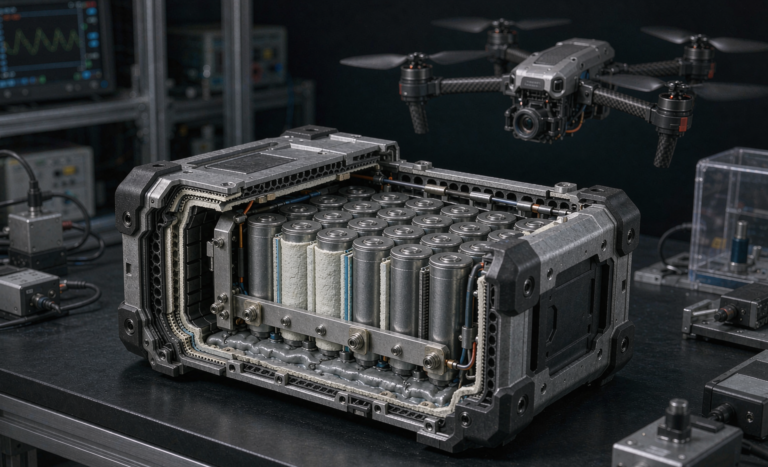
Power cells shed more heat during bursts because internal loss is P_loss = I²R. A pack delivering 6 kW with 8 mΩ of internal resistance is dissipating about 48 W inside the casing. Energy cells, with their higher IR, lose even more at the same current. So a high-power mission demands thermal headroom: sealed passive pods, potting or conformal coating, and careful airflow design. We avoid fans in dusty field environments because they ingest abrasive fines that destroy terminals.
Cold makes the tradeoff brutal. At -20°C a lithium battery delivers only 55-60 percent of its 25°C capacity, and the thick electrode of an energy cell suffers most. Cold plus high power is the worst case, which is why our cold-weather packs include 5-15 W pad heaters to hold the core in a 10-25°C window before launch.
A Worked Example: The 2 kg Class Survey Quad
Numbers make the tradeoff tangible. Take an all-up-weight 2 kg quad needing 1.8 kW to hover, flying 12S. A 25-minute hover demands about 750 Wh usable; with 80 percent depth-of-discharge and a 20 percent margin, you need roughly 940 Wh installed. At a realistic pack-level 230 Wh/kg (cell 250 Wh/kg times 0.9 pack efficiency), that battery weighs about 4.1 kg, which already exceeds the airframe’s 2 kg budget. The conclusion is uncomfortable but real: with today’s chemistry you cannot have both 25 minutes and a 2 kg airframe. You accept 12-15 minutes on a 1.5-2 kg battery, or you grow the airframe.
Contrast that with a burst-climb mission: 90 seconds at 6 kW to gain altitude, then a long glide. The energy cell would weigh 6 kg for its 940 Wh, but you only need a small 0.3 kWh burst pack, around 2 kg, because gliding supplies the rest. Same airframe, completely different battery archetype. This is why we never spec a pack from a headline number alone.
Our Engineering Selection Framework
When a partner comes to Horizon Power, we run the same six-step framework on every custom drone battery program:
- Step 1: Define mission energy (Wh required) and peak power (W) from the real flight profile, not the marketing sheet.
- Step 2: Compute required C-rate = Peak Power / Pack Wh.
- Step 3: Pick a chemistry where rated C-rate times usable Wh meets the peak, and where Wh/kg gives an acceptable pack mass.
- Step 4: Choose the S/P count so operating current stays below 50 percent of the cell maximum and voltage sag stays under 8 percent of nominal.
- Step 5: Validate thermal behavior (I²R loss and temperature rise) from -20°C to 50°C ambient.
- Step 6: Lock the design. A custom battery solution is not simply “bigger”; it is “right-shaped” for the mission’s dominant limit.
Compliance and Safety Notes
No matter where the tradeoff lands, every pack we ship clears the same regulatory bar. We certify to UN38.3 (tests T.1 through T.8), build to IEC 62133-2:2017, and respect the FAA / EASA 100-160 Wh carry-on ceiling and IATA 30 percent state-of-charge rule for shipping. High-power cells still must survive the same abuse tests as energy cells, so we screen internal resistance and verify thermal-runaway propagation control between cells. A powerful pack that cannot pass transport certification is not a solution; it is a liability.
Frequently Asked Questions
What is the difference between energy density and power density in a drone battery?
Energy density (Wh/kg) is how much total energy the pack stores and therefore how long it can fly. Power density (W/kg) is how fast that energy can be delivered and therefore how hard the drone can accelerate, climb, or reject gusts. A long flight needs high energy density; a hard launch needs high power density, and the same cell rarely maximizes both.
Which chemistry gives the best energy density for long-endurance drones?
NMC or NCA lithium-ion at 200-250 Wh/kg is the workhorse for endurance and payload drones, with semi-solid-state cells at 250-300 Wh/kg beginning to qualify for aerospace use. LFP trails on energy at 120-160 Wh/kg but wins on cycle life and power, so it often anchors ground charging nodes rather than the airframe.
Can a high-energy drone battery also deliver high power?
Up to a point. A high-energy NMC cell might manage 3-5C continuous and 10-15C pulse, which covers most survey and inspection missions. But for racing-grade 30-50C bursts you need a power-oriented LiPo or LFP blend, because thick high-energy electrodes raise internal resistance and limit how fast current can be pulled safely.
How does pack voltage affect the energy versus power tradeoff?
Higher series voltage reduces current for the same power (I = P / V), which cuts I²R heating by the square of the voltage ratio. Moving from 6S to 12S halves current and quarters loss, effectively letting the same cells deliver more usable power. That is why heavy-lift and cinema drones run 12S or 14S platforms.
How do I know if my mission is energy-limited or power-limited?
Plot your flight profile. If the drone draws modest current for a long time, hover-dominated, you are energy-limited and should maximize Wh/kg. If it demands short, violent bursts of current for climb or agility, you are power-limited and should prioritize low internal resistance and a high C-rate. Most survey missions are energy-limited; most racing and rapid-climb missions are power-limited.