Drone Battery Performance for Delivery Drones
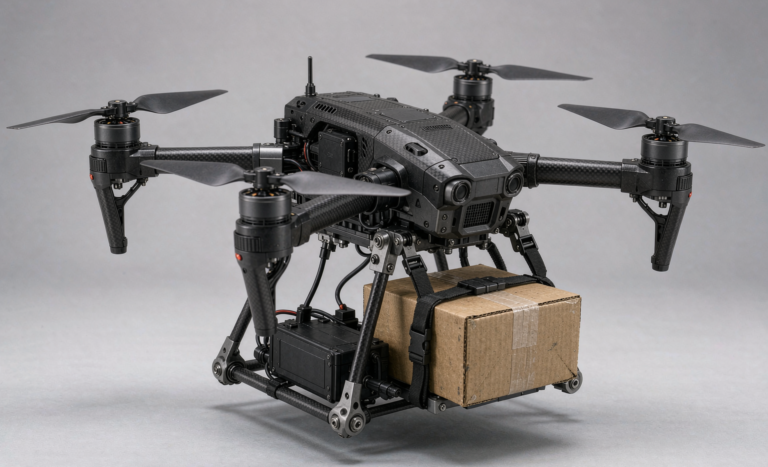
As a senior lithium battery engineer at Horizon Power, I have spent the last decade sizing packs for everything from racing quads to industrial inspection airframes. Delivery drones are a different animal. When the cargo is the payload itself, every gram of package mass is paid for directly in flight minutes, and a fleet that runs 100 parcels a day cares far more about cycle life and fast-charge throughput than about squeezing the last watt-hour out of a single sortie. In this article I will break down how we engineer drone battery performance for delivery operations — the payload-mass endurance curve, the power profile of a real delivery sortie, and why depot throughput, not peak range, is the number that actually decides fleet economics.
Why Delivery Drones Stress a Battery Differently
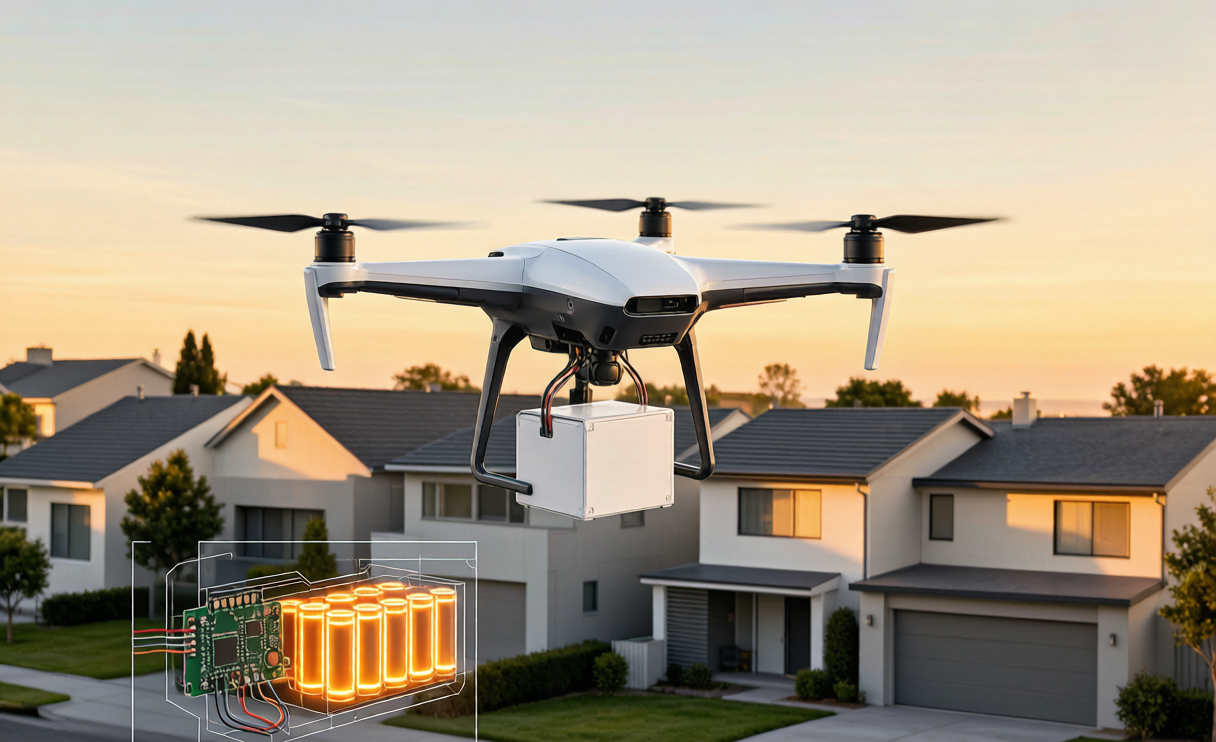
Compared with mapping or inspection airframes — where the aircraft simply transits and loiters — a delivery drone repeats one of the hardest duty cycles in the business: a high-C-rate vertical takeoff, a cruise leg, a hover-and-drop maneuver, and a return-to-home with reserve. Takeoff is the peak-power event. A 6 kg delivery quad can pull 3.5–5.0 kW for 6–10 seconds, which is 6–9C on a 0.6 kWh pack. Then it must do that again every 8–15 minutes, all day. The pack is not just energy-limited; it is pulse-power-limited, and repeated pulses heat it. A drone lithium battery for delivery therefore has to be specified for both Wh/kg and sustained pulse C-rate, a balance most consumer packs get wrong.
The Payload-Mass Endurance Curve
The single most useful chart for a delivery operator is the payload-mass endurance curve: hover power rises almost linearly with takeoff weight, so endurance falls almost linearly with package mass. As a worked example, take a 12S 22 Ah (≈0.97 kWh) NMC pack at 250 Wh/kg in a quad that draws 1.6 kW hovering empty at 4 kg. Adding a 2 kg parcel raises all-up weight to 6 kg and hover draw to ~2.4 kW; a 5 kg parcel pushes all-up weight to 9 kg and hover to ~3.3 kW. The result: a reserve-limited 22-minute hover shrinks to ~14 minutes at 2 kg and ~10 minutes at 5 kg. Every 250 g of package is roughly 1.0–1.5 minutes of endurance lost. That is why we almost always recommend a lithium battery sized to the 95th-percentile parcel mass, not the average — sizing to the average silently strands your heaviest 5% of routes.
The Power Profile of a Delivery Sortie
A single delivery sortie is an energy budget, not a range number. Break it into five terms: (1) takeoff spike — 3.5–5.0 kW for 6–10 s ≈ 0.06–0.14 kWh; (2) cruise out — 0.8–1.4 kW over a 3–6 km leg ≈ 0.20–0.50 kWh; (3) hover-and-drop — 1.5–2.5 kW for 20–60 s while the winch or release settles the parcel ≈ 0.01–0.04 kWh; (4) cruise back + RTL ≈ 0.15–0.35 kWh; (5) regulatory reserve — FAA Part 107 and EASA SORA both expect a minimum state-of-charge buffer, which in practice means we hold back 25–30% of usable capacity as a return-and-landing safety margin. Net usable energy after reserve is typically 0.55–0.70 kWh of the 0.97 kWh installed. The engineering takeaway: design the pack so any single term can be served without the bus voltage sagging below the ESC’s undervoltage lockout — which is why pack DCIR, verified at 1 kHz and a 3C/10 s pulse, is the spec we watch most closely on delivery fleets.
Why Depot Throughput Beats Single-Flight Range
A mapping drone might fly two sorties a day. A delivery drone flies 40–120. The battery that wins is the one that recharges fastest and survives the most cycles, not the one with the highest Wh/kg. We model depot throughput directly: if a hub targets 80 deliveries per 10-hour day and each sortie burns 0.45 kWh, the hub must supply ~36 kWh/day, which at 1C charge (≈1 hour per pack) means a pool of 10–14 packs per aircraft plus 2–3 kW of charging per aircraft. At 2C charge the pool drops to 6–8 packs, but pack temperature must be gated at 40 °C to avoid lithium plating. Cycle life then dominates total cost of ownership: an NMC/NCA pack at 200–250 Wh/kg lasts 500–1000 cycles, while an LFP pack at 120–160 Wh/kg lasts 2000–4000 cycles. For a high-sortie hub, LFP’s lower energy density is often worth the extra pack mass because you replace packs 4× less often. This is the core custom battery solution decision we make with every delivery operator: energy-density-first (NMC) for range-limited rural routes, cycle-life-first (LFP) for dense urban hubs.
Chemistry Selection for Delivery Fleets
- NMC / NCA (200–250 Wh/kg, 500–1000 cycles): default for longer suburban and rural routes where every gram of payload capacity matters and sortie counts are moderate.
- LFP (120–160 Wh/kg, 2000–4000 cycles): the right call for high-frequency urban hubs where charging throughput and pack replacement cost dominate.
- High-power LiPo (150–200 Wh/kg, 30–50C burst): only if the airframe is thrust-limited on takeoff; it trades 20–30% endurance for burst current. We rarely recommend it for delivery because the takeoff spike is brief and a well-designed NMC pack already covers it.
- Semi-solid state (250–300 Wh/kg, qualifying): the emerging option for premium long-range delivery; higher energy density than NMC at comparable safety margins, but still in qualification for most fleet programs.
Thermal Management, Cold-Chain Cargo, and Field Logistics
Delivery brings two thermal problems a mapping drone never sees. First, the package itself may be temperature-sensitive — a cold-chain medical or food parcel wants the pack nowhere near it, so we isolate the battery bay and route heat away from the cargo hold, often with a passive air gap and an isolated regulated payload rail. Second, repeated fast-charge cycles push pack temperature up; we gate charging at 40 °C and store packs at 3.80–3.85 V/cell. Cold ambient is brutal: lithium-ion capacity fades from 100% at 25 °C to ~85% at 0 °C, ~70% at −10 °C, and 55–60% at −20 °C, so winter delivery routes need either a 5–15 W pad heater holding the core at 10–25 °C or a derated range plan. Field logistics follow our standard FIFO discipline: QR/serial identity, baseline IR/capacity/thickness recorded on intake, retire at 80% capacity, 2× baseline IR, >50 mV cell delta, or >5% swelling. Compliance is non-negotiable for carriage: UN38.3 (T.1–T.8), IEC 62133-2:2017, IATA 30% state-of-charge for air transport, and FAA/EASA 100–160 Wh per-battery rules for any depot swaps moved by road or air. That compliance envelope is exactly what a well-built custom drone battery is designed to live inside.
How Horizon Power Specifies a Delivery Drone Battery
Our custom drone battery program starts from the operator’s real route histogram, not a catalog cell. We fix the 95th-percentile parcel mass, the longest out-and-back leg, the drop-cadence (how many stops per charge), and the hub’s charge power. From those four numbers we size energy, pick chemistry, set the pack’s series/parallel configuration so 12S halves current and quarters I²R loss versus 6S, and verify DCIR so sag stays under 8% of nominal. The deliverable is a pack that finishes every planned block on a single charge with reserve, and a depot plan that keeps aircraft airborne instead of waiting on chargers.
How much does package weight reduce drone flight time?
Roughly 1.0–1.5 minutes of endurance lost per 250 g of payload on a typical 6–9 kg delivery quad, because hover power scales with takeoff weight. Size the battery to your 95th-percentile parcel, not the average, or your heaviest routes will fall short of reserve.
Should delivery drones use NMC or LFP batteries?
Use NMC/NCA (200–250 Wh/kg) for longer rural and suburban routes where range matters most, and LFP (120–160 Wh/kg, 2000–4000 cycles) for dense urban hubs where fast-charge throughput and pack replacement cost dominate. Many fleets run both by route type.
Why is the takeoff spike so important for delivery batteries?
Takeoff is the peak-power event — 3.5–5.0 kW for 6–10 seconds, or 6–9C on a 0.6 kWh pack — and it repeats every sortie. The pack must deliver that pulse without the bus sagging below ESC undervoltage lockout, so we verify DCIR at 1 kHz and a 3C/10 s pulse rather than trusting nameplate capacity.
How many battery packs does a delivery hub need?
Model it from throughput: 80 deliveries/day × 0.45 kWh ≈ 36 kWh/day per aircraft. At 1C charge that needs a 10–14 pack pool per aircraft plus 2–3 kW of charging; at 2C charge the pool drops to 6–8 packs but requires a 40 °C charge gate. Cycle life (NMC 500–1000 vs LFP 2000–4000) then sets replacement cost.
What compliance applies to delivery drone batteries?
Carriage and transport follow UN38.3 (T.1–T.8), IEC 62133-2:2017, IATA 30% state-of-charge for air movement, and FAA/EASA 100–160 Wh per-battery rules for depot swaps. In-flight operation stays inside the FAA Part 107 / EASA SORA state-of-charge reserve framework.
Can semi-solid state batteries improve delivery range?
Yes — semi-solid cells offer 250–300 Wh/kg, above NMC, with comparable safety margins, which extends range or payload on the same pack mass. They are still in fleet qualification for most programs but are the premium option for long-range delivery.