Drone Battery Reliability for Inspection UAVs
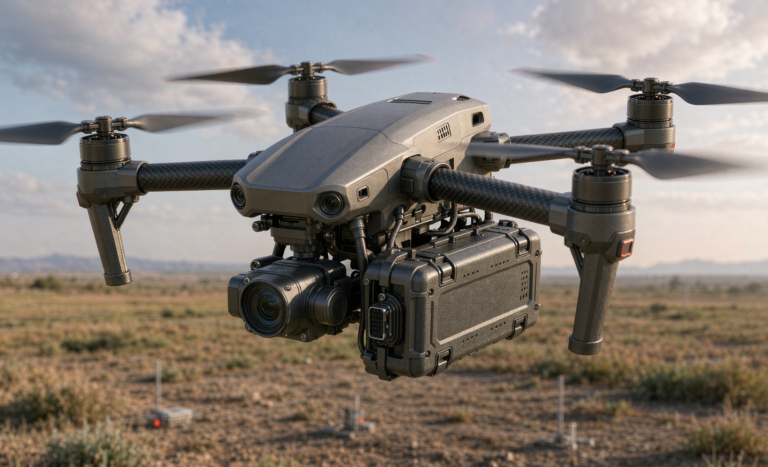
When a survey quad comes back from a turbine-blade or flare-stack inspection with two minutes of shaky, unusable footage, the problem was rarely “not enough flight time.” In my fifteen years building packs at Horizon Power, the failures that actually cost inspection contractors money are quiet ones: a frame dropped at the worst moment, one drone in the fleet landing early mid-job, a connector that grew hot until it cut out. That is why I treat drone battery reliability as a discipline separate from endurance. A reliable drone battery does not just last longer on the ground — it guarantees a usable sortie, every single time, with data you can defend.
Why Inspection Reliability Is Not the Same Problem as Endurance
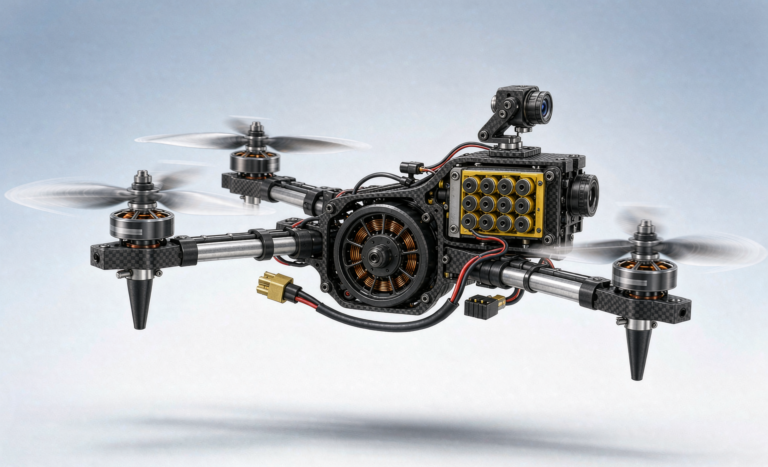
Endurance answers “how many minutes can I stay airborne.” Reliability answers “will this specific flight produce clean, complete, defensible inspection data — and will the next 200 flights behave the same way?” Those are different engineering targets. An inspection drone lithium battery spends most of its life in a stationary station-keep: climb to the asset, hold a precise hover a meter or two off the surface, fight gusts, pan the gimbal, then transit to the next defect. The energy budget is modest; the stability and repeatability budget is brutal.
I quantify reliability the way our fleet customers do: as probability. For a single sortie, P(usable inspection) = P(no sag-blur) x P(no early RTL) x P(no data-loss) x P(no cutout). Each term is a subsystem probability, and because they multiply, a 95% weakness in any one of them drags the whole sortie below 90%. Our internal spec targets better than 99% usable-block rate per 100 sorties across the fleet. That is the number inspection managers care about, not the flight-minute headline.
The Five Quiet Failure Modes That Ruin an Inspection
Most inspection battery failures never show up as a crash. They show up as a re-fly, a missed defect, or a claim that the footage “looked off.” Here are the five I design against:
- Mid-hover voltage sag. A pack with rising DCIR sags under the 1.5–2.2 kW hover plus 10–25% gust overhead. The ESC sees a voltage dip, motor RPM wobbles, and the gimbal picks up micro-jitter — the footage is technically recorded but worthless for crack measurement. We spec pack DCIR under 10 mΩ (measured at 1 kHz ACIR plus a 3C/10 s pulse) and total sag under 8% of nominal.
- Pack-to-pack inconsistency. Two drones, same model, same mission — but one lands 90 seconds early and aborts the last two assets. That is cell-delta drift between packs. We bin incoming packs to ±2% capacity and ±5% DCIR so the fleet flies as one.
- Connector micro-resistance growth. A contact that creeps from 0.25 mΩ to 2.5 mΩ after ~400 mates dissipates 25 W inside a housing rated for 5 W. It heats, swells, and eventually opens mid-flight. Gold-over-nickel plating and IPC/WHMA-A-620 crimps push that out to 500–1000 mates.
- Cold-dawn capacity fade. Pre-dawn inspection windows are coldest. A lithium battery reads 100% at 25°C, but only ~85% at 0°C, ~70% at -10°C, and 55–60% at -20°C. Without a pad heater holding the core at 10–25°C (5–15 W), the morning sortie silently loses a third of its endurance.
- Telemetry dropout. If the BMS log stops streaming, you lose the flight record — no traceability, no warranty defense, no trend line. We run a 2.4 GHz plus 900 MHz heartbeat so a single-band loss never blinds the operator.
Incoming Electrical Screening and Lot Acceptance
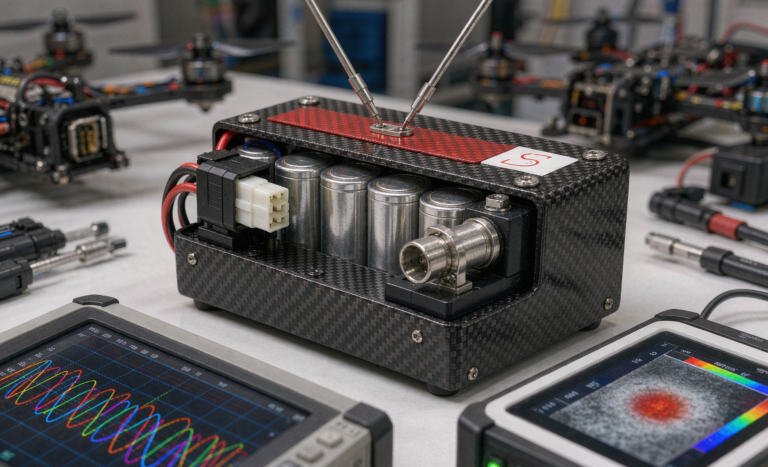
Reliability is built at receiving, not in the field. Every Horizon Power pack passes an incoming Electrical Screening Specification (ESS) before it is trusted on an asset:
- 1 kHz ACIR per cell and per pack, with cell-to-cell delta flagged above 30 mV;
- capacity verified to within 2% of nominal at 0.5C, 25±3°C;
- thickness and swell measured at the 3.80–3.85 V/cell storage window;
- a QR-coded serial baseline capturing IR, capacity, and thickness so the pack’s whole life is traceable.
This is where a custom battery solution pays for itself. Off-the-shelf packs rarely ship with a recorded baseline, so you can never tell a genuine early-life defect from field abuse. Our custom drone battery program stamps every unit with its birth metrics, which is exactly what a failure-analysis claim needs six months later.
Predictive Retirement: Replacing Packs Before They Fail
The most expensive pack is the one that fails on the job. We retire on trend, not on catastrophe. Our thresholds:
- State of Health below 80% of nameplate capacity;
- internal resistance at 2x the baseline;
- cell-to-cell delta above 50 mV;
- any enclosure puff above 5%.
The real signal is the slope. A pack whose IR climbs 10–20% month-over-month is telegraphing a pre-fail condition weeks before it drops a sortie. Fleet dashboards that plot IR trend per serial number let a manager pull that pack on a scheduled swap day instead of during a live inspection. I have pulled packs at 86% SOH purely on trend and found a partially dissolved current collector on teardown — exactly the failure that would have ended a flight.
Redundant Architecture and BMS Safeguards
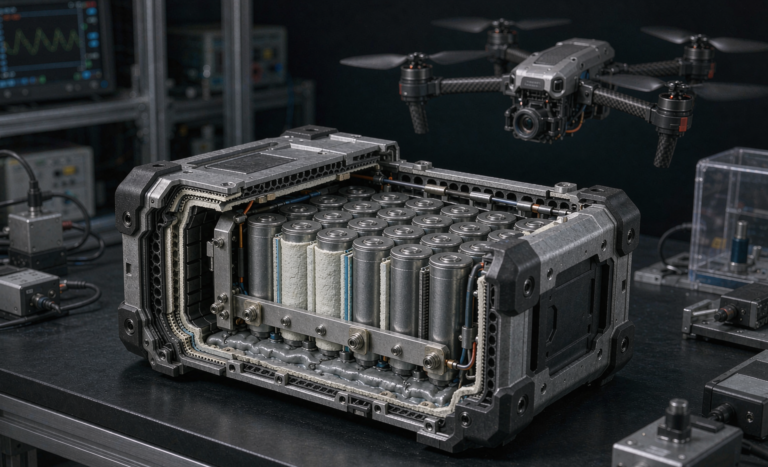
For close-up inspections over people or expensive assets, single-point pack failure is unacceptable. We deploy two parallel packs with diode OR-ing so either one sustains at least 60 seconds of hover on its own — enough to execute a controlled descent. The BMS runs per-cell telemetry at 1–10 Hz with a 20–30 mV delta alarm and an automatic return-to-launch on link or sag breach.
Critically, we isolate the payload power rail. The gimbal, RTK-GNSS module, and onboard compute draw from a regulated rail with 20–40 ms holdup, so when the motors spike during a gust the imaging system never sees the transient. That single design rule is the difference between footage that survives a pixel-level crack audit and footage that does not.
Field Quality Assurance Cadence
Reliability decays without discipline. Our field QA cadence for inspection fleets is deliberately boring:
- daily IR and spot-capacity check on the active pack pool;
- FIFO rotation so no pack sits at high SoC for weeks;
- storage held at 3.80–3.85 V/cell, never above 3.90;
- charge gated at 40°C with a post-flight cooldown before the next cycle;
- three-zone staging (charged / in-use / quarantine) so a suspect pack never re-enters service silently.
Across a typical deployment of 6–10 packs per aircraft, this cadence adds about ten minutes a day and eliminates almost every “mystery” failure we used to investigate.
Chemistry Choices That Protect Repeatability
For inspection work the default is NMC/NCA: 200–250 Wh/kg and 500–1000 cycles, the right balance of energy and pulse power for repeated hover. High-power LiPo earns its place only on gusty, heavy-lift sites where the C-rate demand is extreme. LFP (120–160 Wh/kg, 2000–4000 cycles) is our ground-support and charging-cart chemistry, where weight does not fly and cycle life drives total cost of ownership. Semi-solid cells (250–300 Wh/kg) are qualifying now for fleets that want maximum sorties per charge without giving up pulse headroom. The choice is mission-driven, but the reliability rules — DCIR, binning, retirement, isolation — stay identical regardless of chemistry.
Compliance and Transport for Inspection Fleets
Inspection contractors move packs between sites, often by air. Every Horizon Power inspection pack is built to UN38.3 T.1–T.8 and IEC 62133-2:2017, shipped at the IATA 30% state-of-charge limit, and sized within the FAA/EASA 100–160 Wh carry-on envelope so a technician can board with spares. That paperwork is part of reliability too: a pack held at a border because of missing test certification is just as much a mission failure as a pack that will not hold a charge.
How is drone battery reliability different from drone battery life?
“Life” is a single pack’s cycle count before retirement. “Reliability” is the probability that every sortie across the whole fleet produces usable data. A pack can have decent life and still be unreliable if its DCIR drifts or its connector runs hot. We manage reliability with incoming screening, per-pack baselines, and predictive retirement — not just a cycle counter.
What DCIR number should an inspection drone battery target?
We specify pack DCIR under 10 mΩ measured at 1 kHz ACIR plus a 3C/10 s pulse, with total voltage sag kept under 8% of nominal during a hover-plus-gust event. Interconnect resistance must stay under 15% of pack resistance, typically 1.5 mΩ or less, using XT150/AS150 connectors with 8 AWG silicone wire.
Why does cold weather hurt inspection drones more than the spec sheet suggests?
A lithium battery loses available capacity as temperature drops — roughly 100% at 25°C, 85% at 0°C, 70% at -10°C, and 55–60% at -20°C. Inspection windows are often at dawn when it is coldest, so without a 5–15 W pad heater holding the core at 10–25°C, the morning sortie silently surrenders a third of its endurance and risks an early RTL mid-inspection.
When should an inspection pack be retired?
Retire at 80% State of Health, 2x baseline internal resistance, cell-to-cell delta above 50 mV, or any enclosure puff above 5%. More importantly, retire on trend: a pack whose internal resistance climbs 10–20% per month is a pre-fail risk and should come out on the next scheduled swap, not after it drops a flight.
Do I need a custom drone battery for inspection work?
Not always, but a custom battery solution becomes worthwhile once you operate more than a few aircraft or fly over valuable assets. The deciding factor is traceability: a custom drone battery ships with a recorded electrical baseline (IR, capacity, thickness, serial), which is what lets you prove a failure was a defect versus field abuse, and what lets you bin packs so the fleet flies identically.