Drone Battery Safety for Delivery Drones
When a delivery drone lifts off 80 to 120 times a day from a neighbourhood depot, the battery is no longer just an energy source — it is the single component whose failure can put people, property, and the whole fleet at risk. Over the last decade I have qualified hundreds of packs for logistics operators, and the one lesson that never changes is this: a delivery drone battery must be designed to fail safe, never catastrophically. The article you are reading is not about how far a pack flies or what it costs. It is about the engineering discipline that keeps a thermal fault inside the pack, protects the airframe, and keeps a charging depot from becoming a fire investigation.

In my experience the safest battery in the fleet is rarely the one with the highest energy density. It is the one whose safety was engineered in from the cell level up — chemistry choice, barrier design, abuse qualification, a redundant BMS, and a depot protocol that treats every pack as a small, predictable hazard rather than an unknown.
Why Delivery Duty Demands a Different Safety Philosophy
A survey drone flies one long mission and lands. A delivery drone lithium battery endures a brutal, repetitive duty cycle: a 6–9C launch spike, a hover-and-drop, a rapid swap, and a bank charge back to full — 60 to 120 times a day. That duty concentrates stress in three places: the cell-to-cell interface, the high-current connector, and the depot charging rack. The hazard we design against is not a single bad cell; it is what that one cell can do to its neighbours. Our whole safety architecture is built around containing a single fault so it never becomes a pack-level event.
This is why I treat safety as a separate engineering axis from performance or reliability. Performance answers “how far”; reliability answers “how often it works”; safety answers “what happens when it doesn’t.” A custom battery solution for a delivery fleet is only trustworthy if the third question has a calm, engineered answer.
Chemistry and the Abuse-Tolerance Trade
The first safety decision is chemistry. NMC and NCA cells give 200–250 Wh/kg and excellent power, but their exothermic onset sits around 130–150°C, and once a nail or crush breach starts the reaction, energy density works against you. LFP (lithium iron phosphate) trades 30–40% of that energy for a substantially higher thermal-runaway onset (roughly +20 to +30°C) and far better abuse tolerance — it shrugs off overcharge and crush far better than NMC. For many last-mile delivery packs where the airframe can absorb a slightly larger pack, LFP is my default where safety margin outranks range.
Whichever chemistry we pick, the cell itself must carry internal safety features: a current-interrupt device (CID) that opens above a pressure threshold, a positive-temperature-coefficient (PTC) resettable fuse, and a vent path engineered to release gas away from the terminals and busbars. A lithium battery without these is simply not qualified for a delivery fleet in my book.
Thermal-Runaway Propagation Containment
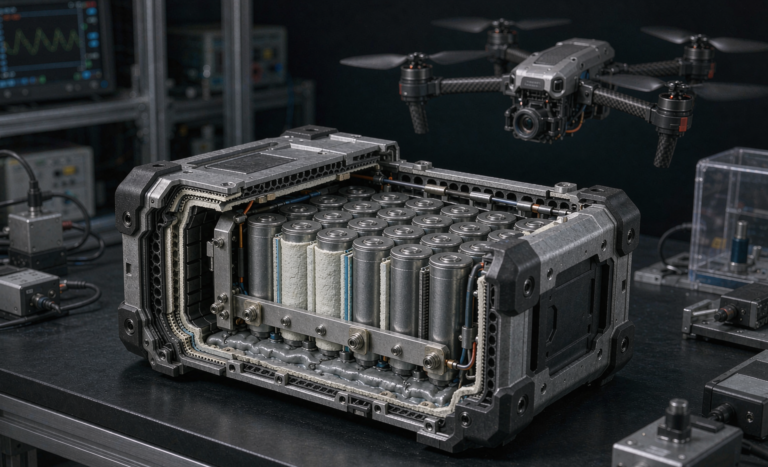
The real danger in any lithium pack is propagation: one cell goes into thermal runaway and, within seconds, cooks its neighbours into the same state. Our design goal is unambiguous — a single cell fault must stay a single cell fault. We achieve that with deliberate spacing and barrier layers between cells and modules: mica sheets (0.2–1 mm), ceramic-filled silicone pads, aerogel blankets, and intumescent coatings that swell to insulate on heat exposure. The target is a propagation delay measured in minutes, not seconds, giving the BMS and the depot time to isolate and cool.
Geometry matters as much as material. We direct each cell’s vent channel away from busbars and the isolated sensor rail, and we pot the pack so that a breach pushes hot gas out a defined relief path rather than laterally into the next module. In our drop tests and abuse rigs we look for zero propagation to adjacent modules and, critically, zero breach of the airframe composites. A custom drone battery that passes every performance test but propagates is a failure we catch on the bench, not in a customer’s neighbourhood.
Abuse Tolerance and Qualification Testing
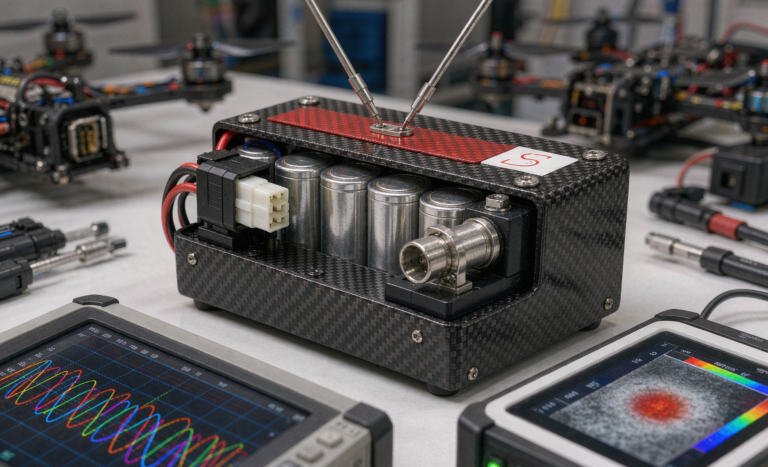
Safety claims are only as good as the abuse we subject the pack to. Every delivery pack we build is qualified against the same regime our customers’ insurers ask about: UN38.3 T.1–T.8 (altitude, thermal, vibration, shock, external short, impact/crush, overcharge, forced discharge), IEC 62133-2:2017 for the cell level, IEC 62619 for the industrial pack, and UL 2580 as the recognised battery-safety standard for mobility. We go beyond the minimum with nail-penetration rigs (Φ5–8 mm at 25–80 mm/s), crush to 13 kN or 1000× the cell’s own weight, overcharge to 200% state or 1C, and external short across a <5 mΩ path while we log peak current and case temperature.
The pass criterion is not “nothing happens.” It is “a single fault is contained.” A cell may vent; that is what the vent is for. What must not happen is propagation, airframe breach, or sustained ignition. We document every abuse test with thermal and voltage traces so the safety case is evidence, not assertion.
The BMS as the Safety Backbone
No barrier design survives without an active guardian, and that is the battery management system. A delivery pack’s BMS is built in redundant layers: cell-voltage monitoring with both over-voltage and under-voltage cut-offs, current sensing for over-current and short-circuit, and a temperature array — never a single NTC, but several placed at the hottest predicted cells and at the connector. A pre-charge contactor limits inrush on the swap connector, and a secondary hardware protector (independent fuse or protection IC) sits in series so that a firmware fault cannot disable safety.
For depot-scale fleets we add isolation-resistance monitoring to catch a slow high-voltage leak to the casing before it becomes a shock or arc hazard, plus a firmware watchdog that forces a safe state on any anomaly. Single-fault tolerance is the design rule: one component failing must never remove the pack’s ability to disconnect and cool.
Depot Field Safety: Where Most Incidents Actually Happen
The pack leaves our bench and enters a depot where dozens charge and swap every hour. This is where most real-world incidents occur, so field protocol is part of the safety product. We specify charging inside enclosed, monitored racks with individual thermal sensors and, where required, water-mist or Class-D suppression. Packs are transported at ≤30% state of charge per IATA rules, stored at 10–30°C on a first-in-first-out rotation, and never charged unattended overnight.
The swap connector gets its own safety rules: AS150/XT150-class gold-over-nickel contacts rated for 500–1000 mates, with a pre-charge stage (400–2000 µF capacitance plus a 10–100 Ω leading resistor) that tames the >500 A inrush that would otherwise weld or pit the terminals. A connector that degrades from 0.25 to 2.5 mΩ silently turns a 5 W housing into a 25 W heater — so we set a mate-count retirement limit and inspect resistance at every service interval.
Regulatory Ceiling and Transport
Safety also means staying inside the law that governs flight and freight. Per FAA Part 107 and EASA SORA guidance we keep each pack at or below the 100–160 Wh ceiling with margin, which caps both the per-pack energy and the thermal budget a single fault can release. For multi-pack transport we follow IATA PI 965/968 with UN38.3 certification and the 30% SoC limit, and we ship only in packaging that has passed the 1.2 m drop and stack-pressure tests. A drone battery that is unsafe to ship is unsafe to fly, and we treat the two as one requirement.
What “Fails Safe” Means in Practice
After all of this, “fails safe” has a concrete definition on our line: a single cell can vent, the BMS opens the contactor, the barrier layers stop propagation, the vent path clears the airframe, and the depot’s monitoring flags the pack for quarantine — with no fire, no breach, and no injury. That is the bar every delivery pack must clear before it earns a serial number. It is less glamorous than range figures, but it is the reason a fleet can run 120 sorties a day and sleep at night.
Frequently Asked Questions
What makes a delivery drone battery fail safe instead of catastrophically?
A fail-safe pack contains any single fault: internal cell safety devices (CID, PTC, vent), barrier layers that stop thermal propagation between cells, a redundant BMS that opens the contactor on anomaly, and a depot protocol that monitors and quarantines suspect packs. The goal is that one bad cell never becomes a pack-level fire.
Which battery chemistry is safest for delivery drones?
LFP (lithium iron phosphate) is the most abuse-tolerant option, with a higher thermal-runaway onset and better overcharge and crush resistance than NMC/NCA, at the cost of 30–40% lower energy density. NMC/NCA are used where range is critical, with extra barrier and BMS margin to compensate. The right choice depends on whether the airframe can absorb a larger LFP pack.
How do you stop thermal runaway from spreading between cells?
We use spacing plus barrier materials — mica, ceramic-filled silicone, aerogel, and intumescent coatings — between cells and modules, and we engineer each cell’s vent path away from busbars. Qualification targets zero propagation to adjacent modules and no airframe breach, with a propagation delay measured in minutes rather than seconds.
What safety tests must a delivery drone battery pass?
At minimum UN38.3 T.1–T.8, IEC 62133-2:2017 (cells), IEC 62619 and UL 2580 (packs), plus our extended abuse rigs: nail penetration, 13 kN crush, overcharge to 200%, and external short. The pass criterion is containment of a single fault, not “nothing happens.”
How should depots handle and charge delivery batteries safely?
Charge in monitored, enclosed racks with thermal sensors and suppression; transport and store at ≤30% SoC per IATA in a 10–30°C environment on FIFO rotation; never charge unattended; and retire swap connectors at a defined mate count after checking for resistance creep. A documented depot protocol is part of the safety product, not an afterthought.