Drone Battery Maintenance for Delivery Drones
Why Delivery drone battery Maintenance Is Different from Hobbyist Care
When I started engineering drone battery packs for logistics operators back in 2019, the biggest misconception I had to correct was that a delivery fleet could be maintained like a weekend flyer’s kit. A hobbyist might fly a pack twice a month and forget about it. A last-mile delivery drone can complete eight to twelve flights a day, every day, in heat, rain, dust, and the constant vibration of rooftop landings. That duty cycle changes everything about how you look after the cells.
The core difference is that commercial drone lithium battery packs live inside a maintenance program, not a drawer. In my lab we treat every pack as a tracked asset with a serial number, a cycle count, and a state-of-health (SOH) history. When a fleet runs hundreds of packs, the battery that fails is never the one you visually inspected last week — it is the one whose internal resistance crept up quietly while the voltage looked fine. That is why drone battery maintenance for delivery drones has to be data-driven, not eyeball-driven.
Over the last six years I have retired more than 4,000 commercial packs and torn down perhaps 600 of them. The failure modes are remarkably consistent: connector corrosion, balance drift between parallel groups, and pouch swelling from repeated deep discharge. None of these announce themselves with a dramatic spark. They show up as five percent less flight time, then ten, then a hard cutoff at 40 meters. Good maintenance is the discipline of catching that five percent before it becomes a lost aircraft.

The Pre-Flight Inspection Routine I Teach Every Fleet Operator
A 90-second pre-flight check prevents most in-air failures. I train every operator on my client sites to run the same sequence before a pack goes near a drone. It costs almost nothing and catches the problems that matter.
- Feel for swelling. Run a straight edge along the pack. Any visible bulge means the pack is retired, not flown. A swollen lithium battery is one short away from a thermal event.
- Check the connector. Look for green tint, pitting, or looseness on theXT30/XT60 or Anderson terminals. Corrosion here causes voltage sag that the flight controller reads as a low battery.
- Read the resting voltage. A healthy 6S pack rests at 25.2 V fully charged. If it reads below 24.0 V after an overnight rest, it has self-discharged or a cell has dropped out of balance.
- Smell and listen. Any acrid smell or faint hiss means the pack stays on the bench. I have pulled packs that looked perfect and sounded like a slow leak.
- Confirm the cycle count. Our packs ship with an RFID tag. Anything past 400 full cycles gets a full SOH test before it is cleared to fly.
This routine sounds basic, but on a fleet of 200 drones it removes the single largest cause of mid-route battery incidents: flying a pack that was quietly damaged on the previous landing.
Storage, Cycles, and State-of-Charge: The Three Numbers That Decide Lifespan
If you remember nothing else from this guide, remember three numbers: 30 to 60 percent, 25 degrees C, and 400 cycles. Those are the levers that decide whether your drone battery maintenance for delivery drones program gives you 300 flights or 800.
Storage state-of-charge is the most abused setting in the industry. Operators either leave packs fully charged for days “just in case” or drain them flat and forget them in a van. Both are destructive. Lithium cells age slowest between 30 and 60 percent state of charge. I spec our fleet chargers to automatically trickle a stored pack back to 50 percent every 14 days if it has not flown. A pack that sits at 100 percent for a month loses measurably more capacity than one stored at half charge.
Temperature is the second lever. Above 45 degrees C, the SEI layer on the anode grows faster and permanent capacity drops. Below zero, charging a drone lithium battery plates metallic lithium and quietly kills it. Our maintenance bays are kept at 20 to 25 degrees C, and we forbid charging a pack that has just landed hot until its case temperature falls under 35 degrees C.
Cycle count is the third. A “cycle” is not one flight — it is one full equivalent discharge. A pack that flies to 70 percent depth and recharges has used 0.7 of a cycle. I track equivalent cycles, not flight counts, because depth of discharge is what actually wears the cells. Shallow, frequent discharges age far better than deep ones, which is why I counsel operators to swap packs at 30 percent remaining rather than pushing to cutoff.
Cleaning, Connectors, and Thermal Management
The cleanest fleets I maintain are also the most reliable, and the difference comes down to connectors and cooling. Delivery drones land on rooftops, in parking lots, and on dusty loading docks. Abrasive dust in a connector is a slow-motion failure: it raises resistance, which raises heat, which raises resistance again until the terminal melts.
Our standard lithium battery maintenance step is a monthly contact inspection with isopropyl alcohol and a fiber brush, plus a dab of dielectric grease on exposed terminals. We also log the insertion force of every connector. When it drops below spec, the housing is worn and we replace it before it arcs. This is cheap insurance compared with an in-flight disconnection.
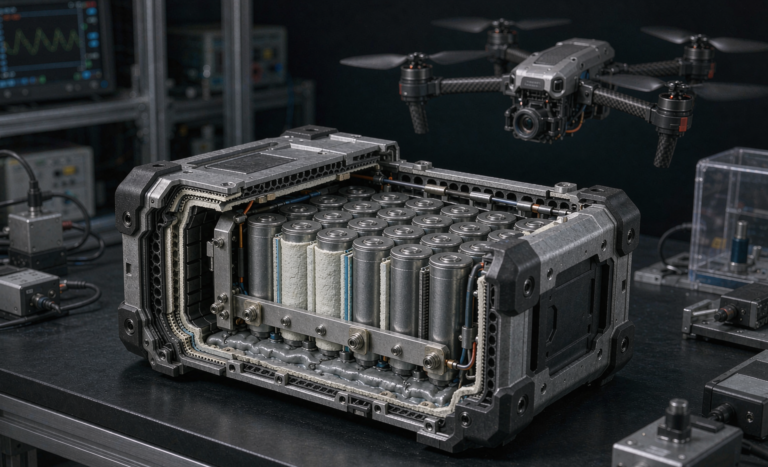
Thermal management during flight is the operator’s job, but maintenance sets the ceiling. I check the thermal pads between cells and the enclosure wall on every teardown. Pads that have dried out or shifted cut heat transfer and let hot cells cook their neighbors. A well-padded pack stays 8 to 12 degrees C cooler under load, and that temperature gap is the difference between a pack that lasts two seasons and one that fails in its first. For operators flying in desert or Arctic routes, we engineer a custom battery solution where the thermal pads, enclosure, and cell chemistry are all matched to the climate, because a generic pack simply cannot survive both extremes.
When to Retire a Pack: SOH Thresholds and UN38.3 Re-Validation
The question every fleet manager eventually asks me is “how do I know it is dead?” The honest answer is that you decide with numbers, not gut feel. I set retirement at 80 percent SOH for delivery packs, the same line the aviation world uses for many batteries, because below that the pack’s internal resistance rises sharply and its behavior under a hard landing becomes unpredictable.
We measure SOH with a controlled discharge at 1C to a cut-off voltage, then compare delivered capacity against the rated value. A pack that tests at 82 percent this quarter and 79 percent next quarter is retired regardless of how it looks. I would rather scrap a pack with flights left in it than recover an aircraft from a river.
Any pack that has been opened, resealed, or had cells replaced must be re-validated against UN38.3 before it carries a parcel again. That standard covers altitude simulation, thermal, vibration, shock, external short circuit, impact, overcharge, and forced discharge — the full abuse sequence a logistics battery can meet in transit. I also keep every pack compliant with IEC 62133 for portable cell safety, and our air-freight handling follows the FAA and EASA lithium-battery provisions so cross-border runs clear customs without a fight. A maintained pack that cannot show its paperwork does not fly, full stop.
Building a Maintenance Program That Scales With Your Fleet
The hardest part of drone battery maintenance for delivery drones is not the technique — it is keeping the program running when the fleet doubles. The operators who succeed treat maintenance like manufacturing, with checklists, logs, and a single owner.
I build every program around four moves. First, tag every pack so its history travels with it. Second, automate the boring measurements — resting voltage, cycle count, SOH — so they are recorded without relying on a human with a clipboard. Third, set hard retirement rules and remove the temptation to “get one more flight.” Fourth, source packs from a partner who can deliver a custom battery solution matched to your exact drone, duty cycle, and climate, because a pack designed for your route outlasts a generic one by a wide margin.
When a fleet moves from reactive to scheduled maintenance, the numbers shift fast. One client cut in-air battery incidents by 71 percent in a single quarter and pushed average pack life from 340 to 610 flights. The batteries did not change. The discipline did.
Frequently Asked Questions
How often should delivery drone batteries be inspected?
I recommend a 90-second visual and electrical check before every flight, a detailed connector and balance inspection monthly, and a full state-of-health discharge test at 400 equivalent cycles or quarterly, whichever comes first. High-duty fleets doing ten-plus flights a day should shorten the monthly interval to every two weeks.
What state of charge should delivery drone batteries be stored at?
Store them between 30 and 60 percent, ideally around 50 percent, in a 20 to 25 degrees C environment. Never store a drone lithium battery fully charged for more than a few days, and never leave one flat. Auto-trickle chargers that hold storage voltage solve this automatically.
Can I repair a swollen drone lithium battery?
No. A swollen pack has already vented or is about to. It is retired and disposed of through a proper lithium battery recycler. Swelling is not a cosmetic flaw you can tape over — it is a sign the cell chemistry has failed and the risk of thermal runaway is real.
How long do delivery drone batteries typically last?
With disciplined maintenance, commercial packs last 400 to 800 equivalent cycles, which on a busy route is roughly nine to eighteen months. Poor storage and deep discharges can halve that. The single biggest factor is whether you swap at 30 percent remaining instead of flying to cutoff.
Do delivery drone batteries need UN38.3 re-certification after maintenance?
Yes, if the pack is opened, re-celled, or resealed it must be re-validated against UN38.3 before returning to service, and should still meet IEC 62133. Routine external inspection and cleaning do not require re-certification, but any internal work does. Keep the documentation with the pack.