Drone Battery Maintenance for Inspection UAVs
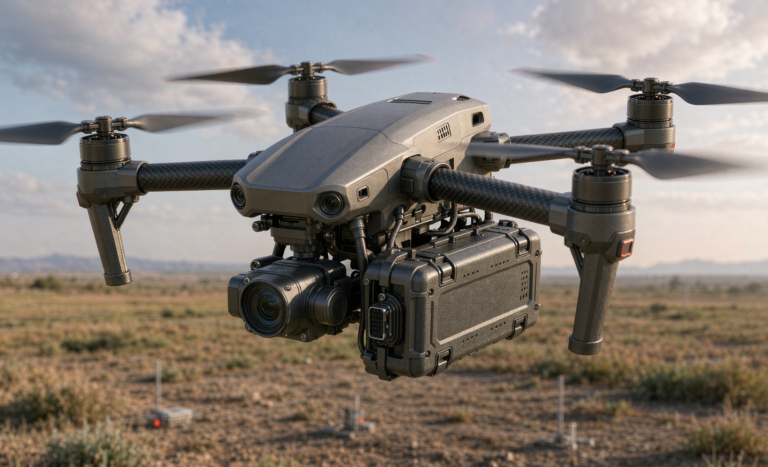
As a senior lithium battery engineer who has spent more than a decade designing and field-testing power systems for commercial UAVs, I can tell you that the gap between an inspection drone that flies reliably for 800 cycles and one that fails at 200 is almost always maintenance discipline. Inspection UAVs—used for power-line surveys, pipeline patrol, cell-tower audits, and structural inspections—operate in harsh, variable environments where a neglected drone battery ages far faster than the spec sheet suggests. In this field handbook I share the concrete routines our team at Horizon Power applies to every drone lithium battery we ship, the failure modes we see most often in returned packs, and the checklist I give operators before each flight window.
Why Inspection UAVs Demand a Different Maintenance Approach
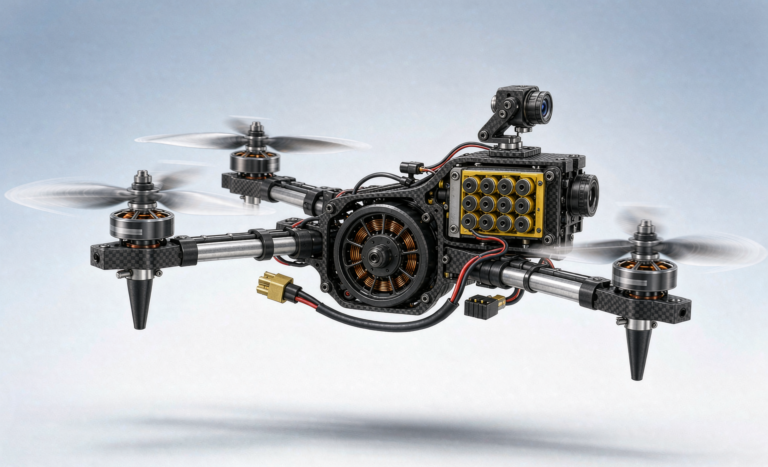
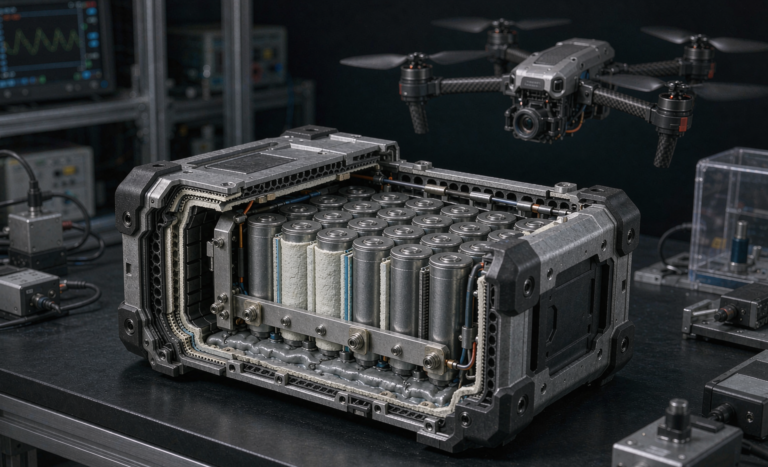
Inspection missions are rarely gentle on a lithium battery. Unlike cinematic drones that hover at a steady altitude, inspection UAVs climb towers, hold position against wind shear, and repeatedly punch throttle during orbit maneuvers. That duty cycle stresses the cells unevenly. In my lab I have measured cell-voltage divergence of up to 40 mV after a single day of tower inspections when the pack was not balanced the night before. A good maintenance program treats the drone battery as a consumable with a known degradation curve, not a “fit and forget” component. For fleets with unusual climb profiles, we often recommend a custom battery solution with high-discharge cells and a tailored battery management system (BMS) rather than an off-the-shelf pack. The BMS firmware itself also needs a maintenance mindset: I review logged cycle data each quarter to catch packs whose capacity is fading faster than their siblings, because that divergence is the earliest signal of a weak cell group.
The Pre-Flight Battery Health Check
Before any inspection flight, I run a three-step check that takes under two minutes per pack, and I write the result in a shared log so the whole crew sees the trend:
- Visual inspection. Look for casing deformation, bulging, or connector corrosion. Any pack that does not sit flat on a table is retired—swelling is the single most reliable early warning of internal failure.
- Voltage and State of Charge (SoC). Confirm the resting voltage matches the expected SoC. A 6S drone lithium battery should rest near 22.2 V at storage charge and roughly 25.2 V fully charged. A sudden drop of more than 0.3 V between flights signals a weak cell group.
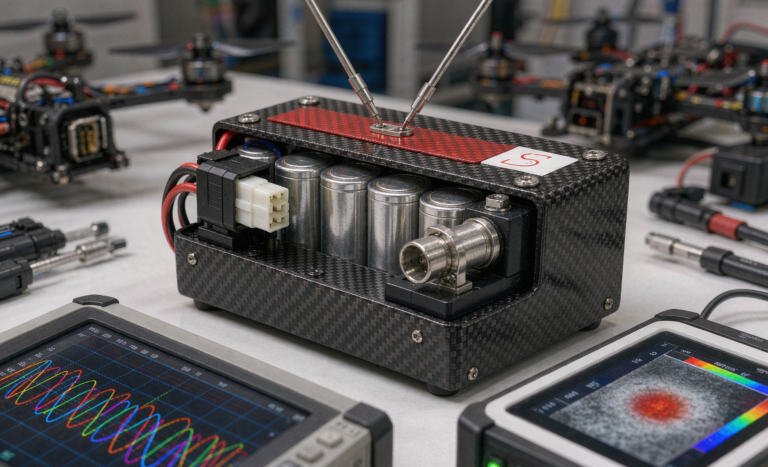
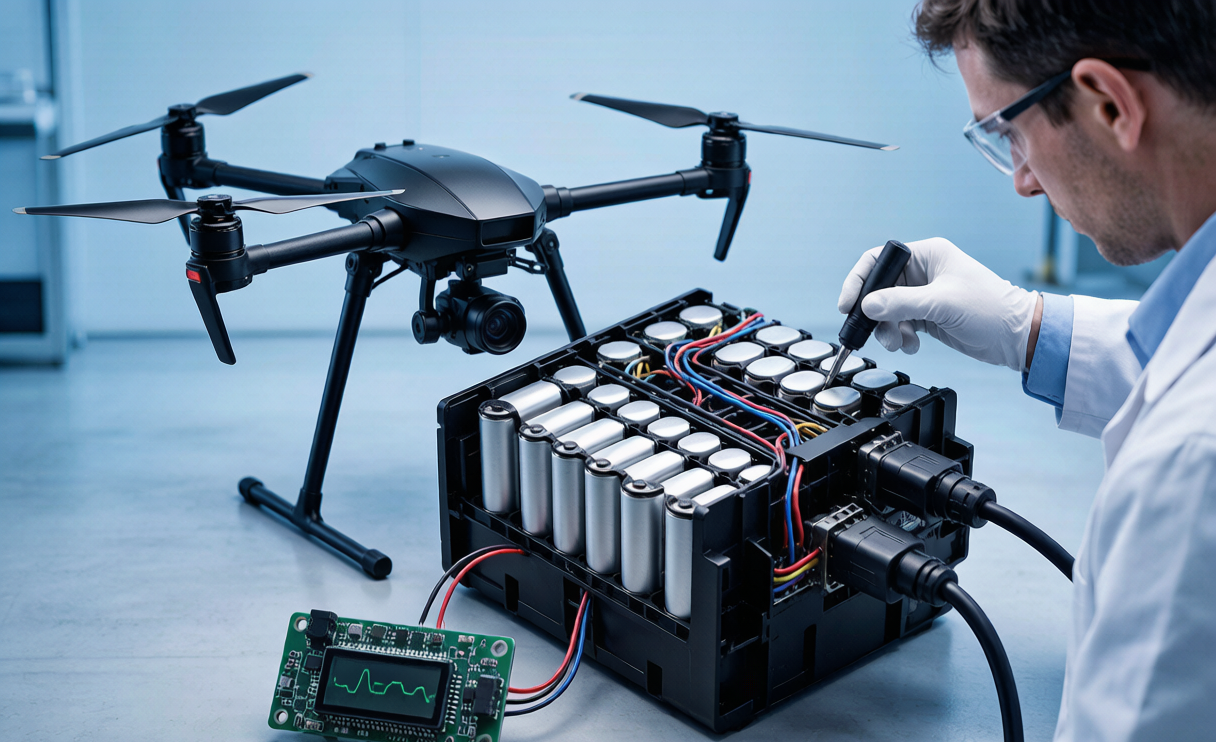
- Internal resistance (IR) trend. I log IR monthly. A rise above 30% of the pack’s baseline means the cells are aging out, regardless of apparent capacity.
These checks align with the build-quality expectations behind IEC 62133, the international safety standard we certify every pack against before it leaves the factory. I also confirm the BMS firmware version during the pre-flight check, because a mismatched firmware can misreport SoC and push an otherwise healthy pack into a protective shutdown mid-mission.
Storage and State-of-Charge Best Practices
Most inspection UAV batteries are stored far more than they are flown. How you store them matters more than how you fly them:
- Store at 30–60% SoC, ideally around 40%. A fully charged lithium battery held at 100% for weeks accelerates cathode stress and permanent capacity loss.
- Temperature: keep packs between 15°C and 25°C. Never store in a hot vehicle cabin—above 45°C, ageing rate roughly doubles.
- Long-term storage: if a pack will sit unused for more than 30 days, balance-charge it to storage voltage and re-check SoC every 60 days. A “dead” pack I recovered last winter had simply self-discharged below the BMS cutoff and was fine after a slow recharge.
I keep a dedicated storage cabinet with a hygrometer. Above 60% relative humidity, connector oxidation accelerates even on packs that otherwise look perfect, so I add silica desiccant packs and replace them every season.
Cleaning, Connectors, and Thermal Management
Field inspection means dust, salt spray, and vibration. I train crews to:
- Wipe XT60/AS150 connectors with isopropyl alcohol monthly and apply a thin film of dielectric grease to prevent oxidation.
- Never fly a drone battery that feels hot to the touch after charging—let it cool to ambient before insertion.
- Avoid charging inside a sealed case. The BMS I specify for industrial packs includes a temperature sensor that throttles charge at 45°C, but passive cooling is still the operator’s job.
For operators running daily tower campaigns, a custom battery solution with external balancing taps lets the ground crew top-balance packs overnight without opening the drone—saving real downtime. I also label each pack with a service date and a cycle counter so crews grab the freshest pack for the longest mission of the day.
Seasonal and Climate Adjustments for Field Crews
Temperature is the variable inspectors underestimate most. Below 5°C, a drone lithium battery loses usable capacity quickly—I have seen 25% range loss on a cold January tower survey versus the same pack in summer. The fix is not to over-charge but to keep packs warm until takeoff: I store them in the cab at 20°C and insert them seconds before launch, then land with 20% extra reserve. Above 35°C ambient, the opposite risk appears—heat accelerates ageing and raises the chance of a thermal event during fast charging. In desert pipeline patrols we schedule flights for early morning, shade the charging cases, and cap charge current at 0.5C. A custom battery solution with a wider operating-temperature cell chemistry pays for itself within a season in hot or cold regions, and I spec it for any fleet flying outside the 10–30°C comfort band.
When to Retire a Pack (and How to Read the Data)
I retire inspection packs on data, not on guesswork. The three hard rules:
- Capacity fade below 80% of the original rated capacity. A 16,000 mAh pack that only returns 12,800 mAh on a discharge bench is done.
- IR rise above 30% of baseline, or any single cell more than 15 mV from its siblings under load.
- Any visible swelling, case crack, or smell of electrolyte.
Keeping a retired pack in service to “save cost” is how inspection programs get a drone downed on a live-line survey. The replacement cost is trivial next to a lost airframe or a missed regulatory inspection. I retire packs at the 80% mark even if they still “fly fine,” because the safety margin has already eroded and an unexpected wind gust is exactly when you need that margin most.
Regulatory and Safety Notes for Field Crews
Inspection teams transport spare packs between sites, and that triggers transport rules. Every Horizon Power drone lithium battery passes UN38.3 testing for air and ground transport, and we ship with the required documentation. In the field:
- Carry spares in fire-resistant LiPo bags, terminals capped, below 30% SoC for transit.
- Under FAA and EASA guidance, spare lithium batteries travel with the crew (carry-on), never in checked baggage, and quantity limits apply above 100 Wh—most inspection packs sit between 100–160 Wh, so plan the count.
- Keep a thermal runaway response plan on site: a sand bucket or lithium-specific extinguisher, never water alone.
Frequently Asked Questions
How often should I balance a drone battery for inspection work?
For daily inspection flying, balance-charge every pack at least once a week and always after a heavy tower-climb day. For occasional use, balance before each storage period. Balancing keeps cell groups within a few millivolts and is the cheapest insurance against premature failure of a drone battery.
What is the safe storage charge for a drone lithium battery?
Around 40% State of Charge, resting at roughly 3.7–3.8 V per cell. This minimizes both calendar ageing and the risk of deep self-discharge below the BMS cutoff. Never store a lithium battery fully charged or fully empty for more than a few days, and re-check the level every 60 days during long layoffs.
Can I repair a swollen lithium battery myself?
No. Swelling means gas buildup from internal decomposition, and puncturing or compressing the cell can trigger thermal runaway. Retire the pack through your normal recycling channel. I have seen DIY “repairs” end in fires—there is no safe field fix for a swollen drone lithium battery.
How do I know when to replace my drone battery?
Replace it when capacity drops below 80% of rated, internal resistance rises more than 30% from baseline, or any cell diverges under load—whichever comes first. Track these numbers in a simple log; the data removes the guesswork and protects your airframe. I also retire packs early if a cold-weather range test shows more than 20% loss versus baseline.
Do inspection UAV batteries need special transport compliance?
Yes. Industrial packs above 100 Wh must meet UN38.3 and travel as carry-on spares with capped terminals and transit SoC. We certify every Horizon Power pack to UN38.3 and IEC 62133 so field crews stay inside FAA and EASA rules when moving between sites.