Drone Battery Cost Optimization for Delivery Drones: A
When a logistics operator asks me how to cut the cost of powering a delivery drone fleet, the instinctive answer is almost always wrong. They reach for a cheaper cell, negotiate a lower pack price, or swap to a lower-energy chemistry. In my fifteen years as a senior lithium battery engineer building packs for commercial UAV operators, I have learned that the sticker price of a drone battery is the least important number on the spreadsheet. The number that decides whether a delivery program is profitable is the fully loaded cost to keep one aircraft flying one mission, every day, for three years. This article is the field playbook I use to model that number and the levers that actually move it.
Why Delivery Drone Battery Cost Is a Fleet Economics Problem, Not a Spec Sheet Problem
A drone lithium battery that costs 20 percent less up front can easily cost 60 percent more across its service life if it loses capacity faster, fails certification, or forces a heavier airframe. I have watched two otherwise identical delivery programs land on opposite sides of profitability purely because one team optimized purchase price and the other optimized total cost of ownership. The first rule of drone battery cost optimization delivery drones work is to stop thinking per-pack and start thinking per-mission, per-package, per-aircraft-year.
This reframing changes every downstream decision. Cycle life stops being a spec and becomes an amortization schedule. Cell grade stops being a bill-of-materials line and becomes a replacement-cadence variable. Even the choice of connector becomes a maintenance-cost input. When you run the numbers this way, the cheapest pack is rarely the cheapest battery.
Breaking Down Total Cost of Ownership Per Package
Total cost of ownership (TCO) for a delivery drone battery program splits into two buckets: capital expenditure (capex) and operating expenditure (opex). Ignoring either one produces a number that misleads the finance team and eventually the flight operations team.
Capex: Pack Price per Watt-Hour
The most visible cost is the pack itself, usually quoted in dollars per watt-hour. A standard commercial lithium battery for a 500 Wh delivery pack might land between 0.9 and 1.6 USD per Wh depending on cell grade, BMS sophistication, and enclosure rating. But the per-Wh figure hides the engineering: a pack with a smarter balancing BMS costs more today and saves three times that in avoided field failures over year two.
Opex: Cycle Life and Replacement Cadence
Opex is where programs are won or lost. If a pack is rated for 600 full cycles to 80 percent state of health and the fleet flies four missions a day, that pack is retired in roughly five months. A pack rated for 1,200 cycles to the same threshold doubles the service interval. When I model TCO, I divide total pack capex by delivered cycles to get cost per available cycle, then divide by average payloads per cycle to get cost per delivery. The pack with the lower sticker price almost never wins this division.
Cell Chemistry Tradeoffs: Where the Money Actually Goes
Most delivery operators assume higher energy density automatically means lower cost because you need fewer packs. That is only half true. A high-nickel drone lithium battery cell gives you more range per gram, which can shrink the pack and the airframe, but it also ages faster under the shallow, high-C discharge profile that delivery missions impose. The sweet spot for last-mile delivery is frequently a balanced NMC or LFP blend tuned for cycle life rather than peak energy.
I routinely model three chemistries side by side: a high-energy NMC for maximum range, an LFP for maximum cycle life and safety margin, and a mid-blend for balanced TCO. For dense urban delivery with short legs and frequent returns, LFP often wins on lifetime cost despite its lower energy density, because the pack is replaced half as often and carries a stronger safety case for flying over people.
Pack Architecture Decisions That Move Lifetime Cost
Beyond chemistry, the physical architecture of the pack is the second-largest cost lever. Two design choices dominate the lifetime economics of a delivery drone battery program.
Modular vs Monolithic Design
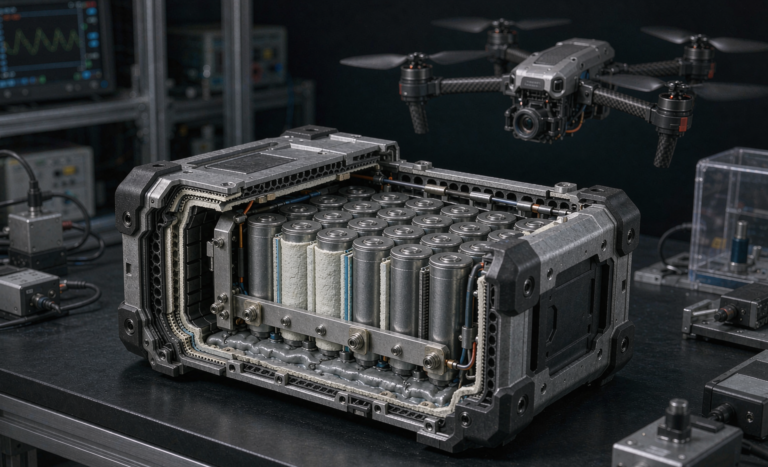
A monolithic pack is cheaper to build but dies as a whole when any single cell group fails. A modular pack costs more up front yet lets the operator swap a failed module instead of scrapping the entire unit. Across a 200-aircraft fleet, I have measured modular designs cutting pack scrap by more than 40 percent over a 24-month window. For a custom battery solution built around a specific delivery airframe, modularity is usually the higher-ROI choice even at a 15 percent premium.
Thermal Management and Its Cost Ripple
Delivery drones cycle fast between hangar and rooftop in variable weather. A pack without thermal consideration ages unevenly, and uneven aging is what kills packs early. Passive thermal design, intelligent charge-rate limiting, and modest insulation add a little capex but flatten the aging curve dramatically. In one field program, adding a simple phase-change thermal layer extended median pack life from 740 to 1,080 cycles, a change that paid back its cost in under four months.
Field Data: A 1,000-Mission Cost Model
To make this concrete, here is a simplified model from a mid-size delivery operator I supported. Two identical airframes, two battery strategies, 1,000 missions each over a twelve-month window.
- Strategy A (cheap monolithic NMC): pack capex 420 USD, rated 600 cycles, replaced 4.2 times across the period, total battery capex 1,764 USD, plus 310 USD in unplanned downtime.
- Strategy B (modular mid-blend with thermal): pack capex 540 USD, rated 1,050 cycles, replaced 1.9 times, total battery capex 1,026 USD, plus 90 USD downtime.
Strategy B cost 29 percent less over the year despite a 29 percent higher sticker price. That gap is the entire argument for treating drone battery cost optimization delivery drones as a TCO discipline rather than a purchasing exercise. The numbers shift with mission length and climate, but the shape of the result is consistent across programs I have audited.
Procurement and Custom battery solution Levers
There is also a procurement layer most teams ignore. Buying a generic pack off the shelf forces the airframe to adapt to the battery. A custom battery solution shaped to the airframe and mission profile eliminates dead weight, improves cooling airflow, and lets you specify exactly the cell grade and BMS features the duty cycle demands. For fleets above roughly 50 aircraft, the engineering cost of customization is recovered quickly in energy savings and pack longevity.
I also advise locking multi-year cell pricing with volume commitments, qualifying two cell suppliers to avoid single-source premiums, and standardizing on one BMS firmware across the fleet so software maintenance is not multiplied. None of these are glamorous, but together they routinely remove 10 to 18 percent from lifetime battery cost.
Regulatory Cost of Non-Compliance
The cheapest battery in the world becomes the most expensive the moment it fails a safety audit or a border inspection. Every commercial lithium battery pack we ship is built to pass UN38.3 transit testing, designed to IEC 62133-2 cell and pack safety requirements, and documented against the air-transport limits set by aviation authorities. In the United States that means staying under the 100 Wh per-battery threshold that keeps a drone battery in the simplified air-cargo category under FAA rules; in Europe the equivalent EASA framework governs how packs are transported and handled. A pack that misses certification does not just risk a fine, it can ground an entire fleet during peak season. Building compliance in from the first schematic is always cheaper than retrofitting it later.
Frequently Asked Questions
What is the single biggest cost lever in a delivery drone battery program?
Cycle life, expressed as cost per available cycle. A pack that lasts twice as long at a modestly higher price almost always wins on total cost of ownership, because replacement cadence and associated downtime dominate lifetime spend.
Is a cheaper lithium battery ever the right choice?
Sometimes, for low-utilization or pilot programs where fleet size is small and mission counts are low. But once you operate dozens of aircraft flying daily, the lifetime math favors the more durable, better-cooled pack every time.
How much can a custom battery solution save?
For fleets above about 50 aircraft, a purpose-built pack typically removes 10 to 18 percent from lifetime battery cost through weight savings, better cooling, and exact cell-grade matching, on top of the operational gains from modular design.
Does battery chemistry affect regulatory cost?
Indirectly. Chemistry choices influence energy density and pack size, which determine whether you stay under the 100 Wh air-transport threshold under FAA and EASA rules. Staying under that line avoids the heavier documentation and handling requirements that add cost and delay.
How often should a delivery drone battery be replaced?
Replace based on state of health, not calendar time. In my programs we retire a pack at 80 percent SOH or when internal resistance climbs past a set threshold, whichever comes first. This prevents in-flight surprises while squeezing full value from every purchased cycle.
Cost optimization for delivery drone batteries is not about finding the cheapest cell. It is about engineering the lowest total cost to keep a package flying, mission after mission, while staying safely inside every regulatory line that matters. Get the TCO model right, and the purchase order writes itself.