Drone Battery Testing for Racing Drones
As a Senior lithium battery Engineer at Horizon Power, I have spent the better part of a decade putting racing drone battery packs through abuse that no consumer product would ever survive. FPV racing is brutal on energy storage: a 6S pack can be asked to deliver 120 C of burst current for a few seconds, sag to 3.0 V per cell under load, then recover and do it again forty times in a single heat. If the drone battery is not fully characterized before it ever leaves the bench, the first symptom of a weak cell is usually a flame on the starting line. In this article I will walk you through the exact testing protocol I use to validate every drone lithium battery we ship for competitive racing drones — from capacity verification and DCIR measurement to thermal profiling and the acceptance criteria that decide whether a pack earns a place in a custom battery solution for a championship team.
Why Racing Drone Battery Testing Is a Different Discipline
The test philosophy for a racing pack is not the same as for a long-endurance survey UAV or a delivery drone. A mapping UAV cares about capacity and cycle life; a delivery drone cares about total cost of ownership. A racing drone lithium battery cares about one thing above all: how much current it can deliver without the pack voltage collapsing. That single requirement reshapes the entire test plan. We are not measuring gentle 1C discharges here. We are probing 50 C continuous and 100–150 C burst pulses, and we are doing it while watching internal resistance, surface temperature, and cell-to-cell balance in real time. The goal of drone battery testing at this level is not a pass/fail certificate for a regulator; it is a prediction of how the pack will behave in the third lap when the pilot yanks full throttle out of a split-S.
The Bench Test Rig I Use for Every Drone Lithium Battery
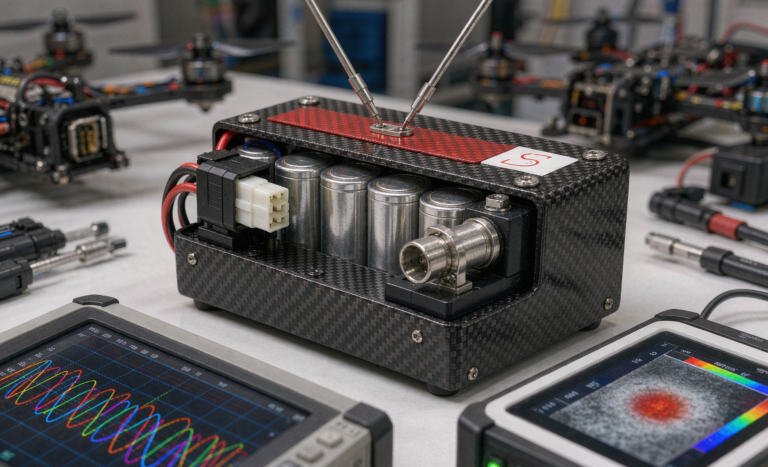
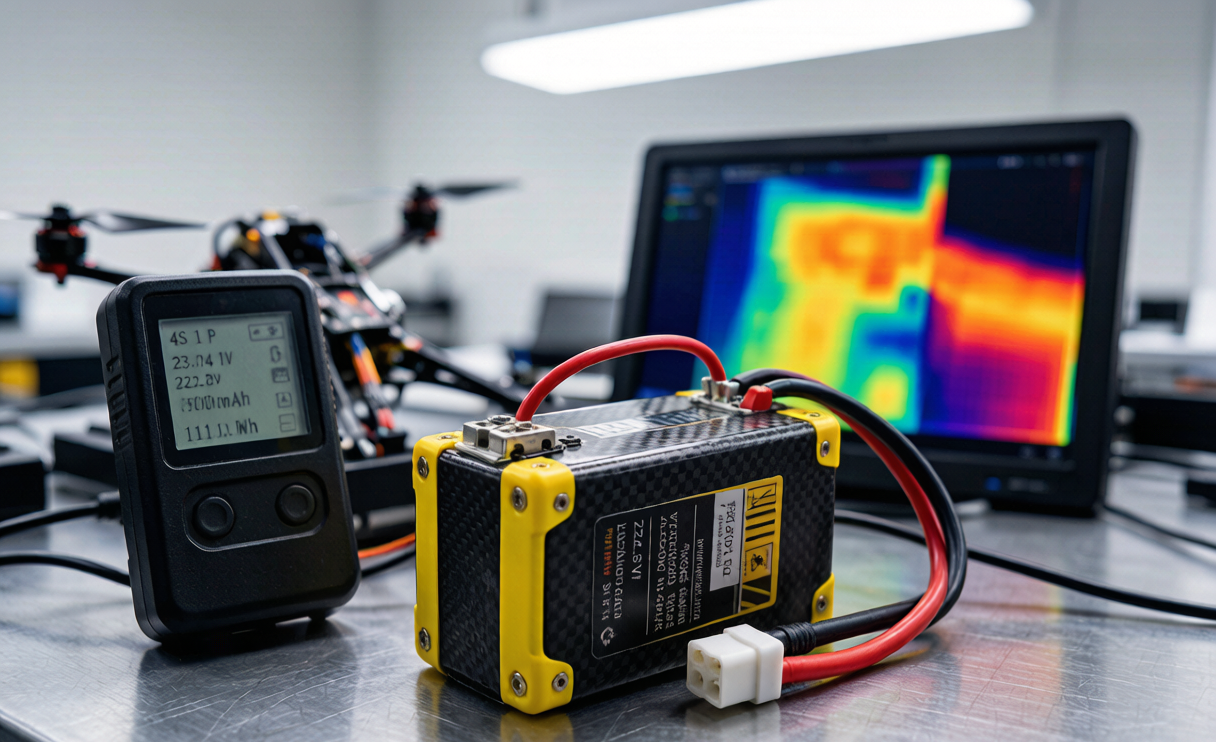
My standard bench for qualifying a racing pack is built around four instruments. First, a programmable DC electronic load capable of 200 A and 1 kW continuous, with sub-millisecond logging so I can capture voltage sag during a 0.2-second burst pulse. Second, a 24-channel data logger reading each cell tap independently, because pack-level numbers hide the weak cell that will end your race. Third, a thermal camera logging the wrap temperature every two seconds. Fourth, a minimum of two calibrated reference chargers for capacity cross-check. Every drone lithium battery built for racing drones enters this rig with a unique serial and a blank test record; nothing ships until the record is complete.
Capacity and Discharge Curve Verification
The first test is a controlled 1C capacity check against the nameplate rating — for a typical 6S 1500 mAh racing pack that means discharging at 1.5 A to the 3.0 V per cell cutoff and confirming we recover at least 95 percent of rated capacity on a fresh pack. More important than the headline number is the shape of the discharge curve. I plot voltage against state of charge and look for the knee — the point where voltage drops sharply. A healthy drone battery holds a flat plateau above 3.5 V until roughly 80 percent depth of discharge; a pack with damaged separator or lithium plating shows the knee climbing toward 50 percent, which tells me the cell has lost usable energy exactly where a racer needs it most.
DCIR Measurement and Cell Matching
Direct Current Internal Resistance, or DCIR, is the single most predictive number for racing performance. I measure it with a paired-pulse method: a 10-second 30 A discharge followed by a 40-second rest, then compute ΔV / ΔI at the moment of load application. A fresh high-C cell reads 3–5 mΩ at cell level; a pack-level DCIR under 20 mΩ for a 6S configuration is my floor for competitive use. Critically, I match cells within ±0.5 mΩ across the pack. Mismatched internal resistance is the silent killer in drone battery testing — the high-resistance cell heats first, ages fastest, and becomes the failure origin long before the pilot notices. When we build a custom battery solution for a team, cell matching is done from a pre-sorted lot, not by hoping retail cells happen to align.
Thermal Profiling Under Burst Load
Racing packs spend most of a heat in short, violent bursts, and that is where heat is born. My thermal test cycles the pack through a 30-round simulated race: 4-second full-throttle burst at 100 C, 8-second coast at 10 C, repeated, while the thermal camera maps the wrap and the cell-to-cell joints. The acceptance limit is a surface temperature below 60 °C at the end of round 30 with no single cell more than 4 °C hotter than its neighbor. If a pack crosses 70 °C, I stop the test — that is the onset region where LiPo swelling accelerates and where a lithium battery begins to lose calendar life at an alarming rate. This thermal data is also what lets me advise pilots on a safe inter-heat cooldown, usually 8–10 minutes for a 6S 1500 mAh pack in summer ambient.
Vibration, Shock, and Mechanical Integrity
A racing drone lithium battery is not tested only electrically. The pack rides a frame that sees 20 g of vibration at motor frequency and the occasional hard landing. After the electrical suite, I run a 30-minute random vibration profile on a shaker table across 20–2000 Hz and then a 50 g half-sine shock, then I re-measure DCIR. Any shift greater than 1 mΩ means a solder joint or a spot weld has loosened — a latent failure that no static check would catch. This is where drone battery testing for racing drones diverges most from lab-only qualification: the pack must survive the mechanical world, not just the electrical one.
The Pass/Fail Acceptance Criteria
By the end of the rig, every pack carries a verdict. My standard for a racing-grade drone lithium battery is: nameplate capacity within 5 percent, pack DCIR under 20 mΩ, cell-to-cell DCIR spread under 1 mΩ, no thermal event below 60 °C through the simulated race, no mechanical drift after vibration, and a balanced resting voltage within 10 mV across all cells. Anything that misses a single gate is either reworked or scrapped; it never quietly ships. These criteria are stricter than the regulatory floors — and they have to be, because the regulator cares that the battery is safe to transport, while I care that it wins on Sunday.
From Test Data to a Custom Battery Solution
The real value of this protocol appears when the data feeds design. When a team comes to Horizon Power for a custom battery solution, we do not start from a catalog cell; we start from their race data — track length, average throttle, peak burst, ambient temperature — and then select a cell whose tested DCIR and thermal curve match that profile. A tight indoor track with constant 80 C bursts wants a different lithium battery chemistry balance than a large outdoor course with long full-throttle straights. The test rig I described becomes the proof that the chosen architecture actually behaves as modeled. It is also how we catch counterfeit or mislabeled cells before they enter a build: a cell that claims 120 C but measures 45 mΩ DCIR never makes it past the first day on the bench.
Linking Testing to Race-Day Performance
Everything I have described exists for one reason — to make the number on the transmitter reliable for racing drones. A pilot who knows their drone battery tested at 18 mΩ pack DCIR and stayed under 55 °C through a full simulated heat can push throttle with confidence instead of nursing voltage. When a pack fails on race day, the test record tells me whether it was a manufacturing defect we should have caught, a charging error at the field, or simply end-of-life after the expected 200–300 aggressive cycles. That closed loop — test, fly, learn, retest — is the discipline that separates a pack that merely powers a drone from a drone lithium battery a champion trusts.
Frequently Asked Questions
How often should I test a racing drone battery?
At minimum, I run a full DCIR and capacity check every 25 aggressive cycles, and a quick balance-and-rest-voltage scan before every race day. A pack that drifts more than 2 mΩ in DCIR between checks is retired from competition use.
What is DCIR and why does it matter so much for FPV racing?
DCIR, or Direct Current Internal Resistance, is the instantaneous opposition to current flow inside the cell. Under a 100 C burst, even a small DCIR produces a large voltage sag — the pack reads “empty” to the ESC while it still holds energy. Lower, matched DCIR means flatter voltage under throttle, which translates directly into faster acceleration and longer usable throttle.
Can I test a LiPo pack the same way as a Li-ion pack?
The electrical methods are similar, but the limits differ. LiPo racing packs tolerate higher C-rates and tighter voltage windows, so my burst pulses go higher and my cutoff is stricter at 3.0 V per cell. A Li-ion drone battery in the same rig would hit its own thermal and current ceilings sooner, so the acceptance criteria are tuned per chemistry.
Do UN38.3 or IEC 62133-2 apply to racing drone packs?
Yes, for transport and general safety. UN38.3 covers the mobility tests — altitude simulation, thermal, vibration, shock, external short, impact, overcharge, and forced discharge — that any lithium battery must pass before it ships by air or road. IEC 62133-2 is the international safety standard for secondary lithium cells and batteries. My bench protocol sits on top of those regulatory floors with the racing-specific performance gates described above. For cross-border teams flying under FAA or EASA oversight, the 100 Wh per-battery threshold still frames how many packs can travel together.
How does rigorous testing actually reduce race-day battery failures?
It removes the three failure modes that end heats: hidden high-resistance cells, mismatched packs that imbalance under load, and thermal runaway risk from swollen or plated cells. By screening every drone lithium battery against the same acceptance criteria, you convert an unknown gamble into a measured, predictable component — and you catch the bad pack on the bench, not at 120 km/h two meters off the ground.