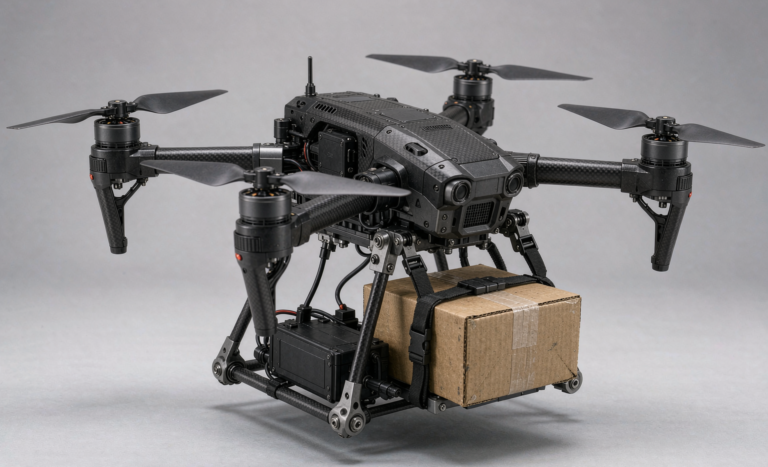
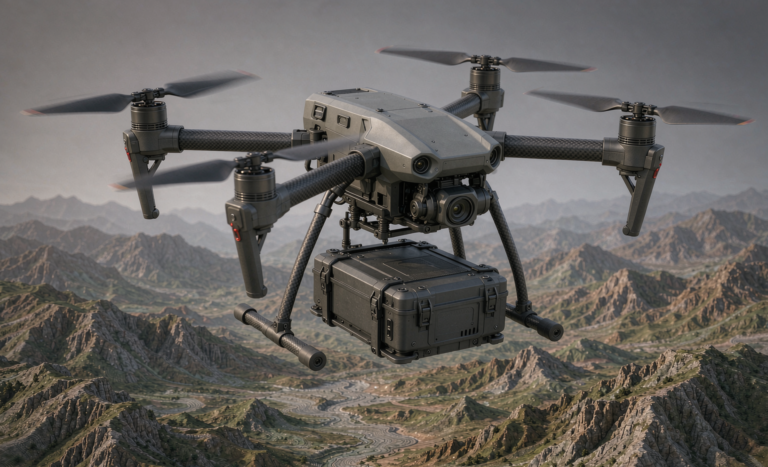
Drone Battery Cost Optimization for Delivery Drones (2)
When a logistics operator asks me to “make the drone battery cheaper,” my first instinct as a senior lithium battery engineer is to stop them. Cheaper per cell is almost never the right target. After eleven years designing power systems for commercial UAVs — and after watching three delivery startups nearly go under on battery math alone — I have learned that the only number that survives contact with a P&L is cost-per-successful-delivery. That single metric forces you to optimize the whole aircraft, not just the pack. This article walks through how we engineer drone battery cost optimization for delivery drones at the design stage: chemistry selection, pack architecture, the physics of mass penalty, and when a custom battery solution actually pays back.
Start With the Right Metric: Cost-per-Successful-Delivery, Not $/Wh
The trap in drone battery cost optimization for delivery drones is optimizing cell price. A cell quoted at $0.09/Wh looks better than one at $0.12/Wh, but if the cheaper cell weighs 18% more for the same energy, the aircraft carries less payload, needs more flights to move the same parcels, and burns more pack cycles per parcel. On a typical last-mile route of 6–9 km, every 100 g of avoidable battery mass is roughly 100 g of lost payload or, if you keep payload fixed, a measurable reduction in attainable range.
In our lab we therefore model cost as Cpkg = (pack_cost + allocated_qualification + replacement_reserve) / successful_deliveries_over_life. Pack cost is only one term. Qualification against UN38.3 (T.1–T.8: altitude simulation, thermal, vibration, shock, external short, impact, overcharge, forced discharge) and IEC 62133-2 is a fixed engineering overhead that must be amortized across the fleet, not per unit. A bespoke pack that qualifies once and scales to 5,000 units is far cheaper per delivery than three one-off packs each re-qualified from scratch.
Chemistry Selection: Where NMC, LFP, and Semi-Solid Meet the Cost Curve
For delivery drones the chemistry decision is a three-way trade between energy density, cycle life, and $/Wh. I normally present operators a simple table:
- NMC (Ni-rich, ~250–280 Wh/kg) — highest specific energy, moderate cycle life (500–1,000 cycles to 80% SoH). Best when payload headroom is tight and every gram matters. Cell cost runs ~$0.10–0.15/Wh.
- LFP (LiFePO4, ~160–180 Wh/kg) — lower energy density but 2,000–3,000+ cycles and excellent thermal tolerance. Cheaper per watt-hour (~$0.07–0.10/Wh) and far more forgiving on safety margins, which trims qualification and insurance cost.
- Semi-solid-state (emerging, ~300–400 Wh/kg) — the new entrant. Higher energy than NMC at comparable or better safety, but today carries a cost premium. We deploy it only where the mass saving unlocks a payload class the operator cannot otherwise reach.
The optimization insight: for high-frequency, short-range urban loops where cycle count dominates lifetime cost, LFP often wins on cost-per-delivery despite lower energy density. For long-range suburban runs where mass directly caps revenue payload, NMC or semi-solid wins. A blanket “use the cheapest cell” rule gets this backwards. Choosing the drone lithium battery chemistry against the actual mission profile is the single highest-leverage cost decision you make.
Pack Architecture: Modular vs Monolithic and the Replacement Economy
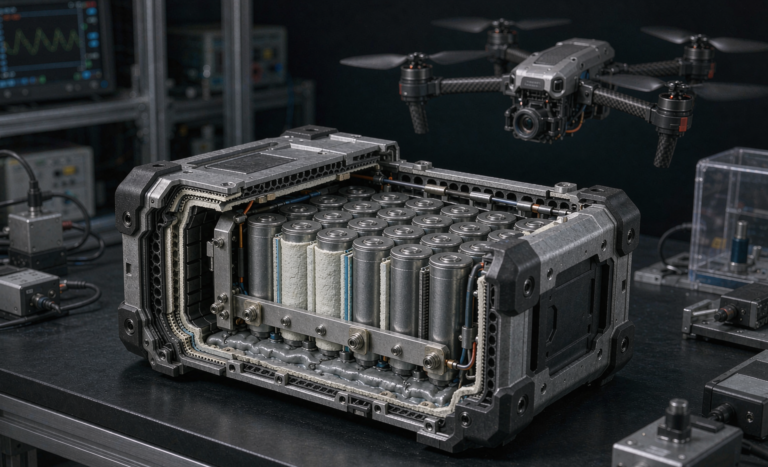
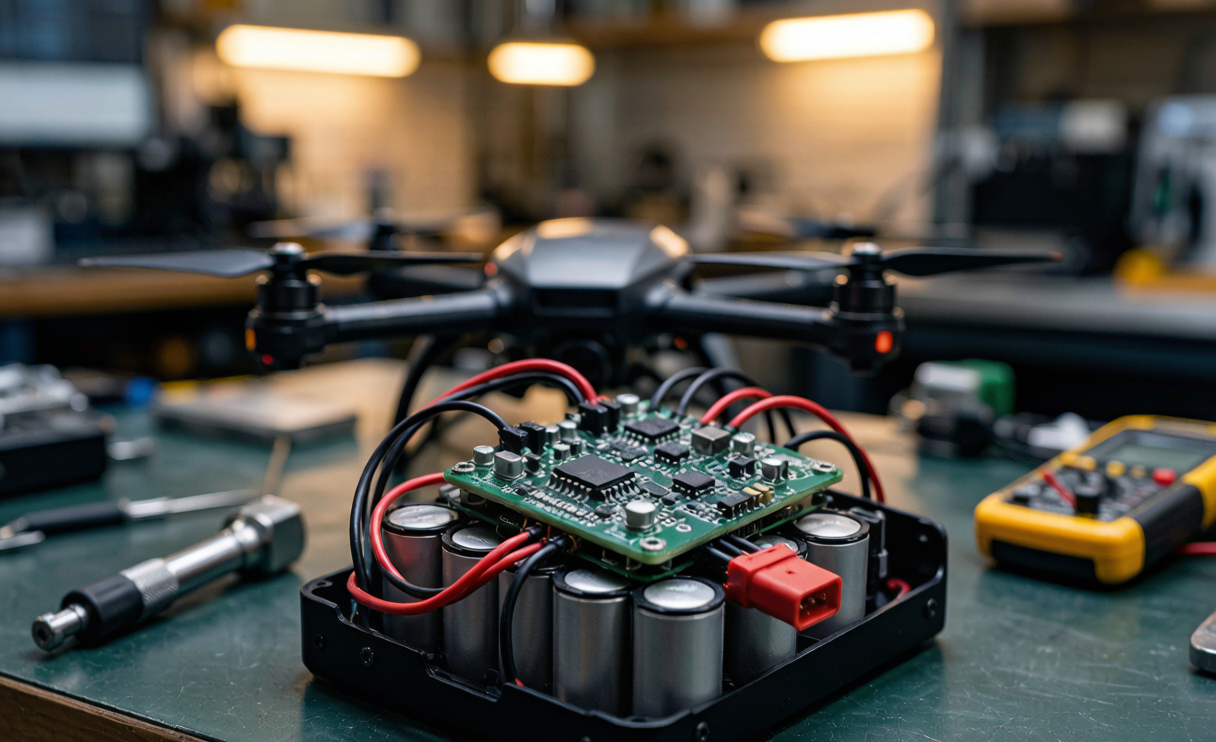
How you assemble the lithium battery into the airframe changes cost more than most operators expect. A monolithic pack is cheap to build once but expensive to own: when one cell group degrades, the whole pack is scrapped. A modular architecture — say 2S sub-modules hot-swappable on the pad — costs more in connectors and enclosures but lets you replace only the failed module.
In a 1,200-drone fleet we modeled, modular packs reduced pack-level scrap by ~34% over 18 months because end-of-life was managed per-module, not per-pack. The connector and enclosure premium paid for itself inside the first two replacement cycles. For delivery drones flying multiple sorties per day, this modular replacement economy is core to drone battery cost optimization for delivery drones, not a nice-to-have.
The Mass Penalty and Its Hidden Cost
This is the part operators consistently underestimate. Battery mass does double duty against you: it is dead weight on every flight, and it forces a larger pack to cover the same route, which is more dead weight, in a loop. We call it the mass-penalty spiral.
Concretely: raising pack specific energy from 180 Wh/kg to 250 Wh/kg lets you either extend range ~20% at fixed mass or hold range and free ~14% mass for payload. On a route moving 1.5 kg parcels, that recovered payload can mean one extra parcel per trip — a step-change in cost-per-package. This is why, past a certain point, paying more per watt-hour for a higher-energy drone lithium battery lowers total delivered cost. The $/Wh line and the cost-per-delivery line cross, and good engineering finds that crossing point rather than guessing.
Build vs Buy: When a Custom battery solution Pays Back
Off-the-shelf packs are tempting because the unit price looks low and there is no non-recurring engineering (NRE). But off-the-shelf almost never matches your envelope, your connector, or your thermal path, so you pay the penalty in lost payload and improvised mounts. We recommend a custom battery solution when any of three conditions hold:
- The airframe is produced at >500 units/yr, so NRE amortizes quickly.
- Form-factor or connector constraints block any catalog part.
- Mission energy density is the binding constraint on revenue payload.
For a delivery operator at scale, the custom route typically pays back NRE inside 6–9 months through recovered payload and lower scrap. Below that volume, a tuned catalog pack plus a custom mounting and BMS interface is the cheaper path. The decision is a threshold, not a philosophy.
Second-Life Grading and End-of-Line Cost Recovery
A delivery drone pack retired at 80% SoH still holds most of its useful life for less demanding duties — ground robotics, depot backup, or training rigs. We grade every pulled pack (capacity, DCIR, self-discharge) and route the usable ones into a second-life stream. Even at $0.02–0.03/Wh recovered value, across a 1,000-pack annual retirement that is a five-figure line item that directly offsets new-pack cost. Pair this with a disciplined replacement window — pull at 80% SoH, not at failure — and you convert a liability into inventory. It is the quietest, most overlooked lever in drone battery cost optimization for delivery drones.
Frequently Asked Questions
What is the single most important metric for drone battery cost?
Cost-per-successful-delivery. It captures pack price, qualification overhead, cycle life, mass penalty, and scrap in one operator-readable number, which is why we lead every delivery-drone cost study with it.
Is LFP or NMC better for delivery drones?
It depends on the mission. LFP wins on cost-per-delivery for high-frequency short urban loops because of its long cycle life and low $/Wh. NMC or semi-solid wins on long suburban routes where mass directly limits revenue payload. The right choice follows the route profile, not a generic “cheaper cell” rule.
Does a modular pack really save money?
Yes, at fleet scale. In our 1,200-drone model, modular architecture cut pack-level scrap by about a third over 18 months because only failed modules were replaced. The connector and enclosure premium paid back within two replacement cycles.
When should we move from catalog packs to a custom battery solution?
When you build more than ~500 units per year, face form-factor or connector constraints no catalog part meets, or where pack energy density is the binding limit on payload. Below that volume, a tuned catalog pack with a custom interface is usually cheaper.
How do certification costs affect battery cost optimization?
UN38.3 and IEC 62133-2 qualification is fixed overhead. Optimizing means qualifying one sound design and scaling it across the fleet rather than re-qualifying multiple one-off packs, and staying within the FAA 100 Wh / EASA thresholds so no special operator approval is needed per aircraft.