Drone Battery Testing for Racing Drones: A Senior (2)
Over the last nine years I have shipped thousands of high-discharge cells to FPV and professional racing teams, and the single habit that separates a podium finish from a mid-air cutoff is disciplined drone battery testing. A racing drone lithium battery is asked to deliver 80–150C bursts while shedding heat faster than any consumer pack, so every batch must be proven before it ever touches a flight line. In this playbook I walk through the exact bench protocol my team at Horizon Power runs on every production lot of drone battery packs destined for racing drones, the acceptance numbers we hold, and the field checks that keep a fleet honest.
Why Racing Drones Demand a Disciplined Test Protocol
A typical 6S racing drone lithium battery rated at 1300mAh and 120C is expected to push 150+ amps in a punch-out yet still land at 3.5V per cell. The margin between a healthy pack and a dangerous one is measured in milliohms, not volts. A custom battery solution for a racing airframe is only as good as the validation behind it, and a single weak cell in a series string drags the whole pack down. That is why we never ship a drone battery on spec-sheet promises alone.
Our testing philosophy is simple: prove three things on the bench before flight — that internal resistance is uniform, that usable capacity matches the label, and that the pack survives the mechanical and thermal abuse a racer will eventually inflict on it. Everything else is commentary.
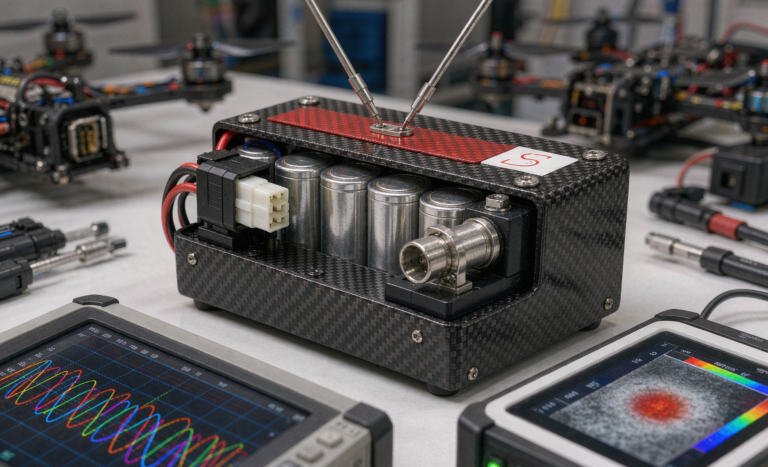
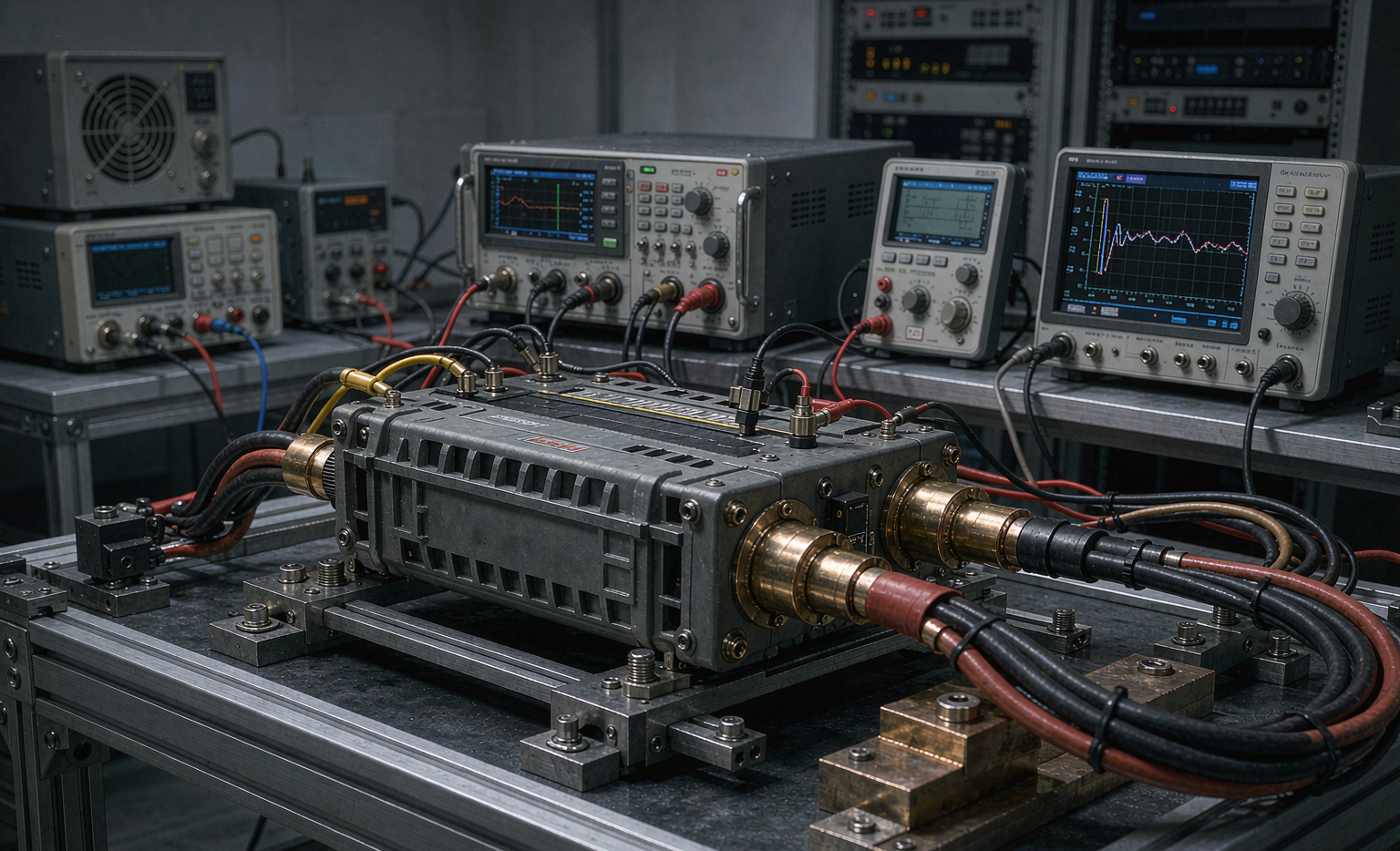
The bench itself matters as much as the procedure. Every lot is processed on a four-channel cycler with 0.05% current accuracy, a thermal chamber holding ±1°C, and a data logger that timestamps each sample at 10Hz. I have watched two seemingly identical drone battery batches return opposite results purely because one was tested on a warm afternoon bench and the other in a climate-controlled cell. Consistency in the environment is what makes the numbers comparable lot to lot, and comparable numbers are the only thing a racing team can actually plan around.
Incoming Inspection and DC Internal Resistance Screening
The first gate is DC internal resistance (DCIR). We measure every cell at 1kHz AC plus a pulsed DC load (10s discharge at 30A) and reject any cell whose DCIR deviates more than 8% from the lot mean. On a 6S pack this means six matched cells within a tight band, because mismatch is what causes one cell to over-discharge while the others still have headroom.
For a 1300mAh 120C drone lithium battery we typically see DCIR around 6–9 milliohms per cell at 25°C. Anything above 12 milliohms at incoming inspection goes back to the cell supplier. We also log open-circuit voltage and self-discharge over 24 hours; a pack that bleeds more than 20mV overnight is pulled. These are not arbitrary numbers — they map directly to how flat your voltage sag stays through a 4-second full-throttle climb.
Capacity Verification and Discharge Curve Profiling
Capacity claims are the most abused spec in the industry, so we verify at the C-rate the pack will actually see. A racing drone battery is discharged at 25C (around 32A for a 1300mAh pack) from 4.20V down to 3.30V cutoff, then we compare delivered mAh against the rated label. We accept nothing under 98% of rated capacity.
More useful than the single number is the discharge curve. We plot voltage against capacity and look for three things: a flat stable plateau (good lithium battery chemistry balance), a predictable sag under burst, and a graceful tail near cutoff rather than a cliff. A pack that holds 3.7V to 80% depth-of-discharge and only sags to 3.45V under a 30A burst is a pack we will put our name on. We attach this curve to the lot certificate so a customer’s custom battery solution can be tuned to their specific ESC and motor draw.
Thermal Behavior Under Burst Loads
Racing is bursty. A qualifying lap punishes a drone battery with repeated 2–5 second full-throttle spikes separated by coasting. We simulate this with a pulsed profile — 40A for 4s, rest 6s, repeated 40 times — and measure surface temperature with an IR camera. We reject any pack that exceeds 60°C on the cell wrap or shows more than 8°C cell-to-cell spread.
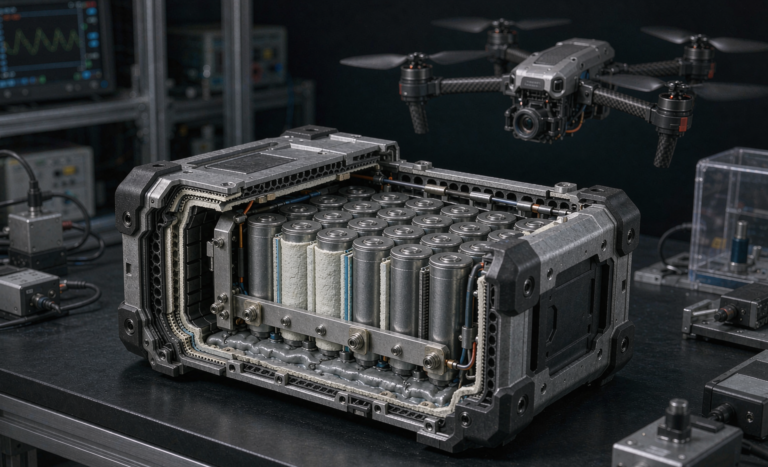
Thermal runaway does not start at the burst; it starts at the weak weld. That is why our drone lithium battery construction uses pure-nickel bus bars with ultrasonic welds inspected by shear test, and why thermal imaging during burst testing is non-negotiable. If one cell runs hot under an identical load, the weld or the separator is suspect, and the whole lot is quarantined.
Mechanical Qualification: Vibration and Shock (UN38.3)
A racing drone lives in a vibration bath. Our mechanical qualification follows the UN38.3 T.3 vibration and T.4 shock tests, then goes further with a racer-specific profile: random vibration 7.7grms from 10–2000Hz plus repeated 50G drop shocks on each axis. Every drone battery must complete this with zero cell deformation, zero venting, and less than 5% capacity loss.
We also run the UN38.3 T.1 altitude (11.6kPa for 6 hours), T.2 thermal (rapid -40°C to +75°C cycling), and T.6 impact tests on sample lots. These are the same safety baselines airlines reference under IEC 62133-2 and the FAA/EASA lithium battery carriage rules, and they are the floor, not the ceiling, for anything we fly. A custom battery solution that cannot clear UN38.3 never leaves the building.
Cycle-Life Characterization and Fleet Retirement Rules
Racing packs age fast, and the job of drone battery testing does not stop at incoming inspection. We characterize every chemistry on a 1C charge / 25C discharge cycle rig until capacity falls to 80% of label, and we feed that curve into our fleet management advice. For a typical high-C drone lithium battery we see 180–250 useful cycles before the knee, but the useful racing life is shorter — most teams retire a pack at 85% capacity because sag becomes unpredictable.
Our retirement rule is hard: any pack whose DCIR has risen more than 35% above its incoming baseline, or whose capacity has dropped below 85% of rated, is pulled from racing duty and demoted to bench training or recycling. We stamp the first-test date on every pack so a customer’s custom battery solution has a known age, not a guessed one.
Flight-Line Go / No-Go Checklist
The bench proves the lot; the flight line proves the individual pack. Before every race day my teams run a five-point check on each drone battery:
- Visual: no swelling, no punctured wrap, no warm-to-touch resting state.
- Resting voltage per cell within 0.02V across the string.
- IR delta under 10% between the highest and lowest cell.
- Recent cycle count logged and under the 85%-capacity retirement line.
- Storage charge confirmed at 3.80–3.85V per cell if the pack has sat more than 48 hours.
A pack that fails any single point stays on the ground. This is the cheapest insurance a racing team can buy, and it is the reason our field return rate stays below 0.4%.
One more habit worth mentioning: log every reading. A racing drone battery that looks perfect today is only trustworthy if you can compare it to its own history. We keep a per-pack record — first IR, first capacity, cycle count, and every flagged anomaly — so a custom battery solution becomes a known entity rather than a mystery wrapped in shrink wrap. When a pack finally misbehaves, that log tells you whether it was manufacturing, abuse, or simply age, and that answer is what improves the next batch.
Frequently Asked Questions
What is the most important test for a racing drone battery?
DC internal resistance matching across cells. A drone lithium battery with one high-IR cell will sag and trip under burst even if the other five are perfect, so uniform DCIR is the single best predictor of clean power delivery on the line.
How often should I re-test my racing packs?
At minimum every 25 cycles, and always after a hard crash or a known over-temperature event. A custom battery solution with telemetry can flag IR drift automatically, but a manual IR check every few weeks catches problems before race day.
Can a pack pass bench tests but still fail in flight?
Yes, which is why we combine lot-level UN38.3 and cycle testing with per-pack flight-line checks. Bench testing proves the design and the batch; the go/no-go checklist proves the individual lithium battery you are about to launch.
What temperature is safe during a racing burst?
We hold our drone battery testing limit at 60°C surface and under 8°C cell-to-cell spread. Above that, weld or separator risk rises sharply, and we pull the pack.
Do your racing packs meet air-transport rules?
Every production lot clears UN38.3, and we document against IEC 62133-2 plus the FAA and EASA lithium battery carriage thresholds. That paper trail travels with the shipment so our customers clear customs and cargo without surprises.