Drone Battery Design for Inspection UAVs: Hot-Swap Modular
When a survey crew launches at first light and flies until the light fails, the bottleneck is almost never the aircraft — it is the drone battery. I have spent fifteen years on the engineering bench building lithium packs for commercial inspection UAVs, and the single design decision that most separates a productive mapping day from a frustrating one is whether the pack is a sealed, charge-in-place unit or a hot-swappable field module. This article is the eleventh in our drone battery design inspection uavs series, and it takes a deliberately different angle: not cell chemistry, not thermal envelopes, but the modular architecture and field-swap logistics that actually determine how many flights you get in a day.
Why Inspection Missions Need Hot-Swap, Not Charge-in-Place
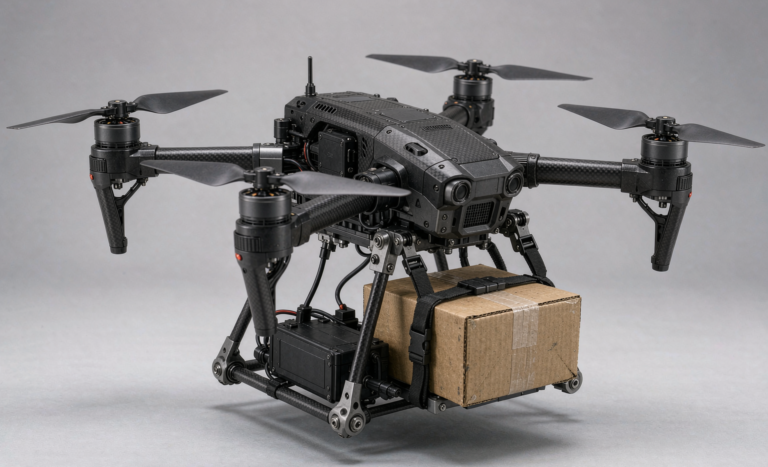
A typical inspection flight — a roof survey, a pipeline patrol, a power-line thermal scan — burns a 6S 21700 pack in 22 to 38 minutes of mixed hover-and-transit duty. Charging that same pack back to a safe 95% state of charge takes 45 to 75 minutes on a field-grade charger. If you design the airframe around a permanently-installed battery, every aircraft is idle for roughly two-thirds of the working day. A drone lithium battery built as a swappable module flips that math: the aircraft stays in the air while a second, third, and fourth pack rotates through the charger back at the truck.
The economics are not subtle. At a regional energy-inspection contractor we supported, moving from charge-in-place to a four-pack rotation per airframe lifted effective flight hours from 2.6 to 6.8 per aircraft per day — a 2.6x gain with no change to the airframe, the motors, or the mission. The design work that unlocked it was almost entirely mechanical and logistic, not electrochemical.
Standardizing the Bay — One Pack, Many Variants
The first rule of a swappable architecture is that the bay, not the battery, is the standard. I specify a cavity envelope — for the 6S3P 21700 class we use 180 x 120 x 55 mm with a hard mechanical datum on three faces — and then hold every pack in the family to it. That single decision lets one lithium battery module serve a visual-inspection quad, a LiDAR-mapping fixed-wing, and a thermal-gimbal hexacopter. The airframes differ; the energy brick does not.
Standardization also protects the operator from vendor lock. When the bay is fixed and the connector interface is published, a custom battery solution from a second supplier drops in without a requalification of the airframe. I have seen operators cut their pack cost 12 to 18% simply by being able to qualify a second source against a frozen mechanical and electrical interface.
Connector Mating-Cycle Life — The Reliability That Quietly Decides Fleet Uptime
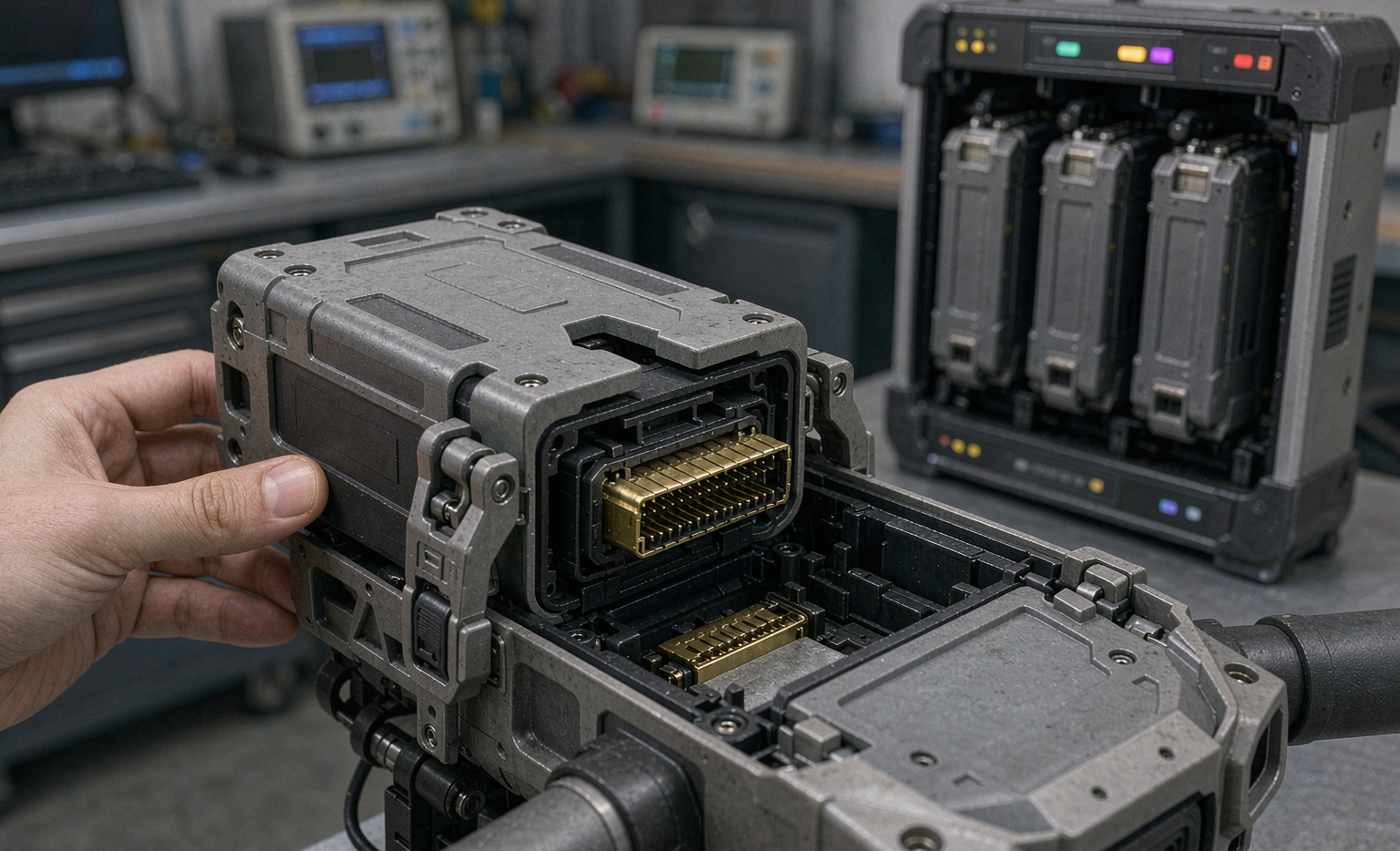
The connector is where most swap architectures fail, and it fails slowly. A field pack is inserted and withdrawn hundreds of times across its service life, and every cycle plows the contact surface a little deeper. I specify hard-gold plating at 30 micro-inches over a nickel barrier rather than the flash-gold you find on consumer connectors; flash gold wears through to nickel in roughly 300 to 500 cycles, while hard gold holds contact resistance under 0.15 mΩ past 1,000 cycles. On a 6S pack the interface carries 40 A continuous and 80 A for 10 second pulses, so a contact that creeps from 4 mΩ to 12 mΩ is quietly dissipating an extra 11 watts of heat at the joint.
I also choose spring-finger contacts over pogo pins for the high-current rails because they tolerate dust and slight misalignment better, and I reserve pogo or pin-and-socket only for the low-current sense and Kelvin lines. The result is a connector rated for 1,000+ mating cycles with a DCIR drift specification, not just an initial resistance number.
Mechanical Retention That Survives Vibration and a Fumbled Swap
A hot-swap pack must stay put through the full mission and yet release in under two seconds on the ground. I use a dual-latch mechanism — one tool-free primary latch the operator feels click, plus a secondary safety catch that cannot release unless the primary is fully disengaged. This prevents the classic failure where a single over-center latch vibrates to half-mast in flight. We qualify the retention against MIL-STD-810H Method 514.8 random vibration at 1.2 grms on each axis; the pack must hold its latches and show less than 0.3 mm of travel at the cells.
Alignment matters as much as retention. A keyed, polarized guide means a tired operator at the end of a long day cannot insert the pack reversed or offset — the geometry physically refuses the wrong orientation. Reverse-polarity and offset insertion are the two most common field-damage modes of a swap system, and both are solved on the drawing board, not in the training manual.
The Sub-90-Second Swap Discipline and Swap-Station Design
The goal I design around is a 60 to 90 second swap, from landed aircraft to armed and ready. That target drives the whole ground workflow. The swap station is a magazine of pre-charged packs held at a SoC gate of 95% or higher, organized so the oldest-cycled pack is presented first (a simple first-in-first-out discipline that flattens wear across the fleet).
We instrument the station with a single-button health check: on insertion it reads the pack’s DataMatrix genealogy tag, confirms cell balance under 30 mV, verifies no over-temperature flag, and gives a green light. An operator who cannot interpret a battery-management readout can still run the swap safely because the system makes the go/no-go decision for them. A drone battery designed for field swapping is, in part, designed to be operated by someone who is cold, tired, and looking at the sun.
Sizing the Fleet Battery Pool — How Many Packs per Airframe
Swap architecture only pays off if you own enough packs. The pool-depth model is straightforward. An aircraft flies roughly 30 minutes per pack and charges in about 60 minutes, so a single pack supports one flight per 90-minute cycle. To keep one aircraft continuously flying during an 8-hour day you need a pool of roughly five to six packs rotating through one charger — four in the air-or-queue and one to two on the charger at any moment.
For a fleet of ten aircraft running two chargers, I typically specify 55 to 65 packs: enough that no aircraft waits on a charger, with a 10 to 15% spare margin for packs pulled for retirement or testing. Undersizing the pool is the most common mistake I see; operators buy the airframes, then discover the battery pool — not the airframe count — caps their daily throughput. A custom battery solution engagement should always size the pool alongside the pack.
Genealogy, Tracking, and Predictive Retirement of Swapped Packs
Because swapped packs move between airframes, you lose the clean one-pack-one-aircraft history that permanent installations enjoy. I restore that visibility with a laser-etched DataMatrix code on every pack and an RFID tap at every bay. Each insertion logs the pack ID, the airframe, the cycle count, and the pre-swap DCIR snapshot. Over a season this builds a per-pack fatigue record far richer than any single aircraft log.
That record lets me retire packs on data, not on a calendar. When a pack’s DCIR climbs past 30% of its fresh value, or its cell-to-cell spread exceeds 40 mV, or its cycle count crosses the Weibull B10 life we qualified it to, it is pulled — often with 50 to 100 useful cycles still in it, but removed before it becomes a field risk. This is the discipline that turns a swap fleet from a liability into a managed asset.
Safety in a Hot-Swap Architecture
Swapping a live 6S pack means breaking and making a 25 V connection under field conditions, and a careless design can arc. I mitigate this with a controlled pre-charge: the bay first touches a current-limited resistor path that bleeds the airframe capacitance up to pack voltage before the main contacts close, so the main latch engages with near-zero inrush. The contactor is isolated and single-fault tolerant — one wiring error or one stuck relay cannot present an arc at the operator’s hands.
None of this replaces transport and air-safety compliance. Every swapped pack still carries UN38.3 T.1–T.8 passage, is built to IEC 62133-2, ships under IATA Section II below 100 Wh (or below 160 Wh with operator approval), and meets the FAA/EASA 100 Wh cabin and cargo thresholds. The bay itself is sealed to IP67 so a dropped pack in wet grass does not become a short-circuit event. A modular drone lithium battery is only as safe as the worst swap a tired operator will ever perform.
Frequently Asked Questions
How many battery packs do I need per inspection drone?
For continuous operation, plan five to six packs per airframe per charger, which covers one flight every 90 minutes across an 8-hour day with margin. A ten-aircraft fleet on two chargers typically needs 55 to 65 packs to avoid the battery pool becoming the throughput bottleneck.
What connector plating should a hot-swap drone battery use?
Specify hard gold at 30 micro-inches over nickel, not flash gold. Flash gold wears to nickel in 300 to 500 mating cycles while hard gold holds under 0.15 mΩ past 1,000 cycles, which matters because the 6S interface carries 40 A continuous and 80 A pulses.
How fast should a field swap be?
Design for 60 to 90 seconds from a landed aircraft to armed-and-ready. That target drives a pre-charged pack magazine, a keyed alignment guide, a dual-latch release, and a one-button health gate that makes the go/no-go call for the operator.
How do you keep swapped packs from wearing out unevenly?
Use a first-in-first-out swap discipline at the station plus per-pack DataMatrix and RFID tracking. Each insertion logs cycle count and DCIR, so packs are retired on data — DCIR up 30%, spread over 40 mV, or past qualified B10 life — rather than on a fixed calendar.
Is a hot-swap drone battery design safe under field conditions?
Yes, with a controlled pre-charge path and an isolated single-fault-tolerant contactor to prevent arcing, plus an IP67 bay. Compliance with UN38.3 T.1–T.8, IEC 62133-2, IATA Section II, and FAA/EASA 100 Wh limits remains mandatory.