Drone Battery Design for Inspection UAVs: Engineering
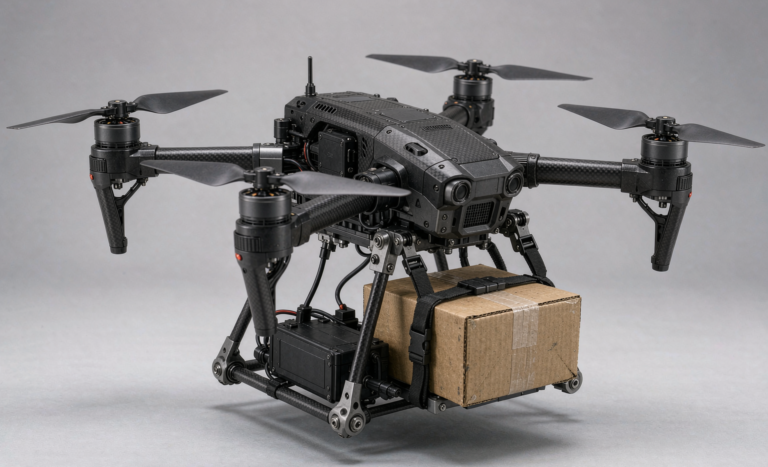
As a senior lithium battery engineer at Horizon Power, I have spent the last decade designing energy systems for commercial unmanned aerial vehicles. When a utility, energy, or infrastructure operator asks me to build a drone battery for pipeline, tower, or roof inspection, the conversation is never about capacity alone. It is about the entire mission profile: hover-heavy flight, temperature swings, constant vibration, and the absolute requirement that the pack comes home every single time. In this article I want to walk you through how we approach drone battery design for inspection UAVs, the international standards we certify against, and the engineering trade-offs that decide whether a custom battery solution survives a real deployment or fails on its third flight.
Understanding the Inspection Mission Profile
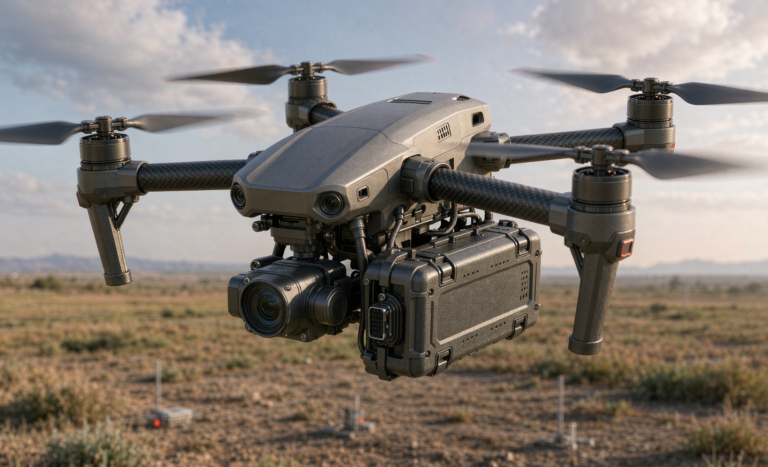
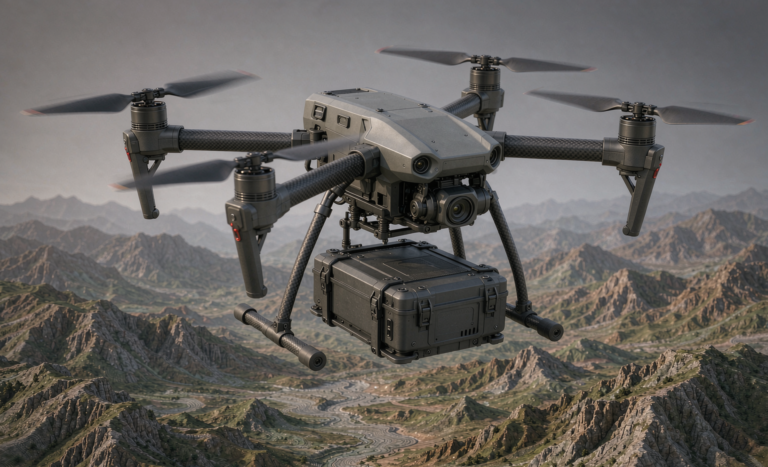
The single biggest mistake I see in off-the-shelf packs is that they are built for racing or photography, not inspection. A cinematography drone cruises and banks; an inspection UAV hovers. Hovering is the worst case for a drone lithium battery because the aircraft must hold its full weight in the air with no gliding benefit, often at 50 to 70 percent throttle for 20 to 40 minutes straight. That means a sustained, high-current draw rather than short bursts.
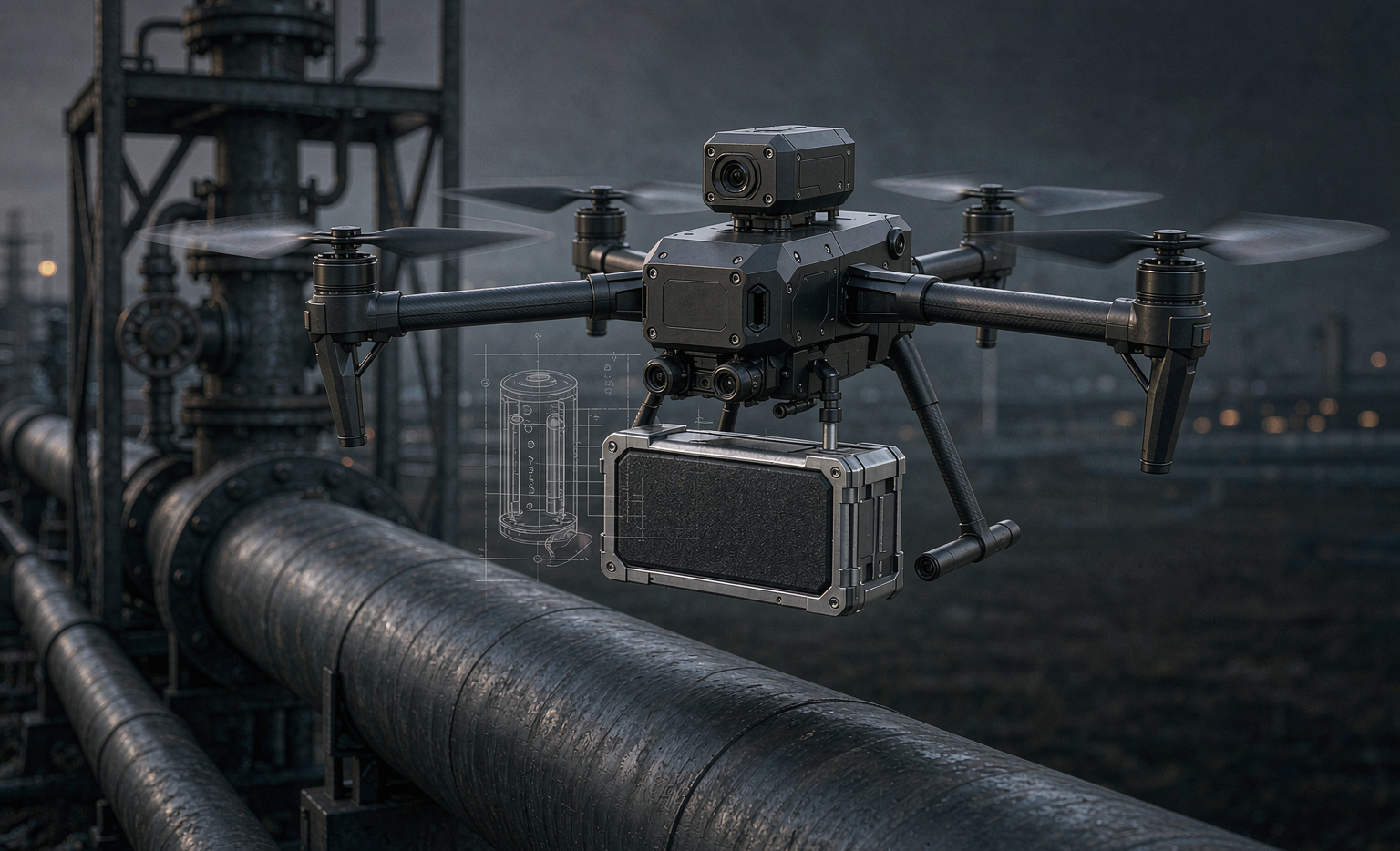
To put numbers on it: a 4 kg inspection airframe needs roughly 600 to 900 W just to stay aloft in calm air, and a 12 m/s headwind or a sudden yaw maneuver can triple that transient demand. Before we draw a single cell, we ask the operator for the mission log: average wind speed, payload mass, target altitude, and whether the flight is mostly hover or mostly transit. A 1.2 kg payload and a gusty site can push the pack to continuous 40 to 60 A discharge. We then model the voltage sag under that load and size the pack so the battery never drops below its safe cutoff while still delivering the rated flight time. This load-first approach is the foundation of proper drone battery design for inspection UAVs.
Cell Selection: Why We Standardize on High-Rate Lithium
For inspection platforms we almost always select high-discharge NMC (nickel manganese cobalt) 21700 cylindrical cells. A single cell gives us 3.6 V nominal, 4.8 to 5.0 Ah capacity, and a continuous discharge rating around 30 A, with pulse capability well above that. Energy density lands in the 250 to 280 Wh/kg range, which matters enormously when every gram of pack mass reduces flight time.
We think in C-rates rather than absolute amps. A 5 Ah cell discharged at 10C delivers 50 A; we deliberately design with 15 to 20C of peak headroom so the pack never runs at its limit. Internal resistance is the hidden variable here: a quality 21700 sits around 20 to 30 milliohms, and lower resistance means less heat and less voltage sag under load. We also benchmark against LFP (lithium iron phosphate), which is safer and longer lived but roughly 30 percent lower in energy density. For inspection work where range and endurance win, a well-engineered lithium battery chemistry is the pragmatic choice, provided the pack is paired with a properly rated BMS and cells from a traceable, tier-one supply chain that we incoming-inspect for capacity and internal resistance.
Pack Architecture and the Battery Management System
A typical inspection pack is a 6S configuration: six cells in series giving a 22.2 V nominal pack. Depending on flight-time targets we parallel two or three cells per group, so you will see 6S2P or 6S3P layouts delivering roughly 10,000 to 16,000 mAh. The series count must match the ESC and motor input, and the parallel count is tuned to the endurance requirement.
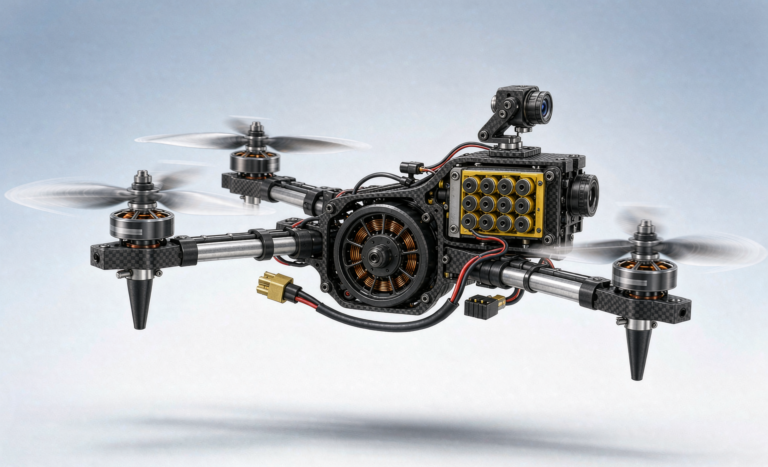
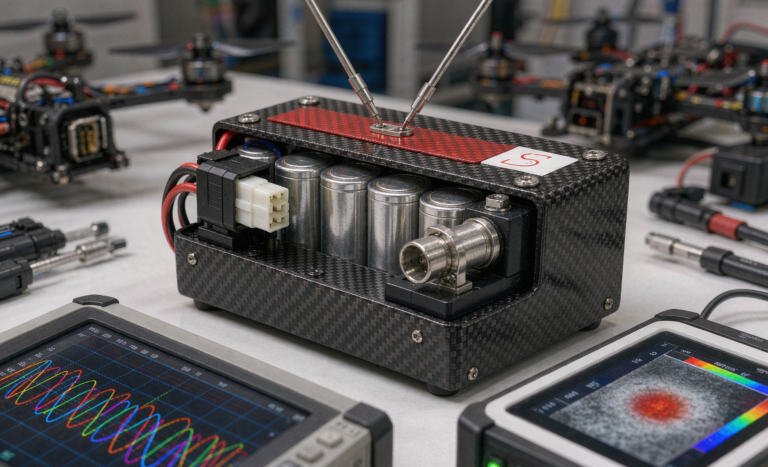
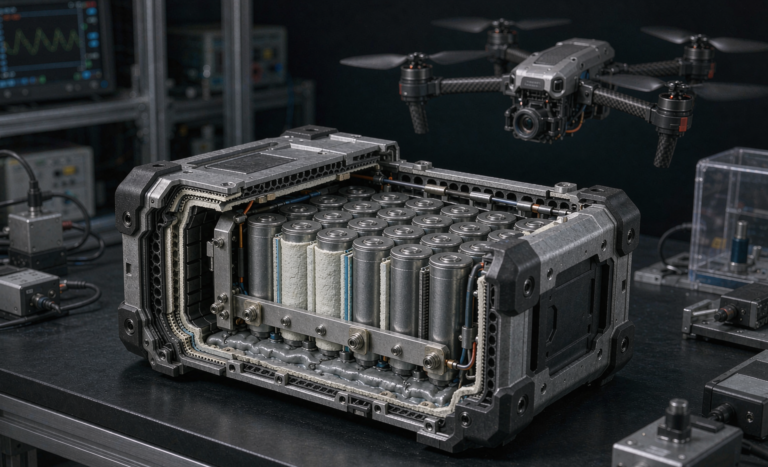
Construction matters as much as chemistry. We join cells with pure-nickel strip, typically 0.15 to 0.2 mm thick, spot-welded rather than soldered, because solder introduces heat stress and higher-resistance joints. The enclosure is molded PC/ABS or light carbon composite with dust ingress protection, and the cell group is held in a compression frame so vibration cannot loosen a weld. The BMS is not optional: it monitors every series group for over-voltage (around 4.25 V per cell), under-voltage (around 3.0 V), over-current, and short circuit, and performs balancing to keep cell voltages within a few millivolts. For inspection fleets we add a CAN or SMBus telemetry link so the ground station reads state of charge, cell temperatures, and cycle count live. A missing or cheap BMS is the most common cause of field failures we are asked to fix.
Thermal Management in the Field
Inspection happens where the assets are, not in a climate-controlled lab. We design packs to operate from about -10°C to 50°C, but chemistry does not behave linearly. Below 0°C, lithium plating risk rises and usable capacity can fall 20 to 30 percent; above 45°C, cycle life can be cut roughly in half. The BMS enforces a low-temperature derate that limits charge current and warns the pilot, and a high-temperature cutoff near 60°C protects the cells.
Because adding active heating or liquid cooling weighs down the aircraft, we rely on passive thermal design: cell spacing, aluminum heat-spreading frames, thermal interface pads, and ventilated enclosures. On a desert pipeline job at 45°C we add vent slots and reduce the continuous-current limit; on a cold offshore morning we pre-warm the pack in the vehicle and keep it above freezing until launch. The goal is a custom battery solution that stays inside its safe window across both extremes without pilot intervention.
Certification and Compliance: UN38.3, IEC 62133, and Air Transport
Commercial operators cannot fly or ship packs that are not documented. Every pack we deliver is tested to UN38.3, the United Nations protocol covering eight tests: altitude simulation, thermal, vibration, shock, external short circuit, impact, overcharge, and forced discharge. For product safety we certify to IEC 62133-2, the international standard for secondary lithium-ion cells and batteries, which covers construction, mandatory protective circuits, and abuse testing.
When operators transport spares by air, FAA and EASA rules apply. Under FAA Part 107 for commercial flight and EASA U-space for European operations, batteries between 100 Wh and 160 Wh require carrier approval and marked packaging, and we recommend shipping at or below 30 percent state of charge to minimize thermal risk. Most inspection packs sit under 160 Wh, keeping them in the permissible band. We supply the UN test summary, watt-hour marking, and transport documentation so a fleet manager can move packs between job sites without customs or carrier disputes. Ignoring these papers is how an entire inspection program gets grounded at an airport.
Connector and Form-Factor Standardization Across a Fleet
A fleet that mixes connector types and mount patterns wastes time on the ground and invites wrong-connection damage. We standardize every pack for a given customer on one connector family, such as an AS150 or XT60-style high-current plug, and one mechanical mounting footprint, so any pilot can swap a depleted pack for a charged one in under a minute. Standardization also simplifies spares inventory and training, which is why a custom battery solution for a fleet almost always includes a form-factor specification document alongside the cells.
Maintenance and Cycle-Life Expectations
An inspection pack is a consumable, not a permanent part. With NMC chemistry you should expect 300 to 500 full cycles before capacity falls to 80 percent of its original value, and the fade is gradual rather than sudden. We tell operators to store packs at 40 to 60 percent state of charge, never at full charge, and to balance them every ten cycles. The BMS logs cycle count and internal resistance drift, and we recommend retiring a pack once it drops below 80 percent usable capacity or shows a cell imbalance the BMS cannot correct. Treating batteries as managed assets, not anonymous bricks, is what keeps an inspection program flying reliably month after month.
Building a Custom Battery Solution for Your Fleet
Off-the-shelf packs rarely fit a specialized airframe, a proprietary connector, or a payload that needs clean regulated power. That is where a custom battery solution pays for itself. We start from the airframe CAD, run finite-element analysis on the mount and vibration path, and specify the connector and lead length to match the ESC. For smart fleets we embed a BMS with Bluetooth or CAN telemetry so maintenance can track each pack’s state of health from a tablet.
Before release we run HALT (highly accelerated life testing): thermal cycling, random vibration, and hundreds of charge-discharge cycles. Only packs that hold capacity and stay balanced ship to the customer. This disciplined process is what turns a generic drone battery into a dependable inspection asset that earns its place on the aircraft.
FAQ
How long should a drone battery for inspection last per flight?
Most inspection UAVs achieve 25 to 40 minutes of usable flight on a well-matched pack, with hover-heavy missions at the lower end. Flight time depends mainly on payload mass, wind, and how aggressively the pilot maneuvers.
What capacity do I need for pipeline or tower inspection?
For a typical 2 to 4 kg inspection airframe, 10,000 to 16,000 mAh at 22.2 V is the common range. We size it from your actual mission log rather than a catalog number, because wind and payload dominate the result.
Can I fly inspection missions in cold weather?
Yes, down to about -10°C, but capacity falls as temperatures drop, sometimes 20 to 30 percent near freezing. Keep packs above freezing when possible, pre-warm them before flight, and rely on the BMS low-temperature derate to protect cell health.
Is it safe to ship inspection drone batteries by air?
Yes, provided they are UN38.3 tested and within the 100 to 160 Wh air-transport band with proper markings, ideally at or below 30 percent state of charge. We supply the test summary and UN documentation with every commercial pack.
How many cycles will my inspection battery deliver?
Budget for 300 to 500 full cycles to 80 percent capacity with NMC cells, provided you store at partial charge and balance regularly. Track cycle count through the BMS and retire packs that fall below the 80 percent threshold.