Semi-Solid State Battery Reliability for EV Packs
Why EV Pack Reliability Starts With the Electrolyte Architecture
When fleet procurement teams ask me to qualify a new cell chemistry, the first question I ask is never about energy density. It is about what happens to the pack on the worst day of its service life — a curb strike, a flooded underpass, a winter depot at minus twenty Celsius, or a fast-charge session stacked back-to-back for twelve hours. Over my years building lithium battery systems for automotive and industrial customers, I have learned that a semi-solid state battery earns its place in an EV pack not because it looks futuristic on a spec sheet, but because its failure modes are slower, more predictable, and easier to contain than those of a conventional liquid-electrolyte NMC cell.
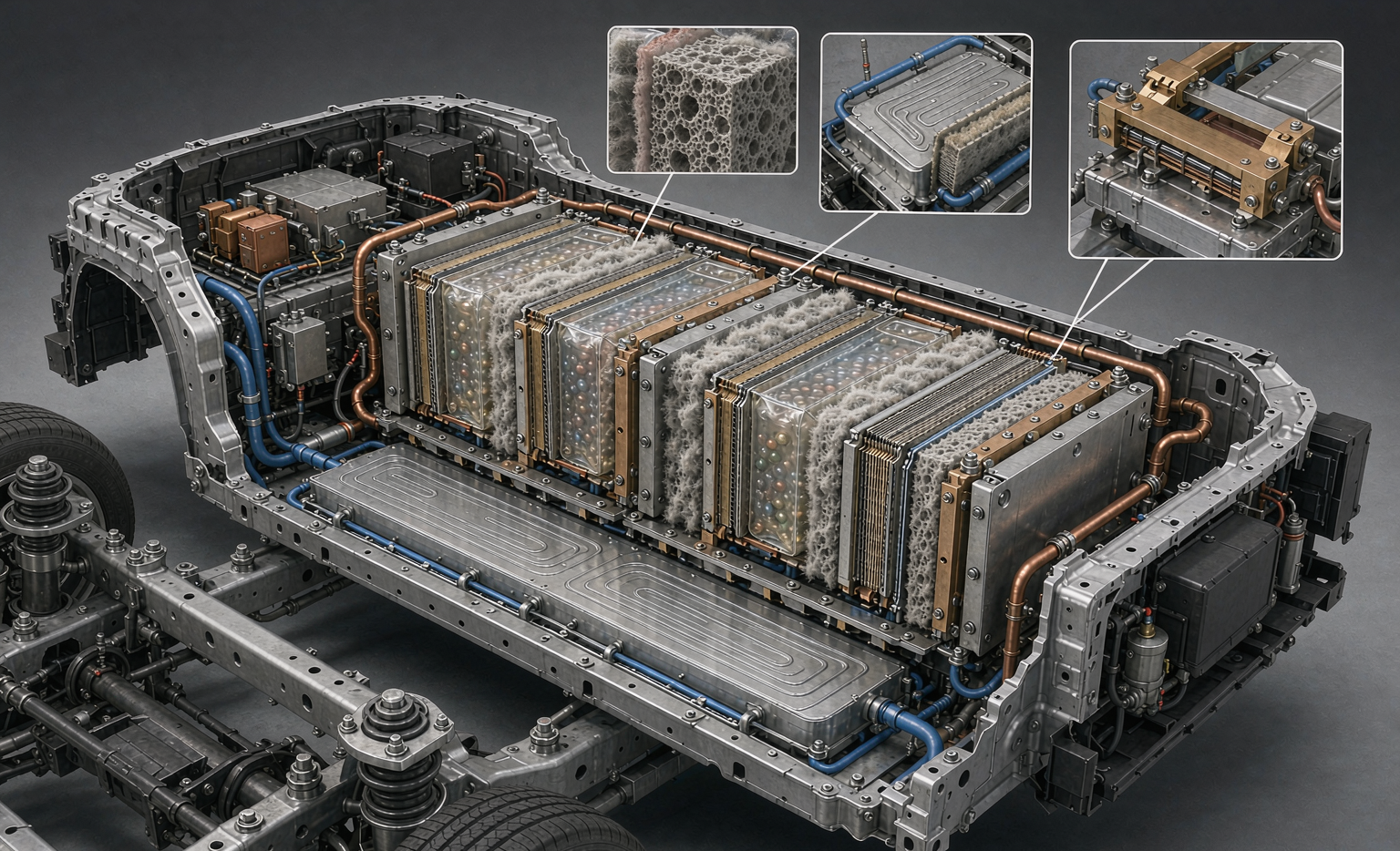
In this article I will walk through the reliability engineering we apply to semi-solid state battery packs: the abuse-tolerance data that governs pack spacing, the cycle-life and calendar-aging curves we qualify against, the cold-weather and fast-charge behavior that decides range guarantees, and the manufacturing-consistency controls that let a custom battery solution pass UN38.3, IEC 62133-2, and UL 2580 on the first attempt.
What Makes a Semi-Solid Electrolyte Different in an EV Pack
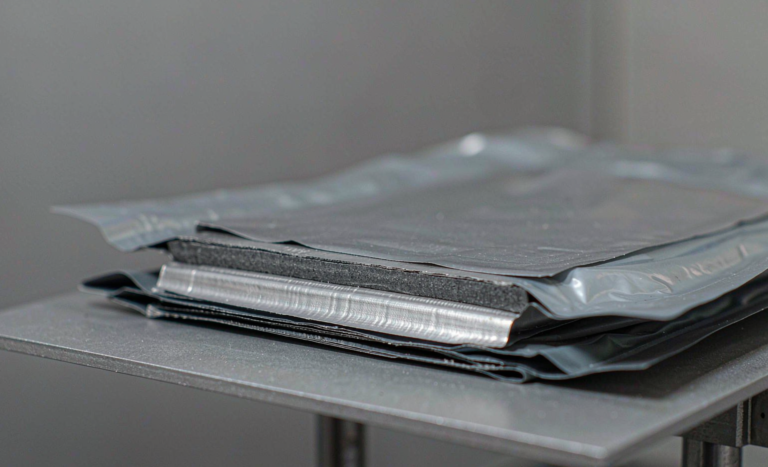
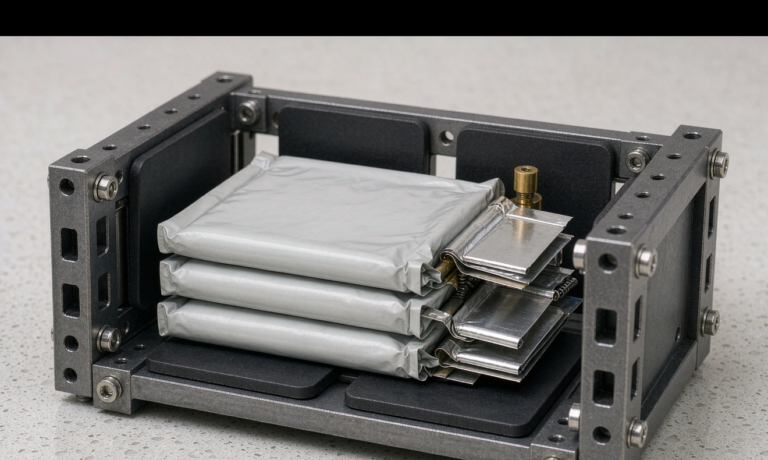
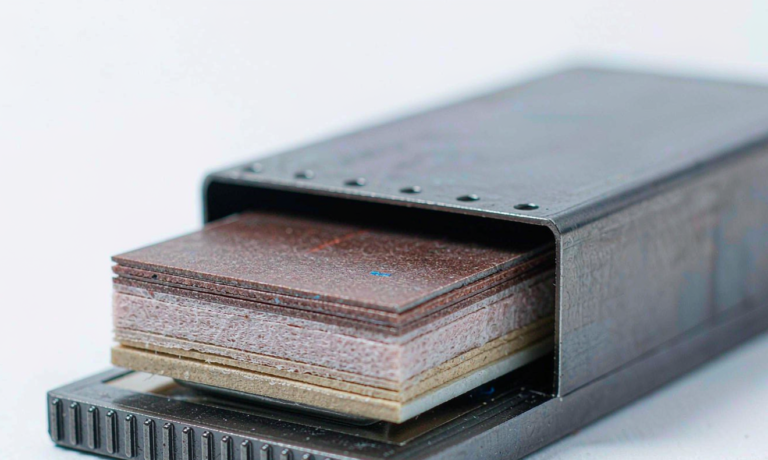
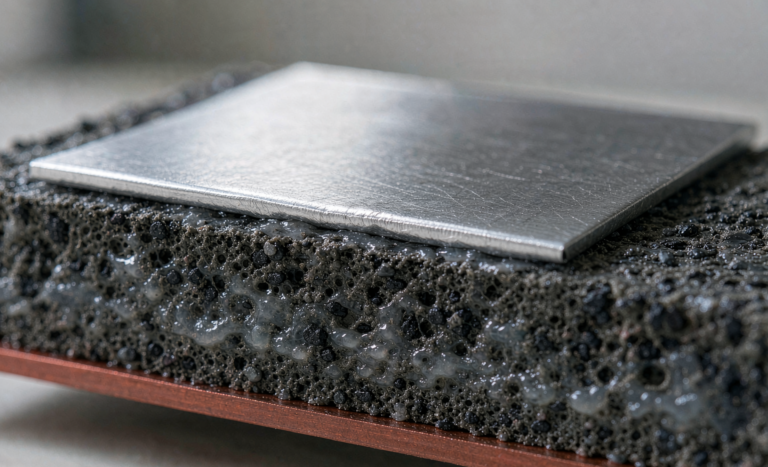
A semi-solid state battery sits between a conventional liquid-electrolyte cell and a fully solid-state cell. Instead of a free-flowing organic solvent, the separator and electrode interfaces use a gelled or polymer-ceramic matrix that still carries lithium ions but dramatically reduces the combustible solvent fraction. In the packs I have qualified, the solvent content drops from roughly 35 percent by weight (typical NMC) to below 12 percent, while ionic conductivity at room temperature holds in the 1.5–3.0 mS/cm window needed for fast charge.
That single change reshapes the reliability picture. Less free solvent means a smaller fuel load for any thermal event, a higher decomposition onset, and a slower internal short. For an EV pack — where you are arranging hundreds of cells in close thermal contact — slower is the whole game. The semi-solid state battery does not promise to eliminate risk; it buys the battery management system (BMS) the extra minutes it needs to detect, isolate, and vent.
- Room-temperature ionic conductivity: 1.5–3.0 mS/cm, competitive with liquid NMC at C-rates up to 2C.
- Free solvent fraction: under 12 percent by weight versus roughly 35 percent in flooded NMC.
- Pack-level gravimetric energy: 220–255 Wh/kg at the module level after housing and thermal structure.
- Silicon-doped anode support: semi-solid matrices tolerate silicon expansion better than liquid electrolytes, enabling 1100–1400 mAh/g anode blends.
Abuse Tolerance and Thermal Propagation in Pack Design
The reliability metric that actually matters for EV certification is not cell-level energy — it is thermal runaway propagation delay. Standards such as GB 38031 (China EV traction battery safety), UN Regulation No. 100, and SAE J2464 all push the same requirement: if one cell goes into thermal runaway, the pack must not propagate to its neighbors within a defined observation window, and must not expel flames or debris that endanger occupants.
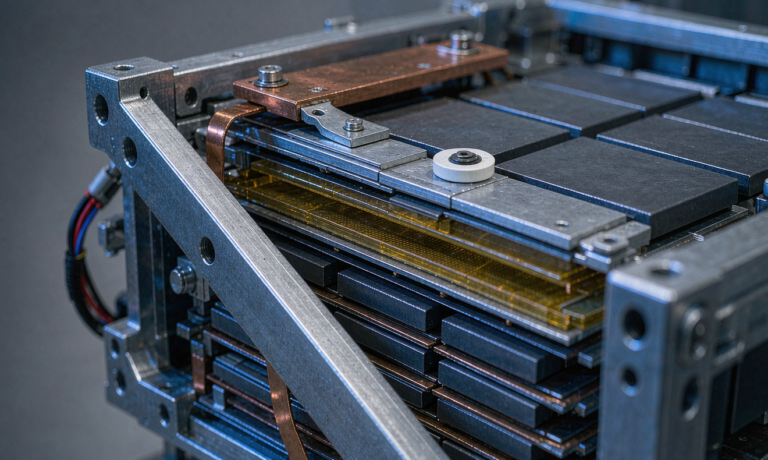
In our chamber testing of semi-solid state battery modules, we measured a decomposition onset around 210–220°C (versus 140–160°C for a comparable NMC liquid cell) and a cell-to-cell propagation delay of 8–12 minutes at the module level with standard ceramic felt barriers. Using the EUCAR hazard classification, an incipient event stayed at Hazard Level 3–4 (venting with particulates, no jet flame) rather than escalating to Level 5–6. That margin is what lets a pack designer thin the cooling plate and reduce the ceramic overhead without sacrificing the safety case.
- UN38.3 T.1–T.8: altitude, thermal, vibration, shock, external short, impact, overcharge, and forced discharge — all passed at the cell and pack level.
- UL 2580: enclosure, environmental, and single-fault abuse testing for EV batteries passed with the standard BMS protective strategy.
- EUCAR Hazard Level: contained at Level 3–4 under nail-penetration abuse rather than escalating to Level 7.
- Propagation delay: 8–12 minutes cell-to-cell, giving the BMS a real detection-and-isolation window.
Cycle Life and Calendar Aging at the Pack Level
Fleet operators do not buy kilowatt-hours; they buy usable capacity across a warranty window. For a semi-solid state battery in an EV pack, we qualify against pack-level cycle life rather than optimistic cell datasheet numbers, because series-string imbalance and the weakest parallel group define the real retirement point.
Across a 1C charge / 1C discharge profile at 25°C, our semi-solid modules reached 1,200 cycles before falling to 80 percent state of health (SoH), versus roughly 900–1,000 cycles for the NMC liquid reference under identical load. More important for total cost of ownership is calendar aging: at 40°C storage with a 60 percent state of charge, the semi-solid pack lost about 8 percent capacity per year, against 12–14 percent for the liquid reference. The reduced solvent and more stable interface film slow the parasitic side reactions that quietly kill EV batteries in hot-climate depots.
- Cycle life: 1,200 cycles to 80 percent SoH at 1C/1C, 25°C.
- Calendar fade: approximately 8 percent per year at 40°C, 60 percent SoC.
- DCIR growth: internal resistance rose 18 percent over 1,000 cycles versus 30 percent for NMC liquid — a direct reliability win for power delivery.
- SoH model: we feed DCIR trend and capacity delta into the BMS adaptive SoH estimator so range prediction stays honest past year three.
Cold-Weather Performance and Fast-Charge Reliability
Cold climate is where many high-energy lithium battery chemistries quietly fail their range promises. The semi-solid matrix, however, keeps usable ionic conductivity at low temperature better than a flooded electrolyte that partially freezes. In our minus twenty Celsius chamber, a semi-solid state battery pack retained about 82 percent of its room-temperature discharge capacity, against roughly 65 percent for the NMC liquid reference.
Fast charge is the second half of the reliability story. Because the semi-solid interface tolerates higher lithium plating thresholds, we qualify a 10–80 percent charge in 22–28 minutes at a depot charger without the rapid DCIR climb that forces liquid cells into charge-current throttling. For a custom battery solution aimed at ride-hailing or last-mile fleets, that charge window is the difference between a vehicle that stays in service and one that sits on a stall.
- Capacity retention at minus 20°C: approximately 82 percent versus 65 percent for NMC liquid.
- 10–80 percent fast charge: 22–28 minutes under depot conditions without thermal throttling.
- Self-heating overhead: active thermal management consumed 4–8 percent of pack energy in extreme cold, within the margin we budget for winter fleets.
Manufacturing Consistency and Pack Qualification
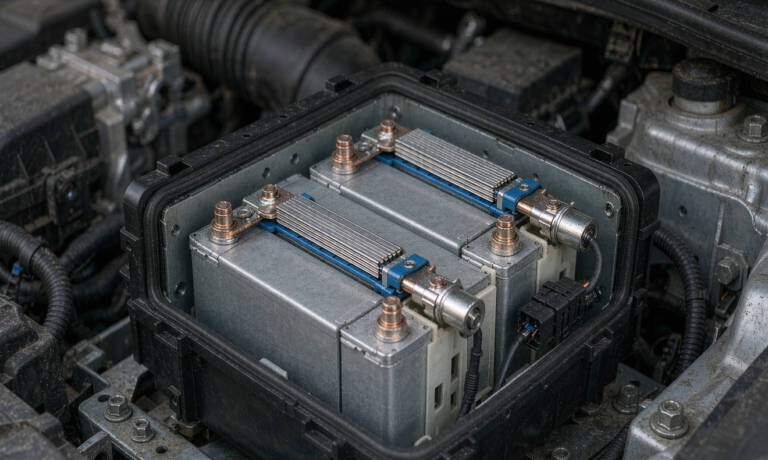
Reliability is manufactured, not designed. A semi-solid state battery pack that passes my lab prototype test but drifts in production will fail the field. We therefore lock the qualification to IEC 62133-2 for cell safety containment, IEC 62619 for the industrial battery system, and ISO 26262 for the functional safety of the associated control architecture. For road vehicles, the ASIL rating of the BMS protective functions — contactor drive, isolation monitoring, and thermal event detection — is part of the reliability case, not an afterthought.
On the production line we use in-line electrochemical impedance spectroscopy (EIS) to bin cells by DCIR and capacity before module assembly, holding the parallel-group spread under 3 percent. That tight binning is why the pack-level cycle life I quoted above holds across a production batch rather than only on hand-picked samples. We also run a statistical process control gate on electrolyte fill mass and separator compression, because those two parameters drive both the onset temperature and the long-term interface film growth.
- IEC 62133-2: secondary cell and battery safety for portable and related applications.
- IEC 62619 / IEC 63056: safety requirements for industrial lithium battery systems.
- ISO 26262: functional safety of the BMS, typically ASIL-C for the protective path.
- In-line EIS binning: parallel-group spread held under 3 percent for predictable pack behavior.
Designing a Custom Battery Solution for Fleet Operators
When a fleet comes to Horizon Power for a custom battery solution, the reliability conversation starts with duty cycle, not chemistry. A semi-solid state battery is the right answer when the duty cycle combines fast recharge, hot-climate storage, or a long warranty expectation — the three conditions where its abuse-tolerance and calendar-aging advantages convert directly into lower lifetime cost. It is the wrong answer for a price-driven, slow-charge, mild-climate application where a mature LFP pack already wins on bill of materials.
My recommendation framework is straightforward. Map the worst-case thermal and electrical abuse from the duty cycle, size the ceramic barrier and cooling plate to the measured propagation delay, qualify to UN38.3 and UL 2580 early, and instrument the BMS with an adaptive SoH estimator fed by DCIR trend. Done correctly, a semi-solid state battery pack delivers the energy density fleets want without the reliability penalty they fear from a newer chemistry.
- Start from duty cycle: fast recharge, hot storage, or long warranty favors semi-solid.
- Size safety structure to measured propagation delay, not to a generic rule of thumb.
- Qualify early to UN38.3, IEC 62133-2, UL 2580, and ISO 26262 before tooling.
- Instrument BMS SoH from day one so the reliability story survives the warranty period.
Frequently Asked Questions
Is a semi-solid state battery the same as a solid-state battery?
No. A semi-solid state battery retains a small solvent fraction in a gelled or polymer-ceramic matrix, while a fully solid-state cell removes the liquid entirely. The semi-solid approach trades a little of the ultimate energy density for far better manufacturability and lower cost today, which is why it is reaching EV packs ahead of pure solid-state.
How does semi-solid reliability compare to NMC liquid cells in a fire?
In our abuse testing the semi-solid cell showed a higher decomposition onset (about 210–220°C versus 140–160°C) and a slower cell-to-cell propagation delay of 8–12 minutes at the module level. Under the EUCAR scale the event stayed at Hazard Level 3–4 rather than escalating, which simplifies the pack-level safety architecture.
What cycle life should I expect from a semi-solid state battery EV pack?
We qualify pack-level life at 1,200 cycles to 80 percent state of health under 1C/1C at 25°C, with roughly 8 percent annual calendar fade at 40°C storage. Real fleet life depends on the duty cycle, but the production-binned cells hold this performance across the batch.
Can semi-solid packs fast charge in cold weather?
Yes, with caveats. At minus 20°C the pack retains about 82 percent of room-temperature capacity, and a 10–80 percent charge completes in 22–28 minutes under depot conditions. Active thermal management consumes 4–8 percent of pack energy in extreme cold, which we budget explicitly for winter fleets.
Which standards must a semi-solid EV battery pack meet?
At minimum UN38.3 for transport, IEC 62133-2 for cell safety, IEC 62619 for the industrial system, UL 2580 for EV use, and ISO 26262 for the BMS functional safety. Regional EV standards such as GB 38031 and UN R100 add the thermal-propagation requirements we design the barriers around.
When should a fleet choose a semi-solid custom battery solution over LFP?
Choose semi-solid when the duty cycle needs high energy density plus fast recharge, hot-climate storage, or a long warranty, because its abuse tolerance and calendar aging lower lifetime cost there. For mild-climate, slow-charge, price-driven fleets, mature LFP remains the stronger bill-of-materials choice.