Sodium-Ion Battery Testing for Backup Power
When a buyer asks me how we qualify a sodium-ion battery for backup power, they usually expect a single pass/fail number. After fifteen years on the production floor and in the field — most of them spent qualifying lithium battery packs for drones, mobility devices, and stationary storage — I have learned that backup power is the least forgiving duty a cell will ever see. The pack may sit idle for eleven months and then be asked to deliver its full rated current in the first second of a grid outage. A missed test step does not show up as a warranty return; it shows up as a hospital wing or a data hall going dark. This is the validation protocol I run for every sodium-ion battery testing backup power build before it leaves the line, written the way my own team would execute it.
Why Backup-Power Testing Is Its Own Discipline
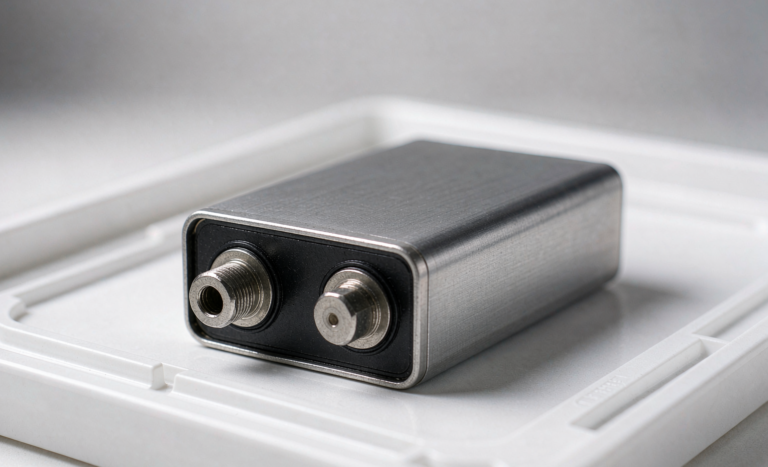
Backup duty is a rare-event, high-penalty service. Unlike a solar kit that cycles every day or a drone battery that flies on a schedule, a backup pack spends 95–99% of its life at rest near full state of charge. That idle time drives three failure modes you will not catch with a normal cycle-life test: calendar fade at high SoC, self-discharge drift that silently strands capacity, and connector/contactor corrosion from condensation during long standby. For that reason I treat backup-power qualification as a separate program rather than reusing the test plan from an energy-storage or mobility product. The sodium ion battery chemistry helps here — it holds roughly 85% of usable capacity at −20°C with no pad heater, which removes the single largest field-failure cause in cold-climate backup sites — but chemistry advantage does not replace a disciplined test sequence.
Another quirk of backup duty is that the pack is rarely fully discharged in a real event. A two-hour outage on a system sized for eight hours of autonomy ends the cycle at roughly 75% SoC, and the cell then sits there for weeks. That partial-state-of-charge idle is harder on some chemistries than a full cycle, so my standby audit deliberately holds the pack at the realistic float band rather than at a constant 100% top-up, and I record recovery capacity after the first real-world-style shallow event. A test that always starts from a perfect full charge hides the exact aging the customer will actually experience in the field.
Incoming Cell Grading and Baseline Characterization
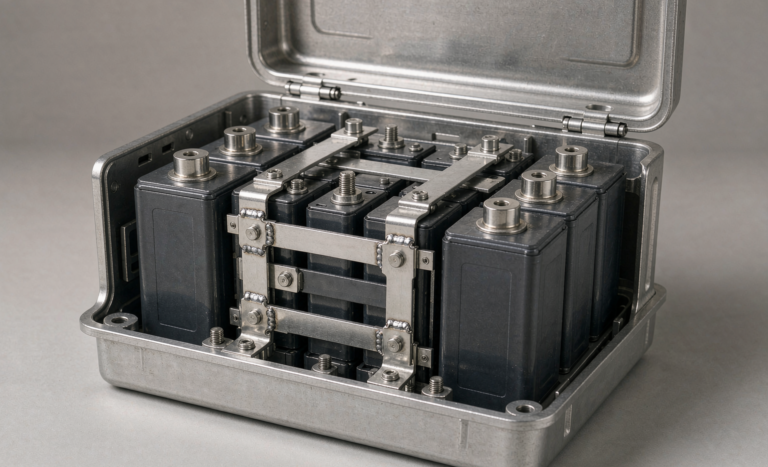
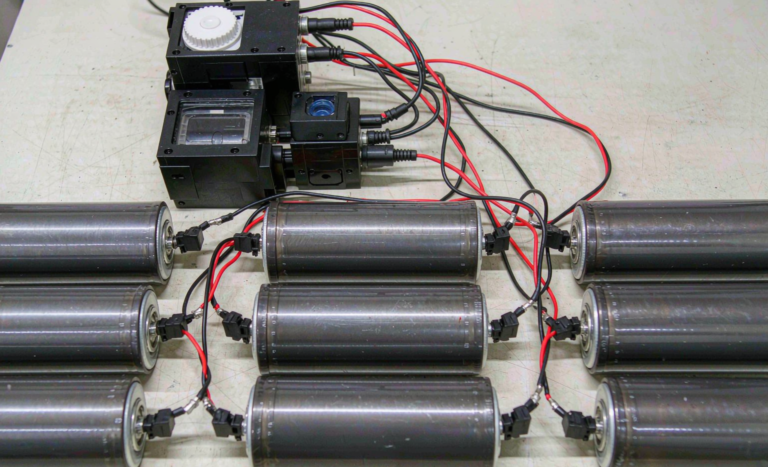
Every pack is only as uniform as the cells we weld into it, so the first gate is incoming cell grading. I sort cells into a build lot only after measuring three parameters on a 4-wire Kelvin fixture:
- Capacity grading — capacity coefficient of variation held below 6% within a lot, so the weakest parallel string does not clip first.
- DC internal resistance (DCIR) — measured 4-wire Kelvin at 50% SoC, lot coefficient of variation below 10%; a single high-IR cell becomes the thermal hot spot under backup surge.
- Self-discharge / K-factor — resting-voltage drift held under 1.0 mV/day; anything higher flags a micro-leak that will strand capacity during months of standby.
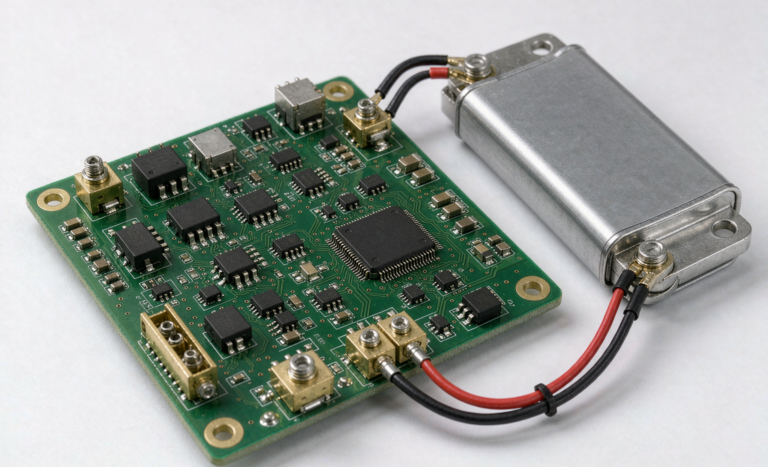
I also record AC internal resistance (ACIR) as a shipping/shock indicator and store every value against a DataMatrix genealogy tag. This is the same discipline I apply to a custom battery solution for robotics or a drone lithium battery where a single weak cell ends a flight; backup power simply raises the consequence of skipping it.
Functional and Electrical Validation
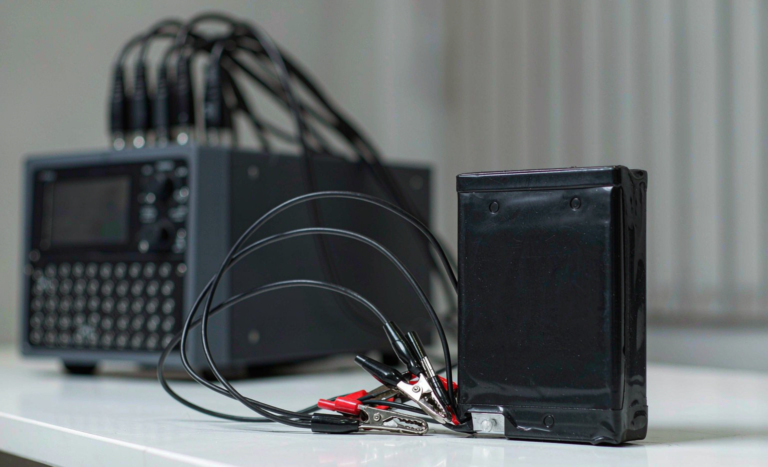
Once the module is welded and the BMS is mated, I replay the real backup duty profile rather than a textbook constant-current discharge. The profile matters because backup loads are step loads, not smooth draws:
- Transfer test — simulate grid loss and confirm the pack picks up the critical bus within the UPS transfer window (typically <10 ms for a static switch, <20 ms for a hybrid inverter bridge).
- Step and surge load — apply the named critical load plus a 1.25× inrush (motor starters, compressor locked-rotor, server inrush) and gate voltage sag above the inverter low-voltage cutoff.
- Capacity at duty C-rate — measure usable ampere-hours at the actual backup C-rate (often C/2 to C/5 for hours of autonomy) and confirm round-trip efficiency of 88–93% at 0.2–0.5C.
- Recharge recovery — verify the pack accepts float/recharge without thermal runaway when the grid returns, including a pre-charge limit on the contactor.
For sodium-ion I add a −10°C to −20°C discharge confirmation, because that is precisely where the chemistry earns its place in unheated telecom huts, pump houses, and remote clinics.
Abuse and Safety Qualification
Functional testing proves the pack works; abuse testing proves it fails safely. Every backup build is taken through the UN38.3 T.1–T.8 sequence as the transport and baseline safety floor, then mapped to the product standards we ship against:
- UN38.3 T.1–T.8 — altitude, thermal, vibration, shock, external short circuit, impact/crush, overcharge, and forced discharge. A green UN38.3 report is the minimum to move the pack by air or road.
- IEC 62133-2 — secondary cell and battery safety for portable use, the foundation for most downstream marks.
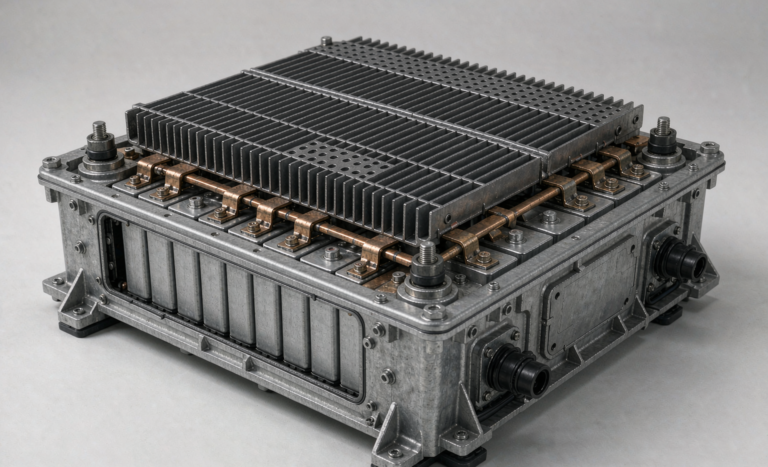
- IEC 62619 / IEC 62477 — industrial stationary battery safety and power-electronic converter safety for the backup enclosure and its DC bus.
- UL 1973 — North American stationary storage cell/battery standard; we cite it for the北美 market alongside NFPA 855 spacing and IEEE 1547 interconnection where the backup feeds a premises bus.
The sodium ion battery’s higher thermal stability gives us a wider margin on the external-short and overcharge cells, but I still run them — margin is not a substitute for evidence, and a customs or integrator audit will ask for the report, not the assumption.
Environmental and Duty-Cycle Stress Screening
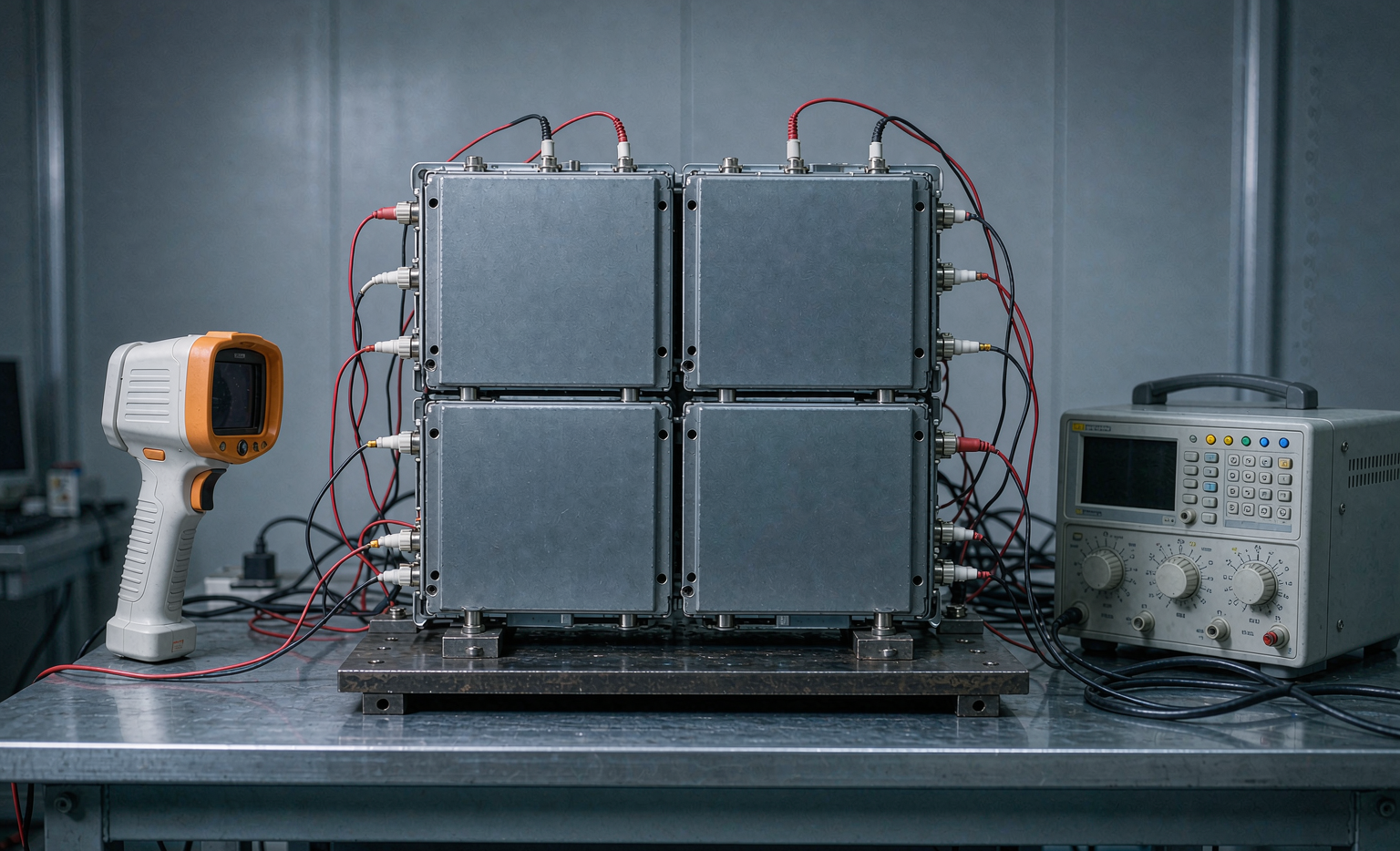
Backup sites are dirty, hot, cold, and humid in turn, so I stress-screen the finished pack before it is trusted:
- Thermal envelope — soak and operate from −20°C to +55°C, confirming the BMS charge lockout engages below 0°C and that capacity stays within spec at both ends.
- Mechanical — MIL-STD-810H Method 514.8 random vibration and Method 516.8 shock for transit and rooftop/wall-mount installs; weld joints are re-checked at <0.15 mΩ and >25 N pull after the screen.
- Sealing — IEC 60068-2-78 damp heat and IEC 60068-2-52 salt fog for coastal or industrial sites, targeting IP54 to IP65 with an ePTFE breather to equalize pressure without ingress.
- Standby self-discharge audit — 72-hour burn-in at float, then a 30-day rested-voltage check confirming the K-factor gate holds over time, not just at incoming inspection.
This screen is where a lithium battery would need a pad heater in the same site; the sodium chemistry lets us delete that component and the parasitic load that comes with it, which is a real reliability win I can put a number on.
The End-of-Line Gate and Fleet Qualification
No pack ships until it passes the end-of-line (EOL) gate: capacity at or above 98% of nameplate, DCIR within +10% of the lot baseline, cell-to-cell voltage spread ≤30 mV, and a clean BMS fault log. Each unit carries a DataMatrix tag linking every cell, weld, and test result back to the build. For fleet rollouts I then qualify a 5–10 pack pilot for two to four weeks on the actual site, retire criteria set at capacity below 80%, DCIR +30%, or spread above 40 mV, and only then release the balance of the order. That is the same fleet-health discipline I use on a custom battery solution for warehouses, and it is what turns a one-off test into a dependable service.
FAQ
How is sodium-ion backup testing different from lithium battery testing?
The safety sequence (UN38.3, IEC 62133-2, IEC 62619, UL 1973) is identical, but sodium-ion removes the cold-weather heater validation and adds a −20°C discharge confirmation instead. We also spend less time on thermal-runaway margin work because the chemistry is more stable, and more time on standby self-discharge, which is the dominant backup failure mode.
How long does a full backup-power qualification take?
Incoming grading and functional validation run in one to two days. Abuse qualification (UN38.3 plus product standards) and the 72-hour burn-in plus 30-day standby audit extend the program to four to eight weeks for a new build, after which recurring production uses the EOL gate only.
Do I still need UN38.3 if the pack never leaves the building?
Yes. UN38.3 T.1–T.8 is the baseline safety floor I cite for internal handling, service access, and insurance, and most integrators will not accept a backup pack without it. It is also the reference many downstream marks (IEC 62133-2, UL 1973) build on.
Can the same test plan cover a drone battery or a robotics pack?
The safety floor overlaps, but the duty profile does not. A drone lithium battery is qualified for high C-rate pulse and crash survivability, while backup power is qualified for long idle, instant transfer, and surge. I reuse the incoming-grading and abuse sections, then write a purpose-built functional and environmental screen for each application.
What is the single test most buyers skip?
The 30-day rested-voltage self-discharge audit. It is the only test that catches a cell that looks perfect at incoming inspection but quietly bleeds capacity during standby — and standby failure is exactly what destroys a backup power system’s reason to exist.