Home Energy Storage Safety for Farms
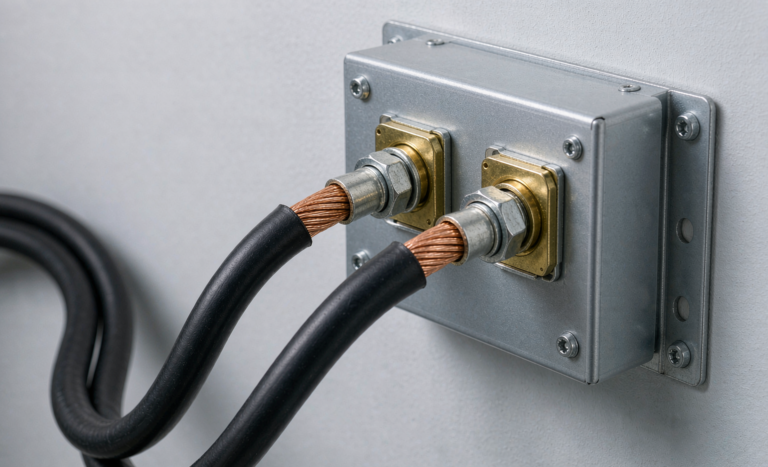
A dairy client called me in the middle of a wet February with a fault I have now seen a dozen times. Their 40 kWh lithium bank was tripping on ground fault every second morning, and the integrator had already swapped the inverter once without effect. It took me about ten minutes in the plant room to find the real cause. The unit was mounted inside the milk room corridor, ten metres from the parlour exit, and the DC terminals had grown a pale blue-green fur of copper-amine corrosion. Ammonia from the barn atmosphere and moisture from the daily washdown had done in eighteen months what no electrical load would ever have done. The cells were fine. The installation was not.
That job is the reason I write about farm safety differently from the way most people write about home energy storage. A farm is not a suburb with a bigger garage. It is a corrosive, dusty, wet, vermin-infested, lightning-exposed industrial site where the family lives upstairs, the livestock cannot self-evacuate, and the nearest fire crew may be twenty minutes away with a tanker instead of a hydrant. Every one of those facts changes the engineering. This guide is what my team and I actually check when we take a residential battery storage project onto agricultural land, from cell chemistry to the final torque mark.
Why a Farm Is Not a Suburb: The Hazard Stack
When I audit a rural site I score four environmental amplifiers and three electrical ones. The environmental set is corrosive gas, combustible or conductive dust, washdown moisture, and vermin. The electrical set is long feeders, back-feed risk from generators and machinery, and lightning exposure on overhead lines. A suburban install typically scores zero or one. A working farm routinely scores five or six at once, and the hazards interact: conductive dust plus ammonia condensate is how you get tracking across a terminal block that passed its dielectric test at commissioning.
Then there is the human layer. A farm family sleeps above the workshop. Dairy cows and pigs cannot walk out of a smoke-filled building, and a fire in a barn with stored feed is a total-loss event for the business, not just the building. Volunteer fire departments in rural districts often run on 15 to 30 minute response times and may arrive with 3,000 to 5,000 litres of water. Water is in fact the right agent for a lithium fire, but you need a lot of it, and “a lot” on a remote property usually means a farm pond, a dry hydrant, or a dedicated tank you planned for in advance.
The design rule that follows from all of this is simple: size and site the system for the worst hour of the year, not the average day. That means the winter cold-soak with the generator down, not the sunny September afternoon.
Start With Chemistry: LFP Buys the Margin a Farm Needs
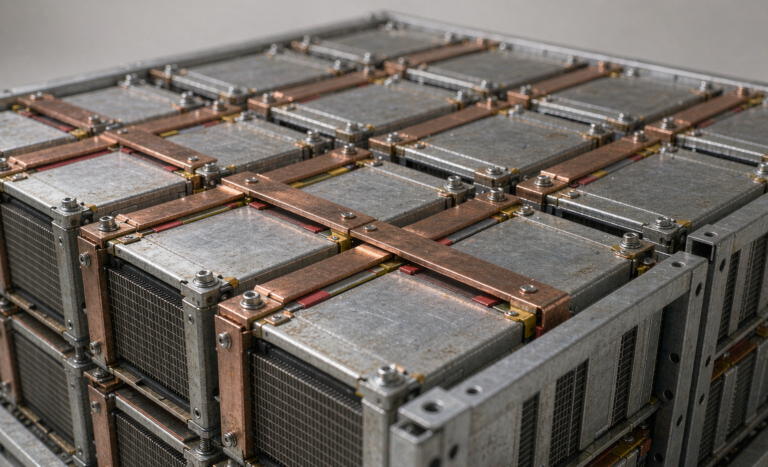
Safety on a farm starts long before the siting decision, and it starts with the cathode. I specify lithium iron phosphate for almost every agricultural job. The electrical envelope is 3.2 V nominal, 3.65 V end-of-charge, 2.5 V end-of-discharge, with 90 to 160 Wh/kg at cell level and 3,000 to 6,000 cycles to 80% state of health at 80% depth of discharge. Calendar life at moderate temperatures runs 10 to 15 years, which matches the depreciation horizon most farm operators use for machinery.
The reason is thermal. LFP does not begin meaningful cathode decomposition until well past 250 °C, with the main exothermic peak in the 270 to 300 °C range. A nickel-rich NCM or NCA cell, by contrast, starts releasing oxygen between roughly 150 and 200 °C, and once it does, the cell supplies its own oxidiser and no amount of external suppression helps very much. Both chemistries rely on the same polyolefin separator trick — polyethylene pores close around 130 to 140 °C, polypropylene melts near 165 °C — but with LFP you have a much wider margin between separator shutdown and cathode decomposition.
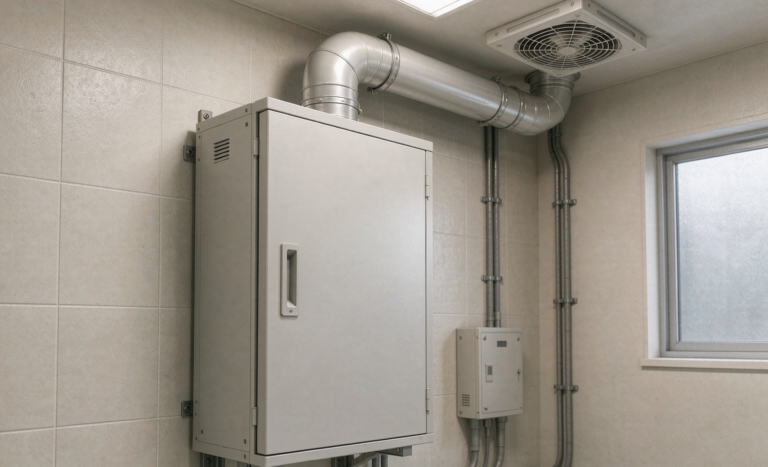
That margin matters because vent gas is the real hazard, not flame. When a lithium cell vents, it releases a mixture of carbon monoxide, carbon dioxide, hydrogen, methane, light hydrocarbons and electrolyte vapour, plus hydrogen fluoride. HF is what sends people to hospital and what corrodes the inside of a milking parlour beyond repair. As an order-of-magnitude planning figure I use roughly one litre of vent gas per amp-hour of cell capacity for a nickel-rich cell at high state of charge: a 40 kWh LFP bank at 51.2 V nominal is about 780 Ah of cell capacity per volt-tier, so a full propagation event in a large bank puts tens of cubic metres of flammable, toxic gas into the room. This is precisely why codes such as NFPA 855 and test methods such as UL 9540A exist, and why deflagration venting per NFPA 68 is discussed for large indoor rooms.
Two more chemistry-level rules I enforce. First, if a farm system is going to sit idle — seasonal operation, a hunting lodge on the same meter — store it at 30 to 50% state of charge, not 100%. Calendar ageing roughly doubles for every 10 K above 25 °C, so a pack held at full charge in a tin shed in August is ageing at several times its design rate. Second, run the working window at 10 to 90% rather than 0 to 100%. You give up a little usable capacity and you get a system that stays balanced and forgiving when the Baler is running and nobody is watching the app.
Siting the Cabinet: Half the Risk Is Decided Before You Drill
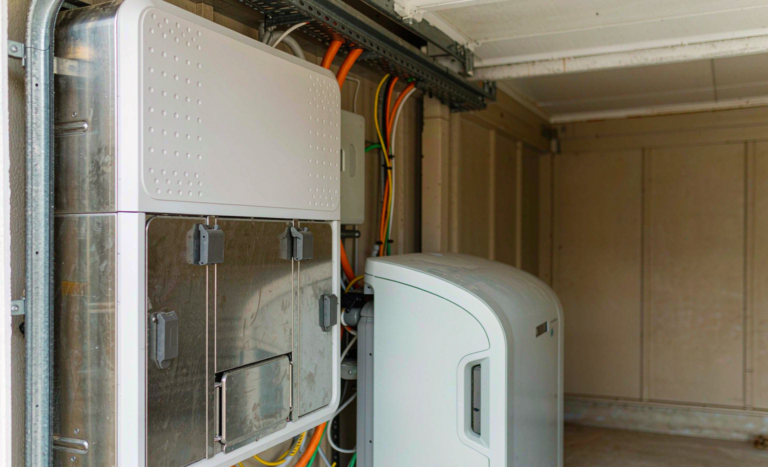
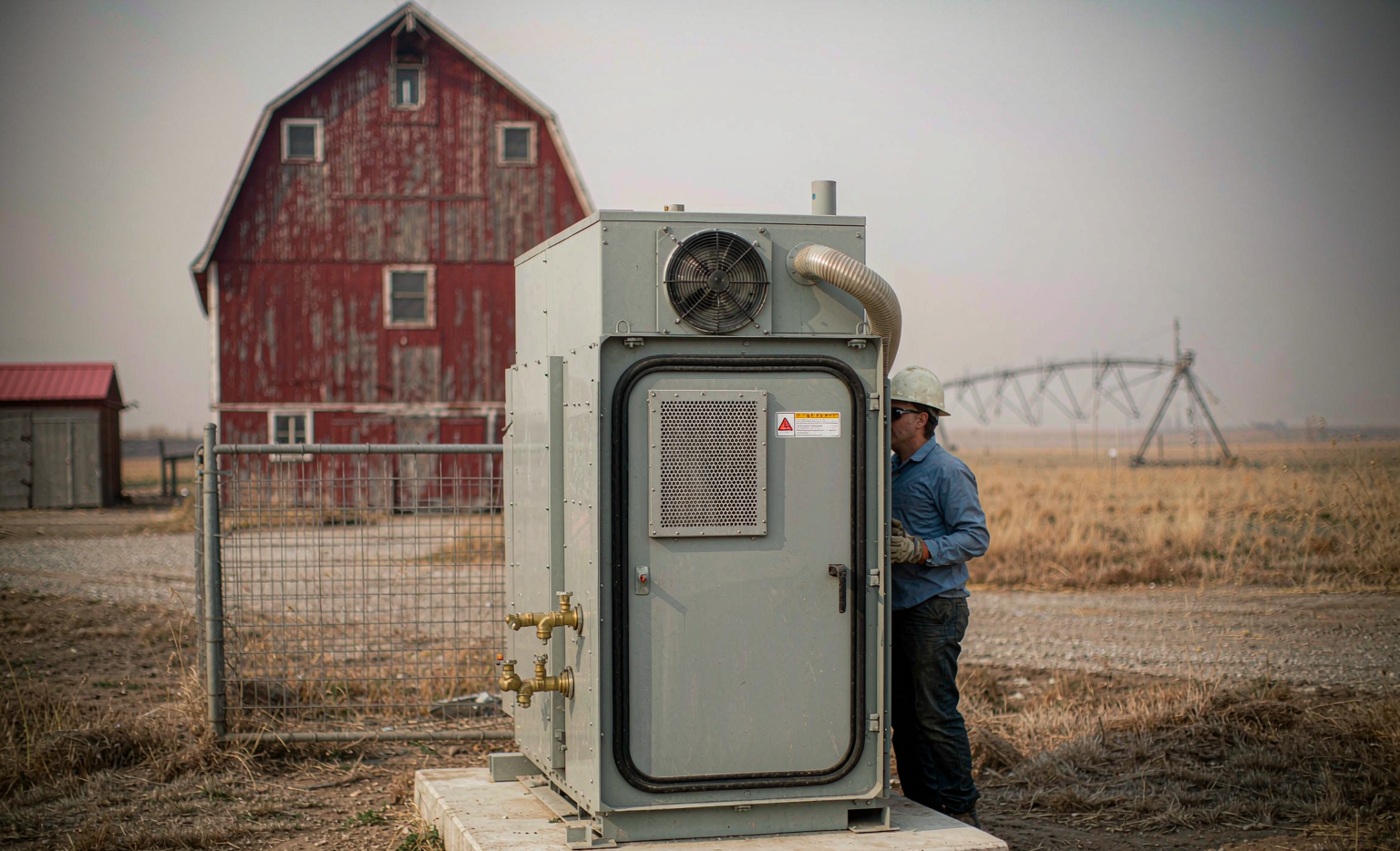
I push every agricultural customer to an outdoor, ground-mounted enclosure unless there is a genuinely clean, dry, non-corrosive room available. The enclosure rating follows the location. NEMA 250 Type 3R is the minimum for a rain-exposed outdoor wall; Type 4 or 4X is what I specify anywhere a pressure washer goes, which on a dairy or pig unit means most of the yard. In IEC terms that is IP54 to IP66 under IEC 60529, and I add IK10 per IEC 62262 wherever tractors, telehandlers or livestock can reach the cabinet.
The pad matters as much as the box. I want a concrete slab at least 100 to 150 mm above finished grade, sloped away, in a spot that does not collect snowmelt or manure runoff. I have replaced two systems that spent a spring with 200 mm of slurry-laced water in the bottom of the enclosure; both were in a low corner the operator described as “flat enough”.
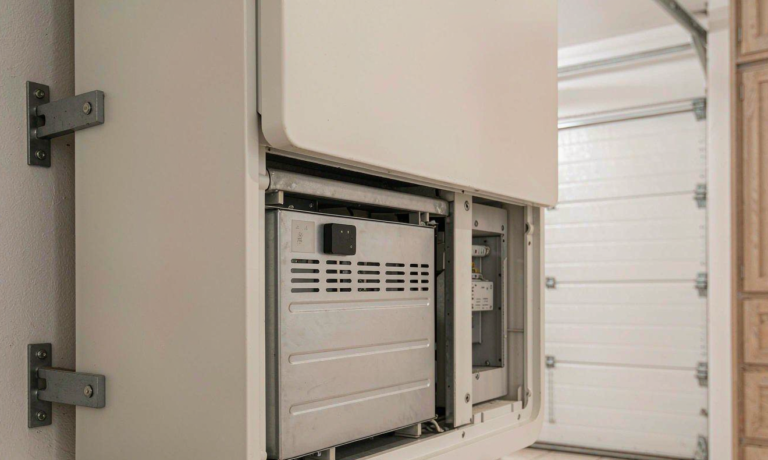
Separation is where I get the most pushback. My house rule for agricultural sites, on top of whatever NFPA 855 and the UL 9540A-based listing require, is at least 3 m clearance from stacked hay, straw, bedding, diesel, fertiliser or pesticide storage, at least 1.5 m of clear working space in front of every door, and no installation directly above or beside a manure pit or lagoon. Codes set the legal minimum; the authority having jurisdiction has the final word; and the listing documentation for your specific home energy storage system is the document they will read. I also refuse attached garages where the garage opens into the house, because a venting event puts carbon monoxide into the sleeping accommodation, and I refuse milking parlour corridors and feed rooms outright.
Finally, plan for the fire service before you need them. A numbered, lockable, visible-break disconnect at the meter, a laminated single-line diagram and the battery SDS in a marked folder next to it, and an honest conversation with the local volunteer chief about where the water is coming from. Fifteen minutes of that conversation is worth more than any amount of equipment.
Corrosion, Dust and Vermin: The Three Silent Killers
Ammonia and Hydrogen Sulphide Eat Copper
Barn atmospheres routinely carry 10 to 50 ppm of ammonia, and poorly ventilated confinement buildings in winter can exceed 100 ppm. Manure agitation releases hydrogen sulphide, which is both lethal at high concentration and aggressive to metals at low concentration. Ammonia forms soluble copper-amine complexes, which is the blue-green creep I found on that dairy client’s terminals; H2S tarnishes silver plating and grows sulphide films that can bridge creepage distances and grow dendrites.
The cells do not care. The electronics and the terminations do. My mitigations, in order: tinned copper lugs and tinned busbar with no bare copper in the air path; sealed or potted terminal compartments; conformal coating to IPC-CC-830 on every exposed PCB; stainless or aluminium hardware with anti-seize; and a filtered, positively pressurised enclosure whose intake is on the clean side of the building, well away from barn exhaust fans and manure storage. In corrosivity terms, per ISO 9223, most livestock buildings I survey land at C4 or C5, not the C1 or C2 of a suburban garage. If you are qualifying equipment, ask the manufacturer for IEC 60068-2-60 flowing mixed gas corrosion results rather than a bare salt mist test.
Combustible and Conductive Dust
Grain handling areas are classified locations under NEC Article 500 and 502, and grain dust has minimum ignition energies in the range of tens to hundreds of millijoules, which is well within what a static discharge or a relay arc can deliver. Dust settling on a warm enclosure is simultaneously fuel on the outside and thermal blanket on the inside. Fertiliser and mineral-feed dust is worse in a different way: it is hygroscopic and conductive, and it bridges creepage distances silently.
Keep the battery out of classified locations entirely. Where dust is unavoidable, use a sealed filtered enclosure rated IP5X or better, clean it quarterly by vacuum rather than compressed air (blowing dust into a suspended cloud inside a building is how you create the explosion you were trying to prevent), and re-inspect creepage and clearance distances against IEC 60664-1 after any ingress event.
Vermin and Wildlife
Mice pass through a 6 mm gap, and they chew PVC conduit, cable jackets and wire insulation. Birds and squirrels nest in warm enclosures and drag in nesting material that is both flammable and conductive when wet. I specify rigid metal conduit or armoured cable for all outdoor runs, stainless mesh of at least 1.6 mm aperture over every vent, sealed penetrations, and a 900 mm gravel strip kept clear of vegetation around the pad. It costs almost nothing at install time and it prevents the most common category of farm fault I attend.
Grounding, Bonding and Stray Voltage Around Livestock
NEC 250.53 requires a single driven rod to measure 25 Ω or less, or a second rod at least 1.8 m away. On farms I do not stop there. I target 10 Ω or better for the energy storage ground and 5 Ω where surge performance matters, because dry sandy or rocky ground routinely measures 300 to 1,000 Ω·m and a single eight-foot rod in that soil is decorative. Ground enhancement material, deeper rods, or a ring electrode are the usual answers.
Agricultural buildings fall under NEC Article 547, and 547.9 requires an equipotential plane in livestock confinement areas with concrete floors. The international equivalent is IEC 60364-7-705. Both exist because of stray voltage, and stray voltage is a real production disease: cattle respond to neutral-to-earth potentials of one or two volts, a few milliamps, by refusing to drink, dropping milk yield, kicking at the milking unit and gaining weight poorly. The causes are usually boring — a long feeder with an undersized neutral, a corroded neutral connection, or a bonded neutral in the wrong place — but a badly integrated inverter can absolutely contribute its own switching noise.
My commissioning procedure for any livestock site: bond the ESS enclosure, the pad reinforcement, the barn steel and the water system into one equipotential system; confirm there is exactly one neutral-to-earth bond, at the service, and that generator transfer does not create a second one; then measure neutral-to-earth under load through a 500 Ω resistor — the standard “cow equivalent” load — before commissioning and again after a week of operation, with the milking vacuum and the well pump running.
Lightning and Surge: The Open-Field Problem
An overhead service drop running 300 m across open pasture is an excellent lightning collector, and farms lose more electronics to induced surges than to direct strikes. IEC 62305 sets the protection levels and the risk assessment; the median first return stroke peaks around 30 kA, with a long tail of events well past 100 kA. Two coupling paths matter: a surge conducted along the service conductors, and ground potential rise across a farm grounding system that is physically large and therefore never at a single potential during a strike.
I use layered protection. A Type 1 SPD at the service entrance rated for Iimp of 12.5 to 25 kA on a 10/350 µs waveform, a Type 2 SPD at the distribution panel rated In 20 to 40 kA on 8/20 µs, then Type 2 or 3 devices at the inverter and the battery with a voltage protection level Up of 1.5 kV or better — I aim for 1.2 kV in front of expensive electronics. The DC side needs its own devices on the battery bus and on any PV array, to IEC 61643-11 for AC and IEC 61643-31 for PV, with the installation practice from IEEE C62.41 in mind.
Installation detail decides whether the SPDs work. Total lead length under 0.5 m, no loops, and every device bonded into the same equipotential system as the battery. After any nearby strike, I have the operator check the SPD status windows, download the event log, and schedule an insulation resistance and capacity check, because a degraded MOV is invisible until it is not.
Inrush, Long Feeders and the Irrigation Pump Problem
The load that breaks farm systems is the motor. A locked-rotor induction motor draws five to seven times full-load current for three to ten seconds, which means a 5 kW pump can demand 20 to 30 kVA for a heartbeat. Hybrid inverters are usually specified with surge capability of around 2× rated power for a few seconds and 3× for one or two seconds, and the shape of that curve in the datasheet matters far more than the headline kilowatt number.
Three fixes, in order of value. Fit a soft starter or a variable frequency drive, which drops inrush to 1.5 to 2× and usually pays for itself in pump and motor life. Sequence the loads so the well pump, the grain dryer, the milking vacuum and the refrigeration compressors never start simultaneously — a simple stagger relay does this for very little money. And lock the grain dryer and the welder out of the backup panel entirely; they have no business on stored energy.
Long feeders compound everything. NEC 215.2 recommends no more than 3% voltage drop on a feeder and 5% total, and hitting that on a 120 V circuit at 200 m forces cable sizes that cost more than moving the battery. My rule is to put the home battery backup close to the load centre and distribute at 240 V or higher wherever the run is long, because voltage drop does not just waste energy: it makes motors run hot and it trips inverters on DC bus undervoltage at exactly the moment you need them. On split-phase 120/240 V systems, keep the two legs balanced within about 20%, or you will fight neutral current and voltage wander all day.
Generators, Transfer Equipment and the Back-Feed That Kills
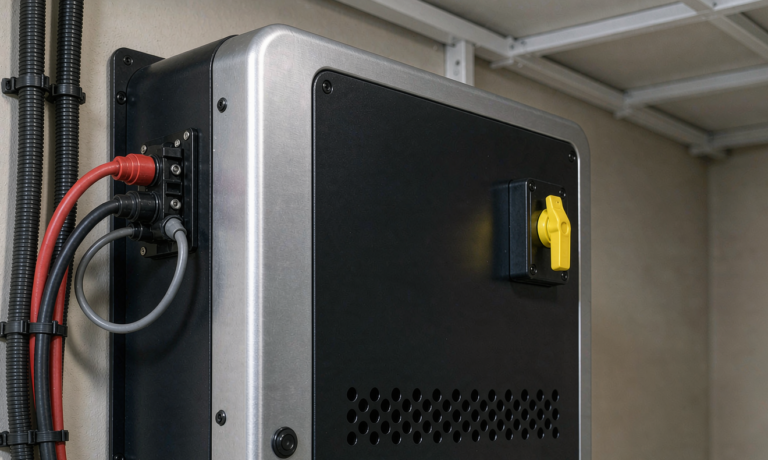
Every winter, somewhere, a farmer back-feeds a generator through a welder outlet and energises a mile of utility line. Do not be that story. Use a listed transfer switch or a mechanical interlock that provides a visible break, and install a disconnect the utility can lock open. NEC Article 705 covers interconnected sources, 702 covers optional standby systems, and 706 covers the energy storage system itself.
Two details that catch people out. First, generator compatibility: many hybrid inverters reject generator output because of waveform distortion, frequency wander or voltage sag on motor starting, and the fix is a proper AVR on the generator plus configuring the inverter’s generator input with wider acceptance windows. Second, neutral switching: whether you need a three-pole or four-pole transfer switch depends on whether the generator neutral is bonded, and getting it wrong creates a second neutral-to-earth bond, circulating current on the grounding conductor, and stray voltage in the barn — the exact symptom set we just spent a section trying to eliminate. Portable versus separately derived generator grounding follows NEC 250.34 and 250.35.
Exercise the set monthly under load, and load-bank it at 30 to 50% for half an hour once a year to prevent wet stacking. A generator that has never been loaded is a generator that will not start in February.
Commissioning, Inspection Cadence and What I Log
A farm commissioning is a documented procedure, not a handshake. Before energisation: insulation resistance on the DC bus at a floor of 100 Ω per volt — roughly 40 kΩ on a 400 V bus — using an insulation monitoring device per IEC 61557-8; a dielectric withstand test where the design permits it, per IEC 62485; torque verification against the drawing with a calibrated wrench; cell-to-cell delta-V of 30 mV or less at rest, with a 50 mV alarm threshold; and a functional trip test of every protection function — overvoltage, undervoltage, overcurrent, over-temperature and ground fault. I take a thermal baseline image under load the same day.
The operating thresholds I hand over are deliberately boring. A joint running 20 K hotter than its neighbours gets investigated; 30 K gets shut down. Capacity is re-tested annually and the pack is re-rated when it reaches 80% of nameplate, when DC internal resistance reaches 1.3× beginning-of-life, or when resting cell delta-V stays above 50 mV. Quarterly, the operator does a visual walk: filters and dust, door seals, vermin screens, SPD windows, a torque sample, and a download of the event log. Annually, we do the capacity test, the insulation re-test, a lockout/tagout drill per OSHA 1910.147, and a water-ingress check before the wet season.
If you integrate or manufacture these systems, understand what gets read after an incident: your battery pack design file, your BMS solution logic and event logs, and the installer documentation. A good custom battery solution for a farm is not a bigger box; it is a documented one.
End of Life, Transport and the Rules That Follow the Pack
Do not park a damaged or swollen pack in the barn and promise to deal with it. Move it outdoors to a non-combustible area with clearance around it, tape the terminals, bag each module separately, and keep it out of the weather and out of the sun. I have been called to two barn fires that started with a “temporary” damaged pack sitting on a concrete floor next to baling twine.
Transport is regulated. A healthy pack moves as UN3480 with a UN38.3 test summary covering T1 through T8 and, for air freight under IATA, a state of charge at or below 30%. A damaged pack moves under a damaged-battery procedure with the carrier’s agreement, not in the back of a pickup. In Europe, the Battery Regulation (EU) 2023/1542 adds due-diligence obligations now and a battery passport from 18 February 2027, so keep the manufacturer’s SDS, the UN38.3 summary and the recycling route in the farm’s compliance folder from day one. If you are qualifying a supplier, ask for the safety file up front — any competent lithium battery manufacturer will have IEC 62619 and UL 1973 reports and will not hesitate to share test summaries.
Frequently Asked Questions
Is a lithium battery safe to install in a barn?
Yes, if you choose lithium iron phosphate, mount it outdoors or in a clean dry room, and use equipment listed to UL 9540 and UL 1973 with cells and batteries evaluated to IEC 62619. What makes a barn dangerous is not the cells: it is ammonia corrosion, grain dust, washdown water and vermin getting into a box that was designed for a garage.
Can the battery go in the milking parlour or the feed room?
No. Parlours combine high humidity, daily high-pressure washdown and ammonia, which is the single worst combination for copper and electronics. Put the system in a separate, clean, ventilated room or outdoors on a pad, and run the feeder properly sized for the distance.
How far from the house and other buildings should it be?
The legal answer comes from NFPA 855 and the separation distances established by the UL 9540A test data for your specific unit, as adopted by your authority having jurisdiction. As a working practice on farms I keep at least 3 m from combustible storage such as hay, straw, bedding, diesel and fertiliser, and I avoid attached garages entirely so that vent gas cannot reach sleeping accommodation.
Does the ammonia in a livestock building really damage the battery?
It damages almost everything except the cells. Ammonia attacks copper terminations and busbars, hydrogen sulphide tarnishes silver-plated contacts and grows conductive sulphide films, and both cross creepage gaps and cause tracking faults. Tinned copper, conformal-coated electronics and a sealed filtered enclosure are the answers.
Will the system survive a cold winter without heat?
LFP must not be charged below 0 °C, so an unheated enclosure in a cold climate needs an insulated cabinet and a thermostatically controlled heater of roughly 100 to 300 W, with typical idle losses of 20 to 60 W on top of the inverter’s own standby draw. Discharge down to about -20 °C is fine; charging is not. Budget the standby energy and put it on the critical load panel.
Do I really need surge protection, or is that upselling?
On a farm with an overhead service across open ground, it is not upselling. Use layered devices: Type 1 at the service, Type 2 at the distribution panel, and a point-of-use device at the inverter and battery, all bonded into one equipotential system with short leads. Surge and lightning damage is the most common cause of the mysterious single-board failures I investigate.
What should be on the backup panel, and what should not?
On it: water pumping for stock, milking vacuum and milk cooling, refrigeration for vaccines or produce, lighting in the parlour, and the farm office. Off it: grain dryers, welders, large three-phase motors without a soft starter, and anything that only runs a few hours a year. Stored energy is for critical and continuous loads, not for peak shaving a 20 kW dryer.
How often does a farm system need inspecting?
Quarterly for the operator — visual, filters, seals, screens, surge device windows, torque sample, event log download. Annually for a technician — capacity test, DC resistance trend, insulation re-test, water-ingress check before the wet season, generator load-bank test, and a lockout/tagout refresher. After any lightning strike or flood, inspect immediately regardless of the calendar.