Sodium-Ion Battery Integration for Forklifts
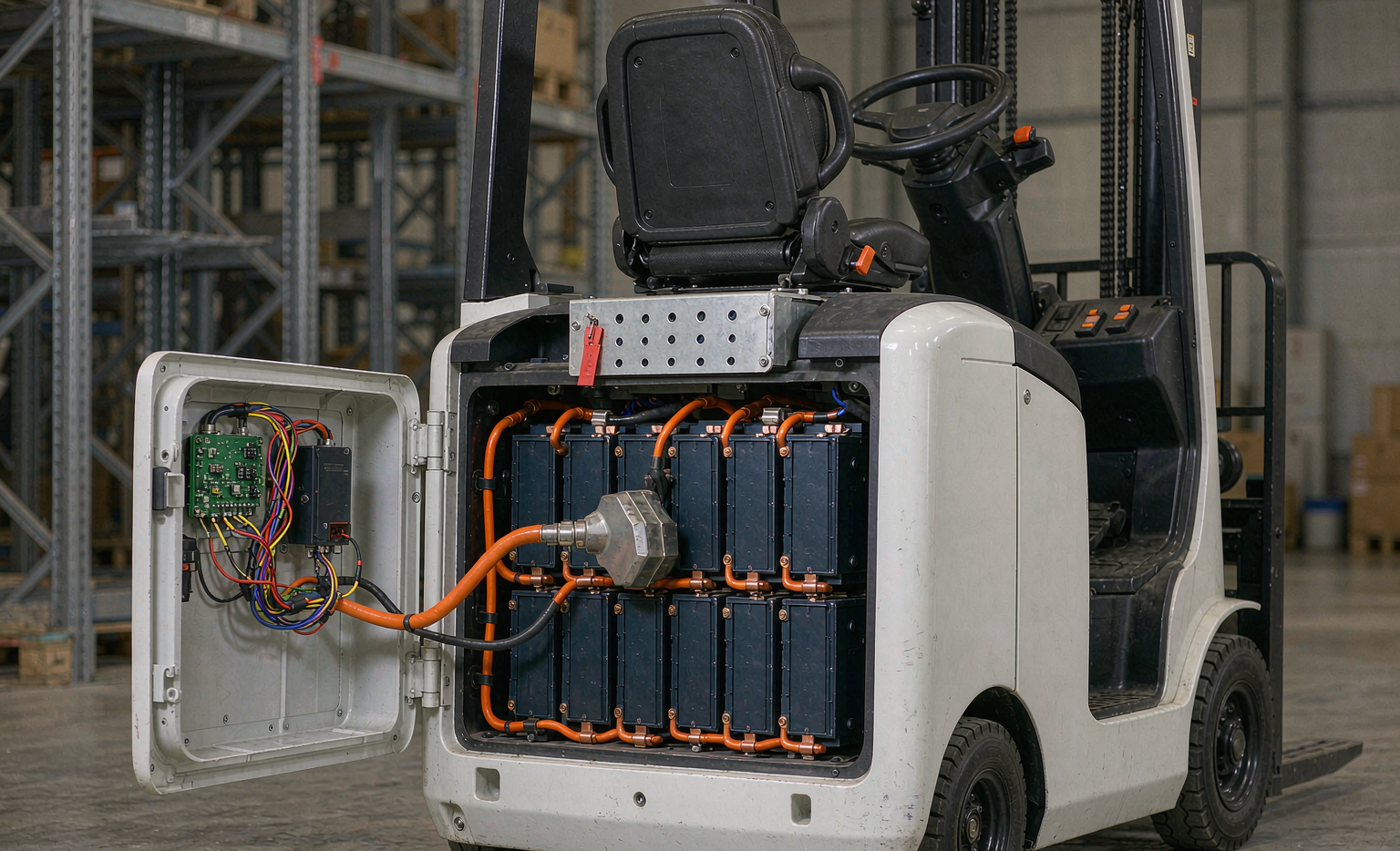
Every few weeks a warehouse operations manager sends me the same photograph: a forklift with its battery compartment door open, a shiny new pack sitting inside, and a fault code on the dash. The cells are fine. The welds are fine. What failed was the integration — the thousand small decisions that connect a battery to a machine that was designed around 1,200 kg of lead. After commissioning sodium-ion battery systems in distribution centres, cold stores and paper mills, I can say with confidence that sodium-ion battery integration for forklifts is 30% cell chemistry and 70% mechanical envelope, voltage-window mapping and controller behaviour.
I am Karl Huang, Senior lithium battery Engineer at Horizon Power. My team builds drone battery packs, lithium battery systems and, for the last several years, sodium-ion battery packs for material handling. This article is the integration playbook I hand to our field engineers before they touch a truck: the compartment and ballast maths, the series-count decision, why the sodium-ion open-circuit voltage curve simultaneously fixes your fuel gauge and threatens your lift speed, and the commissioning checks that keep an EN 1175 audit uneventful.
Sodium-Ion Battery Integration for Forklifts Starts as a Mass Problem
On an electric counterbalance truck the traction battery is not just an energy source — it is structural ballast. The truck’s data plate states a minimum and a maximum battery weight, and the rated capacity printed next to it is only valid inside that window. Take a typical 3.0-tonne Class 1 truck: 48 V, 750 Ah of flooded lead-acid, roughly 36 kWh gross, and 1,150 to 1,250 kg including the steel tray. The data plate might read “min. 1,050 kg / max. 1,400 kg”.
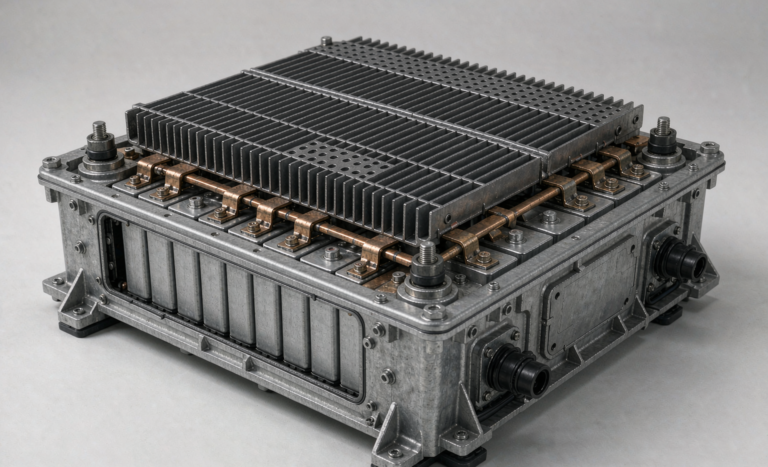
Now size the replacement. Second-generation sodium-ion cells land at 145 to 160 Wh/kg at cell level, which after casing, busbars, cooling plate and BMS gives 105 to 120 Wh/kg at pack level. A 30 kWh usable sodium-ion battery pack — deliberately smaller than 36 kWh gross because we use 90%+ of it instead of 60% — weighs 260 to 300 kg. That is a deficit of roughly 800 kg against the data-plate minimum.
Ignore that deficit and three things happen: rated lift capacity is no longer certified, the rear axle unloads during forward tilt with a raised load, and the truck fails its next stability assessment. So every forklift pack we ship is a ballasted assembly:
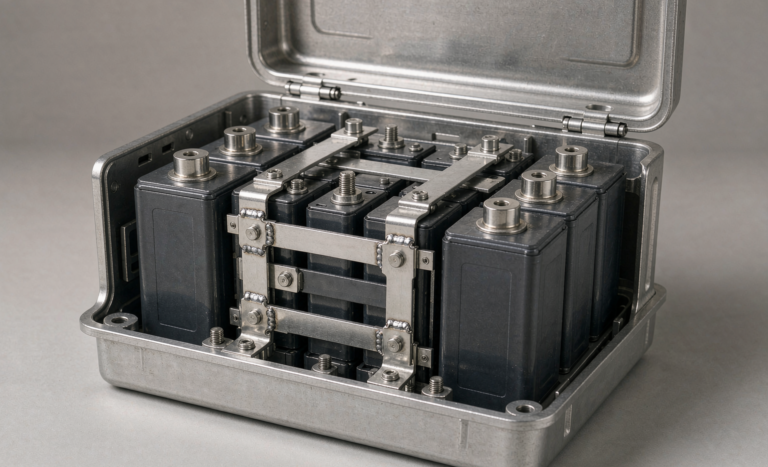
- Bolt-in steel ballast plates inside the original tray footprint, sized to bring total mass within the data-plate window with 30 to 50 kg of headroom.
- Centroid matching — we place ballast so the assembly’s centre of mass sits within ±25 mm horizontally and ±30 mm vertically of the original lead-acid battery’s centroid, calculated from the OEM battery drawing, then verified on four load cells.
- Envelope compliance with the DIN 43531 / IEC 60254-2 compartment families the truck was built to, held to ±3 mm, with shims limiting lateral play to 10 mm or less.
- Restraint hardware designed for ±2 g longitudinal and lateral and 3 g vertical, which comfortably covers the vibration profile of UN 38.3 test T3 and typical dock-plate shock.
We also weld lifting eyes rated for the ballasted mass and mark the total weight on the tray. A 290 kg pack with 800 kg of ballast is a 1,090 kg assembly; a warehouse crew that assumes “lithium is light” and slings it wrong will find out the hard way.
Mapping the Sodium-Ion Voltage Window onto a 48 V Truck
This is where most retrofit projects quietly go wrong. Layered-oxide and Prussian-white sodium-ion cells operate across roughly 1.5 to 4.0 V, with a nominal of about 3.1 V. That is a far wider swing than the 2.5 to 3.65 V of an LFP lithium battery cell, and a 48 V forklift power system has hard limits at both ends.
Run the series-count arithmetic:
- 16S: 49.6 V nominal — attractive on paper — but 64.0 V at 4.0 V/cell. Many 48 V truck controllers, contactor coils and DC/DC converters are specified to 60 V maximum with 63 V capacitors. 16S will sit above their absolute rating every time you finish a charge. We avoid it unless the OEM confirms a 75 V-class front end.
- 15S: 46.5 V nominal, 60.0 V at a 4.00 V/cell charge cut-off, and that is the configuration we standardise on for 48 V trucks.
The low end matters even more. A 15S pack taken to 1.5 V/cell is 22.5 V — deep inside the controller’s undervoltage lockout, which on 48 V trucks typically sits between 33 and 38 V. So the battery management system, not the cell datasheet, defines the usable floor. We clamp the discharge floor at 2.60 V/cell, giving 39.0 V, and reserve the last sliver of chemistry-available energy as sag margin. In practice that clamp still releases 92 to 94% of rated capacity, because the bottom of the sodium-ion curve holds very little energy.
Sag margin is not theoretical. Simultaneous travel and lift on a 3-tonne truck draws 380 to 450 A for 8 to 15 seconds. Our reference 15S6P pack of 100 Ah cells has a cell DCIR of 0.55 to 0.75 mΩ, so the array contributes about 1.6 mΩ, and busbars, main fuse, contactor and cabling add 1.2 to 1.8 mΩ — call it 3.1 mΩ total. At 420 A that is a 1.3 V dip. Add the OCV drop of a nearly empty pack and you can see why the floor has to be conservative: at 15% state of charge the pack rests near 42.8 V and loads to 41.5 V, comfortable; at 5% it rests near 39 V and loads to 37.7 V, which is a mid-lift shutdown and a dropped pallet.
Protection coordination follows from the same impedance figure. A 3.1 mΩ pack has a prospective short-circuit current in the 15 kA region, so we specify DC-rated aR/gR traction fuses with a breaking capacity above 20 kA at 60 V DC, sized at roughly 1.25× continuous current, and verify the fuse I²t stays below the pack’s withstand. Precharge uses a 47 Ω resistor to bring 5 to 15 mF of controller capacitance above 90% of bus voltage in under three seconds before the main contactor closes.
The Sloped OCV Curve: Good for the Fuel Gauge, Hard on Late-Shift Hydraulics
Sodium-ion’s sloping voltage curve is the single most consequential difference for integration, and it cuts both ways.
It Finally Makes the Truck’s Own Fuel Gauge Honest
Older trucks derive the battery discharge indicator and the lift-interrupt threshold from bus voltage alone. Retrofit an LFP lithium battery and that scheme collapses: LFP moves only 150 to 250 mV per cell across the whole plateau, about 2 to 3 mV per percent of state of charge, so the gauge reads full until it reads empty. Sodium-ion moves roughly 1.0 to 1.2 V per cell between 10% and 100%, which is 12 to 14 mV per percent per cell, or 180 to 210 mV per percent at 15S. A recalibrated voltage-based indicator lands within about ±5% instead of the ±20 to 30% error we see on flat-plateau chemistries. Our BMS still blends coulomb counting with rest-OCV correction to hold better than 3% error, but the truck’s native gauge becomes a genuinely useful backup rather than a liability.
It Also Steals Hydraulic Speed at Low State of Charge
The flip side: a pack at 20% SoC sits meaningfully lower than the same pack at 80%, so the hydraulic pump motor sees less bus voltage and the lift slows. Operators notice and — being operators — they compensate by holding the lever longer, which draws more current, which sags the bus further. Three integration measures fix it:
- Voltage-compensated current limits in the pump controller, so torque is maintained by raising current within the pack’s continuous rating as voltage falls, rather than letting speed collapse.
- Re-mapped undervoltage lockout and lift interrupt — where the truck OEM permits it, we move lockout down to 36 V and set lift interrupt at 12 to 15% SoC over CAN, which protects the pack while giving the driver a clear warning instead of a surprise.
- Right-sizing rather than down-sizing. On multi-shift duty we specify the pack so a full shift ends above 20% SoC, keeping the truck in the well-behaved part of the curve for its entire working day.
None of this is exotic, but all of it has to be decided before the pack is built. That is why our sodium-ion battery pack projects for material handling start with a duty-cycle log — bus voltage, current, lift events and idle time recorded on the existing truck for two to three shifts — rather than a datasheet comparison.
Communication, Interlocks and the Charger Handshake
A modern truck expects to talk to its battery. Older ones expect an analog voltage and a key switch. Both are workable; you must know which you have before quoting the job.
On CAN-equipped trucks we integrate over CAN 2.0B at 250 or 500 kbit/s, mapping the BMS to the CANopen or J1939-style frames the truck controller already consumes: state of charge, pack voltage and current, minimum and maximum cell temperature, charge and discharge current limits, and a fault word. Getting the charge/discharge current limit frames right is what stops the controller from asking for 500 A when the pack is at −5°C and can only accept 120 A. On legacy trucks we synthesise the BDI signal, feed the key-switch-derived enable into the BMS, and drive the truck’s existing seat and interlock chain so no energy is available until the operator is seated and the compartment door is latched.
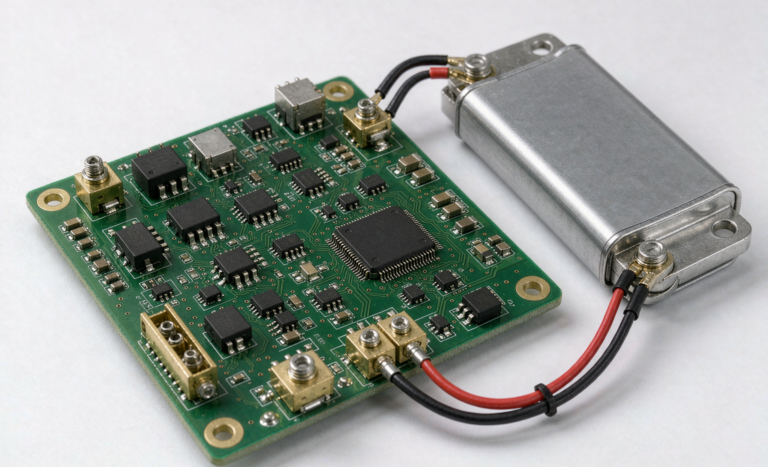
The charger is not optional to replace. Ferro-resonant and 50 Hz taper lead-acid chargers have no idea what a sodium-ion cell wants, and a lead-acid equalisation stage at 2.4 V/cell equivalent will drive a 15S sodium-ion pack far past its limits. We pair packs with a CAN-controlled charger running constant-current to 60.0 V then constant-voltage taper to about C/20, and we insist on a hard interlock: no charge current until the BMS grants permission, and instant shutdown if the CAN heartbeat is lost. Opportunity charging is where the chemistry earns its keep — a 0.5C session over a 45-minute break returns roughly 35 to 40% SoC, and a full replenish at 0.5C takes about 2.2 hours, so most two-shift operations stop buying spare batteries and changing stations altogether. Cycle life of 4,000 to 5,000 cycles to 80% capacity at 0.5C/0.5C makes that daily habit sustainable.
Electrically, two more items belong on the integration sheet: insulation resistance, measured at 500 V DC and expected in the tens of megohms on a healthy pack against a floor on the order of 1 kΩ per volt of nominal system voltage, and EMC. Switching noise from a 15 kW pump inverter couples straight into analog BDI wiring and CAN shields; we route sense harnesses away from the traction loop, use twisted shielded pairs, and verify behaviour against EN 12895 for industrial trucks.
Cold Stores, Where Sodium-Ion Integration Gets Easy
In a −20 to −25°C freezer warehouse, a lithium battery retrofit becomes an HVAC project. LFP cells cannot accept charge below 0°C without damage, so the pack needs a 250 to 600 W heater, a warm-up delay of 20 to 40 minutes, and an energy penalty of 1.5 to 3 kWh per shift just to keep itself comfortable.
Sodium-ion changes that calculation. Our packs deliver 85 to 90% of their 25°C capacity at −20°C and accept 0.2 to 0.3C charge at that temperature without any heater at all. The integration work shifts from heating to moisture: trucks that cycle between a −25°C aisle and a +15°C dock condense water inside the compartment on every trip. We specify IP65 enclosures for cold-store duty, conformal-coat the BMS and balancing boards, fit a membrane breather vent to equalise pressure without admitting liquid water, and seal connector backshells. Frozen-food customers see the payoff twice: no heater energy, and no truck sitting idle waiting to be warm enough to charge.
Compliance and Documentation: What the Auditor Will Ask For
Integration is not finished until the paperwork matches the hardware. For material-handling projects we assemble a file covering the truck standards, the battery standards and transport:
- Truck-level: EN 1175-1 for the electrical requirements of industrial trucks and ISO 3691-1 for safety in the EU, ANSI/ITSDF B56.1 and UL 583 for North America, plus a re-issued or amended data plate reflecting the new battery weight range where the OEM or a competent engineer authorises it.
- Battery-level: IEC 62619 for industrial secondary cell safety, applied to sodium-ion by analogy pending chemistry-specific editions, IEC 62620 for performance, and IEC 60254-2 for compartment and traction-battery practice.
- Transport: UN 38.3 tests T1 through T8, and — a genuine sodium-ion advantage — the dedicated UN 3551 and UN 3552 entries introduced in the 23rd revised edition of the UN Model Regulations, which permit shipment at 0 V. Sodium-ion cells use aluminium current collectors on both electrodes, so they survive a full discharge to zero volts. Shipping at 0 V removes the state-of-charge limits that constrain lithium consignments and materially reduces transport risk.
- Market access: EU Regulation 2023/1542, with the digital battery passport obligation for industrial and traction batteries from 18 February 2027 — which means the serial-level cell traceability, carbon-footprint and material-content data must be captured at build time, not reconstructed later.
We close every commissioning with a signed record: torque values on all busbar joints (M8 copper joints at 12 to 15 N·m with witness marks, re-torqued after 50 cycles on the first unit of a fleet), a static cell-voltage spread of no more than 30 mV on a new pack, a 500 V insulation reading, a thermal-imaging pass under load with 20 K over ambient as the investigate threshold, a logged full charge and discharge, and a photograph of the ballast layout for the maintenance file.
A Field Checklist for Sodium-Ion Forklift Integration
- Read the truck data plate first: nominal voltage, minimum and maximum battery weight, rated capacity, compartment dimensions.
- Log two to three real shifts of current, voltage and lift events before sizing anything.
- Confirm the controller’s absolute maximum bus voltage and undervoltage lockout in writing — this decides 15S versus 16S.
- Design ballast and centroid matching into the tray, then weigh the finished assembly on load cells.
- Set the BMS discharge floor from the controller’s lockout plus measured sag, not from the cell’s datasheet minimum.
- Decide the communication path early: CAN frames on modern trucks, synthesised BDI and interlock chain on legacy ones.
- Replace the charger and interlock it to the BMS over CAN; never reuse a lead-acid profile.
- For cold stores, specify IP65, conformal coating and a breather vent instead of a heater.
- Capture serial-level traceability data at build time for the 2027 battery passport.
- Train operators on what the recalibrated gauge and lift interrupt now mean.
Frequently Asked Questions
Can a sodium-ion battery pack drop straight into a lead-acid forklift compartment?
Mechanically, yes, if it is built as a ballasted assembly to the original DIN 43531 or IEC 60254-2 envelope. Electrically, no — the charger must be replaced, the BMS discharge floor must be matched to the truck’s undervoltage lockout, and the gauge or CAN interface must be configured. Treat it as a custom battery solution with a drop-in form factor, not a like-for-like swap.
How much ballast does a sodium-ion forklift battery need?
For a 3-tonne counterbalance truck replacing a 1,150 kg lead-acid battery with a 30 kWh sodium-ion battery pack of about 280 kg, expect 750 to 850 kg of bolt-in steel, placed to match the original centroid within ±25 mm horizontally. Always confirm against the specific data-plate weight window rather than a rule of thumb.
Do I have to reprogram the forklift controller?
Not always, but you get a better result if you can. Without reprogramming, the BMS must live inside the factory lockout thresholds, which costs a few percent of usable energy. With OEM-authorised access we lower lockout toward 36 V, add voltage-compensated hydraulic current limits, and set lift interrupt at 12 to 15% state of charge.
Will the truck’s existing battery discharge indicator work?
Better than you would expect. Because sodium-ion has a sloping OCV curve of roughly 12 to 14 mV per percent of state of charge per cell, a recalibrated voltage-based indicator achieves about ±5% accuracy — far better than the same gauge fed by a flat-plateau LFP pack. It still needs recalibration to the new curve, and the BMS state of charge remains the authoritative value.
Can I keep my existing lead-acid charger?
No. A lead-acid equalisation stage will overcharge a sodium-ion pack, and taper chargers cannot honour temperature-derated current limits. Use a CAN-controlled charger that runs constant-current to 60.0 V on a 15S pack, tapers to about C/20, and refuses to deliver current without BMS permission.
How does sodium-ion compare with a lithium battery retrofit for forklifts?
A lithium battery pack is lighter and more energy-dense per kilogram, which matters when compartment volume is tight. Sodium-ion wins on low-temperature charging without heaters, on 0 V transport under UN 3551 and UN 3552, on raw-material supply independence from lithium and cobalt, and on gauge accuracy. In cold stores and in fleets exposed to lithium price volatility, sodium-ion is usually the better integration choice; in space-constrained high-energy applications, lithium still leads. We build both and pick per duty cycle.
Does sodium-ion really work in a −25°C freezer warehouse?
Yes, and it is the strongest case for the chemistry in material handling. Expect 85 to 90% of rated capacity at −20°C and 0.2 to 0.3C charge acceptance without a heater. The design attention moves to sealing and condensation control — IP65, conformal coating and a membrane vent — because trucks cycling between freezer and dock condense moisture on every pass.
What should I require from a sodium-ion battery manufacturer?
Ask for UN 38.3 T1–T8 reports on the shipped configuration, IEC 62619 and IEC 62620 evidence, a documented BMS communication specification with the CAN frames you will actually consume, a ballast and centroid calculation signed against your truck’s data plate, cell-level traceability suitable for the 2027 EU battery passport, and a commissioning record template. A supplier who cannot produce the integration documents has not done the integration.
Closing Note From the Bench
The fleets that succeed with sodium-ion in material handling are the ones that treat the pack as a subsystem of the truck rather than a component in a box. Get the mass and centroid right, map the voltage window onto the controller’s real limits, respect what the sloping OCV curve does to late-shift hydraulics, and interlock the charger properly — and a sodium-ion forklift battery becomes the least interesting thing in the warehouse, which is exactly what a maintenance manager wants. If you are scoping a retrofit, start by logging your duty cycle; every good integration decision we have ever made came out of that data, not out of a datasheet.