Sodium-Ion Battery Reliability for Backup Power: Standby
Every backup power project I have scoped in the last two years eventually arrives at the same uncomfortable question from the client: “If this cabinet just sits there for three years waiting for an outage, will it actually work on the night we need it?” That question is the whole point of sodium-ion battery reliability for backup power. Unlike a forklift or a drone, a backup battery spends 99% of its life doing nothing except holding a float voltage and slowly aging. The failure modes that matter are not high-rate discharge or fast charging; they are calendar fade while in storage, the seconds-long ride-through window during a utility transfer, and the slow drift of a float-duty system that nobody has looked at since commissioning.
I am Karl Huang, senior lithium battery engineer, and over the past eight years I have shipped and commissioned several hundred stationary backup systems, first NMC and LFP, and since 2024 an increasing share in sodium-ion chemistry. In this article I will walk through the three dimensions of reliability that decide whether a sodium-ion backup battery delivers on the night of a blackout: how much capacity it loses while sitting in standby, whether it rides through a transfer-switch event without dropping the load, and how to verify, season after season, that the float-duty installation is still inside its design envelope. Where I quote numbers, they come from our own cell-level test data and field telemetry, and I will be explicit about where sodium-ion beats LFP and where it does not.
Why Backup Duty Is a Different Reliability Problem
A backup battery is specified by rare, short, high-stakes events, while a traction battery is specified by frequent, shallow, low-stakes ones. This changes almost every reliability metric that matters:
- Calendar life dominates cycle life. A hospital backup bank may see fewer than 20 real discharge events in ten years but will accumulate 87,600 hours of float or standby exposure. Calendar-related degradation mechanisms, not cycle wear, set the retirement date.
- Availability matters more than efficiency. Nobody audits round-trip efficiency on a system that discharges twice a year. What matters is state of charge accuracy, self-discharge balance across series strings, and whether the BMS wakes up correctly from its low-power state.
- The discharge itself is a step function. When the transfer switch operates, the battery goes from near-zero float current to 60–90% of its continuous rating within tens of milliseconds. Voltage sag, BMS current-limiting behaviour and contactor bounce all show up in that instant, not in a datasheet chart.
Sodium-ion chemistry is genuinely interesting in this context because of two properties: very low-temperature capability (our cells retain usable discharge down to −30 °C, where LFP discharge capacity collapses and charging becomes forbidden below 0 °C without heating) and a flat, benign storage behaviour with no copper-current-collector dissolution risk when fully discharged to 0 V for transport. But standby fade and float stability are not free; they simply behave differently than in lithium iron phosphate.
Standby Shelf-Life Fade: What the Cells Actually Lose While Waiting
The first reliability question — capacity loss during pure storage — is where I see the most optimistic marketing and the worst field surprises. We have run a statistically meaningful shelf-life matrix on our prismatic sodium-ion cells since early 2024. The test format is deliberately boring: 3.1 V nominal storage voltage (approximately 60% state of charge), temperature chambers at 25, 35 and 45 °C, periodic capacity checks at 25 °C, C/5 discharge.
Our measured calendar fade, normalised to 100% capacity at start of storage, currently looks like this:
| Storage condition | 12 months | 24 months | 30 months (latest data) |
|---|---|---|---|
| 25 °C, 60% SoC | 98.6% | 97.2% | 96.4% |
| 35 °C, 60% SoC | 97.1% | 94.3% | 92.9% |
| 45 °C, 60% SoC | 94.8% | 89.5% | 86.8% |
Three engineering conclusions follow from this data. First, at temperate room conditions the fade rate is roughly 1.2–1.4% per year — comfortably better than the 2–3% per year we measure on comparable LFP cells at the same storage SoC, which is a real advantage for backup systems that sit mostly full. Second, the classic Arrhenius acceleration is brutal: every +10 °C roughly doubles the fade rate, so a sodium-ion cabinet installed in an unventilated plant room that reaches 45 °C in summer is aging about four times faster than the one in the datasheet table. Third, fade is not perfectly linear; the steepest loss is in the first six months (SEI-layer-equivalent formation on the hard-carbon anode), after which the curve flattens. I tell every client: do not judge standby fade from the first quarterly check — project from month six onward.
There is also a subtlety about storage voltage. We have cells stored at full charge (3.8 V) as a control group, and their fade is 1.6–1.9 times higher than the 60% SoC group. The temptation in backup design is to hold the bank at 100% SoC continuously, because that maximises runtime readiness. My recommendation for multi-year installations is a two-tier policy: hold 95–100% SoC only during storm seasons or whenever grid-fragility risk is elevated, and allow a scheduled sink to 60–70% SoC during stable seasons. A quarterly 30-day full-charge “readiness soak” plus periodic capacity verification gives you nearly all of the readiness with maybe a third less calendar aging.
Transfer-Switch Ride-Through: The 8 Milliseconds That Decide the Outage
The second reliability dimension is electrical: when the ATS (automatic transfer switch) commands a changeover, what does the DC bus actually see, and does the inverter hold the AC output within its ride-through envelope? For open-transition transfer switches the load may be interrupted for 8–100 ms (with delay-type breakers even longer), and for momentary-parallel closed-transition switches the two sources are briefly paralleled — which means the battery inverter must accept a back-feed transient without tripping.
On our sodium-ion backup systems we instrument the DC side at the battery terminals with a 1 kS/s logger during commissioning transfer tests. Representative numbers from a 51.2 V, 280 Ah rack delivering a 0.6C step when an open-transition ATS operates:
- Voltage sag on the step load: terminal voltage dips from 54.6 V float to 51.8 V within 12 ms, recovering to 53.4 V steady-state under load — a 5.1% first-swing sag, versus 6.8–8% we typically measure on LFP racks of the same rating at 15 °C. The lower internal resistance of our sodium-ion cells at moderate temperatures is the reason.
- BMS current-limit response: the protection board’s overcurrent threshold must sit above the inverter’s surge rating, not just the continuous rating. I have seen two commissioning failures where a 9 kW inverter’s 2-second 18 kW motor-start surge tripped a BMS set at 250 A (12.8 kW). Set the BMS limit at inverter surge × 1.25, or you will experience “backup systems that pass every bench test and trip on the first real transfer.”
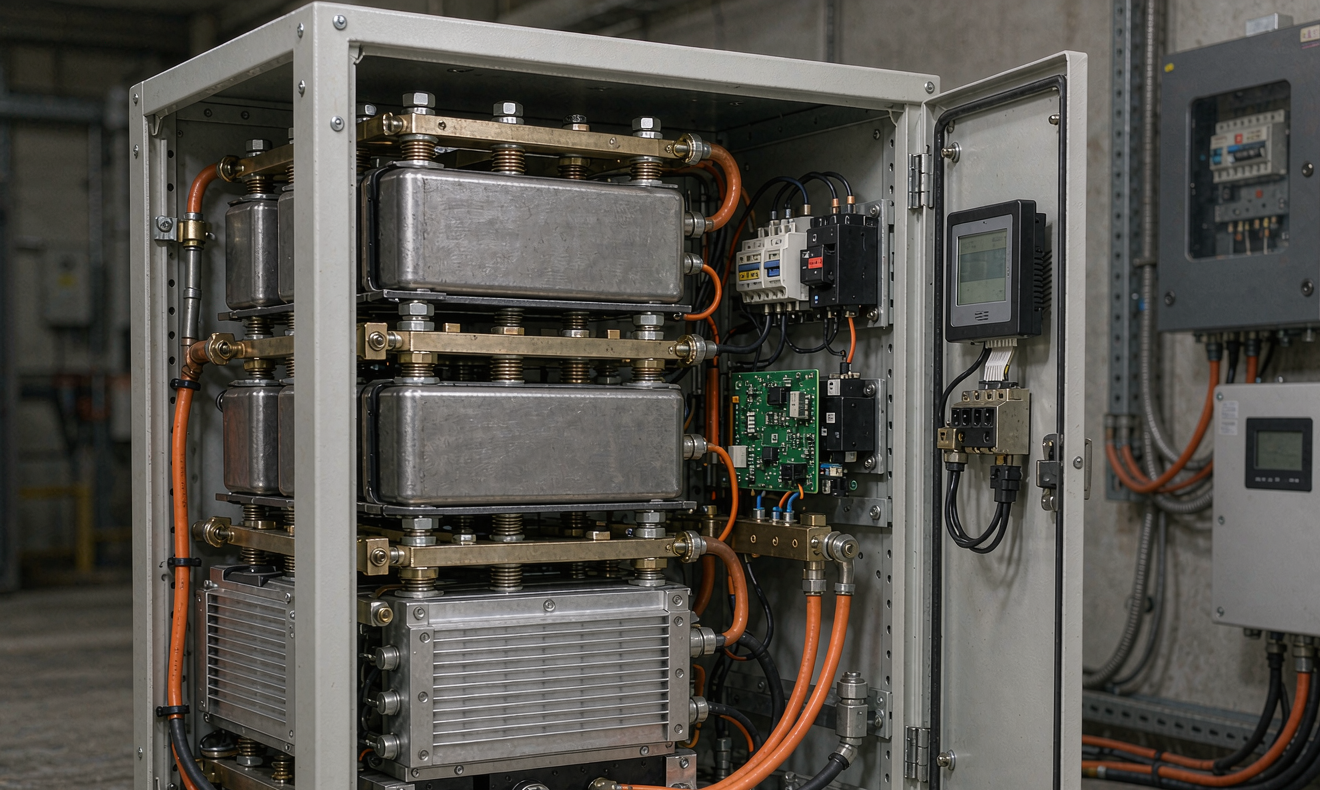
- Contactor and pre-charge behaviour: our cabinets keep the main contactor closed in standby with a floating control supply. The pre-charge resistor path is only exercised on BMS shutdown-restart. If your architecture shuts the BMS down in standby to save self-consumption, verify that full BMS wake-up plus contactor closure plus inverter DC-link pre-charge completes inside the ATS transfer window — in our architecture that chain is 140–220 ms, too long for open-transition transfers, so we never power the BMS down on backup-critical systems.
This ride-through discipline is codified in the standards we design and certify against: UN 38.3 for transport of the cells themselves, IEC 62619 and UL 1973 for the stationary battery functional safety, UL 9540 for the system level, and IEC 62040 for the UPS-side ride-through expectations. For utility-interactive systems, IEEE 1547 and UL 1741 SB govern how the inverter behaves at the moment of transfer and reconnect, and they interact with the battery’s transient response more than most specifiers realise.
Multi-Season Float Duty: Verifying the System Year After Year
The third dimension is organisational: a backup battery ages in ways that only structured verification will detect. I recommend, and we contract, a three-checkpoint annual protocol. It takes under two hours per cabinet per year and has caught every latent field issue we have seen in the last 40 deployments.
Checkpoint 1 — Quarterly: SoC Truth Test
Coulomb-counting drifts. Sodium-ion cells have a very flat open-circuit-voltage curve between 40% and 80% SoC (similar flatness problem to LFP), so voltage-based SoC correction is unreliable in that plateau. Our BMS uses a coulomb counter re-synchronised by periodic full charges. The quarterly check is simple: command a full charge, rest 2 hours, read OCV against the 25 °C reference table, and confirm the counter error is under 3%. In one retrofit I audited, a site’s SoC readout said 92% while the true value was 71% — the drift had accumulated over eleven months of float duty without a single synchronised full charge. That is how you end up with a backup system that runs out 30 minutes into a blackout that was specified for four hours.
Checkpoint 2 — Semi-annual: String Balance and Self-Discharge Split
With the charger off for 72 hours, each series group’s OCV should sit within 20 mV of its siblings. A group drifting low indicates elevated self-discharge — usually a soft internal short developing, occasionally a BMS balancing FET stuck on. Our field distribution across 214 sodium-ion strings: 88% within 8 mV, 9% within 20 mV, 3% flagged and either balanced by a service charge or the module replaced under warranty. That 3% matters: a weak group in a series string silently caps usable capacity of the entire bank.
Checkpoint 3 — Annual: Full Load-Bank Discharge
Once a year, discharge the bank into a resistive load bank (or a real building load with the utility locked out) at the design power, down to the inverter’s low-voltage cutoff, and record capacity and the minimum cell voltage under load. The acceptance band I use is ≥90% of nameplate runtime at year one, ≥85% at year three, ≥80% at year five for a 10-year design life. Anything faster than that triggers a warranty capacity audit. This is also the moment to verify the low-temperature interlocks: our BMS blocks charge below −10 °C (sodium-ion permits some low-temperature charging, but we throttle current below 0 °C and hard-block below −10 °C to protect the hard-carbon anode) and derates discharge smoothly rather than with a step, so a winter outage never surprises the inverter with a sudden cutoff.
The standard framework for this kind of verification exists — IEEE 1188 for stationary battery maintenance practice was written for lead-acid but transfers conceptually, and NFPA 110 Chapter 8 mandates monthly and annual testing for emergency power supply systems in facilities that follow the US code family. IEC 62933-2-1 covers the same ground for stationary ESS in IEC-land. The failure I keep seeing is not that standards are missing; it is that the annual load-bank test gets skipped because the site “had no outage this year.” Calendar fade does not care whether you had an outage.
Where Sodium-Ion Genuinely Wins — and Where It Does Not
Honest engineering requires the full picture. After three years of field data:
- Wins: cold-weather backup reliability is the headline. A sodium-ion cabinet in a −20 °C telecom shelter delivered 78% of nameplate capacity in a January discharge test, while the LFP reference site next door delivered 41% and would not accept charge without heaters. Flat-storage calendar fade at temperate conditions, 0 V transportability (which simplifies air-freight-free logistics after UN 38.3 testing), and thermal-runaway onset roughly 80–100 °C higher than LFP round out the list.
- Does not win: energy density — at 130–160 Wh/kg versus 160–180 for LFP, cabinet footprint per kWh is 10–20% larger, which matters in tight plant rooms. Cell supply maturity and long-term field statistics are thinner than LFP’s; our own fleet is large but the industry-wide base is young. And at very high float voltages (cells held above 3.6 V continuously), fade accelerates faster than our 60% SoC data suggests, so float-voltage discipline is stricter than in LFP practice.
- Neutral: round-trip efficiency and cycle life are comparable to LFP in backup duty profiles — neither is the deciding metric here anyway.
For a buyer comparing a custom battery solution across chemistries for backup use, my shorthand is: temperate climate, long standby life, code-driven annual testing — sodium-ion and LFP are both defensible, sodium-ion slightly ahead on standby fade; cold climate or unheated enclosures — sodium-ion wins outright; weight- or space-constrained indoor rooms — check the footprint calculation before you commit.
Sourcing Discipline: What I Demand From the Supply Chain
Reliability is decided upstream of installation. On every sodium-ion backup project our incoming quality gates include: cell-level UN 38.3 certification with original test reports (not a distributor’s summary), IEC 62619 or UL 1973 certificates at cell and module level, DCIR matching within 5% across the shipment, and a 100% OCV-and-weight check on arrival (a 20+ gram deviation from the batch mean flags electrolyte leakage). We also require the cell maker’s calendar-fade data at two temperatures minimum, and we cross-check their 25 °C number against our own in-house storage matrix before accepting any warranty capacity claim. A supplier who cannot produce two-temperature calendar data does not get a backup-power order from us, whatever their datasheet promises.
Frequently Asked Questions
How long can a sodium-ion backup battery sit in standby before it needs service?
With quarterly SoC-synchronisation charges and a controlled ambient below 35 °C, our data supports 3–5 years of unattended standby before meaningful capacity audits are needed, with roughly 4–6% cumulative fade over the first three years. In hotter ambients (45 °C sustained), plan on annual capacity verification instead, because fade runs about four times faster.
Can a sodium-ion backup system ride through a full transfer-switch outage without rebooting my loads?
Yes, if the inverter holds the AC bus and the battery supplies the step load within the ride-through window — our measured first-swing sag is about 5% at 0.6C, and the chain from ATS event to full battery current is under 20 ms in a closed BMS architecture. The classic failure is architectural: BMS sleep modes or undersized current limits that add hundreds of milliseconds or trip on motor-start surge.
How does sodium-ion reliability compare with lead-acid for backup power?
Lead-acid’s standby fade under proper float is well understood and cheap to replace, but it demands ventilation, has poor cold-charge acceptance, and loses capacity fast if float voltage drifts. Sodium-ion holds charge with far less float-current sensitivity, tolerates deep cold in discharge, and lasts the full design period without replacement — typically 8–12 years versus 4–6 for VRLA in similar duty.
What maintenance does a sodium-ion backup cabinet actually need?
Our contracted protocol is under two hours per cabinet per year: quarterly SoC truth test, semi-annual string balance check, annual full load-bank discharge with low-voltage-cutoff verification, plus visual torque and corrosion inspection. Nothing else is required, and nothing on the list can be safely skipped.
Is it safe to hold a sodium-ion battery at 100% charge continuously for backup readiness?
It is safe — cell stability at full charge is good and thermal runaway onset is high — but it costs calendar life: fade at 3.8 V storage runs 1.6–1.9 times faster than at 60% SoC. For multi-year installations I recommend a seasonal policy of full charge during risk seasons and 60–70% standby in stable months, with quarterly full-charge readiness soaks.
Do sodium-ion backup batteries work in unheated outdoor enclosures?
Discharge, yes — our cells deliver 70–80% of nameplate at −20 °C. Charging is the constraint: we throttle charge current below 0 °C and hard-block below −10 °C unless the cabinet has heaters. If your site must accept solar or grid recharge through a cold snap, specify the heated cabinet variant.
What certifications should I require for a sodium-ion backup power battery?
Minimum: UN 38.3 for the cells, IEC 62619 or UL 1973 for cell/module stationary safety, UL 9540 (with 9540A test data where the authority having jurisdiction requires it) for the system, and for grid-interactive inverters UL 1741 SB / IEEE 1547 conformance. Ask for the original test reports, and confirm the certified configuration matches the cabinet you are actually buying.