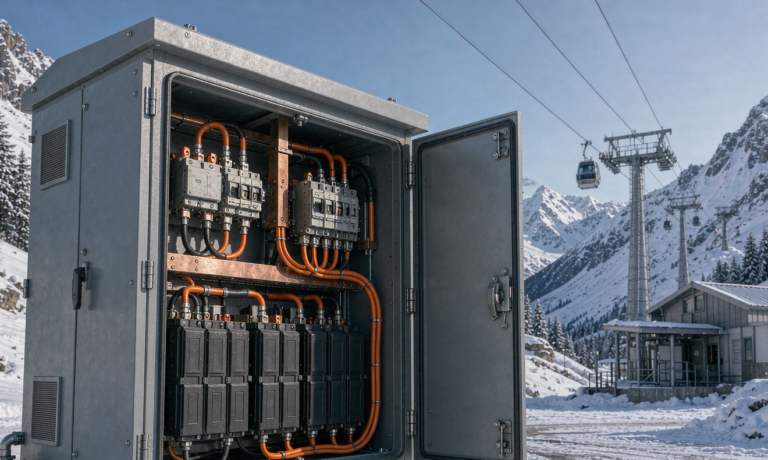
Battery Solution for Forklift and Material Handling Fleets
Forklift fleets are the one place in a warehouse where a power decision shows up on the profit and loss statement inside a single shift. I have spent the past decade sizing and qualifying packs for material handling operations, and the pattern is almost always the same: the truck is well chosen, the racking is fine, and the energy system quietly becomes the bottleneck. Aisle throughput, shift productivity and even operator confidence trace back to how the battery was specified, not to how the truck was purchased.
This guide is the field version of that lesson. It covers the decisions I make when I specify a battery solution for forklift and material handling fleets: chemistry selection, duty-cycle profiling, thermal design, opportunity charging, and the compliance work that keeps a pack legal and insurable. The same physics applies whether you run reach trucks, counterbalance trucks, order pickers or automated guided carts.
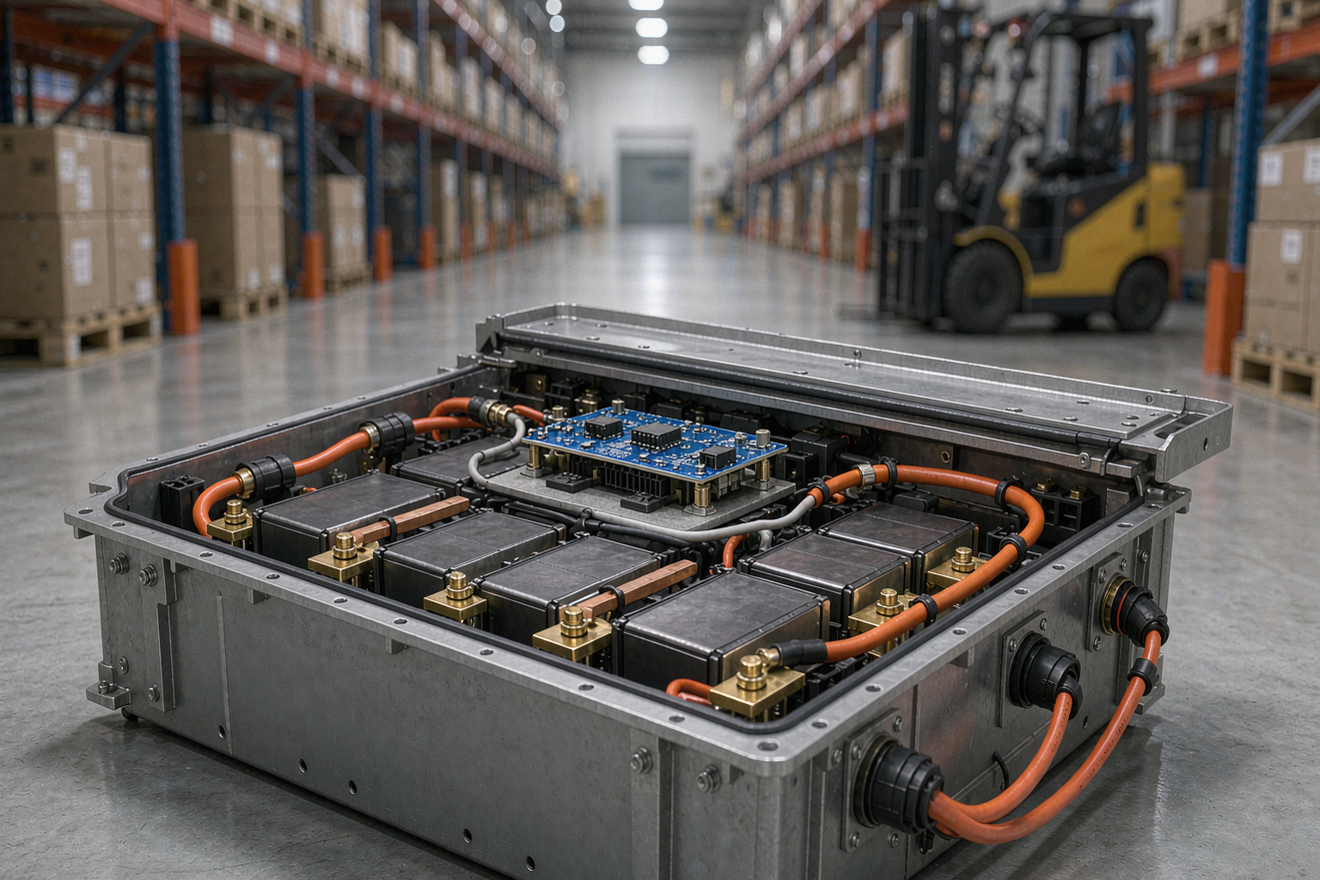
Material Handling Is a Duty-Cycle Problem Before It Is a Capacity Problem
Every underperforming forklift lithium battery pack I have replaced was undersized against duty cycle, not against nameplate capacity. A truck rated for two tonnes does not care about kilowatt-hours on a datasheet; it cares about how many pallet moves you demand per hour and how much rest the pack gets between them. I start by logging three things for at least a full week: trucks per shift, lifts per hour, and the real idle fraction. In a busy distribution centre the load profile is rarely steady. It looks like a series of short, high-current bursts followed by coasting, and the peak current during a lift and tilt easily reaches three to four times the average draw.
That profile explains why a pack sized on average current overheats and sags under real work. I size for the 95th percentile of current, then confirm the thermal design against the worst continuous block of the shift. A typical counterbalance truck on a two-shift pattern runs a 48 V or 80 V bus and needs roughly 20 to 30 kWh per shift, but the number that dominates the design is the peak, not the total. Get that wrong and the pack will be excellent on the test bench and disappointing on the floor.
Choosing Cell Chemistry for a Forklift Battery Solution
Chemistry is where a custom battery solution earns its keep, because no single cell type wins everywhere in a warehouse. I default to LFP battery chemistry for high-cycle, high-abuse indoor fleets: it tolerates deep discharge, resists thermal runaway better than nickel-rich cells, and routinely delivers 3500 to 6000 cycles at 80 percent depth of discharge. When a truck needs the most energy per kilogram, or works a cold store where every kilogram of counterweight matters, I move toward an NCM battery blend and accept roughly 2000 to 3000 cycles.
A semi-solid state battery is an interesting middle path for premium fleets that want better abuse tolerance without a heavy pack, and sodium-ion battery packs have started to make sense for indoor, temperature-stable operations where cost per cycle and cold-weather behaviour matter more than energy density. The right answer is a question about your aisle, not about the current trend. I usually build two candidate packs and test both against the real duty profile before committing a fleet.
Thermal Design From a Hot Aisle to a Cold Dock
Material handling is thermally hostile in both directions. A pack that spends its day beside steel racking in a summer warehouse can see ambient air above 40 degrees Celsius, and the same truck may later work a chilled dock at minus 20 degrees Celsius. Both ends of that range shrink usable capacity, and both ends accelerate ageing if the pack is mismanaged.
My rule is to design the thermal path before the enclosure, not after. For indoor fleets I favour a sealed metal enclosure with a controlled air path and a cold plate bonded to the module bases, plus temperature sensing on every module so the BMS solution can derate the charge current before cells reach their limit. For cold stores I add a low-temperature charge lockout, because plating lithium below zero is the fastest way to destroy cycle life. Self-heating at charge is acceptable when the BMS gates it correctly; self-heating at discharge in a cold aisle usually means the pack was specified for the wrong duty.
Opportunity Charging and the True Cost of a Charge Window
The reason lithium won the warehouse is not energy density. It is that lithium accepts charge during a coffee break. A lead-acid truck has to be swapped or parked for a long, tapered charge; a well-designed lithium battery solution can take a 15 to 30 minute opportunity charge at 0.5C to 1C and return to work. That changes fleet sizing more than any cell datasheet.
I model opportunity charging as a logistics problem first. How many trucks, how many chargers, and where does the 15 minute window fall in the shift. If you cannot place the charge window, no chemistry will save the design. Connector and busbar resistance matter here too: at high C-rates a poor contact becomes a hot spot, so I specify plated contacts, verify the mating cycle rating, and confirm torque on the terminals at every service interval. This is also where battery pack design discipline pays off, because a pack that was not built for repeated mid-shift events will show it in the connector long before it shows it in the cells.
Safety and Compliance: UN38.3, IEC 62133 and the Floor Reality
Compliance is not paperwork for its own sake; it is the difference between a fleet you can insure and one you cannot. The transport baseline is UN38.3, which every lithium cell and pack must pass before it ships by air, sea or road. For the pack as a system, IEC 62133 covers the safety of secondary lithium cells and batteries, while IEC 62619 addresses industrial applications specifically, which is the standard I cite most often for forklift duty.
For the truck itself, ANSI/ITSDF B56.1 and EN 1175 set out the electrical and safety requirements a powered industrial truck must meet, and any pack you bolt into one has to respect that envelope. In practice I test three things beyond the certificates: crush and vibration on the enclosure, connector retention under repeated mating, and a controlled internal short on a single cell to confirm the propagation path stays contained. A battery solution that passes UN38.3 and IEC 62133 but fails a real propagation test is a liability with good documentation.
Sizing a Custom Battery Solution for Multi-Shift Fleets
For a single-shift operation the sizing exercise is gentle. For two or three shifts the design changes shape. The question stops being how big the pack is and becomes how energy moves across a 24 hour window. I build a simple model with three inputs per truck: energy per shift, charge power available, and the availability the operation actually requires. Then I test pack size against the worst day of the week rather than the average.
Two practical results fall out of that model. First, a modest increase in pack size often removes the need for an extra spare truck, which is the most expensive way to buy headroom. Second, a custom battery solution should be specified together with its charger, because the charge profile and the pack acceptance curve are one system, not two purchases. When a client asks me to quote a pack in isolation, I usually push back and ask for the duty log first. That single conversation prevents most of the field failures I later get called in to diagnose.
Frequently Asked Questions
How long does a lithium forklift battery last compared with lead-acid?
LFP packs in this duty class typically deliver 3500 to 6000 cycles at 80 percent depth of discharge, against roughly 1500 cycles for a well-maintained lead-acid battery. In calendar terms, a two-shift operation often sees five to eight years of useful life before capacity falls below a practical replacement threshold.
Can a forklift battery solution be retrofitted into an existing truck?
Yes, and it is one of the most common projects I take on. The retrofit has to match the truck voltage window, its counterweight requirement and the charger profile. You also need to confirm that the truck controller accepts the new pack state-of-charge signalling, because a mismatch there can cause premature lift cut-off.
What does opportunity charging do to battery life?
Handled correctly, very little. Lithium chemistry tolerates partial state-of-charge cycling well, so short top-up charges during breaks are far gentler than a full deep discharge every day. The risk is thermal rather than chemical, so the design has to keep cell temperatures inside their window during repeated high-rate top-ups.
Which standards should a forklift battery pack comply with?
Transport compliance starts with UN38.3. Pack-level safety is covered by IEC 62133, and industrial applications are addressed by IEC 62619. The truck itself must meet ANSI/ITSDF B56.1 or EN 1175 depending on your market, so the pack design has to fit inside that electrical and safety envelope.
Is sodium-ion a realistic option for material handling today?
For indoor, temperature-stable fleets, yes. Sodium-ion chemistry offers good cold-weather behaviour and a lower cost per cycle, and it does not depend on the same raw-material supply chain as nickel-rich cells. It gives up some energy density, so it suits trucks with generous counterweight rather than weight-critical designs.
How do I know when a forklift battery pack needs replacing?
I use three signals rather than one: a fall of more than 20 percent in measured capacity against the original nameplate value, a rise in internal resistance that shows up as voltage sag under a standard lift load, and a longer charge time without a matching gain in runtime. Any two of those together usually justify planning a replacement.
Further Reading
References