Sodium-Ion Battery for Robotic Lawn Mowers
As a senior lithium battery engineer at Horizon Power, I have spent the last few years helping original equipment manufacturers choose cells for autonomous grounds-care machines. Robotic lawn mowers are an interesting case. They sit outdoors, charge in unheated sheds, and run at dawn or dusk when temperatures drop. For this duty profile, a sodium-ion battery is often a better engineering choice than the lithium iron phosphate packs most brands ship today. In this article I explain why, with the packaging math and the test data we use when we design a sodium-ion battery for robotic lawn mowers.
Why Robotic Mowers Suit Sodium-Ion Chemistry
The first reason is temperature. A robotic mower is not a warehouse device. It lives in a garage or a weatherproof base station, and in many markets it works through spring and autumn mornings when the air is near freezing. Sodium-ion cells keep 85 to 92 percent of their room-temperature capacity at minus 20 degrees Celsius, while a lithium iron phosphate cell typically falls to 70 to 80 percent in the same conditions. More importantly, the sodium cell can accept a charge at low temperature without the lithium plating risk that limits iron phosphate. That single property removes a heater, a controller interlock, and a few percent of daily energy loss from the bill of materials.
The second reason is safety in a residential setting. Sodium-ion uses abundant, non-cobalt chemistry with a thermal runaway onset around 165 to 230 degrees Celsius for layered-oxide cells, compared with 110 to 140 degrees for nickel manganese cobalt. A mower runs under a child’s window and next to a pet, so a chemistry that is harder to ignite and slower to propagate is a real selling point for the OEM, not just a spec sheet line.
The third reason is cost and supply. Sodium is everywhere. When cell makers reach volume, sodium-ion packs land roughly 20 to 40 percent below iron phosphate on a cost-per-kilowatt-hour basis, which matters for a price-sensitive consumer robot. For an OEM building thousands of units a year, that gap flows straight to margin or to a lower shelf price.
Pack Voltage and Capacity for an Autonomous Mower
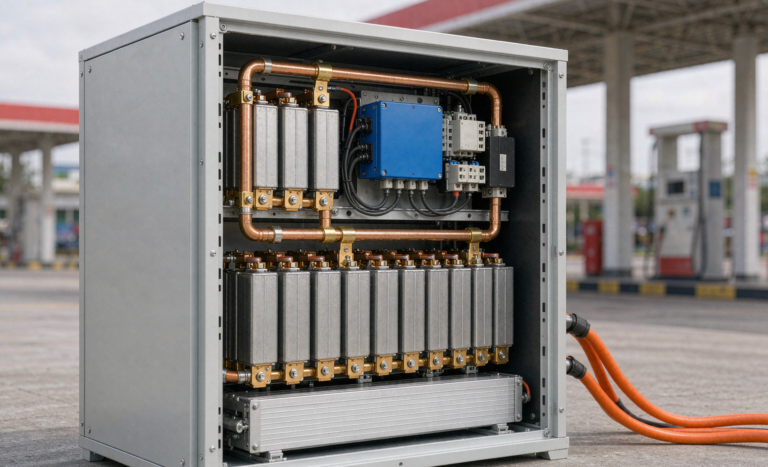
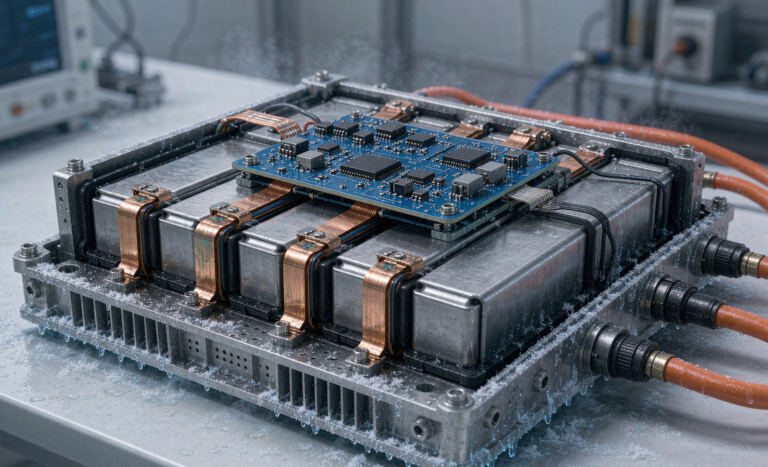
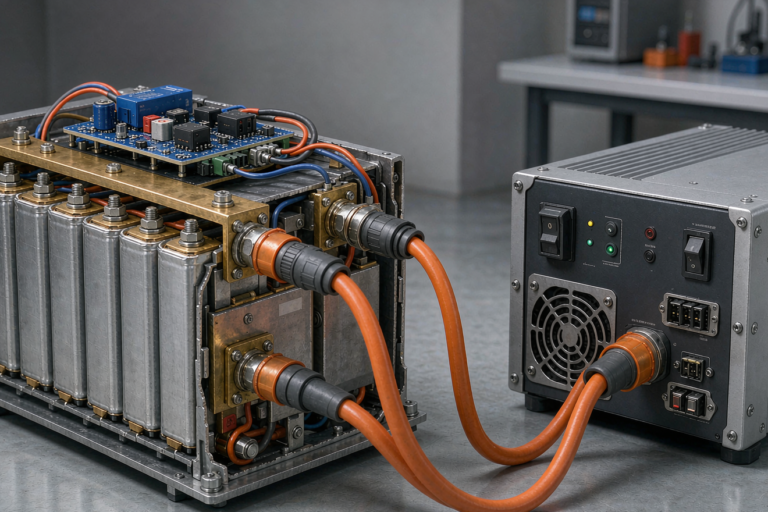
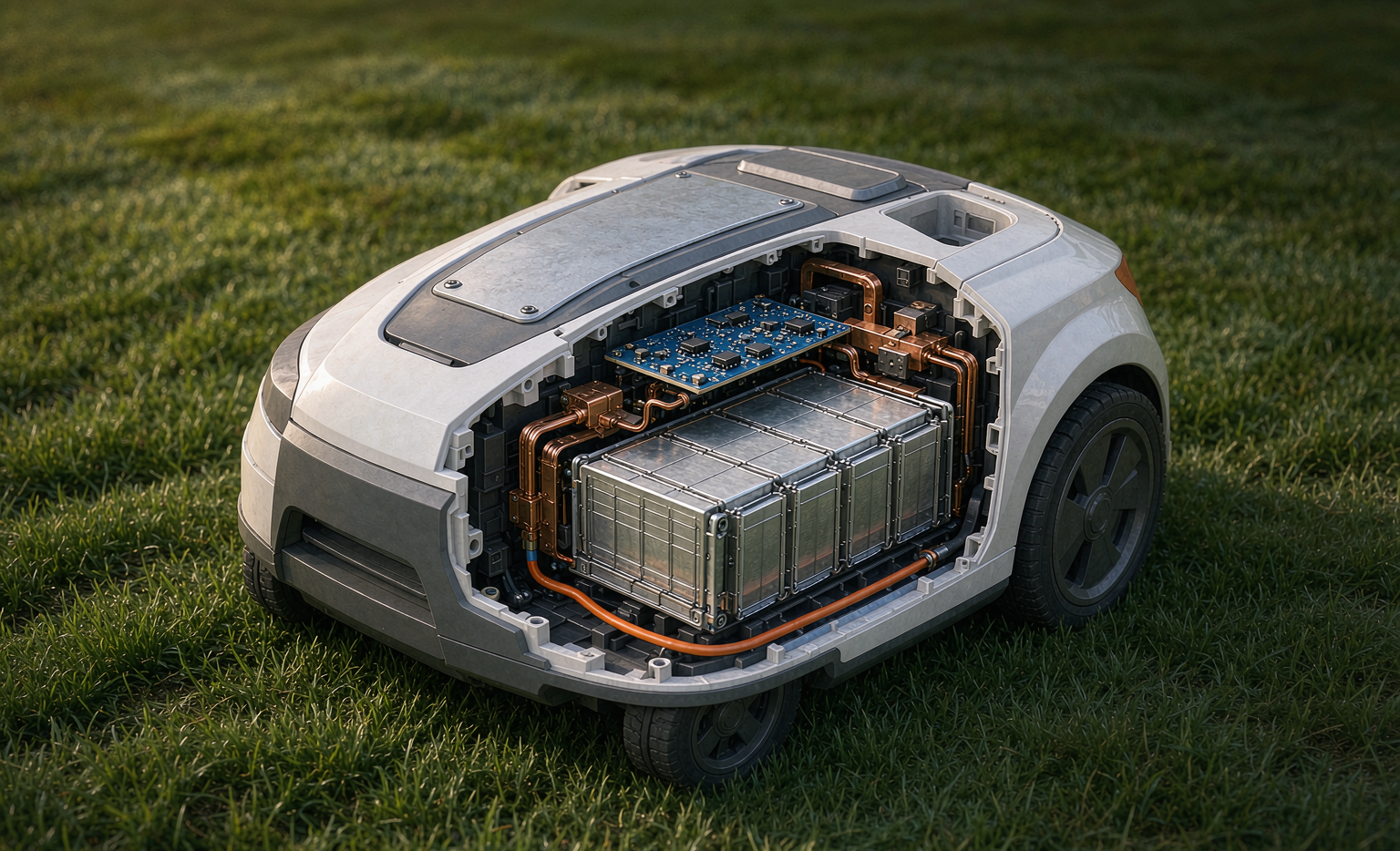
For a mid-size autonomous mower covering 0.5 to 1 hectare per day, we build the pack at a 48 volt nominal bus. Sodium-ion cells sit at about 3.1 to 3.2 volts nominal, so a 15-series string gives 46.5 to 48 volts, which matches the brushless blade motor and the 48 volt charging dock the OEM already stocks. We use prismatic cells with laser-welded nickel-coated copper busbars and a single blue battery management board mounted on the pack lid.
Capacity depends on the site. A machine that averages 250 to 450 watts while cutting, with a 300 to 600 watt blade motor, 150 to 300 watt drive, and 20 to 40 watts for navigation and compute, will draw 2 to 4.5 kilowatt-hours across an 8 to 10 hour day. We usually specify a 30 to 40 ampere-hour pack at 48 volts, which is 1.4 to 1.9 kilowatt-hours. That gives two to three dock recharge cycles per day at a 0.5 to 1C charge rate, each topping up in about 1.5 to 2 hours.
Energy density is lower than nickel chemistries but acceptable here. Sodium-ion delivers 100 to 160 watt-hours per kilogram and 250 to 320 watt-hours per liter. A mower does not care about 300 grams of extra pack mass the way a drone does, so the lower gravimetric density is not a design problem, and the volumetric figure fits the flat under-deck enclosure we already use.
Cold-Weather Charging Is the Real Advantage
This is the section I would put in bold if I could. Most mower packs are iron phosphate, and iron phosphate hates cold charging. Below about 0 degrees Celsius the cell must be warmed, or the charge current must be slashed, or lithium plates onto the anode and the pack dies young. The usual fix is a heating pad that burns 5 to 10 percent of the daily energy and a battery management system interlock that blocks charging until the cells are warm.
A sodium-ion battery for robotic lawn mowers charges without that baggage. It will take 0.2 to 0.5C at 0 degrees Celsius with no plating and no pad. In field data from northern European and North American installs, that translates to a mower that leaves the dock on time on a 4 degree Celsius April morning instead of waiting twenty minutes for its pack to warm up. For a fleet operator who pays per hectare cut, that uptime is the whole argument.
Cycle Life Under Daily Dock Recharging
Mowers do not deep discharge. A typical duty cycle is 30 to 50 percent depth of discharge between dock visits, then a partial recharge. Sodium-ion handles this well. At 25 degrees Celsius and 80 percent depth of discharge we expect 2000 to 4000 full equivalent cycles, and the shallow daily cycling we see on mowers pushes the practical life toward 4000 to 6000 equivalent cycles before the pack hits 80 percent of original capacity.
Calendar aging is the other axis. Sodium-ion loses about 1.5 to 2.5 percent of capacity per year at 25 degrees Celsius when stored around half state of charge, and that rate roughly doubles at 40 degrees. A mower base station in direct sun can hit 40 degrees inside the enclosure, so we spec a shaded, vented dock and an aluminum cooling plate bonded to the cell stack. That one design choice is the difference between a pack that lasts four seasons and one that ages out in two.
Safety, Ingress Protection and Relevant Standards
A yard robot gets wet, gets vibrated by its own wheels and blade, and sits next to a Wi-Fi and GNSS radio. The pack must be sealed and quiet electrically. We build to IP67 for the enclosure, with molded gaskets and breather vents that block water but equalize pressure, and we anchor the cell stack against the random vibration profile of IEC 60068-2-64.
On the standards side, the cells carry UN38.3 for transport at 30 percent state of charge or below, IEC 62133-2 for portable cells, and IEC 62619 for the industrial cyclic duty the mower sees. Larger packs also meet UL 1973. Electromagnetic compatibility matters because the mower’s RTK GNSS and mesh radio share the enclosure, so we design to IEC 61000-6-2 and 6-4 and keep the battery management system switching noise away from the navigation band. RoHS and REACH compliance closes the documentation set for European and North American OEMs.
The battery management system itself samples cell voltage at 200 hertz, temperature at 10 hertz, and runs passive balancing with a dock-present signal that starts the charge safely. Because sodium charges cold, we do not need the low-temperature inhibit that iron phosphate requires, which simplifies the firmware and removes a common cause of winter service calls. At end of life the pack is non-cobalt and easier to sort than mixed lithium streams, which helps the OEM meet take-back rules.
Frequently Asked Questions
Can a sodium-ion mower battery charge in freezing weather?
Yes. A sodium-ion battery for robotic lawn mowers accepts 0.2 to 0.5C charge at 0 degrees Celsius without lithium plating, while iron phosphate needs a heater or a current limit. That means the mower can leave its dock on cold mornings without waiting for the pack to warm up.
How long does a sodium-ion robotic mower battery last per charge?
On a 0.5 to 1 hectare site a 1.4 to 1.9 kilowatt-hour pack runs 8 to 10 hours of cutting, then recharges in 1.5 to 2 hours at the dock. Most machines complete two to three charge cycles per day.
Are sodium-ion mower batteries safe around children and pets?
They are safer than cobalt chemistries. Layered-oxide sodium cells show thermal runaway onset near 165 to 230 degrees Celsius, well above the 110 to 140 degrees typical of nickel manganese cobalt, and the pack is sealed to IP67. No chemistry removes all risk, but the margin is wider.
How many charge cycles will a sodium-ion mower pack deliver?
Expect 2000 to 4000 full equivalent cycles at 80 percent depth of discharge and 25 degrees Celsius, and 4000 to 6000 equivalent cycles under the shallow 30 to 50 percent daily cycling a mower actually sees before capacity falls to 80 percent.
Why choose sodium-ion over lithium iron phosphate for a mower?
Cold charging is the headline: sodium needs no heater and no low-temperature interlock. It is also cobalt-free and often 20 to 40 percent cheaper per kilowatt-hour at volume, with a wider safety margin in a residential yard.
Does sodium-ion work for large commercial grounds-care mowers?
Yes. The same 48 volt architecture scales to 24 to 56 volt commercial machines for golf courses, parks, and sports fields. The lower energy density is acceptable because mass matters less than uptime and cold-weather charging on those sites.
Further Reading
References