Battery Solution for Electric Construction Machinery
As a senior lithium battery engineer at Horizon Power, I have spent the last decade helping original equipment manufacturers replace diesel hydraulics with battery-electric drivetrains on construction sites. The shift is no longer a pilot project. City zero-emission zones, tight noise limits inside built-up areas, and a falling total cost of ownership are pushing excavators, wheel loaders, and compactors toward electrons. A credible battery solution for this segment is not a resized forklift pack. It is a ruggedized energy system engineered for shock, dust, water, and brutal peak power.
Why Construction Machinery Is Moving Off Diesel
The economics changed first. A 3.5 tonne mini-excavator burning diesel idles through most of its shift, wasting fuel while the operator maneuvers and repositions. Electric drive removes idle burn, cuts scheduled maintenance to a fraction because there is no diesel particulate filter, no exhaust aftertreatment, and no starter motor, and it drops cab noise from the low 80s dB(A) to near silent. On a residential demolition or a night shift, that silence is a permit in itself.
Regulators accelerated the move. London’s Ultra Low Emission Zone, German low-emission construction rules, and similar measures in Scandinavia and California now restrict or price diesel on urban sites. For fleets working those zones, an electric construction machinery battery is no longer optional. From a total-cost view, the crossover arrives around 1,000 to 1,500 operating hours once you include fuel, servicing, and emission-compliance paperwork. Idle-heavy duty cycles reach payback sooner. That is why we see the first volume deployments on compact machines, where battery mass is easier to absorb within the existing weight budget.
Power Profiles: What Excavators and Loaders Actually Demand
Hydraulic pumps set the battery specification, not the road speed. A small excavator’s implement pump can pull 20 to 30 kW in steady digging and spike higher during breakout. A wheel loader moving aggregates peaks at 40 to 60 kW under lift and traction combined. These are pulse loads, not a flat discharge, so the pack must sustain 3C to 5C peaks without excessive voltage sag.
We size around the duty cycle, not the nameplate. If a machine averages 18 kW over a four-hour shift but sees 50 kW pulses, the battery needs both usable energy, roughly 80 kWh for that shift, and a pulse C-rate the cells can deliver at 80 percent state of charge, not only at full charge. Cell internal resistance and busbar cross-section decide whether the pack holds voltage under load. A custom battery solution for construction almost always starts from this load profile, then validates it on the actual machine.
Two recovery opportunities are easy to miss. Excavator swing motors and loader descents can return energy to the pack through regeneration, trimming the effective energy draw by 5 to 15 percent on mixed cycles. We design the power stage to capture that, because on a battery-electric machine every recovered watt is a shorter charge later.
Cell Chemistry and Certification for Harsh Sites
For job-site energy storage, lithium iron phosphate (LiFePO4) is the default at Horizon Power. Its thermal-runaway onset sits above 270 C, versus roughly 210 C for nickel manganese cobalt, and it tolerates partial-state cycling with minimal degradation. A typical lithium battery pack built on LiFePO4 delivers 2,000 to 4,000 cycles at 80 percent depth of discharge, which matches a machine’s service interval better than consumer cells rated for shallow laptop use.
Certification is non-negotiable. Industrial packs must meet IEC 62619 for the safety of secondary lithium cells in industrial applications, and UN38.3 before they can be shipped by any mode. We also design to IEC 62477 for power-conversion safety and keep the high-voltage architecture clearly managed around the relevant limits. Specifying cells without IEC 62619 on a shared construction site is a liability I will not accept, because the pack will sit next to people, fuel, and steel all day.
Nickel manganese cobalt still earns a place where mass or volume is the binding constraint and the cooling budget is generous, but for most outdoor machinery the safety margin and cycle life of LiFePO4 win. A good battery solution explains that trade-off in numbers, not slogans, and lets the OEM choose with eyes open.
Ruggedization: IP Ratings, Vibration and Thermal Management
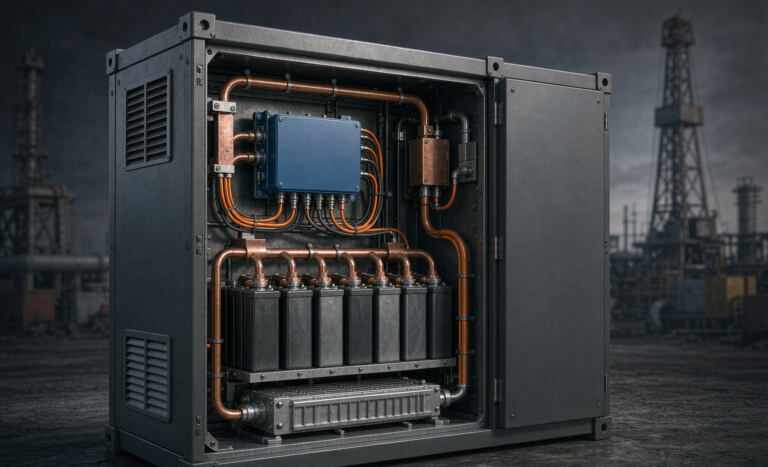
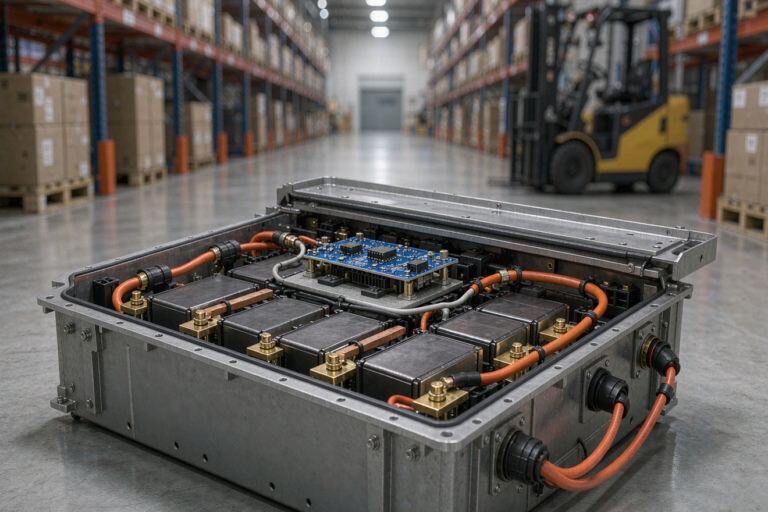
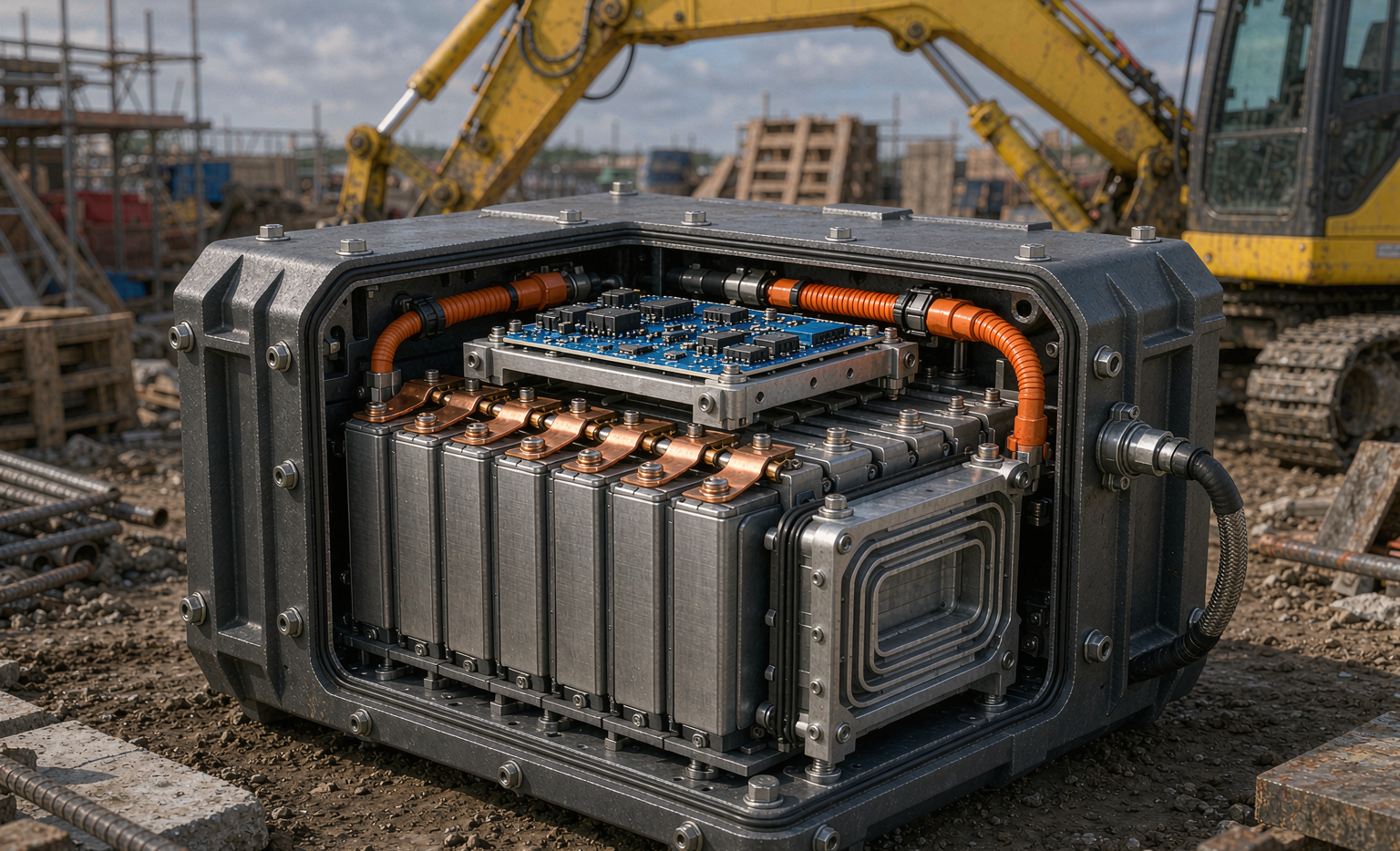
A pack on an excavator lives in mud, wash-down spray, and continuous vibration. We seal to IP67 as a floor and often IP6K9K for high-pressure cleaning, then validate against IEC 60068-2-64 random vibration and shock profiles that mimic a bouncing chassis. Busbars are bonded, not loosely screwed, and the enclosure uses a matte metal shell that will not trap labels or show false gauges under site light.
Thermal management is active liquid cooling through an aluminum plate bonded to the cell stack, holding cells in a 15 to 35 C window even when the machine works in 45 C ambient. Cold morning starts are handled by pre-conditioning the pack from grid power before the operator arrives, so the first dig is full power rather than a sluggish warm-up. Dust ingress is blocked at every connector, because a single conductive grain in a high-voltage junction is a failure mode we design out at the gasket, not the service manual.
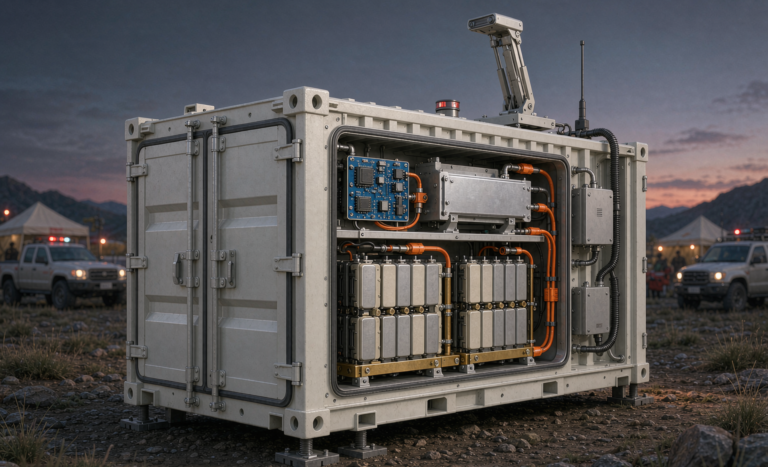
Fire containment matters on a shared site. We group cells into modules with vent paths and thermal barriers, and the battery management system isolates a faulted module instead of letting one cell drag the string down. That compartmentalization is what lets an electric machine stand safely beside a diesel fleet.
Charging Strategy: Opportunity, Fast Charge and Swap
Three charging models work, and the right one depends on the fleet. Opportunity charging tops the pack during operator breaks from a 480 V DC supply at 60 to 150 kW, keeping a smaller battery on the machine. Depot overnight charging suits machines that return to base, using a cheaper AC or moderate DC feed, and pairs well with rooftop solar at the yard. Battery swap, where a spent pack is exchanged in minutes, maximizes machine uptime but demands standardized mechanical and communication interfaces across the fleet.
Whatever the model, the charging connector and the battery management system must speak the same protocol so the pack reports temperature, state of charge, and fault codes to the charger in real time. We treat the charge port as a safety boundary, not just a power inlet, because a job site is not a clean garage. The BMS also throttles charge current when a cell drifts, protecting the pack long after the warranty card is signed.
Sizing a Pack for a Mini-Excavator
Here is a worked example we use for a 3.5 tonne electric mini-excavator. Average draw 18 kW, peak 50 kW, shift length 4 hours, with a 20 percent reserve for cold mornings and unexpected loads. Usable energy needed is about 18 multiplied by 4 multiplied by 1.2, roughly 86 kWh. At 80 percent usable depth of discharge, the nameplate is about 108 kWh.
Voltage choice: a 358 V nominal string, 112 cells in series at 3.2 V, keeps current manageable at peak. Peak current at 50 kW is about 140 A, well inside 3C of a 50 Ah cell. Cycle life targets 2,500 cycles to 80 percent capacity, which on a single-shift machine is several years of service. At pack-level energy density near 100 to 130 Wh per kilogram, that 108 kWh pack weighs roughly 600 to 800 kg, a budget the chassis can carry once the diesel tank and aftertreatment are removed. We usually split it into two 54S modules for serviceability. This is the kind of transparent calculation a custom battery solution should hand the OEM before a single cell is ordered.
What battery chemistry is best for electric construction machinery?
Lithium iron phosphate (LiFePO4) is the best default for most outdoor machinery because its thermal-runaway threshold sits above 270 C, it tolerates partial-state cycling, and it delivers 2,000 to 4,000 cycles at 80 percent depth of discharge. Nickel manganese cobalt wins only where mass or volume is the hard limit and cooling is generous. A proper battery solution weighs both against the machine’s duty cycle.
How long does a construction machinery battery last in daily use?
A well-specified LiFePO4 pack lasts about 2,000 to 4,000 cycles to 80 percent capacity. On a single-shift excavator that is several years of normal service. Life depends most on depth of discharge, sustained temperature, and whether the battery management system balances cells, so the same chemistry can last very differently between two fleets.
Can electric excavators work in cold weather?
Yes. The pack is pre-conditioned from grid power before the shift so cells enter the 15 to 35 C working window, and liquid cooling holds that window through the day. Without pre-conditioning, cold cells lose peak power and charge acceptance, which is why we treat warm-up as a planned step, not an afterthought.
How are construction batteries charged on a job site?
Most fleets use opportunity charging from a 480 V DC supply during breaks, depot overnight charging at base, or battery swap for maximum uptime. The charger and battery management system share a protocol so temperature and state of charge are reported continuously, and the charge port is treated as a safety boundary rather than a simple power inlet.
Are lithium battery packs for machinery safe around diesel equipment?
They are, when built to industrial standards. IP67 or IP6K9K sealing, IEC 60068 vibration validation, compartmentalized modules with vent paths, and a battery management system that isolates a faulted module let an electric machine stand safely beside diesel plant. IEC 62619 and UN38.3 compliance are the floor we design from.
What certifications does a construction battery solution need?
At minimum, IEC 62619 for industrial lithium-cell safety and UN38.3 for transport, with IEC 62477 covering power-conversion safety. Region-specific marks and on-site electrical rules also apply, so the certification list should be agreed with the OEM before volume production rather than discovered during inspection.
Further Reading
References