Semi-Solid State Battery Electrode Slurry Mixing and Dispersion
When engineers talk about semi-solid state batteries, most of the attention goes to energy density numbers and the promise of safer chemistry. In my work as a Senior lithium battery Engineer at Horizon Power, I have found that the real differentiator often sits one step earlier, in how the electrode slurry is mixed and dispersed. A semi-solid electrode is not a dry powder and it is not a conventional solvent-borne coating either. It is a thick, flowable composite where active particles, conductive additive, and a liquid or gel electrolyte are blended into a thixotropic mass. Get the mixing wrong and you lose capacity, raise impedance, and create defects that no amount of cell formatting will fix. Get it right and you build a conductive network that supports high loading, fast ion transport, and a long cycle life.
What Sets a Semi-Solid Electrode Slurry Apart
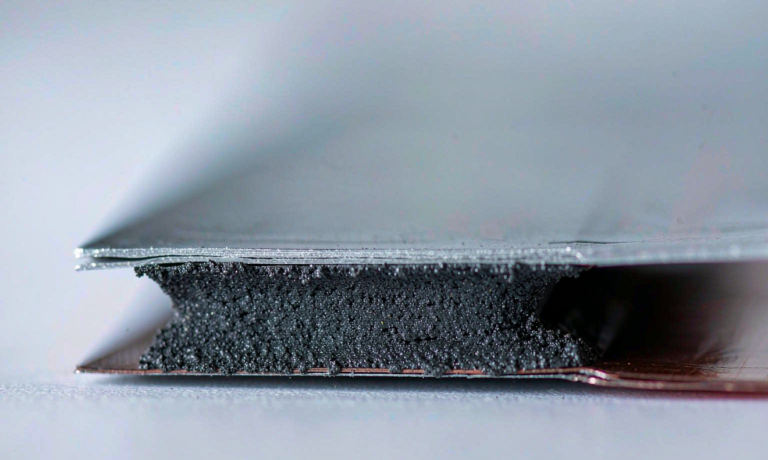
A conventional lithium-ion electrode is coated from a slurry where active material, conductive carbon, and binder are suspended in a volatile solvent such as NMP at roughly 40 to 60 percent solids. A semi-solid electrode pushes solids loading much higher, typically 60 to 80 weight percent, and it intentionally keeps a meaningful fraction of liquid electrolyte inside the wet film. The result is a paste-like composite with viscosity in the range of 10^3 to 10^5 centipoise that flows under shear but holds its shape when at rest. That thixotropic behavior is the whole point. It lets us deposit thick electrodes, often 80 to 250 micrometers after drying, which is what drives the leap in areal capacity and cell-level energy density toward 270 to 340 watt-hours per kilogram. The cost is that every particle must be wetted and dispersed, because there is no extra solvent to hide poor mixing.
The Mixing Sequence and the Hardware Behind It
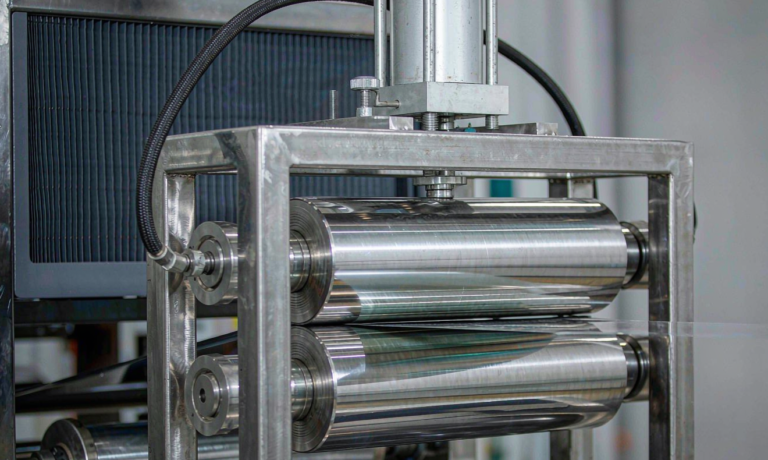
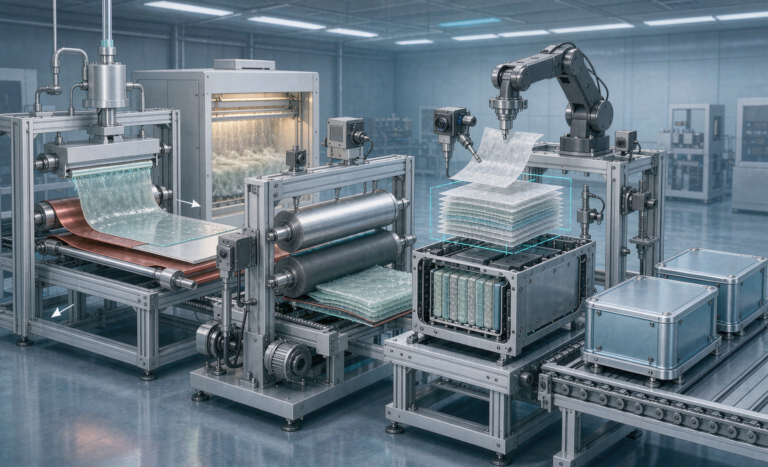
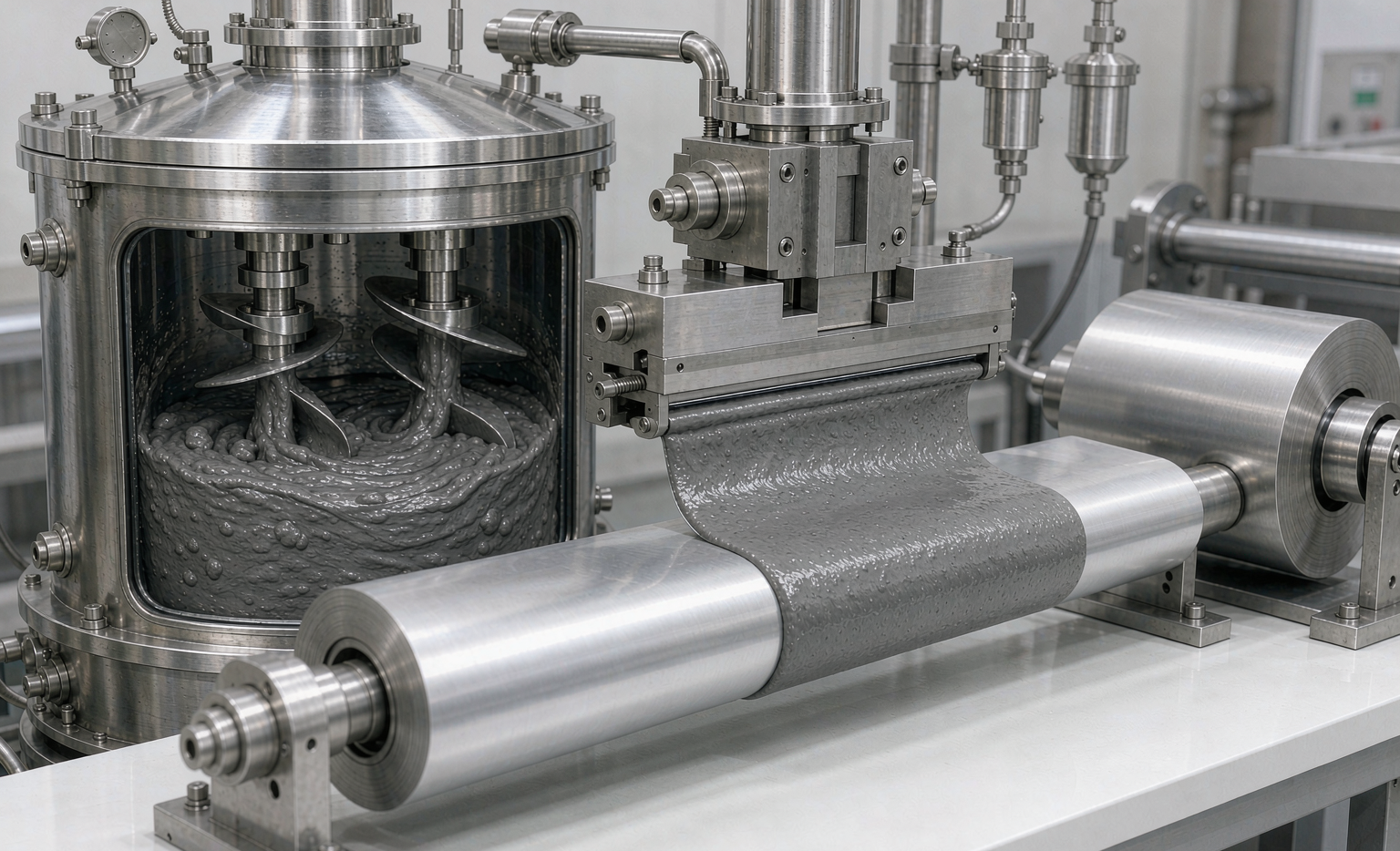
We do not dump everything into one tank. The sequence starts with a low-speed premix that just combines powders and liquid into a homogeneous feed without generating heat. Premix deserves more respect than it gets. If the powder is added too fast or wetted unevenly, you form dry lumps that high-shear mixing can take hours to erase, and by then you have already overheated the batch. We add liquid incrementally and let the binder pre-swell, which lowers the energy needed later. From there the batch moves to a high-shear disperser, most often a dual-shaft design with an anchor sweep and a high-speed dissolver disc running at tip speeds of 15 to 30 meters per second. The dissolver breaks agglomerates; the anchor keeps the bulk moving so nothing settles. For higher volume we shift to a co-rotating twin-screw extruder, which gives continuous, repeatable dispersion and far tighter residence-time control than a batch kettle.
Deagglomeration itself is a balance of hydrodynamic stress and time. Too little and the carbon network stays clumped; too much and you generate heat that accelerates solvent or electrolyte loss. In practice we tune the disperser speed against batch temperature and stop the moment the torque curve flattens, which is a more reliable endpoint than a fixed timer. The cardinal rule is to deagglomerate the conductive network and the active particles without fracturing the particles themselves. Over-shear is a real failure mode. It can cut carbon nanotubes short, widen the particle size distribution, and actually reduce conductivity rather than improve it.
How We Measure Dispersion Quality
Mixing is only as good as our ability to measure it. Off-line we run laser diffraction to track the agglomerate size distribution, targeting a D90 below 15 to 25 micrometers with no isolated clumps above 50 micrometers. In-line we watch mixing torque and rheology, because a well-dispersed paste shows a predictable shear-thinning curve and a stable yield stress. We also check the percolation of the conductive network: below a certain carbon loading the electrode is electrically dead, and above it the gains flatten, so we tune to the knee of that curve. Porosity and void fraction matter too, since a semi-solid electrode relies on connected pathways for both electrons and ions. A coating that looks smooth to the eye can still hide micrometer-scale voids that become local hot spots during fast charge, and those voids almost always trace back to a mixing step that was stopped too early.
Rheology, Coating, and the Defects We Fight
After dispersion the slurry goes to slot-die coating, and rheology decides whether that step succeeds. We need a material with a defined yield stress so it does not sag, strong shear thinning so it lays down cleanly at line speed, and a recovery time slow enough to avoid ribbing. Wet films land in the 100 to 300 micrometer range and are dried in zones from 80 to 130 degrees Celsius. The danger is skinning: if the surface dries before the bulk, solvent or electrolyte is trapped and the electrode blisters. We also fight comet defects, streaks, and edge bead, all of which trace back to viscosity transients that began in the mixer. A stable, well-dispersed paste is the cheapest insurance against a scrap-heavy coating line, and for a solid-state battery program where material cost is high, scrap control is directly a cost control.
Why Mixing Shows Up in Cell Performance
I tell our customers that dispersion quality is invisible until it is not. Poor mixing leaves isolated active particles that never contribute capacity, raises tortuosity so ions take a longer path, and pushes cell impedance up by double digits. Good mixing lowers internal resistance, lifts rate capability, and protects cycle life. In our testing a well-dispersed semi-solid cell holds the 270 to 340 Wh/kg class while still targeting 2000 to 4000 cycles, versus roughly 240 to 280 Wh/kg for an NMC 811 cell and 150 to 180 for LFP, with the semi-solid edge coming as much from electrode engineering as from chemistry. When a cell underperforms in the lab, the root cause is frequently a coating or mixing variable, not the active material itself, which is why we invest as much in the mixer as in the formulation.
Scaling from the Lab to the Production Line
A lab formula and a line-ready process are not the same thing. In the lab a few hundred grams of paste can be mixed by hand in a planetary mixer, but production demands throughput, consistency, and traceability. We bridge that gap with a staged scale-up: small planetary batches to set the formulation, then a pilot dual-shaft disperser to lock the shear profile, then a co-rotating twin-screw line for volume. The twin-screw is attractive because residence time is seconds rather than minutes, so heat input is lower and batch-to-batch variation shrinks. The trade-off is that screw geometry, fill ratio, and throughput become first-order variables you must characterize, not just the recipe. For a lithium battery maker moving into semi-solid, this scale-up discipline is usually the longest pole in the schedule, longer than the chemistry work itself, and it is where most yield losses are won or lost.
Controls, Contamination, and Standards
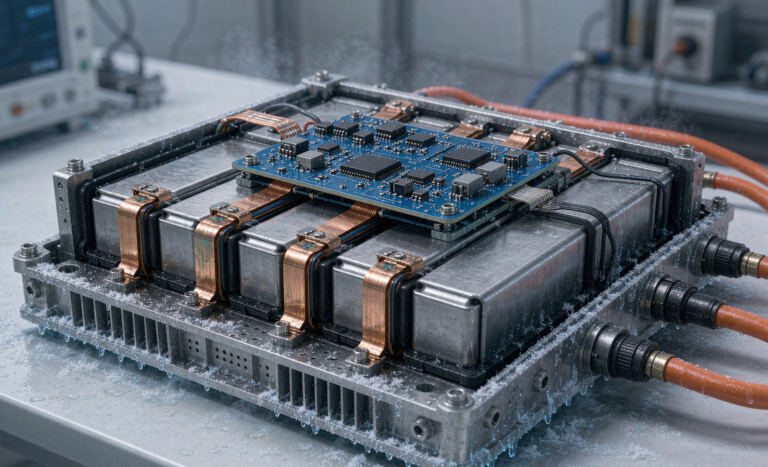
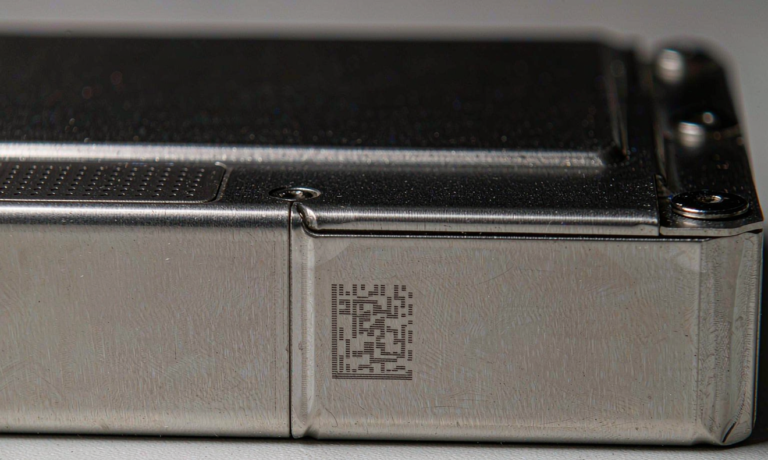
Because the slurry is sensitive, the process is wrapped in controls. We run in-line metrology on every batch, sample for particle size and rheology, and hold moisture to a tight dew point so the electrolyte component is not compromised. On the compliance side, finished cells ship under UN38.3 transport rules, and the designs follow IEC 62133 for portable safety and IEC 62619 for stationary and industrial use, on top of an ISO 9001 process framework. For a custom battery solution this discipline is what lets us move from a lab formula to a repeatable battery pack design without surprises at the battery management system level, where inconsistent impedance would otherwise trip protection thresholds and confuse fleet diagnostics.
Frequently Asked Questions
What solids loading is typical for semi-solid electrodes?
Most semi-solid electrode slurries run between 60 and 80 weight percent solids. The upper end is what enables thick, high-areal-capacity coatings, but it also demands stronger dispersion because there is less liquid to keep particles apart during mixing.
How is dispersion quality measured in production?
We combine off-line laser diffraction for agglomerate size with in-line torque and rheology monitoring. The aim is a D90 under 15 to 25 micrometers, a stable shear-thinning curve, and a conductive network tuned to its percolation knee.
Does semi-solid slurry mixing differ from conventional lithium-ion?
Yes. Conventional lithium battery slurry is thinner and solvent-rich, around 40 to 60 percent solids, and tolerates rougher mixing. Semi-solid paste is far thicker and more sensitive to both under-shear and over-shear, so it needs higher-solids dispersion hardware and tighter rheology control.
What coating method is used after mixing?
Slot-die coating is the standard. The thixotropic paste is laid down at 100 to 300 micrometer wet thickness and dried in staged zones up to 130 degrees Celsius, with careful control to avoid surface skinning and trapped solvent.
How does mixing affect battery cycle life?
Better dispersion lowers tortuosity and internal resistance, which reduces heat and lithium plating risk during charge. That protection is a major reason well-mixed semi-solid cells can target 2000 to 4000 cycles rather than degrading early in service. The same network that helps cycle life also enables faster charging, because lower tortuosity shortens the ion path during a high-rate fill, which is one of the reasons semi-solid is attractive for applications that were previously the domain of lithium battery packs with aggressive thermal management.
Can semi-solid slurry be processed on existing Li-ion lines?
Often yes, with upgrades. The coating and drying hardware is similar, but the higher solids content and thixotropy usually require stronger dispersion mixers, revised rheology windows, and tighter moisture control to avoid scrap and keep yield acceptable.
Further Reading
References