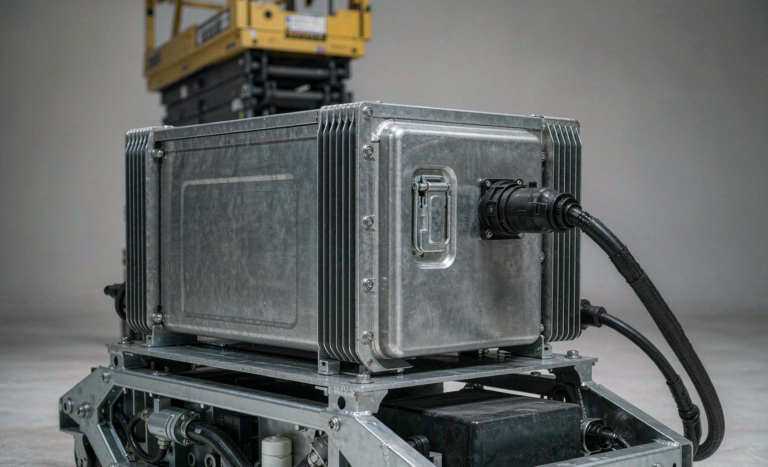
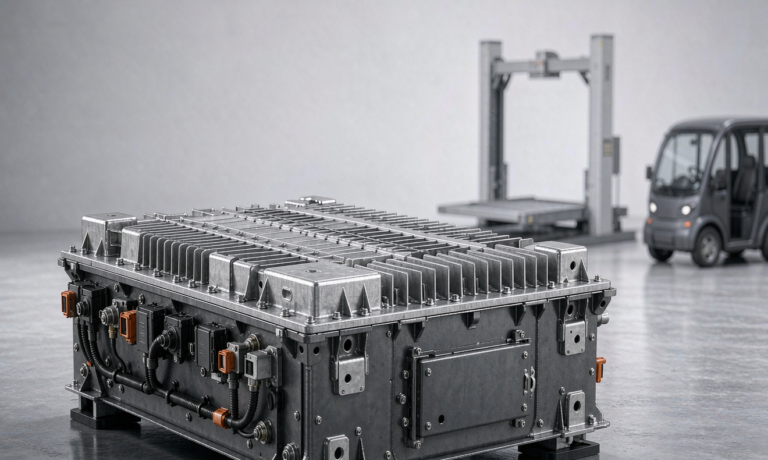
Sodium-Ion Battery for AGV and Automated Guided Vehicles
Automated guided vehicles live or die by battery economics. After twenty years of designing lithium packs for warehouse fleets, I have learned that the best AGV is useless if its pack cannot survive five thousand partial cycles, tolerate opportunity charging, and stay safe inside a building full of people and inventory. At Horizon Power we now evaluate sodium-ion battery for AGV platforms as a serious option for high-cycle, cost-sensitive intralogistics. The chemistry trades some gravimetric energy density for calendar life, abuse tolerance, and freedom from cobalt and nickel supply swings. In this article I will explain how to size, integrate, and qualify a sodium battery for automated guided vehicles.
Why AGV Fleets Need a Different Battery Economics
An AGV is not a car. A typical unit runs fifteen to twenty hours a day, stops every few minutes at pick stations, and expects a ten-minute opportunity charge during a shift change. That pattern is brutal on conventional lithium-ion cells because it combines shallow cycling, high-frequency partial-state-of-charge operation, and thermal transients. As a senior lithium battery engineer I have seen NMC packs designed for one thousand full-equivalent cycles degrade to eighty percent capacity after only eighteen months in three-shift distribution centers.
The total cost of ownership for an AGV battery is dominated by replacement downtime and labor, not the invoice price. Swapping a pack inside a vehicle often means removing the load deck, reprogramming the battery management system, and recalibrating the fleet scheduler. A chemistry that doubles replacement interval can cut the real cost per moved pallet significantly. That is where a sodium-ion battery becomes attractive. Sodium-ion cells use abundant raw materials, cost less per kilowatt-hour at scale, and tolerate deep daily cycling better than energy-density-optimized lithium cells.
How Sodium-Ion Chemistry Matches AGV Duty Cycles
Modern sodium-ion cells for industrial use deliver one hundred and twenty to one hundred and sixty watt-hours per kilogram. That is lower than nickel-manganese-cobalt but comparable to lithium iron phosphate in the same form factor. For an AGV moving pallets at walking speed on a flat warehouse floor, weight is rarely the limiting factor; aisle width, turning radius, and mast height are. The battery volume that fits under the deck is usually enough for a full shift even with sodium-ion energy density.
Cycle life is where sodium-ion shines for AGV duty. Test data from prismatic sodium-ion cells cycled between twenty and eighty percent state of charge routinely exceed four thousand cycles before reaching eighty percent of initial capacity. Some hard-carbon anode designs reach six thousand cycles at twenty-five degrees Celsius. That maps to six to eight years of continuous warehouse operation, far longer than most AGV mechanical refresh cycles.
Sodium-ion also handles partial-state-of-charge operation without the accelerated aging that plagues graphite anodes in lithium-ion systems. A sodium battery can opportunity charge for five minutes at a staging lane, absorb a few percent of energy, and continue without memory-effect penalties. This fits the intermittent charging pattern of natural AGV workflows.
Safety Advantages in Indoor Intralogistics
The single most important specification for any indoor battery is what happens when something goes wrong. Sodium-ion chemistry runs at a lower voltage than NMC, around three point one volts nominal per cell, and the thermal runaway onset temperature is higher. In abuse testing the heat released during a short circuit is typically a fraction of what a cobalt-rich cell releases. That is a meaningful advantage when the pack lives under a plastic body in an aisle shared with human pickers.
From a certification standpoint, a sodium-ion battery for AGV should meet IEC 62619 for industrial secondary cells, IEC 62133 for portable and light traction use, UN38.3 for transport, and IEC 62620 for marking and naming. If the vehicle is classified as a light industrial truck, referencing ISO 3691 safety standards and UL 2580 test methods during qualification gives end users confidence. Horizon Power validates every sodium-ion pack with nail penetration, overcharge, external short, and crush tests in a third-party lab before releasing it for fleet trials.
Sizing Voltage Platforms and Energy for AGV Fleets
Most warehouse AGVs use twenty-four volt or forty-eight volt nominal buses. A twenty-four volt sodium-ion pack is usually eight cells in series, giving a nominal voltage of about twenty-four point eight volts. A forty-eight volt pack is sixteen cells in series. The pack voltage window is roughly twenty-one to thirty volts for the twenty-four volt system and forty-two to sixty volts for the forty-eight volt system, which is close enough to existing motor drives that retrofits are straightforward.
Energy sizing starts with the route simulation. A small tugger moving two hundred kilograms per trip at one point five meters per second may draw two to four ampere-hours per kilometer. A larger unit with a lift deck can draw eight to fifteen ampere-hours per kilometer. I always add a twenty percent margin for winter capacity loss and another fifteen percent for end-of-life fade. A typical one-ton AGV in ambient warehouse conditions ends up with a forty-eight volt, fifty to one hundred ampere-hour sodium-ion battery pack.
Peak power matters during acceleration and lifting. AGV motor controllers often request two to three times continuous power for a few seconds. A sodium-ion battery can deliver one to two C continuous and three to four C pulse, so a one hundred ampere-hour pack can support two hundred to four hundred amperes briefly without voltage collapse.
Thermal Management and Operating Environments
Unlike passenger EVs, most AGVs never see highway speeds or aerodynamic cooling. They operate in warehouses at five to thirty-five degrees Celsius, sometimes in refrigerated areas near zero degrees Celsius. Sodium-ion performs well across that range. At sub-zero temperatures it retains more discharge capacity than conventional lithium-ion cells because the hard-carbon anode does not suffer from lithium plating during charge.
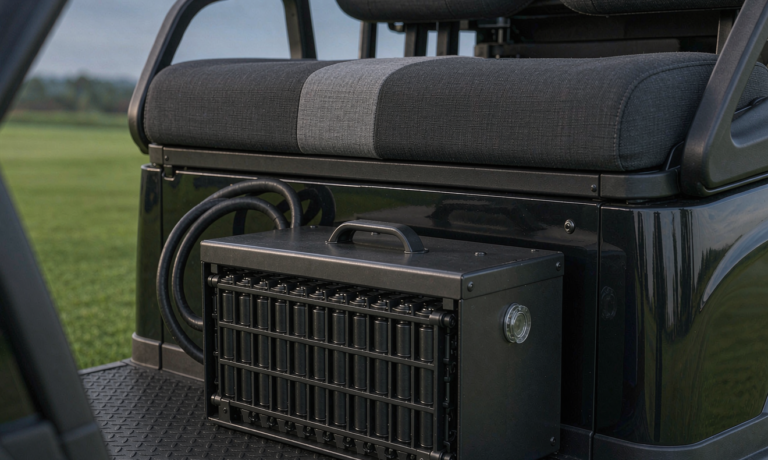
A simple passive aluminum tray with thermal pads is usually enough for indoor AGVs. Active liquid cooling is overkill unless the vehicle runs continuous high-speed sprints in a tropical facility. I specify a battery management system temperature guard band of minus twenty degrees Celsius to plus fifty-five degrees Celsius and derate charge current below five degrees Celsius. This keeps the sodium-ion battery inside its comfort zone and avoids warranty disputes.
Integration, BMS, and Fleet Charging Infrastructure
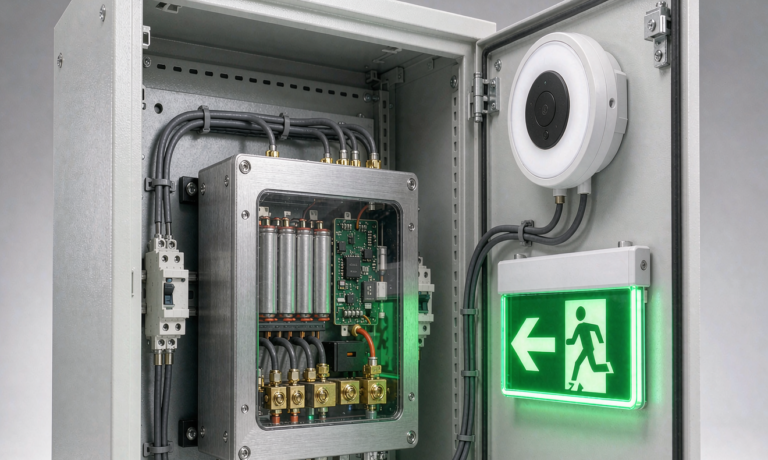
The battery management system is the real product. A sodium-ion pack for AGV needs cell balancing, state-of-charge estimation calibrated to sodium voltage curves, and CAN bus or RS-485 communication to the vehicle controller. The state-of-charge curve of sodium-ion is flatter than lithium iron phosphate, so coulomb counting plus voltage correction works better than simple lookup tables. I also recommend SOC synchronization at every full charge opportunity to prevent drift.
Charging infrastructure is where fleets often underestimate cost. A sodium-ion battery can charge at one C for the bulk stage and taper at ninety percent state of charge. For a one hundred ampere-hour pack that means a fifty ampere charger can refill half the pack in one hour. Opportunity chargers at staging lanes can be smaller because the chemistry does not mind frequent shallow top-ups. The charger profile should follow the cell manufacturer recommendation; most sodium-ion cells prefer a constant-current constant-voltage regime with a cutoff around three point seven volts per cell.
Procurement Checklist for AGV Battery Buyers
When Horizon Power engineers review a sodium-ion battery for AGV specification, we ask for cycle-life data at the actual depth of discharge and temperature of the deployment. We confirm the pack has third-party reports for UN38.3, IEC 62619, and IEC 62133. We verify the BMS supports the vehicle communication protocol and that the warranty covers cycle count, not just years. We also demand a sample production run for fleet validation before committing to a purchase order, because sodium-ion supply chains are maturing and cell-to-cell consistency must be proven.
Frequently Asked Questions
What is the main advantage of a sodium-ion battery for AGV fleets?
The main advantage is cycle life combined with cost stability. A sodium-ion battery can deliver four thousand to six thousand cycles in partial-state-of-charge service, which extends replacement intervals and lowers total cost of ownership in high-utilization warehouses.
How many cycles can a sodium-ion battery deliver in an AGV?
Under typical AGV duty, with daily shallow cycling and controlled temperature, a well-designed sodium-ion pack can reach four thousand to six thousand cycles before falling to eighty percent of initial capacity.
Is a sodium-ion battery safe to use inside a warehouse?
Yes, when qualified to IEC 62619, IEC 62133, and UN38.3. Sodium-ion chemistry has a higher thermal runaway onset temperature and releases less heat during abuse than cobalt-based lithium cells, making it well suited to indoor intralogistics.
What voltage should I specify for an AGV battery?
Most warehouse AGVs use twenty-four volt or forty-eight volt nominal systems. An eight-cell sodium-ion string gives about twenty-four volts nominal and a sixteen-cell string gives about forty-eight volts nominal, matching common motor controllers.
Can sodium-ion AGV batteries fast charge during short breaks?
Yes. Sodium-ion tolerates frequent one C opportunity charging and partial-state-of-charge operation without the accelerated aging seen in some lithium-ion chemistries, making it ideal for staging-lane top-ups between missions.
Which standards should an AGV sodium-ion battery meet?
The pack should meet IEC 62619 for industrial secondary cells, IEC 62133 for safety testing, UN38.3 for transport, and IEC 62620 for marking. Light-industrial truck applications may also reference ISO 3691 and UL 2580 test methods.
Further Reading
References