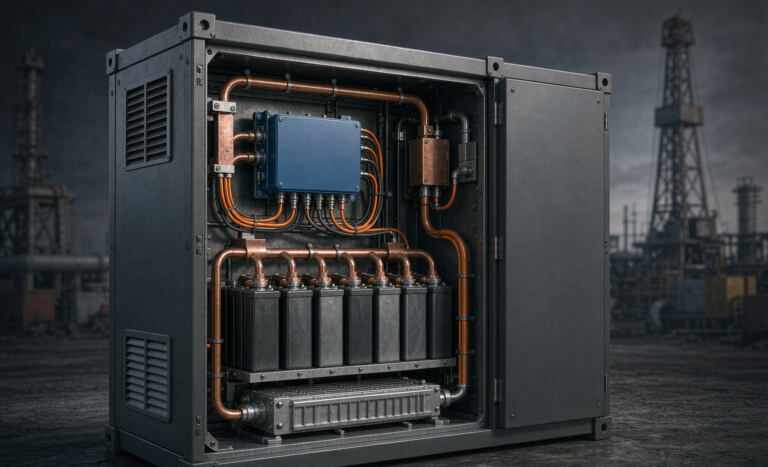
Reach Stacker Battery Solution for Container Yards
A reach stacker can lift a 45-tonne container onto the third row, and every one of those lifts starts with a violent current spike. After helping several container yards move from diesel to lithium, I have learned that a reach stacker battery is not a scaled-up forklift pack. It is a high-power, high-cycle, high-vibration problem that must be solved with measured duty cycle data, the right cell chemistry, and certification that satisfies both transport and industrial safety rules. In this guide I walk through how we specify a reach stacker battery solution for container yards, from energy demand and pack sizing to charging strategy and compliance.
Why Container Yards Are Electrifying Reach Stackers
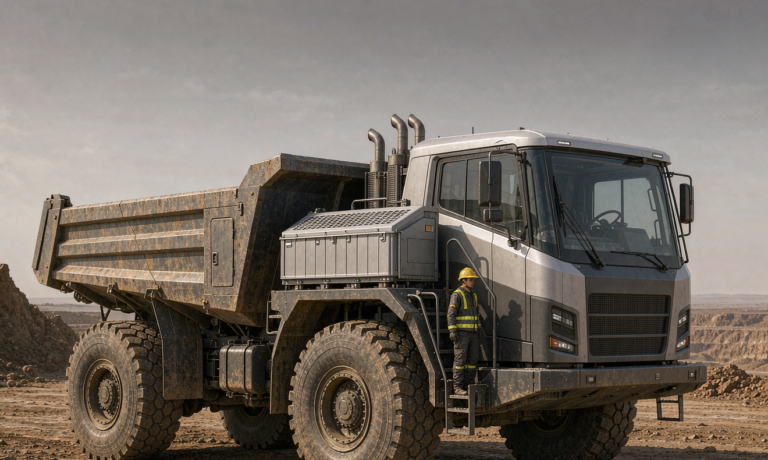
Ports and inland depots face tightening emissions and noise rules, and diesel reach stackers are an obvious target because they idle heavily and burn fuel all shift. Electrifying them removes local exhaust emissions, cuts noise below the level that disturbs nearby housing, and reduces scheduled maintenance because there is no torque converter, no transmission fluid, and far fewer wear parts.
The catch is power. Lifting motion is intermittent but brutal. When the boom raises a loaded spreader, the electric drivetrain can pull 100 to 200 kW from the pack for several seconds, then drop to near zero during travel and idle. That stop-start profile is why energy capacity alone is a poor way to describe a reach stacker battery. The pack must deliver high peak current without excessive voltage sag, absorb regenerative energy on every lowering move, and survive tens of thousands of full-height lifts over its life.
Duty Cycle and Energy Demand in Container Yards
Before choosing cells, we instrument the machine, logging current, voltage, hydraulic pressure, lift count, travel distance, and idle time for at least two full shifts. In our measurements, a busy reach stacker performs 20 to 30 container moves per hour, and each loaded lift costs roughly 0.4 to 0.9 kWh depending on container weight and stacking height. Unloaded travel and waiting add another 15 to 30 percent on top of the lifting energy.
That data usually lands a single-shift reach stacker in a daily energy band of 90 to 180 kWh, and a two-shift machine in a band of 180 to 320 kWh. Regenerative lowering gives some of that back. On a typical lift-and-place cycle we recover 15 to 25 percent of the energy that went into lifting, which is enough to matter over a week but never enough to eliminate charging.
The duty cycle also sets the peak power requirement. If a 150 kW hoist and a 60 kW traction drive run together, the pack must supply close to 200 kW at low state of charge, at the end of a shift, in summer heat. A pack rated only for continuous 1C will sag and overheat. We size for peak power at minimum state of charge, not at a comfortable 60 percent.
Sizing a Reach Stacker Battery Pack
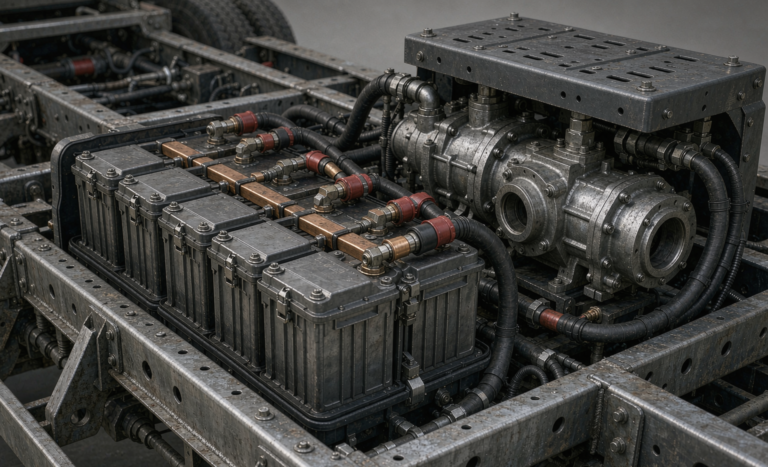
Container handling machines generally run at higher voltage than forklifts. We work in the 350 to 400 V DC class for medium machines and 700 to 800 V DC for heavy reach stackers, because doubling voltage halves the current for the same power and keeps cable and connector sizes practical. A 700 V platform pushing 200 kW draws about 285 A, manageable with standard high-current connectors and busbars.
Capacity follows duty cycle rather than habit. For a single-shift machine with a 30-minute opportunity charge, we typically specify 60 to 120 kWh. For a two-shift machine, we specify 150 to 250 kWh or, more often, a smaller pack paired with a swap or fast charge routine. It is usually cheaper to buy less energy and charge more often than to haul a huge pack that sits at 90 percent state of charge all day.
Cycle life matters as much as capacity. Lithium iron phosphate cells routinely deliver 3000 to 6000 cycles to 80 percent depth of discharge, while nickel-rich NMC cells land nearer 2000 to 3500 cycles under the same duty. A yard running two shifts can accumulate 600 to 900 equivalent cycles a year, so the chemistry choice decides whether the pack lasts five years or a decade. We always model total cost of ownership across the expected service life, including the cost of the second pack if a short-life chemistry is chosen.
Cell Chemistry and Thermal Management
For most container yards we start with lithium iron phosphate prismatic cells. They tolerate deep discharge, resist thermal runaway better than nickel-rich chemistries, hold up under high current, and cost less per usable kilowatt hour. Where a machine must work in very cold climates and space is tight, we may move to an NMC pack to gain energy density and cold performance, but that choice comes with stricter thermal design and usually a shorter life.
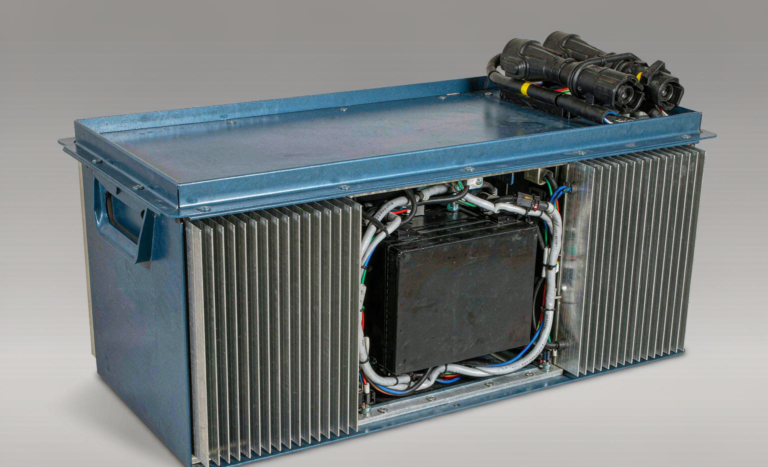
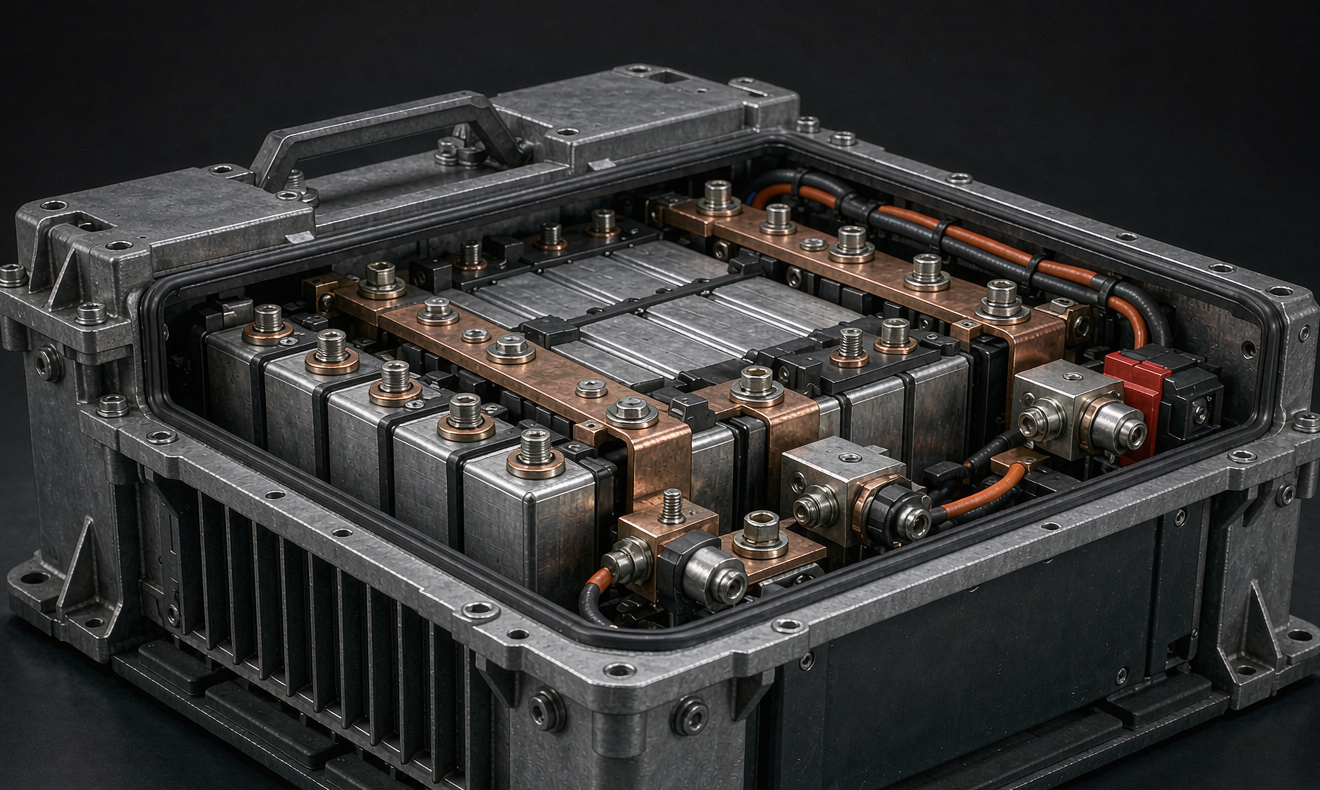
Thermal management is not optional in this application. Lifting current heats the cells quickly, and a hot pack loses power exactly when the machine needs it. We use liquid cold plates with thermal interface pads in the 3 to 6 W/mK range, keep cell-to-cell temperature spread under 5 degrees Celsius, and target a coolant inlet temperature that holds cells between 20 and 40 degrees Celsius in normal duty. Temperature spread is the number that quietly kills packs, because the hottest cell ages fastest and drags the whole string with it.
We also design for propagation. A single cell that goes into thermal runaway must not take its neighbours with it. Barrier materials between modules, vents that direct gas away from the operator, and an enclosure that survives internal pressure all matter. Container yards are often near the sea, so we specify IP67 sealing minimum, IP6K9K where washdown is frequent, and corrosion-treated hardware throughout.
Charging, Swapping, and Uptime Strategy
Uptime is the constraint that shapes everything. A reach stacker that is plugged in is not moving containers. We plan charging around the work pattern, not around the battery. Opportunity charging during breaks and truck queues keeps a single-shift machine going without a mid-shift stop, as long as the charger delivers enough power to replace a meaningful share of energy in 20 to 30 minutes.
For two-shift and three-shift operations we usually recommend battery swapping. A well-designed swap takes five to ten minutes and lets the machine run around the clock while spare packs charge on a slower, gentler profile off the critical path. Depot charging at 60 to 150 kW suits overnight and longer breaks, while fast charging at 150 to 350 kW supports short turnaround, at the cost of more heat and slightly faster degradation. We treat fast charging as a tool, not the default.
Safety, Certification, and Compliance
Industrial battery packs travel, so transport rules come first. Every pack we ship is tested to UN38.3, with the test summary available on request, and cell-level safety is covered by IEC 62133 or the equivalent. For industrial applications, IEC 62619 is the standard that matters most, because it addresses the large-format cells and battery management functions used in machines, including overcharge, over-discharge, and thermal propagation requirements.
On the machine side, we align with UL 2580 for electric vehicle traction packs and ECE R100.2 where a road-registered variant is involved. Functional safety of the battery management system follows IEC 61508 principles, with redundant voltage and temperature sensing, contactor weld detection, insulation monitoring, and a manual service disconnect that a technician can reach without tools. High-voltage interlock loops shut the pack down the moment an enclosure is opened.
For yards inside the European Union, the machine must also carry CE marking, and we provide the technical file that supports it. In practice, certification is where cheap packs fail: a cell datasheet is not a pack certificate, and a pack certificate from another application does not transfer to a different duty cycle. We test the pack as installed, with the real load profile, and document it.
Integration and Customization
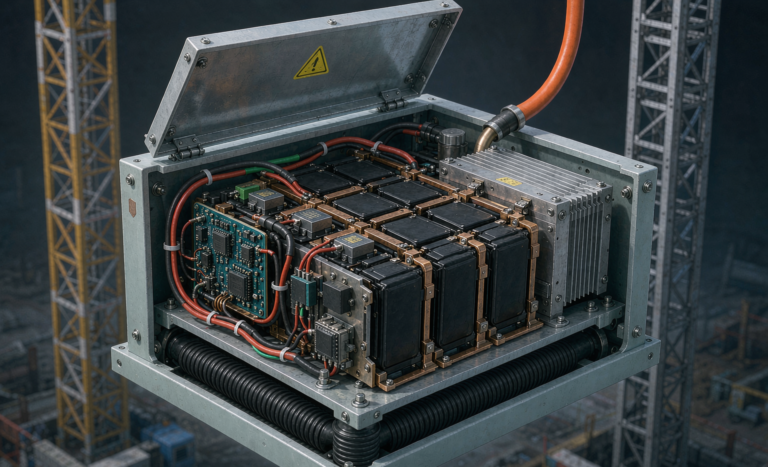
Every container yard has an existing fleet, and no two machine controllers speak exactly the same language. Our battery management systems support CANopen, SAE J1939, and Modbus, so the pack can report state of charge, state of health, cell voltages, temperatures, and fault codes into the machine or the terminal operating system. That data is what turns a battery from a black box into a managed asset, because maintenance teams can plan a pack replacement instead of reacting to a failure mid-shift.
This is where a custom battery solution earns its place. Voltage, capacity, enclosure shape, connector type, coolant routing, and communication protocol are all adjustable within the limits of safety and certification. We start from a proven platform and change only what the machine needs, because every change adds validation work. The goal is a pack the operator never has to think about.
How long does a reach stacker battery last on a single charge?
It depends on the duty cycle, not nominal capacity alone. A 90 kWh pack on a single-shift machine doing 20 to 25 moves per hour usually covers 6 to 8 hours with one short opportunity charge. Two-shift machines normally use a larger pack or a battery swap instead of stretching a single charge.
What voltage and capacity should a reach stacker battery have?
Medium machines commonly use 350 to 400 V DC, while heavy reach stackers run at 700 to 800 V DC to keep currents and cable sizes reasonable. Capacity typically ranges from 60 to 120 kWh for single-shift and 150 to 250 kWh for two-shift duty, always sized for peak power at low state of charge rather than average load.
Is LFP or NMC better for reach stacker batteries?
For most container yards, lithium iron phosphate is the better first choice because of its longer cycle life, stronger abuse tolerance, and lower cost per usable kilowatt hour. NMC makes sense only where cold performance and energy density are critical and the thermal design can handle the extra load. Weigh total cost of ownership over the full service life before deciding.
How fast can a reach stacker battery charge?
A modern liquid-cooled pack can accept 1C to 2C continuous charging, which means a 100 kWh pack can take roughly 100 to 200 kW. We reserve that rate for short-turnaround situations because heat and cycle cost rise with current. For regular overnight and break charging, a gentler 0.3C to 0.5C profile protects cycle life and keeps the site load manageable.
What certifications does a reach stacker battery need?
Expect UN38.3 for transport, IEC 62133 at cell level, and IEC 62619 for industrial applications. Machine-level traction packs often align with UL 2580 and ECE R100.2, while battery management functional safety follows IEC 61508 principles. Request pack-level test reports, not just cell datasheets, and confirm they match your installed duty cycle.
Can you customize a battery for a specific reach stacker model?
Yes. Voltage, capacity, enclosure geometry, connector type, coolant routing, and communication protocol can all be tailored, provided the changes stay inside validated safety and certification limits. We start from a proven platform, modify only what the machine requires, then validate the finished pack against the real load profile before it enters service.
Further Reading
References