Home Energy Storage for Greenhouse and Backyard Hydroponics
The first time I was called to a greenhouse that had cooked six trays of tomato seedlings, the owner blamed the ventilation controller. It was fine. The battery behind it had dropped below its cutoff voltage during a three-day February outage, the fan had stopped, and the air inside the structure climbed past 40 degrees Celsius in one afternoon. That call is why I now size a home energy storage greenhouse system from the load instead of from the roof.
What a Greenhouse Actually Draws from the Battery
Greenhouse loads look small on a spreadsheet and behave badly on a bench. They run flat for twelve hours, then spike for a fraction of a second, and the spikes are what kill inverters rather than the average current. A vent fan is a small inductive motor: it draws three to five times its rated current at start-up for roughly 200 to 300 milliseconds. A nutrient pump does the same every time a feed cycle opens a solenoid, so the pack must not be sized from the biggest nameplate alone.
Typical residential greenhouse load profile
- Exhaust and intake vent fan: 35 to 60 W continuous, with inrush up to 300 W
- Circulation or nutrient pump: 25 to 90 W, running only during feed cycles
- LED supplemental lighting: 150 to 1000 W, scheduled 12 to 16 hours per winter day
- Seedling heat mat and propagation bench: 60 to 120 W, thermostatically cycling
- Curtain or shade gear motor: 80 W for a few seconds per cycle
- Controller, sensors and network gateway: 3 to 10 W continuously
In the field that means a base load under 100 W around the clock, a lighting block that dominates the daily total, and a few half-second peaks. It is a very different duty from a vehicle charger, so specify for calendar life and partial-state behaviour rather than brute power.
Sizing the Pack from the Worst Day, Not the Average
Work through a real winter day. Suppose the grower runs a 400 W LED array for 14 hours, which is 5.6 kWh. The vent fan adds 60 W for 16 hours at 0.96 kWh. The pump fires four times a day at 90 W for a quarter hour each, about 0.09 kWh. The heat mat cycles to 100 W for eight hours, roughly 0.8 kWh. Curtain gear and electronics add a rounding error. The daily total lands near 7.5 kWh.
Now apply two days of autonomy at 80 percent depth of discharge for a lithium iron phosphate pack, which is the figure I recommend for a structure with no generator backup: 7.5 times 2 divided by 0.8 gives about 18.5 kWh. A 20 kWh cabinet covers that with headroom; a pack that never drops below 30 percent state of charge outlasts one dragged to the floor nightly.
Peak power is a separate number from capacity
Add the simultaneous peak: 400 W of light, 60 W of fan, 90 W of pump and 100 W of heat mat is a little over 650 W. I would still specify a 1.5 to 2 kW inverter, because the inductive inrush on the fan and pump lands on top of that steady figure for a few hundred milliseconds. Undersize the inverter and the protection unit will trip on a transient that a slightly larger unit simply absorbs.
AC Coupled or DC Coupled to the House Array
This is the decision I am asked about most, and the answer depends on whether the greenhouse is already wired. If the structure has its own small solar array on the roof and a garden feeder cable back to the house, the low-risk retrofit is to place an AC coupled storage cabinet near the house or inside the structure and let it sit on the greenhouse sub-panel. The battery talks to the loads through a normal inverter on the AC side, there is no high-voltage direct current running through a cold, damp building, and commissioning is a matter of setting breakers rather than re-terminating strings.
DC coupling wins on efficiency, typically two to four percent better round trip because the energy never passes through an inverter twice, but it demands that the charge controller and the pack share a location and a thermal environment. In a greenhouse that drops to freezing, that is a problem, because the power electronics need the same protection the cells need. For a retrofit, AC coupling. For a new build where the cabinet is already going to live in a conditioned utility room, DC coupling is defensible.
Whichever topology you pick, the installation has to respect rapid shutdown requirements and the local wiring rules. In North America that means NEC article 705 and 706 for the interconnection and dispersed generation; in Europe it is IEC 60364 with the national annex. The storage cabinet is not a plug-in appliance, and the garden feeder is a real circuit.
Temperature Is the Hard Limit on Charging
Lithium iron phosphate cells cannot be charged below 0 degrees Celsius, and the battery management system will refuse to accept current rather than risk plating lithium on the anode. A greenhouse loses heat fast on a clear winter night; I have logged minus 7 degrees Celsius inside an unheated structure during a cold snap. Left unattended, a pack sitting outdoors in that structure simply stops charging at the first hard frost and stays flat until spring, which is exactly the wrong moment for the plants.
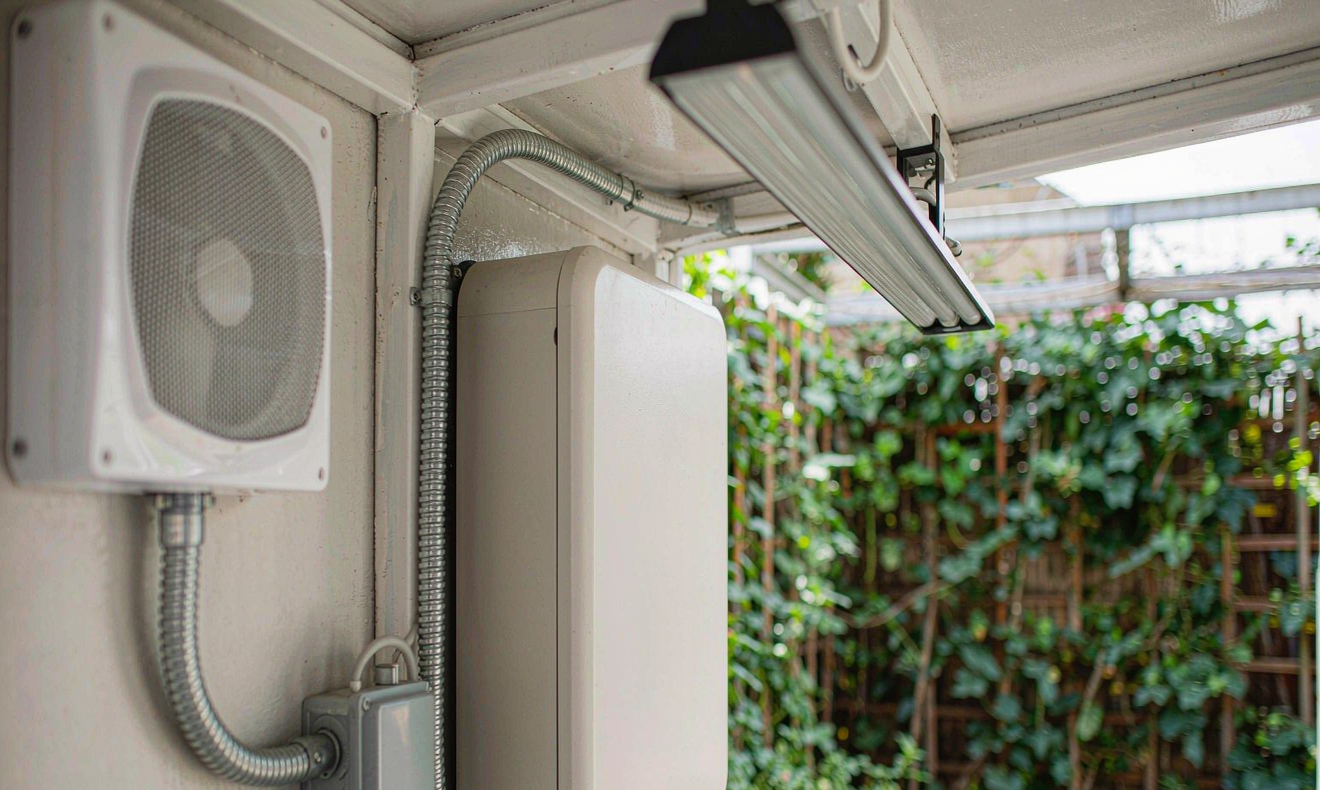
Three fixes, in the order I would spend money on them. First, move the cabinet into the house or an insulated utility shed and run a short protected cable to the greenhouse sub-panel. Second, keep the pack inside the structure but in a cabinet with a 30 W thermostatically controlled heater that holds the enclosure between 5 and 30 degrees Celsius. Third, specify a self-heating pack with internal films that warm the cells before charging; it sips 20 to 40 W, and that figure belongs in your load budget rather than in a footnote.
Heat is the other half. Sustained operation above 40 degrees Celsius accelerates calendar ageing, so ventilate the cabinet, keep it out of direct sun, and hold the charge window below 90 percent through summer.
Backup Autonomy and the Transfer Detail
Decide which loads survive an outage before you buy anything, because a whole-house transfer switch and a sheddable sub-panel produce very different hardware. For a greenhouse, the non-negotiables are ventilation, the water pump, the controller and the propagation bench. Supplemental lighting is the natural first load to shed, and in deep winter it is the one people argue to keep; if your plants depend on a winter photo period, give the lighting second priority and shed the curtain gear instead.
Use a sub-panel with a load-shed controller wired to the pack, and let the controller drop the light array when state of charge falls below 25 percent, then the pump, then hold the fan to the last. Static transfer under 20 milliseconds protects the electronic controller, but the fan motor does not care, and the pump does not care either. What does matter is that the inverter can carry the combined inrush of a fan and a pump starting together, and that the neutral and the grounding conductor of the garden feeder are handled correctly by a qualified installer.
Certification, Shipping and Commissioning
Every pack I ship for this duty leaves with a UN38.3 test report and a safety data sheet, travelling at UN3480 alone or UN3481 packed with equipment at near 30 percent state of charge. IEC 62133-2 governs the cell assembly. In North America the installed system is expected to sit behind a UL 9540 listing with fire behaviour characterised by UL 9540A, and grid interconnection in the United States is handled against IEEE 1547.
Commissioning is short and pays for itself. Test capacity at site temperature rather than trusting the nameplate, confirm the management system reports cell delta voltage and not just pack voltage, set the charge temperature limits explicitly, and leave data logging on for a full season. Require the pack to expose a documented protocol rather than a closed phone application; when a fan stops in February you need the alarm history, and a pretty gauge is not an engineering tool.
Matching the Pack to the Duty Cycle
A greenhouse is a modest load with a sharp edge. Size the kilowatt-hours from the December day, size the inverter for the inrush, keep the cells above freezing when they must take current, and give the pack a documented way to speak to you when something in the structure stops moving.
How large a home energy storage greenhouse battery do I need?
Start from the winter daily consumption, multiply by the autonomy days you want, and divide by an usable depth of discharge of about 80 percent. A 7.5 kWh per day structure with two days of autonomy needs roughly 19 kWh of lithium iron phosphate capacity, sized up to a standard 20 kWh cabinet for margin.
Can a home battery charge in a freezing greenhouse?
Not reliably. Lithium iron phosphate cells are not charged below 0 degrees Celsius, so an unheated structure will strand the pack all winter. Either locate the cabinet in conditioned space, use a thermostatically heated enclosure, or specify a self-heating pack that warms the cells before current is applied.
Should I AC couple or DC couple the greenhouse storage?
AC coupling is the safer retrofit because it keeps high-voltage direct current out of a cold, damp building and only needs a sub-panel and a breaker. DC coupling is two to four percent more efficient but places the charge electronics and the cells in the same thermal box, which is a poor choice in an unheated structure.
What happens to the pack if the grid fails in winter?
Ventilation, water pump, controller and propagation bench should stay up on the pack while lighting and curtain gear are shed, in that order. A load-shed controller that drops the lighting below 25 percent state of charge and holds the fan to the last is what keeps the structure survivable.
Do greenhouse fans and pumps need surge-rated inverters?
Yes. Small inductive motors draw three to five times their running current for 200 to 300 milliseconds at start-up, so specify an inverter with roughly double the continuous rating of the combined peak load rather than matching the nameplate sum.
How long will a lithium greenhouse battery last in daily cycling?
A lithium iron phosphate pack cycled to 80 percent depth of charge at moderate temperature typically reaches 6000 cycles or more, which is a decade of daily greenhouse duty. Calendar life, not cycle count, is usually the limiting factor if the pack sits near full charge in hot summer conditions.
Further Reading
References