Semi-Solid State Battery Preheating Before Charging
Winter fleet callbacks are the ugliest kind of design review. The vehicle has sat outside all night and the driver wants to leave on time, but the charger will not draw more than a trickle. I have seen that symptom on start-stop cars, city buses and two-wheeler platforms, and on a semi-solid state battery the low-temperature charge gate is the main reason a good pack looks defective. What follows is the preheating logic I write into specification reviews: the target temperature, the warm-up rate, the charge current limits, and the pressure behaviour that separates a solid-electrolyte pack from a liquid one.
Why a solid electrolyte is more temperature sensitive than a liquid one
A liquid carbonate electrolyte conducts at roughly 8 to 12 millisiemens per centimetre at 25 degrees Celsius and still manages 1 to 2 at minus 20. A sulfide solid electrolyte starts around 1 to 4 millisiemens per centimetre at room temperature and loses three to ten times that by minus 20, because ion transport through a ceramic-rich phase follows a steeper Arrhenius curve, with an activation energy near 0.3 to 0.5 electronvolts, against 0.15 to 0.25 for the liquid.
The practical result is that a semi-solid cell presents three to six times the charge-transfer resistance of a comparable liquid cell at minus 20. The charger sees a sagging voltage, decides the cell is misbehaving and backs off, while the driver blames the pack.
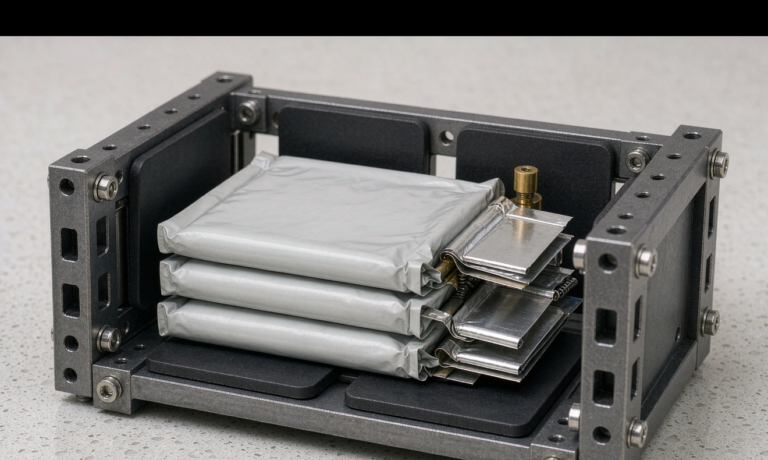
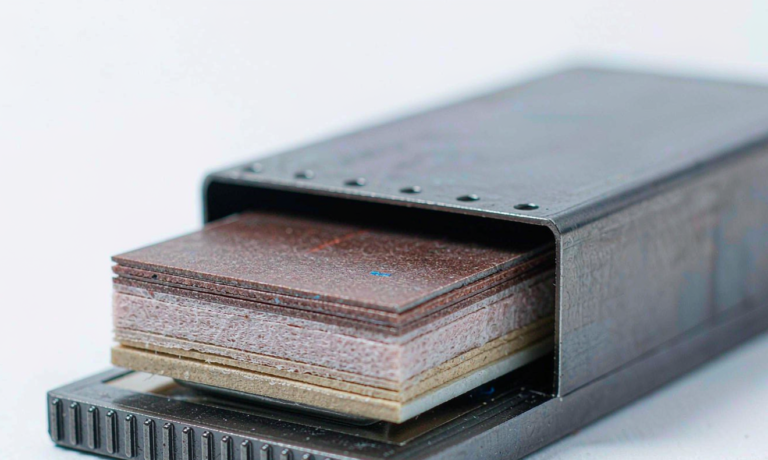
Semi-solid construction softens the problem without removing it. Most commercial semi-solid cells, including the pouch cells we qualify for Horizon Power programmes, carry 5 to 20 percent of a compliant polymer or liquid phase in a ceramic matrix. That residual phase keeps ionic contact at the electrode interface, and the ceramic skeleton keeps the temperature sensitivity, since it dominates conduction once the temperature drops.
What actually happens inside the cell below zero
Three failure modes show up in post-mortem work.
Lithium plating is the dangerous one. Below roughly 0 degrees Celsius the anode potential slides under 0 volts versus lithium metal at any meaningful charge current, and lithium deposits on the graphite instead of intercalating. That deposition is not reversible, and the filaments it nucleates are suppressed by a solid electrolyte inside the cell’s normal temperature window only. A dendrite-free claim on a datasheet describes the tested window, not a licence to charge at minus 20.
Interface delamination follows. The cell contracts more than the electrolyte as it cools and the cathode contact area shrinks. I measure 15 to 30 percent growth in interfacial resistance after a hundred thermal cycles between minus 30 and 45 degrees.
Gas generation is the third. Sulfide electrolytes react with freshly plated lithium to release hydrogen, and a sealed pouch swelling two or three millimetres along the top edge reports exactly that. Swelling is not cosmetic: the gas lifts the electrode stack and unloads the interface it was holding together.
Setting the preheat target and the warm-up window
My rule on a semi-solid pack is no charge current below 0 degrees, derated current between 0 and 10, and full rate only above 20. Preheat to 10 degrees before the pack is allowed near the charge circuit, and hold the warm-up rate at 0.5 to 1.5 degrees per minute. Warming from minus 20 to 10 at 1 degree per minute takes half an hour, a number I put in every fleet downtime conversation.
The energy cost is smaller than operators fear. A 40 kilogram module with a specific heat near 1000 joules per kilogram per kelvin needs about 1.2 megajoules to cross a 30 kelvin span, and 1.2 megajoules is 0.33 kilowatt-hours. Against a 40 kilowatt-hour pack that is under 1 percent of the available energy, or 3 to 6 percent with standby losses and a pre-departure cold soak.
Run the preheat in a state-of-charge window of 20 to 60 percent. Below 20 the cell has too little stored energy to hold heat and the heater cycles against the pack; above 60 the cells sit close to full, where any plating error has nowhere to go. A set point of 10 degrees with a cutoff at 12 keeps the pack off the thermal ceiling and still leaves margin.
Preheating methods that survive a sealed pack
Four approaches are in production and their differences matter more than the marketing suggests.
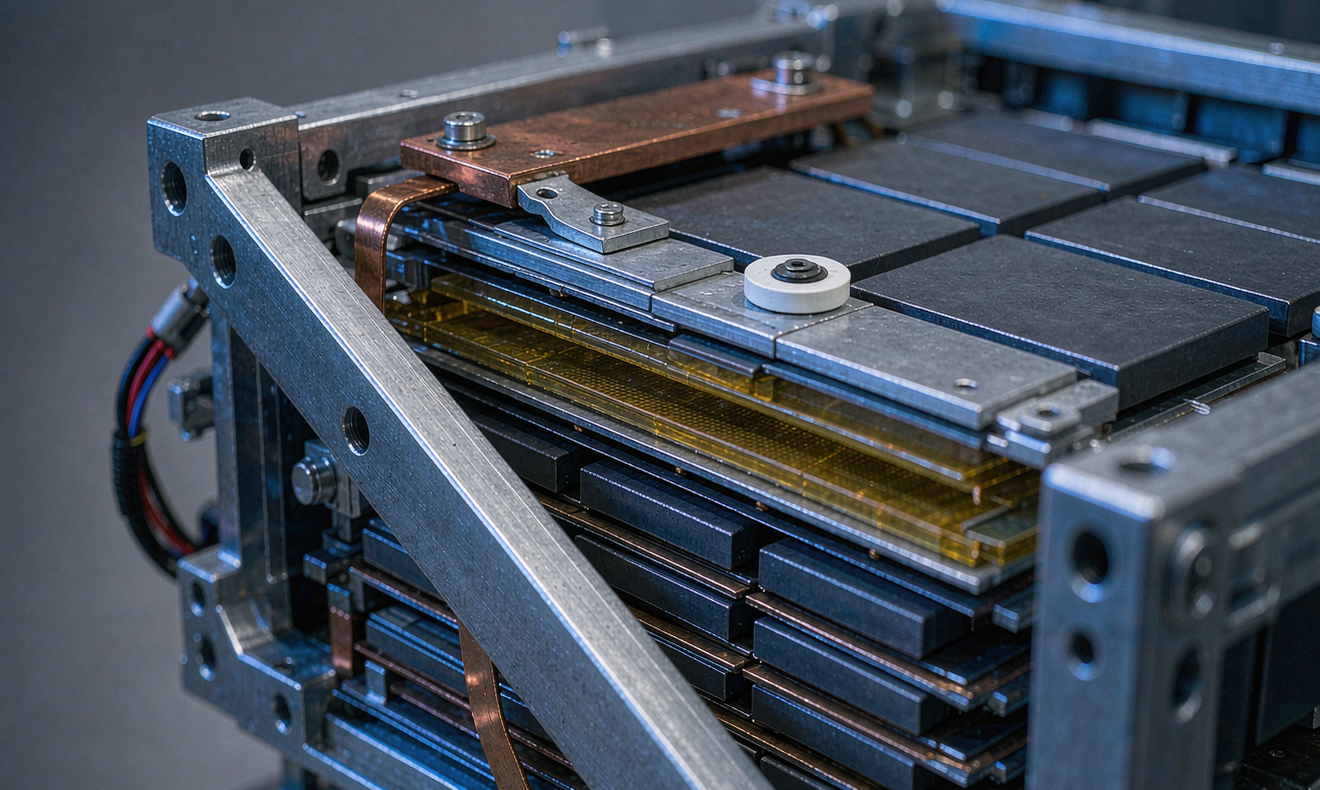
Bonded polyimide film heaters are the most uniform. They sit between the cell stack and the aluminium plate, run at 15 to 40 watts per kilowatt-hour, and hold the gradient across a module under 3 kelvin. They need a low-voltage feed and add a gram or two of harness per module, which is why I specify them on cars and vans where every kilogram counts twice.
PTC resistors sandwiched between plates are cheaper and blunter, and sixty to a hundred watts in a small block gives a fast warm-up and a hot spot on the outer cells. Drive the preheat power on a duty cycle and put the thermistor between the plate and the cells.
Coolant loops work when the vehicle already has a thermal circuit. Pushing glycol back through the cold plate after a drive recovers motor waste heat at no electrical cost, but on a cold morning the coolant is as cold as the pack, so an in-line heater of 1 to 3 kilowatts is still needed.
Enclosure heaters warm the whole box and are the slowest option, with gradients that can crack a seal. Self-heating cells that drive alternating current through the stack warm from the core outward and are genuinely interesting, but the bias current eats into cycle life and the approach is not yet in a semi-solid product I would sign off.
Whatever the method, preheat from the mains or the charger AC side. Drawing the heat from the pack itself only shrinks the pack.
Charge current limits and the firmware state machine
My gate table looks like this: below minus 10, preheat only; minus 10 to 0, preheat to 5 and then permit 0.05C; 0 to 10, 0.1 to 0.2C; 10 to 20, 0.3 to 0.5C; above 20, the rated 2 to 4C the cell was qualified for.
The subtlety is sensor placement. A thermistor on the module surface trails the core temperature by 10 to 30 kelvin during a fast charge, so gating on surface temperature alone lets the cell enter plating while the operator believes everything is behaving. Model the core temperature from current, resting voltage and the surface reading, and gate on that.
Cut the preheat as the pack approaches the top of its window. Sulfide electrolytes degrade above 60 and the polymer fraction softens well before that, so I hold the pack under 45 during warm-up and stop heating at 12.
Log three values: cumulative preheat energy, degree-hours spent below 5, and every event where the charge circuit refused to start. Those separate a cell problem from a schedule problem, and they are the evidence you want before a warranty conversation.
Why stack pressure changes as the pack warms
This is the semi-solid difference that catches engineers from liquid packs. A semi-solid pouch runs under 0.3 to 1.0 megapascals of stack pressure from a spring plate or gas bladder, and that pressure does real work keeping electrode and electrolyte in contact.
Thermal expansion mismatch between the aluminium case, the cathode and the ceramic layer shifts that load as temperature swings. and across a minus 30 to 45 degree cycle the preload moves 10 to 20 percent. Design the spring for the cold end and the cell is under-clamped when hot, which is when gas generation is most likely.
Warm slowly. Heating from outside raises the edge first, so I keep the gradient under 5 kelvin per centimetre and the rate at or below 1.5 kelvin per minute to avoid delamination at the seal.
Sealed pack, reactive electrolyte. Never open a cold sulfide pack in a damp bay. Condensation on warm internal components ruins a dried cell, so a pack returning from minus 25 goes into a sealed dry bag and acclimatises for hours before anyone unbolts the cover. The dew point target is minus 40 or colder for sulfide handling, and that figure is not negotiable.
Field checklist for operators
- Park plugged in. Holding the pack on the charger at 30 to 50 percent with the preheat timer armed 90 minutes before departure costs less than a driver idling for an hour.
- Preheat before the trip, not during it. A pack already at 10 degrees accepts full charge current; a pack still at minus 5 will not.
- Use a garage wherever the route allows, even an unheated one at 5 to 10 degrees, and skip the preheat entirely on those nights.
- Check the spring preload and retorque the module clamps after roughly 200 thermal cycles. Most winter drift complaints are a mechanical problem in a thermal costume.
- Trend capacity at the start of each winter and compare against the same cell at the end. A drop beyond 8 percent in one season points at the charge gate, not at the chemistry.
- Treat swelling, a hiss or a sudden drop in preheat time as a stop-work signal. Warming faster than 1.5 kelvin per minute on a semi-solid pack is a symptom, not a benefit.
How cold is too cold to charge a semi-solid state battery?
Below 0 degrees Celsius, for any chemistry with a graphite anode. Charge current in the minus 10 to 0 band is possible at 0.05C and only after the pack has reached 5 degrees. Semi-solid cells are stricter rather than looser, because the solid matrix cannot heal the interface.
Does preheating consume too much of the pack energy?
Not if it comes from the mains. Crossing a 30 kelvin span costs well under 1 percent of pack energy on paper, and 3 to 6 percent in real duty. Preheat from the battery’s own cells and it becomes a slice of the range, which is the mistake to avoid.
Can a vehicle preheat the pack while driving?
Yes, and it is the cheapest route. Waste heat from the drive motor and inverter brings the pack to 15 to 25 degrees within 20 to 40 minutes of hard running, drawing no heater power from the high-voltage battery. The limitation is departure timing, not capability.
How long should the preheat hold before departure?
Enough to cover the cold soak, which in a northern winter is 30 to 60 minutes at 1 degree per minute. Arm the timer 90 minutes ahead so the pack sits at its 10 to 12 degree hold point, and keep it plugged in so the charger and heater share the load.
Is a semi-solid state battery safer at low temperature than a liquid one?
Safer in the thermal runaway sense and less forgiving at the charge gate. The rigid electrolyte limits how far a plating filament propagates, but the plating reaction still occurs below 0 degrees and sulfide electrolytes generate hydrogen. Do not read the safety claim as permission to charge cold.
What state of charge should a pack sit at through winter storage?
40 to 60 percent, on maintenance charge if the facility has power, and never below 20. Full charge in a cold pack maximises plating risk, and a pack stored empty in a cold shed arrives in the spring with a section of capacity that never returns.
Further Reading
References