Battery Solution Cost Optimization for Equipment
When a procurement manager asks me to “make the battery cheaper,” I have learned to pause. After fifteen years designing packs for everything from aerial drones to floor scrubbers and agricultural equipment, I can tell you the sticker price of a lithium battery pack is the worst possible number to optimize. The real cost lives in cycle life, warranty returns, certification delays, and the labor your technicians spend swapping failed units at 2 a.m. A genuine battery solution cost optimization equipment program is about total cost of ownership (TCO), and that is a systems-engineering problem, not a sourcing problem. In this field guide I will walk through the levers I actually pull on equipment programs, the test standards that gate your launch, and a worked example with real numbers from a recent custom battery solution we shipped.
Why Equipment Battery Costs Are So Often Misunderstood
Most equipment OEMs budget a battery as a line item: so many dollars per kilowatt-hour. That single number hides three costs that dominate the program over five years. First is replacement cost — a pack rated for 800 cycles that actually delivers 600 because of thermal stress doubles your effective $/kWh. Second is qualification cost — every late redesign to pass UN38.3 or IEC 62133-2 adds weeks of calendar time and retest fees. Third is field-failure cost — a swollen pack in a remote machine is not just a warranty claim, it is a service truck roll and a lost customer. When I scope a custom battery solution for equipment, I build the TCO model before I pick a cell.
Build the Cost Model Before You Build the Pack
The TCO model I use for equipment has five terms: pack acquisition, energy throughput (energy delivered per dollar over life), cooling and housing, certification, and end-of-life. I express everything as $ per megawatt-hour delivered. On a typical industrial battery pack this reframes the decision completely. A premium LFP cell that costs 12% more upfront but lasts 4,000 instead of 1,500 cycles usually wins on throughput by a factor of two. I have walked clients away from “cheap” NMC packs toward LFP purely on this math.
Throughput Is the Only Number That Matters
Energy throughput = usable capacity × cycles × depth-of-discharge efficiency ÷ price. For equipment that runs daily, this number compounds. I show clients a simple table: at 3,000 equivalent full cycles and 90% round-trip efficiency, a $120/kWh pack and a $95/kWh pack can invert once you account for one mid-life replacement. The cheaper pack becomes the expensive one.
Cell Chemistry Selection Drives the Majority of Lifetime Cost
For equipment, the LFP versus NMC decision is the single biggest lever. LFP gives you 155–165 Wh/kg and 3000–6000 cycles at 80% DOD, with excellent thermal stability (ARC onset above 250°C). NMC gives 200–250 Wh/kg and 800–2000 cycles, with higher energy density but tighter thermal margins. For most ground equipment where volume is not the constraint, LFP’s cycle life and safety margin make it the cost-optimal choice even at slightly lower specific energy. I reserve NMC for weight-critical platforms where every gram counts, such as a drone lithium battery where 30% mass savings outweighs cycle cost.
Matching Chemistry to Duty Cycle
A forklift doing two shifts a day is a different animal from a sensor that sips microamps. High-cycling equipment rewards LFP’s longevity; low-duty or cold-environment equipment may favor chemistries with better low-temperature behavior. The mistake I see most often is over-specifying energy density for an application that never needs it, then paying for it in replacements.
Design-for-Manufacturing Levers That Cut Real Cost
Once chemistry is set, the pack architecture is where a battery solution either bleeds money or saves it. I use four DfM levers on every equipment program.
Cell-to-Pack and Standard Modules
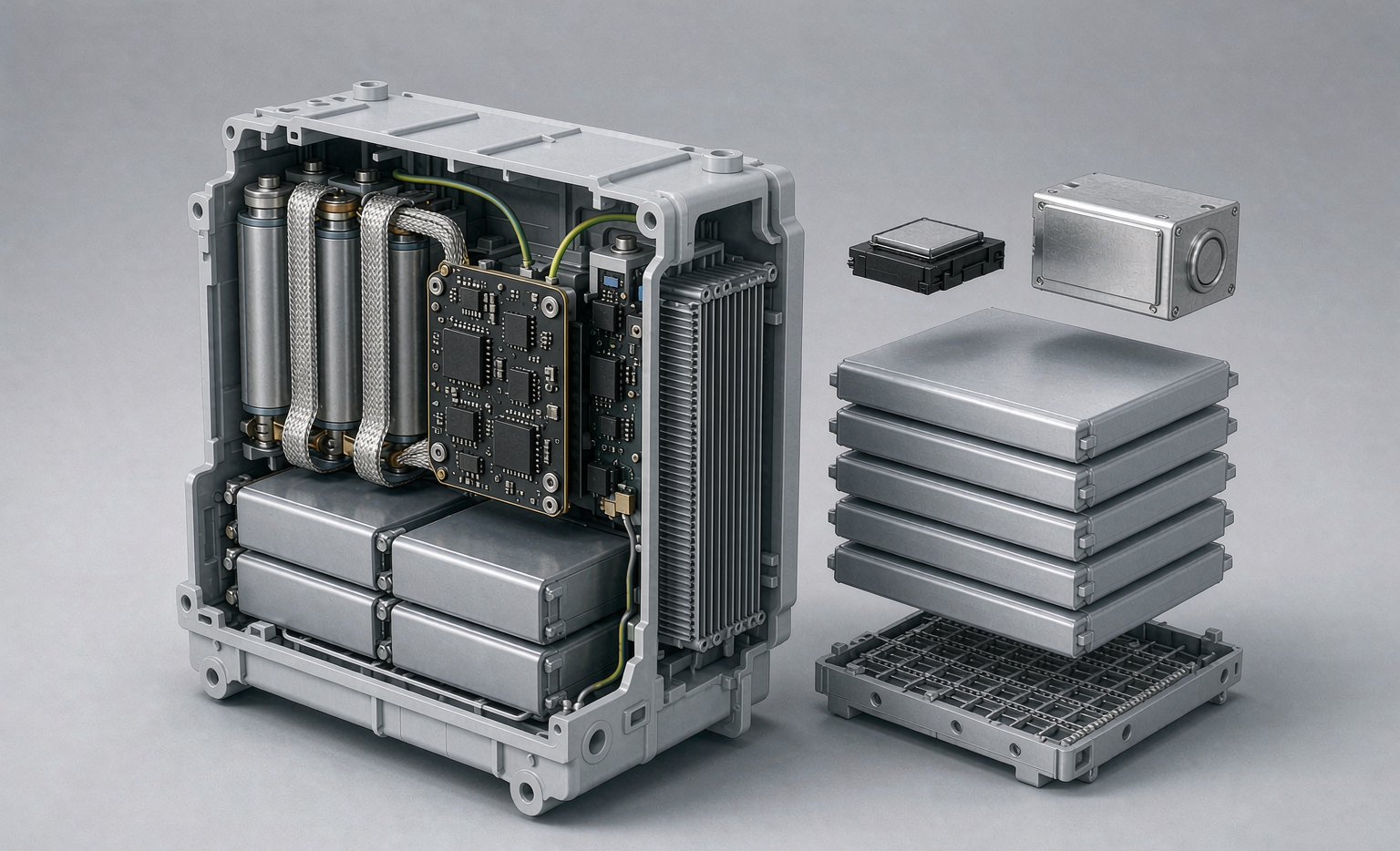
Moving from discrete module-and-harness assembly to a cell-to-pack (CTP) structure typically removes 30–40% of the mechanical parts and lifts volumetric utilization from 40–50% to 60–70%. Fewer parts means fewer failure points and less labor. Where the product family spans multiple equipment SKUs, I standardize on one or two module sizes and configure them in series/parallel — that amortizes tooling and certification across the whole lineup.
Busbar, Welding, and Connector Choices
Ultrasonic and laser welding beat crimped terminals on both cost and reliability over volume. I spec gold-free tin-plated busbars and connectors rated for 5,000 insert cycles, which avoids the premium of precious-metal contacts while still meeting durability. Terminal torque is set at 8–10 N·m with thread-locker to prevent field loosening — a 30-cent fix that prevents a $400 service call.
Thermal Management as a Hidden Cost Lever
Heat is the silent tax on battery life. Every 10°C of sustained over-temperature roughly halves cycle life. A passive aluminum heat-sink design costs almost nothing and can extend pack life 10–20% in ventilated equipment. For sealed or high-power equipment, liquid cooling adds upfront cost but extends life 20–30% and keeps cell-to-cell temperature spread under 5°C, which protects warranty. I model both and pick based on duty cycle, not habit.
Insulation and Safety Margins
I keep isolation resistance above 1 MΩ at 500 VDC and specify a 30 mA ground-fault trip within 300 ms. These are not optional nice-to-haves; they are what keep a pack from becoming a liability claim. Designing them in from revision one is cheap. Retrofitting after a failed certification is not.
Certification Strategy: UN38.3, IEC 62133, and Regional Marks
Certification is where optimistic budgets go to die. For any lithium-ion battery shipping or operating in equipment, UN38.3 (T.1–T.8: altitude simulation, thermal, vibration, shock, external short, impact, overcharge, forced discharge) is non-negotiable for transport. IEC 62133-2 governs cell and pack safety for portable applications. For stationary or large industrial packs, IEC 62619 and UL 1973 apply, and UL 9540 / UL 9540A plus NFPA 855 govern system-level fire safety. For aviation-adjacent or drone platforms, FAA and EASA expectations and RTCA DO-160 environmental testing come into play.
Certify Once, Reuse Everywhere
My rule: design the pack to pass the strictest applicable standard first, then the regional marks are incremental, not revolutionary. A pack built to IEC 62133-2 and UN38.3 from day one typically needs only documentation and local testing to add CE or other marks. The cost of a late discovery that your enclosure fails the T.6 impact test is a full重新tooling cycle. Front-loading compliance is the cheapest insurance in the budget.
Fleet-Level Optimization and Second Life
Equipment fleets let you optimize at the system level, not the pack level. I deploy battery health monitoring so packs that fall below 80% capacity in one duty cycle can be reassigned to a lighter-duty machine instead of being scrapped. A pack retired from a high-power scrubber at 80% SOH still has years of life in a low-rate backup role. This “second life” step alone has cut my clients’ effective $/MWh by 15–25%. I also pool spare packs across a fleet to shrink the inventory buffer you must carry.
A Real Equipment Program Walkthrough
Last year we rebuilt the power system for a line of autonomous floor-cleaning robots. The incumbent pack was an NMC module at $138/kWh rated 1,200 cycles. We moved to an LFP CTP custom battery solution at $126/kWh with 4,000-cycle cells, added a passive heat sink, and certified to UN38.3 and IEC 62133-2 on the first pass. Acquisition dropped 9%, but the real win was life: throughput cost fell from roughly $0.115/kWh to $0.031/kWh delivered — a 73% reduction in effective energy cost. Warranty returns dropped from 4.1% to 0.6% in the first year. That is what battery solution cost optimization equipment work actually looks like when you optimize the right number.
Frequently Asked Questions
Is LFP always cheaper than NMC for equipment?
For high-cycling ground equipment, almost always, because its 3,000–6,000 cycle life dwarfs NMC’s 800–2,000 cycles and its safety margin reduces certification and cooling cost. The exception is weight-critical platforms — a drone battery where every gram matters may justify NMC’s higher specific energy despite the cost trade-off.
How much can design-for-manufacturing actually save?
Cell-to-pack construction typically removes 30–40% of mechanical parts and lifts volumetric utilization from about 45% to 65%. Across a product family that translates into meaningful per-unit savings and, just as importantly, fewer assembly defects and warranty claims.
Do I really need both UN38.3 and IEC 62133?
Yes, for most equipment. UN38.3 governs safe transport (T.1–T.8) and is required before the pack can legally ship. IEC 62133-2 governs in-product safety of cells and packs. Skipping either exposes you to shipping holds or market-access rejection. Designing to both from revision one avoids costly late redesigns.
What is the fastest payback lever for an existing fleet?
Second-life reassignment. Packs retired at 80% state-of-health from demanding duties still deliver years of service in lighter roles. Combined with fleet-level spare pooling, this is often a 15–25% reduction in effective energy cost with zero new hardware.
How do I justify a more expensive cell upfront?
Run the throughput model: usable capacity × cycles × efficiency ÷ price, expressed as $/MWh delivered. A cell costing 10–15% more that lasts 2–3× the cycles almost always wins. I have rarely seen the cheapest pack win this calculation on equipment that cycles daily.
Conclusion
Optimizing battery cost for equipment is not about hunting for the lowest $/kWh on a quote sheet. It is about engineering the whole system — chemistry matched to duty cycle, a manufacturing-friendly architecture, disciplined thermal design, and compliance built in from the first revision. When you do that, the number that matters, cost per megawatt-hour delivered, falls dramatically while reliability climbs. If you are scoping a new equipment platform, bring the TCO model to the table before the sourcing meeting, and the rest of the program gets easier.