Battery Solution for Greenhouse and Vertical Farming
Walk into any commercial greenhouse at 3 a.m. and the first thing you notice is the hum. Rows of LED grow lights pull steady current, circulation fans push humid air, and a misting system pulses on a timer. As a senior lithium battery engineer at Horizon Power, I have spec’d energy systems for controlled-environment agriculture for more than a decade, and the load profile never stops surprising newcomers. A battery solution for greenhouse and vertical farming operations is no longer a luxury. It is the difference between a profitable crop cycle and a total loss when the grid falters.
Why Greenhouses and Vertical Farms Need a Dedicated Battery Solution
Controlled-environment agriculture concentrates electrical demand in a small footprint. In a vertical farm, stacked racks of LEDs can draw 30 to 50 watts per square foot, and climate equipment adds another 25 to 35 percent on top. A single mid-size greenhouse with supplemental lighting, ventilation, humidification, and CO2 injection can exceed 200 kilowatt-hours per day. The grid connection that feeds this load is often the weakest link. Utilities in growing regions impose steep demand charges when your peak draw coincides with the system peak, and a two-hour outage in summer can collapse temperature and humidity fast enough to ruin a crop.
A generic backup generator solves only the outage problem, and it does nothing for your monthly bill. A purpose-built battery solution for greenhouse farming attacks both. It shaves the demand peak, stores cheap off-peak or solar energy, and carries the farm through blackouts without a drop in light or airflow. For growers running a custom battery solution sized to their exact duty cycle, the payback often lands inside three years.
Sizing the Battery Pack for Grow-Light and HVAC Loads
Sizing starts with a load audit. List every continuous and pulsed load, then multiply by its daily run hours. A representative 1,000 square meter greenhouse might carry 10 kilowatts of LED lighting, 5 kilowatts of HVAC and dehumidification, and 2 kilowatts of pumps and controls, running 16 hours on a typical winter day. That is roughly 272 kilowatt-hours of usable energy. Add a 20 percent capacity headroom for aging and cold-weather derate, and you are shopping for a 330 kilowatt-hour energy storage battery pack.
Discharge rate matters as much as capacity. Grow lights and fans ramp relatively smoothly, so a 0.2C to 0.5C continuous discharge is normal. But compressors and circulation pumps can spike at startup, so the battery and its inverter should tolerate a 1C burst for a few seconds without voltage sag. I always spec the lithium battery cells with a sustained 1C rating even when the average load is far lower, because headroom is what keeps a system alive on the worst day of the year.
Chemistry Choice: LFP vs NMC in a Humid, Warm Environment
In a warm, wet space, chemistry selection is a safety decision before it is a performance decision. Lithium iron phosphate, or LFP, is the default for Horizon Power greenhouse systems. It tolerates high ambient temperature, carries no cobalt, and stays chemically stable well beyond the thermal runaway threshold of nickel-based cells. A prismatic LFP battery pack routinely delivers 6,000 charge cycles at 80 percent capacity, which maps to roughly sixteen years of daily use.
Nickel manganese cobalt cells offer higher energy density, but they are less forgiving in a humid enclosure near flammable growing media. For a battery solution for greenhouse farming where the cabinet sits meters from crops and irrigation, the thermal margin of LFP wins every time. I have retrofitted two sites that started with NMC and migrated to LFP after a single summer of thermal alarms.
Thermal Management and IP Rating for Wet, Saline Air
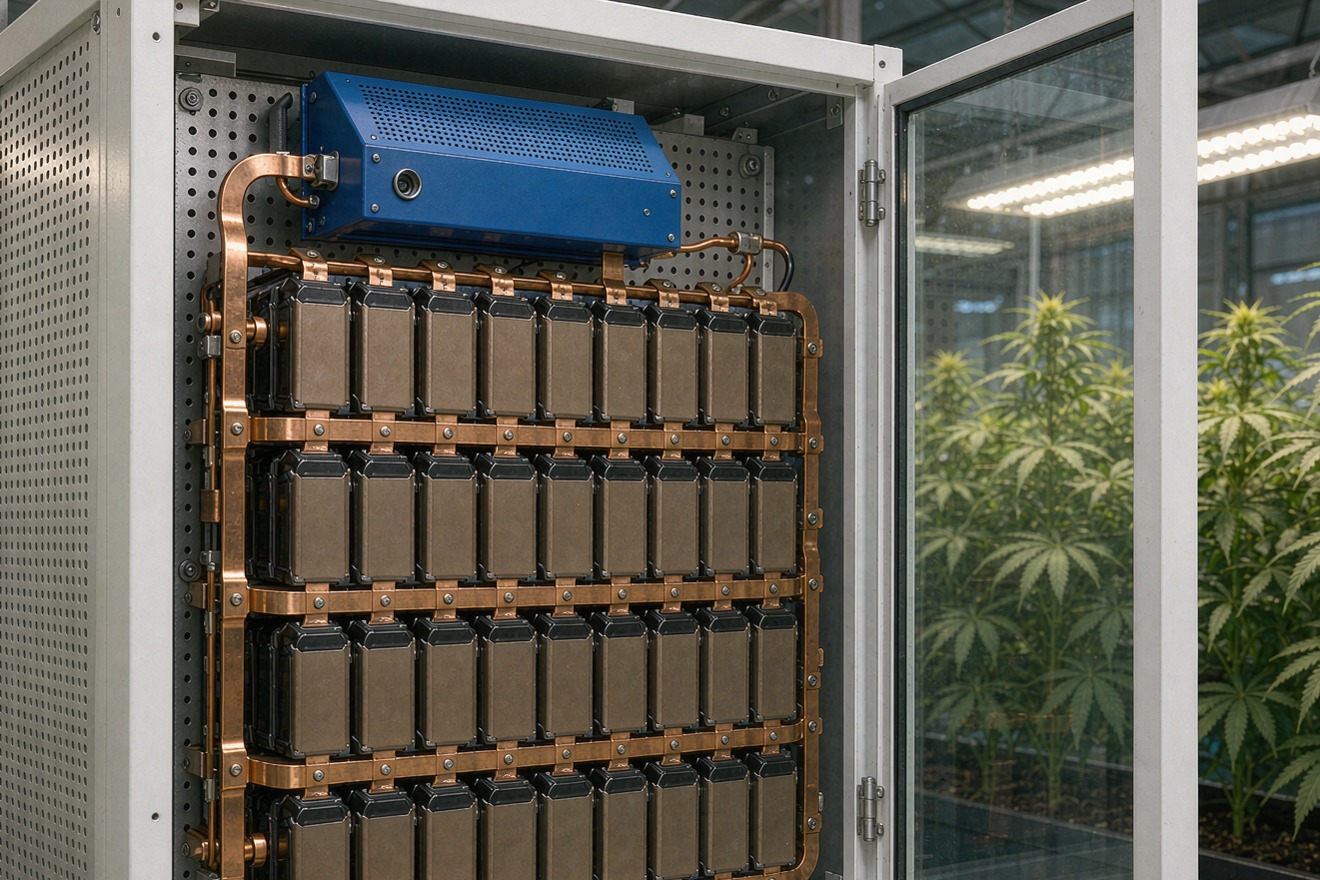
Greenhouse air runs 70 to 90 percent relative humidity, and coastal operations add salt mist that eats unprotected electronics. The enclosure must be at least IP65 to keep mist and dust out, with stainless hardware and conformal-coated boards inside. Battery cells like a steady 15 to 35 degrees Celsius, so the cabinet needs either passive ventilation with a large thermal mass or active cooling driven by the battery management system.
Condensation is the silent killer. I specify desiccant breathers on every vented compartment and a positive-pressure fan that excludes outside air during humid nights. On the compliance side, industrial stationary packs should meet IEC 62619 for safety, UL 1973 for cell construction, and UL 9540A for fire propagation control. UN38.3 still applies if the modules are shipped between facilities.
Peak Shaving, Demand Charges and Solar Self-Consumption
The biggest hidden cost in controlled-environment agriculture is the demand charge, the fee a utility levies on your single highest 15-minute draw each month. A battery solution for greenhouse loads flattens that peak by discharging during the expensive window and recharging when rates drop. On a time-of-use tariff, the same energy moved three hours earlier can cut the bill by 30 to 50 percent.
Most greenhouses already carry rooftop solar, and a battery turns that intermittent generation into firm power. Instead of exporting surplus at a low feed-in rate, the energy storage system stores it and displaces grid draw at the evening light peak. A custom battery solution tuned to the site’s solar curve and tariff schedule typically pays for itself faster than a storage system sized only for backup.
Monitoring, State of Health and Remote Fleet Management
A modern battery pack is only as good as the data behind it. Our battery management system streams cell voltage, string current, module temperature, state of charge, and state of health to a cloud dashboard, so a grower in another city can see every cabinet. Threshold alerts catch a single weak cell before it drags the string, and the historical log supports warranty claims and capacity trending.
For operators running several sites, remote fleet management turns maintenance from reactive to planned. I grade cells at commissioning and track their divergence over time, then rotate or rebalance the worst performers during a scheduled downtime. Standards such as IEC 63056 cover the stationary battery system interface, and the same telemetry feeds the energy management controller that decides when to charge, discharge, or hold.
Frequently Asked Questions
What size battery do I need for a small greenhouse?
For a small greenhouse under 200 square meters with LED supplemental lighting, plan on 20 to 40 kilowatt-hours of usable storage per day of autonomy you want. A 30 kilowatt-hour battery pack with a 1C inverter covers lighting and a small circulation fan through an overnight outage, and it also shaves the daytime demand peak.
Can a battery solution run LED grow lights during a blackout?
Yes. A correctly sized battery solution for greenhouse farming carries the LED racks and fans through a blackout without interruption. The inverter must handle the startup surge of circulation fans and pumps, so I spec a sustained 1C rating even when average load is lower.
Which battery chemistry is safest for a humid greenhouse?
LFP is the safest choice in a humid, warm enclosure. It has no cobalt, stays stable at high temperature, and resists thermal runaway far better than nickel-based cells, which matters when the cabinet sits near crops and irrigation.
How long does a greenhouse battery system last?
A quality LFP battery pack delivers 6,000 cycles at 80 percent capacity, roughly twelve to sixteen years of daily use. Lifespan depends on depth of discharge, ambient temperature, and how often the system hits its 1C rating.
Does a battery work with existing rooftop solar?
It does. The battery stores surplus solar instead of exporting it at a low rate, then discharges during the evening light peak. A custom battery solution mapped to your solar curve and tariff pays back faster than backup-only storage.
What certifications should a greenhouse battery have?
Look for IEC 62619 for industrial safety, UL 1973 for cell construction, UL 9540A for fire propagation control, and UN38.3 if modules are shipped between sites. An IP65 enclosure rating is the minimum for humid greenhouse air.
Further Reading
References