Battery Solution for Tower Cranes and High-Rise Construction Hoists
I am Karl Huang, a senior lithium battery engineer who has spent the last decade putting high-voltage packs onto machines that used to run on diesel. One of the fastest-moving electrification jobs right now is vertical: tower cranes and the high-rise construction hoists (mast climbers, material hoists, and personnel hoists) that feed a building as it rises. A well-designed battery solution for tower cranes removes the on-site generator set, cuts noise and emissions at the fence line, and quietly pays for itself through regenerative braking. In this guide I walk through the duty cycle, pack architecture, energy recovery, enclosure design, and the sizing math I actually use when a contractor asks me to replace a diesel genset with cells.
Why Diesel Is Leaving the Tower Crane
For years the standard answer was a diesel generator feeding the hoist inverter. It worked, but it came with a long list of problems that city job sites no longer tolerate. A genset on a residential tower emits NOx and particulates into the neighborhood, runs loud during early shifts, and needs fuel deliveries that add cost and a fire-load risk on a crowded site. Many municipalities now restrict diesel inside enclosed structures, basements, and underground parking decks where hoists often start their life.
Battery power solves the local problem directly. The hoist inverter draws from a pack instead of a generator, so the crane base stays silent and fume-free. The only recurring input is grid charging, which can happen off-peak. When I spec a custom battery solution for a tower crane, the first conversation is almost never about chemistry; it is about removing the generator and the fuel logbook from the daily routine.
Reading the Duty Cycle of a Hoist Drive
A tower crane hoist is not a steady load, and that fact drives every design choice downstream. The motor pulls peak power while lifting a load, coasts near zero while traversing, and actually pushes power back into the pack while lowering. In motor standards this maps to IEC 60034 duty types S3 (short-time) and S4 (intermittent periodic with starting), where the duty factor is the share of a cycle the motor is actually loaded.
On a typical high-rise hoist the duty factor lands between 25 percent and 60 percent depending on how the crew stages lifts. Peak power can run three to five times the cycle average, so the pack and its contactors must handle short, repeated surges without voltage collapse. I size the bus and the cell parallel count for the peak, then size energy for the shift average. Getting this order right is the difference between a pack that lasts years and one that cooks its fuses in a month.
Pack Architecture for a Tower Crane Battery
Most tower crane and hoist packs I build sit at 400 to 600 volts nominal, built from prismatic LFP cells. I choose LFP (lithium iron phosphate) over NCM for two reasons that matter on a job site: a much wider thermal runaway margin and a cycle life well past 3000 cycles at 80 percent depth of discharge. A crane base is not a climate-controlled rack, so chemistry toughness counts more than raw energy density here.
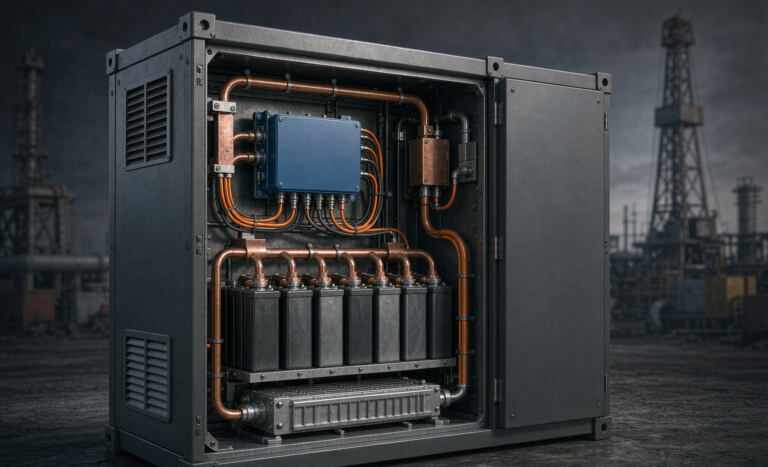
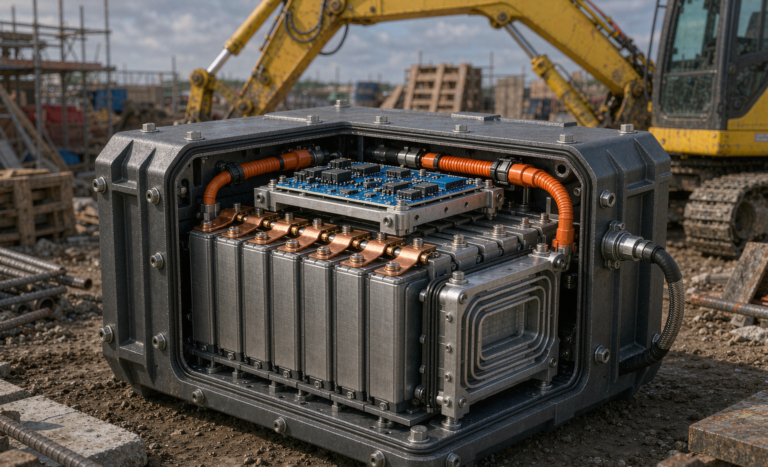
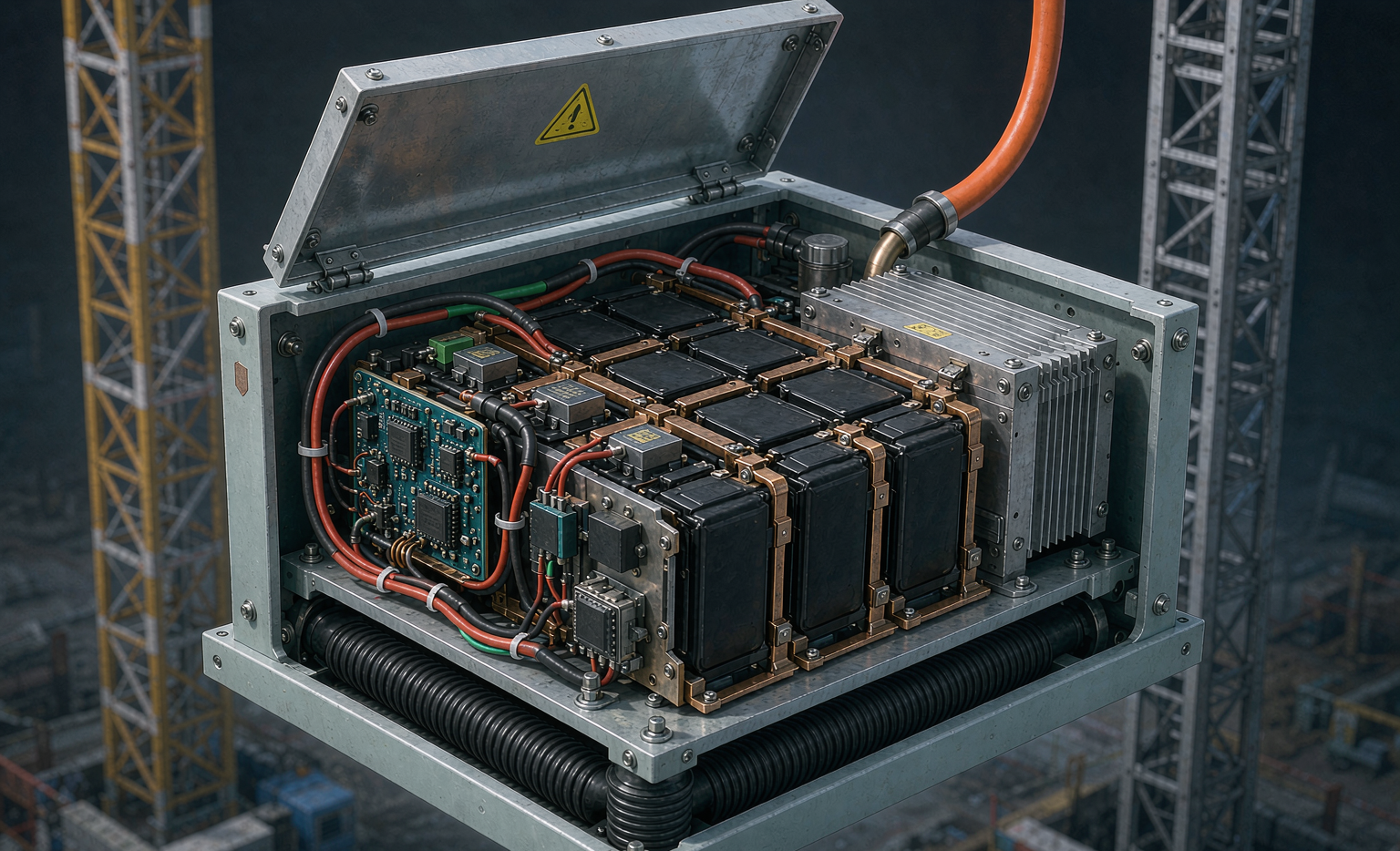
Inside the enclosure, modules connect in series for voltage and in parallel for capacity. A precharge circuit protects the contactors from inrush when the inverter caps charge, a hall current sensor logs every amp, and an insulation-monitoring device watches the high-voltage bus to ground. The BMS solution talks to the hoist inverter over CAN so the crane controller knows state of charge, pack temperature, and contactor state before it ever closes the main relay. Good battery pack design here is mostly about contactor sequencing and fault isolation, not about the cells themselves.
Recapturing Energy on Every Descent
The single biggest efficiency win on a crane is regenerative braking, and it is the reason a battery pack can outrun a diesel set on operating cost. Lowering a loaded skip or an empty hook returns energy to the pack instead of burning it in a resistor. A 12-ton load descending 50 meters gives back a meaningful chunk of watt-hours, and on a busy hoist those recoveries add up across hundreds of cycles per shift.
The engineering catch is that regen arrives in bursts. The BMS must cap charge current so the cells never exceed their safe charge C-rate, and when the pack is already near full the surplus is diverted to a brake resistor. I tune the regen window against the expected duty factor so that on a normal shift almost every descent lands as recovered energy rather than wasted heat. This is where a lithium battery pack with a tolerant charge profile beats the older lead-acid banks that could not absorb fast regen at all.
Thermal and Enclosure Design for the Job Site
A crane base lives in dust, vibration, rain, and summer heat, so the enclosure does real work. I specify a minimum of IP54 for a protected base and IP65 where the pack gets washed down or sits exposed on the mast. Cells sit in a welded steel enclosure on vibration isolators, with the busbars torqued to a schedule and re-checked after the first commissioning week.
Cooling is usually passive with a forced-air assist for high-duty shifts, because moving air is simpler than liquid loops on a structure that is constantly being climbed and serviced. Cold weather is the other edge: lithium derates below about 0 degrees Celsius, so for winter sites I add pad heating or simply limit available power until the pack warms. The rule I give crews is simple: keep the pack within its window and it will keep the crane within its window.
Sizing a Pack for a Full Shift
Here is the math I use for a 12-ton tower crane on an eight-hour shift. Take peak hoist power at roughly 90 kilowatts, apply a duty factor of 40 percent, and you get an average draw near 36 kilowatts. Multiply by eight hours and divide by inverter efficiency of about 0.92, and the gross energy need is around 313 kilowatt-hours before any recovery credit. Subtract a conservative regen recovery of 15 to 25 percent and a realistic pack lands near 240 to 270 kilowatt-hours at a 1 to 2C discharge rating.
I then add margin for the fact that crews rarely run a perfectly average shift, and I size the charger so the pack refills during the off-peak window without stressing cell life. A battery solution that is too small forces the crane to idle while charging; one that is too large just wastes capital. The shift-sizing calculation is the only way to land between those two failures, and I always hand the contractor the spreadsheet, not just the number.
Safety Standards You Cannot Skip
Compliance is not optional on a structure where a failure drops steel. Transport of the pack and its cells follows UN38.3, which covers the shock, vibration, and thermal abuse tests every cell must pass before it ships. For the installed industrial system the relevant standard is IEC 62619, which governs safety for industrial stationary and traction batteries; note that IEC 62133 applies to portable cells and is not the right citation for a crane pack, a mistake I still see in lazy specifications.
Beyond the certificates, the physical design carries the real safety margin. The hoist must keep a fail-safe mechanical brake that works independent of the battery, so a pack fault never drops a load. Contactors are redundant, the bus is insulated and monitored, and the enclosure vents any thermal event away from personnel. When a custom battery solution passes both the paper audit and the on-site fault test, that is when I am comfortable signing it off.
How much battery capacity does a tower crane need for one shift?
For a 12-ton hoist on an eight-hour shift, plan roughly 240 to 270 kilowatt-hours after regen recovery, at a 1 to 2C discharge rating. The exact number depends on peak hoist power, duty factor, and how much energy the descents return to the pack.
Can a tower crane battery recover energy while lowering loads?
Yes. Regenerative braking returns energy to the pack on every descent, often cutting total shift energy by 15 to 25 percent. The BMS caps charge current and diverts surplus to a brake resistor when the pack is near full.
Which battery chemistry is best for tower cranes?
LFP (lithium iron phosphate) is my default for crane and hoist packs because of its wide thermal runaway margin and long cycle life past 3000 cycles. Energy density matters less on a fixed base than toughness and safety do.
What IP rating should a construction battery enclosure have?
Use at least IP54 for a protected crane base and IP65 where the pack is exposed or washdown is expected. The rating protects cells and busbars from dust and water ingress during a multi-month build.
Does cold weather reduce tower crane battery performance?
It can. Lithium cells derate below about 0 degrees Celsius, so winter sites need pad heating or a reduced power limit until the pack warms. I size for the site climate, not just the nameplate.
How do I charge a tower crane battery pack on site?
Charge from the site grid during the off-peak window with a charger sized to refill the pack without stressing cell life. Keep the main contactor open until precharge completes, and let the BMS confirm insulation before the inverter connects.
Further Reading
References