Drone Battery Reliability for Racing Drones: How Engineers
As a senior lithium battery engineer at Horizon Power, I have spent more mornings than I can count on the bench with a LiPo pack that “tested fine” the night before and then sagged into a brownout mid-lap. In drone racing, reliability is not a comfort feature—it is the difference between finishing a heat and watching a $400 airframe cartwheel into a fence. This article is the playbook my team uses to engineer drone lithium battery packs that stay predictable under the brutal duty cycle of FPV racing: relentless 100C-plus discharge pulses, hard landings, and thermal swings that would wreck a consumer cell in a single season.
I still remember the first pack that humbled me. It balanced perfectly, read full voltage, and then dropped two cells to 2.9 V under a single throttle punch on the start straight. The autopsy showed a single welded tab with a hairline crack invisible to the naked eye. That failure taught me that racing reliability is an engineering discipline, not a spec-sheet claim—and it is the reason every pack we ship carries a documented test report instead of a marketing slogan.
What “Reliability” Actually Means in a Racing drone battery
Before we can improve reliability, we have to define it. For our purposes a reliable drone battery is one that delivers its rated voltage and current without a safety event across a defined number of flights and cycles under racing stress. That is a much harder bar than “holds a charge on the shelf.” A pack can read 4.20 V per cell at rest and still fail the moment you pull 80–120 A through it.
In the field we see six dominant failure modes, and every design decision below is meant to suppress one of them:
- Voltage sag and internal-resistance (IR) rise — the pack browns out the ESC and the quad drops out of the sky.
- Vibration-induced weld and busbar fatigue — spot welds crack after hundreds of hard landings.
- Connector and harness fatigue — the XT60 or SH lead works loose and arcs.
- Swelling from over-discharge or heat, which then wedges the pack in the frame or ruptures the wrap.
- Thermal runaway triggered by dendrites, a crushed cell, or an external short.
- Ingress of dust and moisture in open 5-inch frames that short the balance leads.
Cell Selection Is Where Reliability Is Won or Lost
Reliability starts with the cell, not the wrap. We spec racing cells by their continuous and burst C-rating and by their matched internal resistance, never by milliampere-hours alone. A typical quality racing cell sits under 3 mΩ of AC-IR; we bin a pack so that every cell in it is within 0.5 mΩ of its neighbors. Mismatched IR is the single most common cause of one-cell voltage collapse during a punch-out, because the weak cell becomes the bottleneck for the whole series string.
We also grade cells hard. Any cell above our IR ceiling, or with more than 20 mV resting imbalance against its pack mates, is rejected before it ever reaches a build. This is the unglamorous part of being a lithium battery manufacturer that racers trust with their airframes: you throw away margin you already paid for, because a single weak cell takes the whole pack down with it. The cost of a rejected cell is trivial next to the cost of a pack that quits on the final gate.
Mechanical Design for Vibration and Impact
A racing quad sees shock loads that would disqualify most electronics. Our structural approach has four layers:
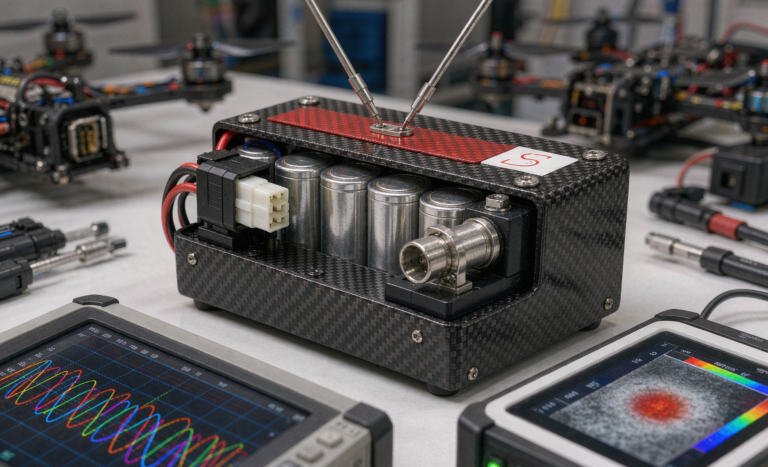
- Busbar and weld integrity. We use the thickest nickel strip the weight budget allows and verify weld nugget diameter under a microscope. A cracked weld is an intermittent open circuit waiting to happen, and intermittent faults are the worst kind because they pass every bench test until they don’t.
- Strain relief. Every lead gets a molded stress-relief boot and a strain loop so vibration bends the loop, not the weld.
- Potting and conformal coating. We pot the cell tabs in soft silicone. It damps high-frequency vibration that would otherwise fatigue the welds and protects balance leads from ingress.
- Mounting interface. Soft silicone grommets isolate the pack from frame resonance. There is a trade-off—a hard-mounted pack couples vibration into the gyro—so we tune the mount with the flight controller in mind, not against it.
In the lab we qualify builds against IEC 60068-2-27 shock (half-sine, 150 m/s²) and IEC 60068-2-6 random-vibration profiles that mimic a rough landing. If a pack cannot survive the shaker, it never reaches a pilot.
Thermal Margins: The Quiet Killer
Most racers obsess over C-rating and ignore heat, yet thermal margin is where packs live or die. Every ohm of internal resistance converts current into heat, and a pack pulling 100 A through even 5 mΩ of combined IR is dissipating 50 W inside a sealed shrink-wrap with no airflow at speed. Left unchecked, cell temperature climbs, IR climbs with it, and you get a thermal runaway feedback loop.
We manage this three ways. First, by keeping per-cell IR low through aggressive grading so the pack runs cooler from the start. Second, by specifying wraps and frames with at least some passive airflow path rather than burying the pack in foam. Third, by setting a hard retirement rule: any pack that exceeds a safe surface-temperature threshold during a logged test, or that shows a sustained IR rise across a cycle, is pulled. LiHV chemistries run at a higher per-cell voltage and therefore carry slightly less thermal headroom than standard LiPo at the same load, which is why we never let LiHV packs approach their upper voltage limit in a race.
The Test Plan That Proves a Pack Is Race-Ready
Anyone can solder cells together. What earns the word “reliable” is a documented abuse-and-life test matrix. Ours starts with the UN38.3 transportation battery test regime, because those eight tests are exactly the abuse a racing pack meets:
- T.1 Altitude simulation — rapid pressure drop, relevant for pilots flying to events.
- T.2 Thermal test — −40 °C to +75 °C cycles; a pack that leaks here fails on a cold morning grid.
- T.3 Vibration and T.4 Shock — the core of our racing durability argument.
- T.5 External short and T.6 Impact — crash survivability.
- T.7 Overcharge and T.8 Forced discharge — BMS and wiring fault tolerance.
On top of UN38.3 we apply IEC 62133-2 for portable cell safety, and our own extended abuse cycle: 200 high-C discharges while logging IR every 20 cycles, followed by an X-ray of every weld to confirm no micro-cracking. For transport to races, packs ship at or below 30% state of charge under FAA and EASA air-carriage rules—a detail we print on every case label so a pilot never gets turned away at a gate.
Field Reliability Metrics We Actually Track
Reliability is only real if you measure it. The numbers we publish to teams are:
- Flights-to-first-sag — our proxy for MTBF in the field.
- Capacity retention — a racing pack holding above 80% after 200 aggressive cycles is excellent; we report honest figures, not lab fantasies.
- IR growth rate — a slowly climbing IR is the earliest warning of a dying pack, often visible 20 flights before a sag event.
- Swelling threshold — we retire any pack past a 3% thickness increase. A puffy pack has already lost margin.
Our pre-flight checklist is short and non-negotiable: IR check on every cell, balance within 0.01 V, visual wrap inspection for puff or puncture, and a connector-torque check. Pilots who skip it are the ones who land a pack on fire.
A Reliability-First custom battery solution for Your Airframe
Off-the-shelf packs are built to a price. When a team comes to us we co-engineer a custom battery solution around their actual duty cycle: define the burst-current profile, the weight budget, the connector standard (XT60, XT30, or SH), and the soft-mount interface of their specific frame. The deliverable is not just cells in shrink-wrap—it is matched cells, a strain-relieved harness, a potted busbar, and a documented test report they can hand to a race official.
Chemistry choice matters here too. Standard LiPo remains the reliability baseline; LiHV buys headroom at the cost of tighter voltage windows; and semi-solid and solid-state chemistries are on our roadmap for the classes where energy density and thermal margins outweigh raw burst C. For today’s 5- and 7-inch racers, a well-built lithium battery pack with disciplined cell grading still wins on the only metric that counts: it shows up every lap.
Frequently Asked Questions
How many cycles should a racing drone battery last?
Expect 150–250 aggressive flights from a well-built pack before IR climbs enough to hurt lap times, with many lasting longer if you retire them at the first sign of sag rather than pushing to failure. Treat capacity and IR trend, not raw cycle count, as the retirement signal—two pilots flying the same pack can see very different lifespans based on how hard they punch the throttle.
Why does my pack sag more after just a few flights?
Rising internal resistance. Every hard landing and every high-C punch microscopically damages the electrodes and welds, so IR creeps up and voltage under load drops. Binning cells tightly and potting the tabs slows this; ignoring it guarantees a mid-lap brownout. A simple IR meter check between flights will show the trend long before your lap times do.
Is LiHV more reliable than standard LiPo?
Not inherently. LiHV gives more voltage headroom per cell but operates in a tighter, less forgiving window and runs with marginally less thermal margin at the top of charge. Reliability comes from cell grading, weld quality, and vibration design—not from the chemistry label alone. Pick LiHV for the extra punch, not for the promise of durability.
Can I safely fly a slightly puffed battery?
No. Swelling means gas generation from internal damage; the pack has already lost structural and thermal margin and is far more likely to vent or ignite under a hard impact. Retire it. The cost of a new pack is a rounding error next to a fire, an injured spectator, or a lost airframe.
What should I check before every race?
IR on each cell, pack balance within 0.01 V, a visual wrap check for puff or puncture, and a secure connector with correct torque. Thirty seconds of checking prevents ninety percent of race-day pack failures, and it is the habit that separates pilots who finish from pilots who rebuild.