Drone Battery Deployment for Mapping UAVs
Every mapping pilot I meet has a horror story about the day the batteries ran out before the survey grid did. I’m Karl Huang, Senior lithium battery Engineer at Horizon Power, and after staging lithium packs for hundreds of survey campaigns — from quarry volumetrics to coastal erosion monitoring — I can tell you the failure is almost never the cell. It’s the deployment plan. A mapping UAV flies a predictable, repeatable lawn-mower pattern, which means its energy draw is one of the easiest profiles to model in the entire drone world. Yet crews still show up with too few packs, no rotation discipline, and a charger that can’t keep pace with the aircraft. This article is the field playbook I hand our customers when they ask how to actually deploy a drone battery fleet for all-day mapping work without losing daylight.
Why Mapping Missions Break the Normal Battery Math
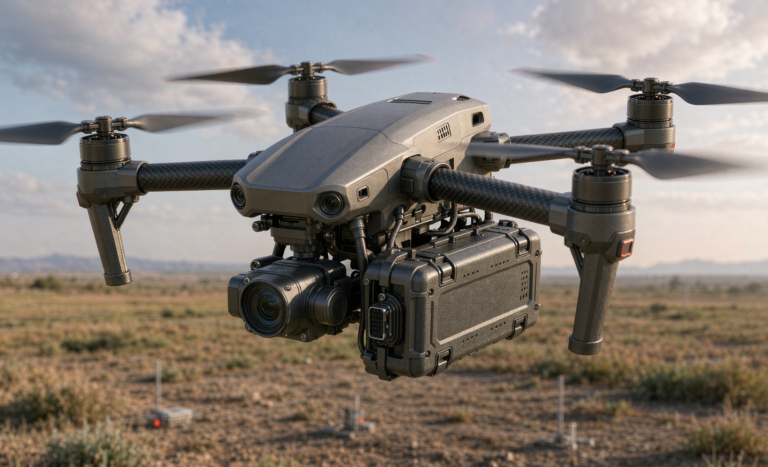
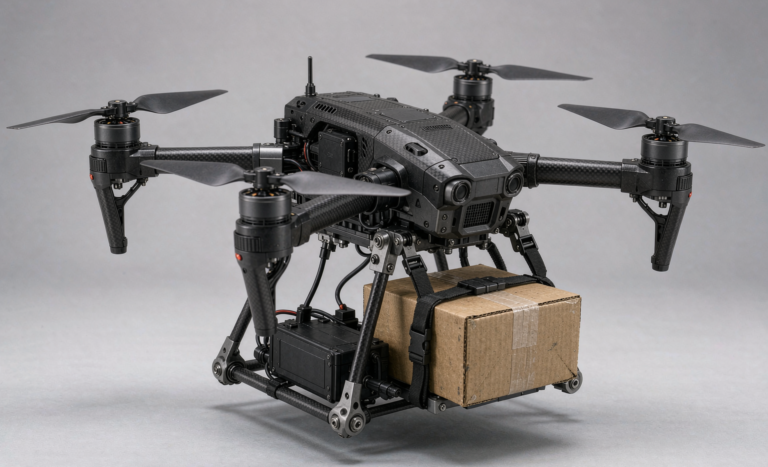
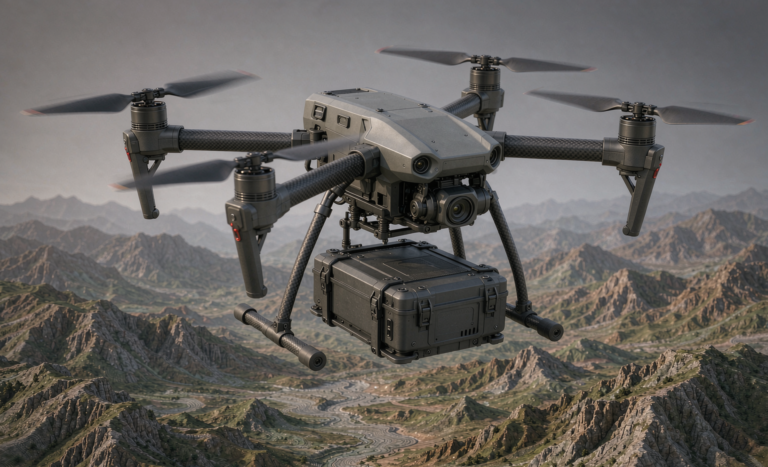
A cinematography flight is bursty: climb, orbit, hover, dash, repeat. A mapping mission is the opposite — it’s a sustained, near-constant cruise at fixed airspeed and fixed altitude, often with a heavy payload slung underneath for RTK positioning and a downward LiDAR or photogrammetry gimbal. From an electrical standpoint this is a gift: the average power is close to the peak power, so your drone lithium battery runs in a narrow, well-behaved state of charge band the entire sortie.
The catch is duration. A typical fixed-pattern orthomosaic grid over, say, 40 hectares at 80 m AGL with 75% frontal overlap might need 22–28 minutes of productive flight per sortie. Add takeoff, transit, landing, and a 15% reserve and you’re at 30+ minutes per battery. A 6S 22.2 V, 16 000 mAh pack delivers roughly 355 Wh; at a real-world mapping draw of 650–720 W that’s about 28–32 minutes of usable energy. The math is clean — but the moment you need four, five, or six such sorties in a day, deployment logistics, not chemistry, becomes the bottleneck.
Sizing the Battery Inventory for a Survey Day
I teach a simple inventory formula our field engineers use: packs needed = (productive flight minutes required ÷ single-pack flight minutes) × rotation factor. The rotation factor is where amateurs get it wrong. You cannot fly a pack, drop it, and immediately relaunch it — it’s hot, and you’re still charging the previous one. Realistically you need at least 2.5–3× the number of packs you’d consume if charging were instant.
For a one-day 200-hectare corridor mapping job needing ~150 productive minutes, plan for roughly five sorties. At 30 minutes each that’s five packs of flight energy, but with charging lag you want 10–12 physical lithium battery units on site so three are always cooling/charging while two are flying and one is staged. Under-build this and you’ll watch the sun move while packs sit on chargers. Over-build it and you’re hauling dead weight and paying for cells that idle.
I also keep a “contingency ring” of two extra packs per aircraft. Wind gusts, a longer-than-planned transit, or a rejected pass over a shadowed area all eat minutes you didn’t budget. The contingency ring is the difference between finishing at 4 p.m. and coming back tomorrow.
Mission-Day Energy Budgeting per Mapping Grid
Before anyone drives to the site, I model each grid. The dominant variables are airspeed, altitude, payload mass, and wind. Payload is brutal: every 100 g of gimbal or LiDAR reduces endurance by roughly 1.5–2.5%, and mapping payloads are rarely light. Wind is worse — a 6 m/s headwind on the outbound leg can cost 20–30% of range on that axis, even if the return is a tailwind that recovers some of it.
Our deployment sheets list, per grid: sortie count, per-sortie Wh, cumulative pack cycles for the day, and a hard cutoff SoC. I never let a mapping sortie end below 20% state of charge — the last 10% comes out grudgingly under load and the voltage sag near the ground is exactly when you risk a hard landing that destroys a gimbal. I budget the return-to-home climb explicitly: climbing 120 m with a depleted pack draws peak current, so I reserve 8–10% just for the climb-back-and-land.
This is where a custom battery solution pays off. If your mapping payload is fixed and your grids are repeatable, we can spec a pack at the exact capacity and C-rate that lands you at 22% on every single sortie — no wasted gram of cell, no anxious reserve padding.
The Charge-Staging and Rotation Discipline That Keeps You Flying
The single biggest deployment mistake is treating batteries like infinite fuel. They are not; they are a thermal and chemical system that needs respect between flights. My rule set for mapping crews:
- Three-zone staging. Label one bin “Hot / Just Landed”, one “Charging”, one “Ready / Cool”. A pack moves hot → charging → ready, never jumps a zone, never gets relaunched while warm.
- FIFO by cycle count. Track each pack’s cycle number on a tag. Fly the lowest-cycle pack that’s ready. This evens wear so your fleet ages together instead of one pack dying early and skewing your energy math.
- Storage voltage discipline. Between sorties within a day, a pack waiting more than 30 minutes goes to a 3.80–3.85 V/cell storage hold, not left at full. Full-resting LiPos age faster and fly puffier.
- Charge current gate. I cap field charging at 1C–2C depending on cell chemistry. Faster invites heat, and heat is the enemy of both cycle life and the accurate state-of-charge your flight controller relies on.
On a good day with two 4-channel chargers at ~1 kW each, you can turn a pack around in 35–45 minutes. That matches a relaxed mapping cadence and keeps three packs in the air across a long shift.
Deploying to Remote Survey Sites
Mapping rarely happens next to a wall outlet. Quarries, pipelines, flood plains, and farmland are off-grid, so your deployment kit must include power generation. I spec a quiet inverter-generator or a large LiFePO4 base station sized to the charger load plus margin — a 2 kW unit comfortably runs two 1 kW chargers with headroom for the tablet, RTK base, and lights.
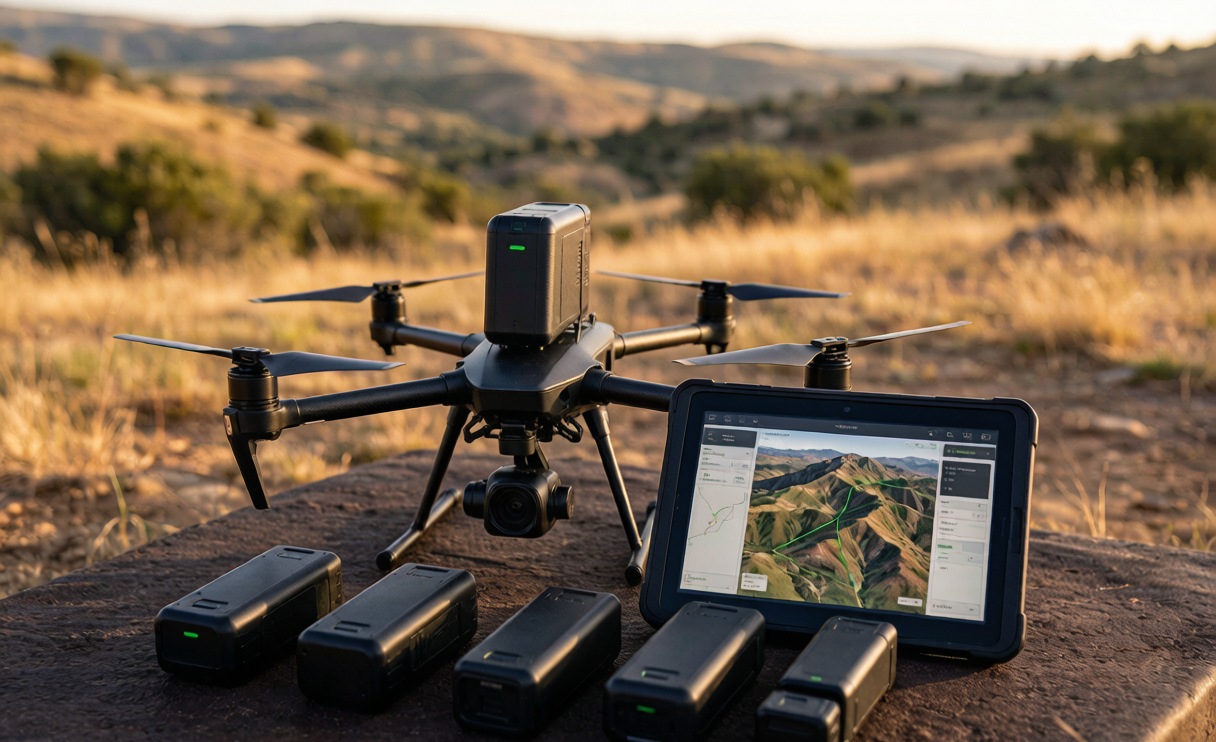
At the site, I lay out a “battery command point”: a folding table in shade (never direct sun — pack surface above 45 °C degrades cells and triggers charge locks), chargers on one side, staged bins on the other, and the survey tablet in the middle running both the flight plan and a live pack-temperature log. One crew member owns that table for the whole day. When battery logistics have a single owner, sorties launch on schedule; when everyone assumes someone else is watching the chargers, you lose an hour before lunch.
For multi-aircraft surveys, multiply the command point, not the chaos. Two drones need two charging rails and a shared staging ledger so packs don’t get cross-contaminated between airframes with different calibration.
Transport and Compliance for Field Kits
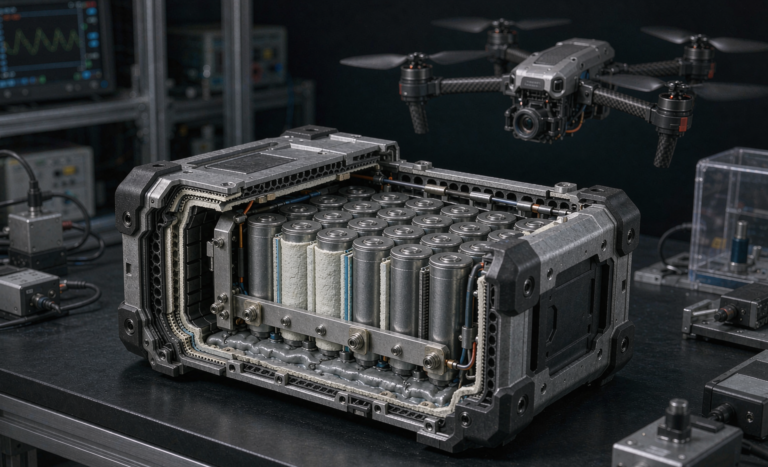
A deployment kit is a shipment of hazardous goods the moment it leaves your building. Every drone battery we ship to or move between survey sites travels under UN38.3 (T.1–T.8) certified cells, packed to IEC 62133-2:2017 mechanical and thermal safeguards, and — for air movement — IATA rules requiring packs carried at or below 30% state of charge in UN3480/UN3481 compliant cases with terminal protection.
On commercial flights, spare drone lithium battery units fall under FAA and EASA carry-on limits: individually protected, in cabin, with the usual 100–160 Wh per pack band for most survey packs (anything above needs operator approval). I print the UN38.3 summary and a pack manifest in the lid of every transport case. The five minutes it takes has saved more than one crew from a gate-side confiscation that would have killed a multi-day campaign.
Building a Custom battery solution for Repetitive Survey Work
If your mapping program is recurring — weekly volumetrics, monthly inspection grids, seasonal agriculture scans — stop buying generic packs. A custom battery solution engineered to your exact airframe, payload, and grid profile gives you three wins: predictable sortie time (so scheduling is real, not hopeful), lighter weight per Wh because we trim unused margin, and a traceable cycle history that makes your maintenance predictable.
At Horizon Power we start these programs with a measured mission profile, not a catalog number. We log your actual climb, cruise, and payload current, then design the pack around the 95th-percentile draw, not the average. The result is a fleet of identical packs that age identically, charge identically, and let your deployment math stay stable for the life of the contract. For survey operators running the same grids month after month, that consistency is worth more than any single gram of weight savings.
Frequently Asked Questions
How many spare drone batteries do I need for a full-day mapping job?
As a working rule, plan 2.5–3× the number of packs you’d consume if charging were instant. A day needing five sorties typically means 10–12 physical packs on site so three are always cooling or charging while two fly and one is staged. Add a two-pack contingency ring per aircraft for wind and re-flight margin.
Can I fast-charge drone lithium batteries between flights in the field?
You can, up to 1C–2C for most survey chemistries, but only after the pack has cooled below its charge gate (around 40 °C surface). Faster charging builds heat that shortens cycle life and destabilizes the state-of-charge your flight controller trusts. With two 1 kW chargers you can turn a pack around in 35–45 minutes, which matches a relaxed mapping cadence.
How do I keep mapping batteries safe during transport to remote sites?
Use UN38.3 (T.1–T.8) certified cells in IEC 62133-2:2017 compliant packs, carry them at or below 30% state of charge in UN3480/UN3481 cases with terminal protection, and keep a printed UN38.3 summary and pack manifest in the case lid. For air travel, follow FAA/EASA carry-on rules and the 100–160 Wh per-pack band.
What’s the best way to store drone batteries between survey campaigns?
Store at 3.80–3.85 V/cell (roughly 40–60% state of charge) in a cool, dry place away from direct sun, with cycle counts tagged and FIFO rotation maintained. Avoid leaving packs fully charged or fully drained for weeks — both accelerate capacity fade and puffing far faster than the flights themselves.