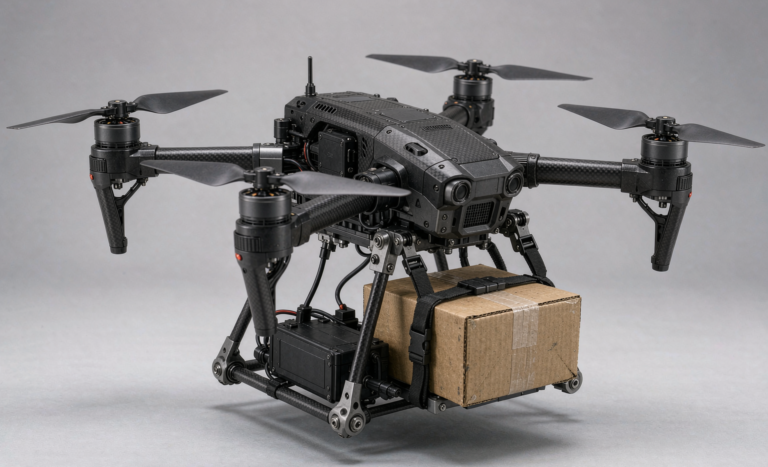
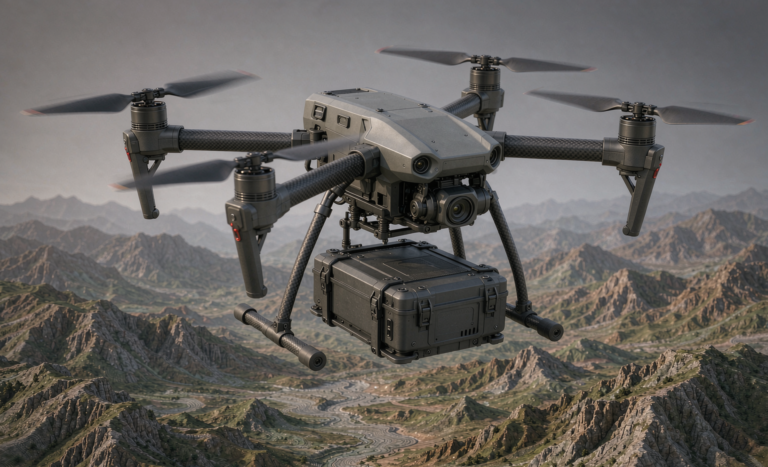
Drone Battery for Livestock and Rangeland Monitoring
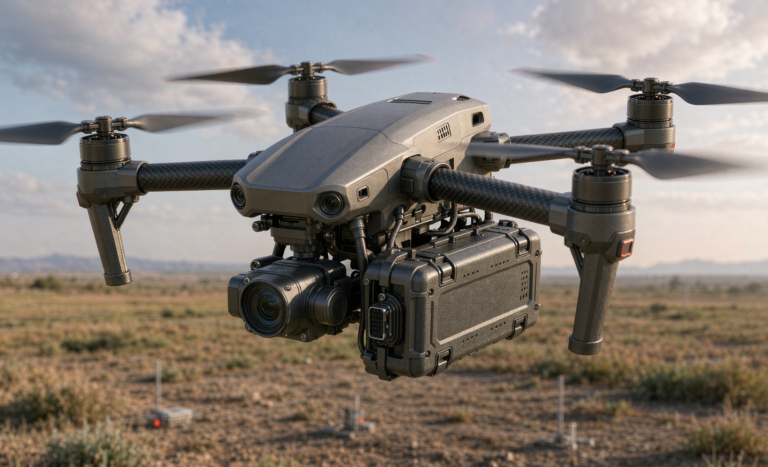
When most people picture a drone battery, they imagine a racing quad flipping through gates or a cinematography rig chasing a car. In my decade as a senior lithium battery engineer at Horizon Power, the assignment that has quietly taught me the most is none of those. It is the drone battery for livestock rangeland monitoring — the pack that has to leave a ranch headquarters before sunrise, track a herd to a far waterhole, check the fenceline, scan for predators at dusk, and still come home with margin to spare. Out on open range, nobody cares about top speed. They care that the aircraft lands safely after a 30-minute circuit and that the pack is ready to fly again an hour later.
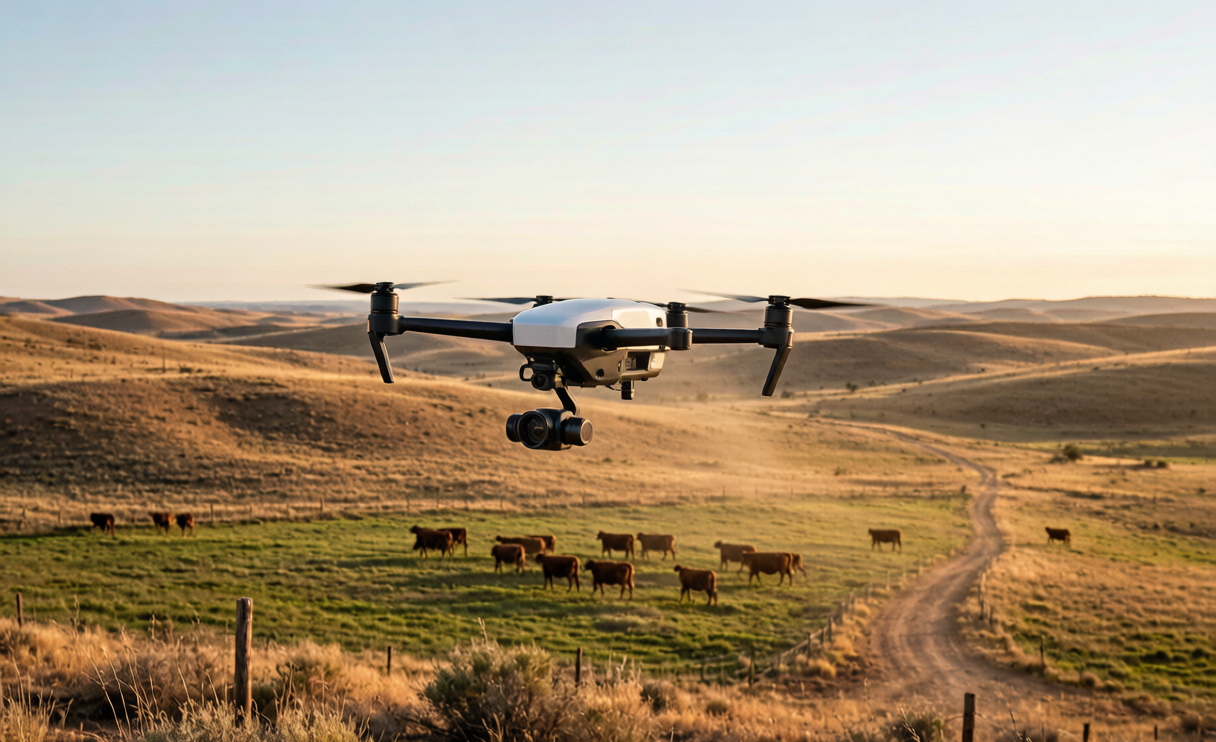
This article is the field engineering brief I wish every rancher and ag-drone operator had before they spec their first pack. We will walk through the flight-energy budget, the chemistry trade-off between NMC and LFP, off-grid charging on a working ranch, thermal and dust ruggedization, payload power draw, the compliance paperwork that lets a pack ride in the back of a pickup across state lines, and a fleet-maintenance routine that prevents a dead pack during calving season.
Why Rangeland Monitoring Breaks Average Consumer Packs
The defining feature of livestock and rangeland work is distance without infrastructure. A typical monitoring circuit on a 5,000-acre operation is not a short hop: leave the HQ, transit 3–6 km to the herd, loiter and hover to count animals and thermally scan for illness or calving distress, move to the nearest water source, patrol a stretch of fenceline, and return. Round trips of 8–18 km are normal, and the flight profile is loiter-heavy rather than cruise-heavy.
That matters because hover is the most expensive flight mode. A mid-size quad or hexa running a monitoring payload draws roughly 1.4–2.0 kW in hover and 0.7–1.1 kW in cruise, with the camera and radio adding another 12–45 W. The 4S and 6S “5-minute” packs sold for sport flying are simply the wrong tool — they are optimized for burst C-rate, not for sustained, margin-rich endurance. A proper drone lithium battery for this job is built around usable watt-hours at a conservative depth of discharge, not peak amps.
Then there is the environment. Open range means dust, vibration from hard landings on rough ground, dew and river-crossing moisture, and temperature swings from +40 °C summer afternoons to −15 °C winter nights. A pack that is merely “flight-capable” in a lab will frustrate a rancher in the field.
Energy Budget: Sizing the Pack for a Dawn-to-Dusk Circuit
Let me show the arithmetic we use with ranch customers. Take a 14 km circuit flown in about 28 minutes, hover-dominant, with an average power of roughly 0.9 kW. Energy = 0.9 kW × 0.467 h ≈ 0.42 kWh of usable energy. At an 80% depth of discharge (we never recommend deeper for cycle life), the pack needs about 0.53 kWh of nominal capacity. That is a 6S (22.2 V) pack at ~24 Ah, or a 12S (44.4 V) pack at ~14 Ah.
To that base number we always add overhead:
- Gust reserve (+10–25%): open-range wind is unpredictable; a 14 m/s gust on a ridgeline can double instantaneous draw.
- RTL buffer (30%): a forced return-to-launch on a headwind must never end in a forced landing.
- Night predator patrol: a spotlight adds 20–60 W and can extend the mission by 10–15 minutes.
Temperature is the silent budget-killer. Lithium-ion capacity fades with cold: we measure about 100% usable at 25 °C, ~85% at 0 °C, ~70% at −10 °C, and only 55–60% at −20 °C. Shoulder-season mornings and winter checks on rangeland routinely hit those cold bands, so we size the pack for the worst expected ambient, not the pleasant afternoon.
Chemistry Choice: NMC vs LFP on the Ranch
For a drone battery for livestock rangeland monitoring, the two chemistries we actually deploy are NMC (nickel-manganese-cobalt) and LFP (lithium-iron-phosphate).
NMC delivers 200–250 Wh/kg and 500–1000 cycles. The higher energy density means longer endurance for the same mass — valuable for long-range scouting where every gram of payload trades against flight time. Its weakness is tighter thermal and abuse tolerance.
LFP lands at 120–160 Wh/kg and 2000–4000 cycles. It is heavier and stores less energy per kilogram, but it is far more forgiving thermally, intrinsically safer, and dramatically cheaper per cycle. The total-cost-of-ownership math is decisive for many ranches: a daily operator flying three sorties a day, 330 days a year, accumulates ~1,000 cycles per year. An LFP pack lasts 2–4 years; an NMC pack 1–2 years. On a working ranch where the pack cycles constantly, LFP usually wins on cost despite the weight penalty.
Our usual custom battery solution pairs both: NMC for the occasional long-range boundary survey, LFP for the twice-daily herd checks. The airframe and BMS are designed so either pack slots in without rewiring.
Charging Off-Grid: Solar, Pickups, and FIFO Discipline
Many staging points on a ranch have no reliable grid power. We spec a portable charging kit: a 200–400 W folding solar panel feeding a 1–2 kWh LFP buffer, then one or two 1C–2C smart chargers. The buffer smooths the solar input and lets the operator charge packs steadily through the day.
Discipline matters more than hardware. We enforce FIFO (first-in, first-out) rotation: the pack that finished charging first flies first. Each pack carries a QR or serial label so the operator can log cycles. Packs that will sit idle more than 12 hours are stored at 3.80–3.85 V/cell — the proven sweet spot that minimizes calendar aging. Field charging has a hard gate: do not start a charge if the cell surface is above ~45 °C; pre-cool the pack in shade first. Most ranches run two to four packs per airframe and hot-swap in under 60 seconds, so a single drone supports a full morning of monitoring.
Thermal and Environmental Ruggedization
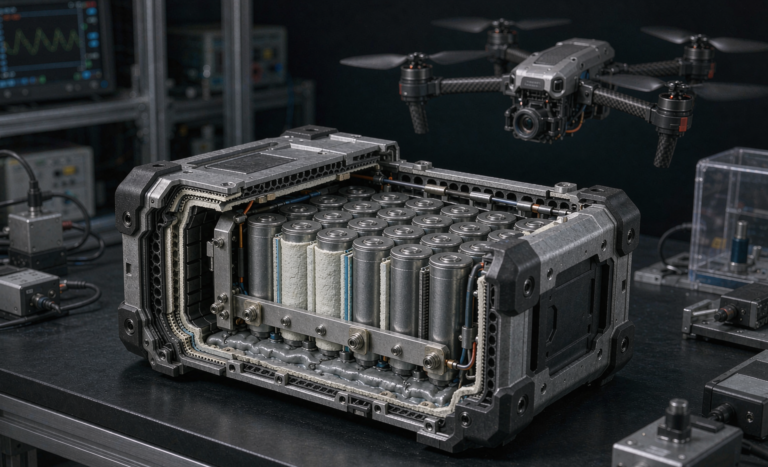
Rangeland is hostile to electronics. Summer afternoons push pack surfaces past 40 °C; winter nights drop below −15 °C; dew and river crossings add moisture; dust finds every seam. Our enclosure strategy combines conformal coating on the BMS, a gasketed shell rated IP54–IP65 depending on the mission, a small desiccant pack in the sealed compartment, and 316L stainless or nickel-plated terminals to resist corrosion.
Cold-start is the subtle failure mode. A lithium cell below 0 °C under load will not deliver rated current and can suffer plating damage. We add a 5–15 W pad heater that holds the core in a 10–25 °C window during pre-flight warm-up — cheap insurance against a pack that “suddenly” underperforms on a frosty morning. The BMS monitors 2–4 cell temperatures and a current sensor (Hall effect or shunt, ±0.5–1% accuracy), and flags any cell-delta above 20–30 mV.
Payloads and the Power They Actually Draw
The monitoring payload is not free energy. Typical draws we budget:
- Multispectral camera for pasture/NDVI health: 8–20 W
- Thermal imager for livestock fever screening and predator detection: 20–45 W
- Spotlight for night patrol: 20–60 W
- RTK GPS module and long-range radio relay: 5–12 W
We co-design the lithium battery capacity with the payload team rather than treating the camera as an afterthought. A common mistake is to size the pack for the airframe alone, then watch dusk missions end in a forced landing because the thermal camera quietly ate 40 W for 20 minutes. Build the budget with the payload included and the drone battery will deliver the promised endurance.
Compliance: Moving Packs Across State Lines in a Ranch Truck
A rancher hauling spare packs between properties — or a dealer shipping them — triggers transport rules. Every pack we ship meets UN38.3 (the T.1–T.8 battery test sequence: altitude simulation, thermal, vibration, shock, external short, impact, overcharge, forced discharge) and is built to IEC 62133-2:2017 for portable cells and packs. For transport we stage cells at the IATA 30% state-of-charge limit and label per UN3480/UN3481, and we stay inside the FAA/EASA 100–160 Wh per battery carry-and-transport window so a technician can legally move packs in a vehicle without special permits. We include the test summary and transport documentation with every shipment; a rancher crossing borders should keep that paperwork in the truck.
Fleet Maintenance and Retirement
The difference between a smooth season and a ruined one is a pack log. We have every operator track four numbers per pack: baseline internal resistance, measured capacity, case thickness (puffing), and cycle count. Retire a pack at any of these thresholds:
- Capacity fallen to 80% of nameplate
- Internal resistance at 2× the baseline
- More than 5% case swelling
- Cell-to-cell voltage delta above 50 mV under load
I have seen a single unlogged degraded pack strand an operator during calving season, when daily monitoring matters most. A simple spreadsheet or a QR scan into a phone app removes the guesswork and turns battery management from folklore into procedure.
FAQ
How long should a drone battery last for daily livestock monitoring?
For twice-daily herd checks on a mid-size ranch, plan for 25–35 minutes of practical flight per charge at 80% depth of discharge, which covers an 8–18 km circuit with reserve. Endurance depends on payload and wind; size the pack from a real energy budget, not a marketing number.
Can I charge drone batteries with a solar panel on the ranch?
Yes. A 200–400 W folding panel feeding a 1–2 kWh LFP buffer and a 1C–2C smart charger is a proven off-grid setup. Keep a FIFO rotation, store idle packs at 3.80–3.85 V/cell, and never start a charge on a pack hotter than ~45 °C.
What is the best drone battery chemistry for cold ranch mornings?
LFP is the safer and more cycle-durable choice for cold, high-flight-count operations, while NMC gives more endurance per kilogram for occasional long-range surveys. For most daily monitoring, LFP’s cold tolerance and 2000–4000 cycle life win on total cost.
How many spare packs do I need per drone?
Two to four packs per airframe supports continuous morning monitoring with under-60-second hot-swaps, assuming one or two chargers in the field. More packs simply extend the daily flight window.
Is it legal to transport drone batteries in my ranch truck across states?
Within the FAA/EASA 100–160 Wh per-battery window and at the IATA 30% state-of-charge for transport, yes — with proper UN3480/UN3481 labeling and the UN38.3 test summary on hand. Larger or denser packs may need additional hazardous-goods handling.
Designing a reliable drone battery for livestock rangeland monitoring is less about peak performance and more about predictable, repeatable endurance under dust, wind, and temperature extremes. Get the energy budget, chemistry, charging routine, and compliance right, and the pack becomes the quiet piece of equipment the rancher stops thinking about — which is exactly the goal.